

Trading
Explore a wide range of markets with competitive pricing, deep liquidity, and advanced trading tools.
Learn More 
Platform
Trade seamlessly with TMGM's powerful platform, built for speed, precision, and a superior trading experience.
Learn More Trading Platform
Academy
Learn the fundamentals of trading with beginner-friendly resources, including guides, webinars, and market insights.
Learn More News & Analysis
Get real-time market updates and expert analysis to stay ahead of trading opportunities
Learn More News & Analysis
About
Learn what sets TMGM apart — our global presence, regulatory strength, and commitment to innovation in trading.
Learn More Why Choose TMGM
Sponsorship
BTC extends losses: Bitcoin Weekly Forecast weighs ETF inflows against risk-off sentiment
- A third consecutive weekly decline is in sight for Bitcoin. Modest losses this week have extended its correction.
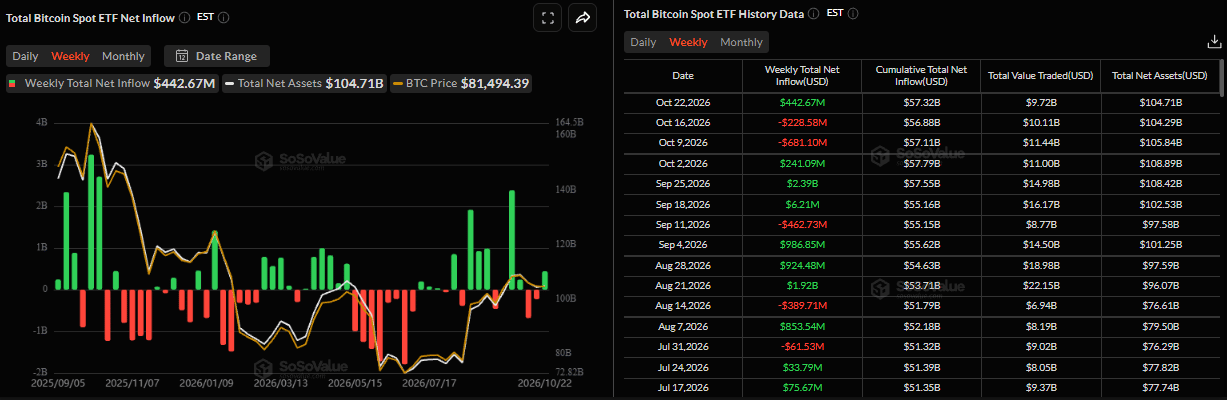
- $442.67 million in net inflows through Thursday puts US-listed spot ETFs on course to end two weeks of outflows.
- BTC’s upside remains constrained as intensifying Middle East tensions, higher oil prices and worries about inflation and AI spending undermine risk appetite.
$81,800 is Bitcoin’s (BTC) approximate trading level on Friday. Pressure persists, with modest losses recorded so far this week. Despite the slight pullback, institutional demand has shown signs of returning: spot exchange-traded funds (ETFs) attracted $442.67 million in net inflows through Thursday.

Caution is still warranted for traders. Worsening Middle East tensions, climbing oil prices and concerns about inflation and AI spending are suppressing risk appetite and restricting the Crypto King’s rebound.
$442.67 million in ETF inflows signals returning institutional demand
Some resilience in institutional Bitcoin demand has emerged this week. According to SoSoValue, spot ETFs registered $442.67 million in net inflows through Thursday, putting them on course to end a two-week run of outflows. A continuation and acceleration of those inflows on Friday could help BTC recover.
Separately, Thursday brought an announcement from BIT Asset Management AG, BIT’s wholly owned Swiss asset management subsidiary: the Swiss Financial Market Supervisory Authority (FINMA) has approved the Bitcoin Fund ETF (BBIT).
FINMA confirmed that this is Switzerland’s first exchange-traded fund to invest directly in Bitcoin. It is also currently the only spot Bitcoin ETF in Europe. Trading on the SIX Swiss Exchange is expected to start in November. By widening institutional access to BTC, the launch could support broader adoption and reinforce the Crypto King’s long-term prospects.
$100-plus oil and inflation concerns constrain BTC’s rebound
West Texas Intermediate (WTI) climbed above $100 per barrel this week, following a rally of over 8% the week before. Persistent Middle East tensions have fuelled the rise in energy prices.
A sharp escalation in fighting between Saudi Arabia and Yemen’s Iran-backed Houthi movement has brought Houthi drone and missile attacks on the kingdom’s airports and critical energy infrastructure.
Iran’s Islamic Revolutionary Guard Corps (IRGC) also said that, under its new offensive strategy, renewed US attacks could lead Tehran to invade neighbouring countries and strike bases used for US military operations. Separately, a report said the US and Israel have prepared plans for a brief but intense military campaign against Iran following the US midterm elections.
Together, these developments sustain the geopolitical risk premium and upward pressure on oil prices. They have also raised fears that inflation expectations could accelerate further, weakening risk appetite and limiting BTC’s rebound.
Bitcoin faces liquidity pressure from elevated AI spending
Liquidity appears to be shifting out of markets including fixed income and cryptocurrencies as AI investment booms, Simon-Peter Massabni, Head of Business Development at XS.com, told FXStreet in an exclusive interview. Bitcoin has failed to match the stock market’s continued climb to record highs. This reflects the concentration of capital in AI-related investments and technology shares.
Simon-Peter traced this week’s renewed concerns about the sustainability of AI spending to a warning from IBM Chief Executive Officer Arvind Krishna. Despite the company’s better-than-expected results, Krishna said corporate clients were increasingly questioning whether substantial AI investments would deliver tangible returns.
For Bitcoin, Massabni said, the implications depend on how those concerns evolve. Continued strong earnings and sustained AI investment by Big Tech companies could preserve the appeal of related shares. That could keep liquidity out of cryptocurrencies and postpone BTC’s recovery.
Such an outcome could also prolong the current stop-start pattern: traders enter to capture short-term gains, then withdraw as doubts about the recovery’s sustainability return. Spot Bitcoin funds illustrated this pattern, taking in $1 billion earlier this week before losing more than $600 million yesterday alone.
Conversely, mounting concerns about AI expenditure could prompt investors to question returns on large technology investments. An equity correction could then divert some capital into Bitcoin. If that correction stays contained without causing broader economic deterioration, Bitcoin could draw fresh buying interest, having already fallen nearly 35% below its all-time high. This could support a recovery across the wider cryptocurrency market.
A more severe, extreme scenario would involve the AI bubble bursting and major indices plunging beyond bear-market territory. Results falling far short of investors’ optimistic expectations, alongside worsening Middle East geopolitics, could drive such a collapse. Further escalation in regional tensions could also cause larger oil-market shocks. Under those conditions, both equities and cryptocurrencies could suffer steep declines at the same time. Even at lower prices, the risk may appear unattractive given the sheer scale of the surrounding threats.
Massabni concluded: “Over the next few days, I expect Bitcoin to remain sideways, with the potential for further downside and a break below the $80,000 level, as the heavy focus on geopolitical factors amid the deteriorating situation in the Middle East may prevent Bitcoin from benefiting from capital rotation,”
$81,800 Bitcoin: Technical outlook shows modest weakness
Following two consecutive weeks of correction, the Crypto King was trading near $81,800 on Friday, with small losses recorded so far this week.
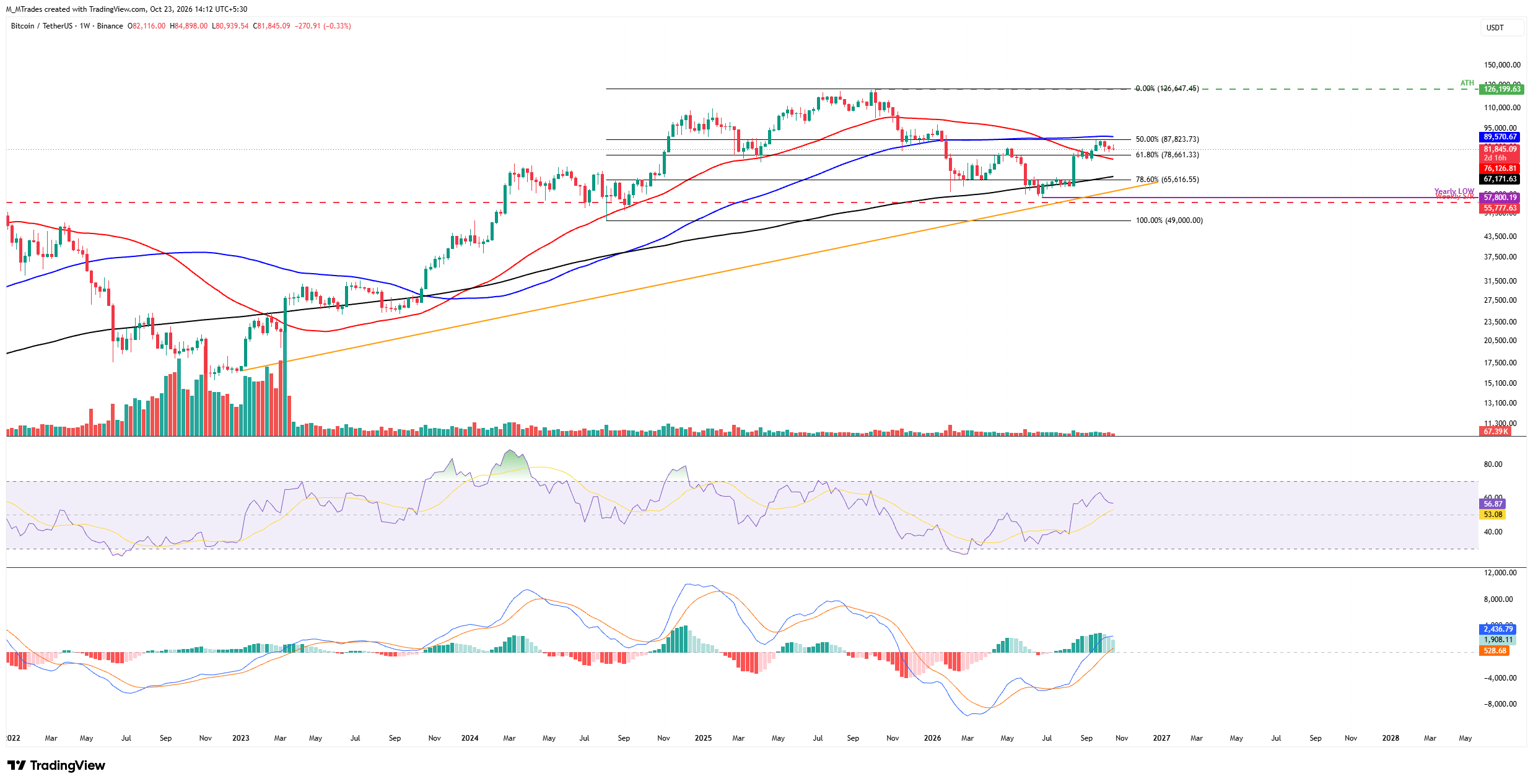
Further corrective pressure could send BTC towards $78,661, the 61.8% Fibonacci retracement of the move from the August 2024 low of $49,000 to the October 2025 record high of $126,199. That level broadly coincides with the 50-week Simple Moving Average (SMA) at $76,126.
On the weekly chart, the Relative Strength Index (RSI) is near 56 and moving down towards the neutral 50 mark, signalling weaker bullish momentum. The Moving Average Convergence Divergence (MACD) histogram is still positive, but its bars are shrinking. Broader upside momentum therefore remains intact, although nearby resistance and the continuing pullback are eroding its strength.
A recovery, by contrast, could take BTC towards the 50% retracement at $87,823, followed by the 100-week SMA at $89,570.
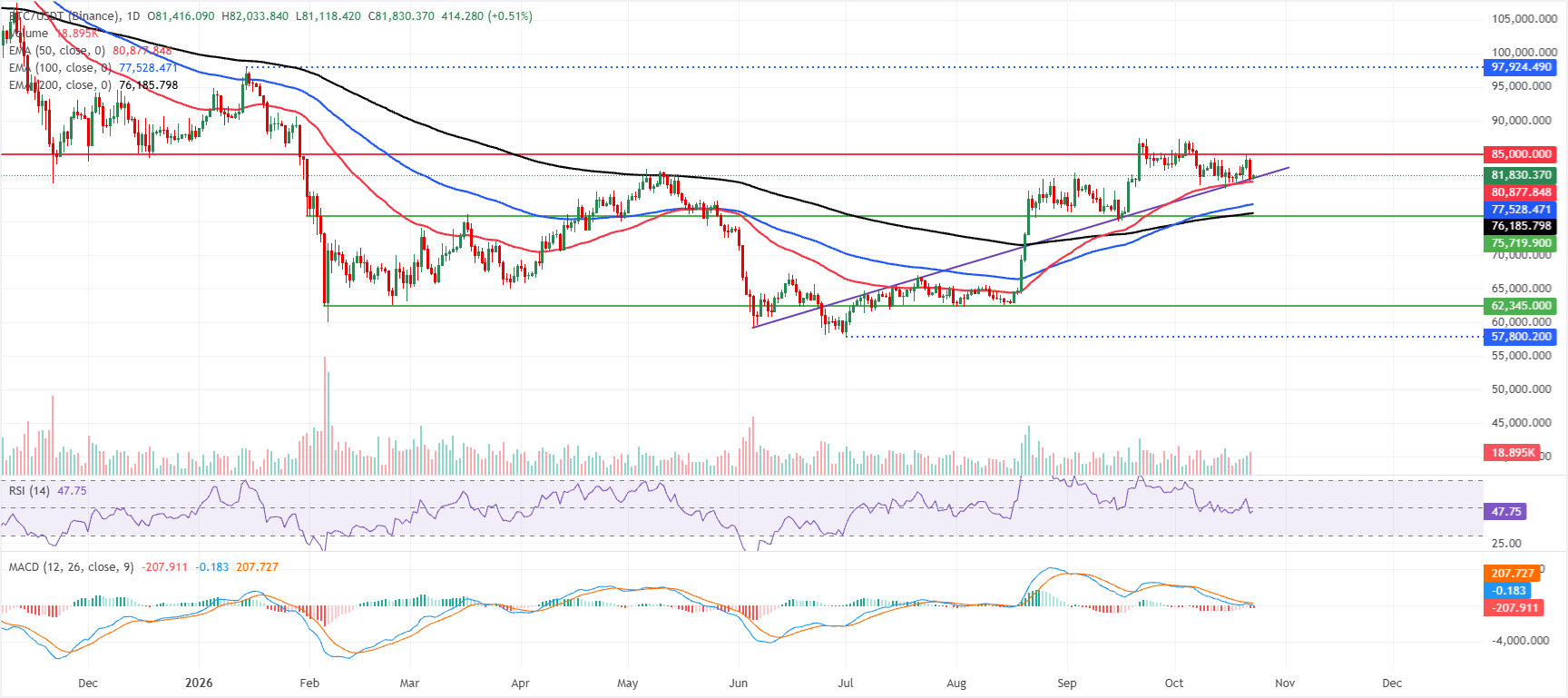
BTC retains a constructive short-term bullish bias on the daily chart. Price is holding above the 50-day, 100-day and 200-day Exponential Moving Averages (EMAs), at $80,877, $77,528 and $76,185 respectively. With these averages clustered below spot, the uptrend appears well supported. However, a daily RSI of around 47 points to momentum cooling towards neutral. A below-zero MACD and negative histogram also indicate that the bullish tone remains fragile, rather than signalling an impulsive breakout phase.
The horizontal barrier near $85,000 provides initial upside resistance. Previous supply at that level could restrain further gains.
Initial downside support lies around the 50-day EMA at $80,877. Should corrective pressure persist, deeper structural support follows at the 100-day EMA of $77,528 and the 200-day EMA of $76,185.
(The technical analysis of this story was written with the help of an AI tool. Know more.)
Bitcoin, altcoins and stablecoins: Frequently asked questions
By market capitalisation, Bitcoin ranks as the largest cryptocurrency. It is a virtual currency created to function as money. No single person, group or entity can control this payment method, removing the need for third parties to participate in financial transactions.
Any cryptocurrency other than Bitcoin is classed as an altcoin. Some also exclude Ethereum, however, because forking originates from these two cryptocurrencies. Under that interpretation, Litecoin is the first altcoin: it was forked from the Bitcoin protocol and is therefore an “improved” version of it.
Designed to maintain a stable price, stablecoins are cryptocurrencies backed by reserves of the assets they represent. Each stablecoin’s value is pegged to a commodity or financial instrument, such as the US Dollar (USD), while an algorithm or demand regulates its supply. Their primary purpose is to offer an entry and exit route for investors seeking to trade and invest in cryptocurrencies. They also provide a means of storing value, as cryptocurrencies are generally subject to volatility.
Measured as Bitcoin’s market capitalisation divided by the combined market capitalisation of all cryptocurrencies, Bitcoin dominance offers a clear view of investor interest in Bitcoin. BTC dominance is typically high before and during a bull run, when investors favour relatively stable cryptocurrencies with large market capitalisations, such as Bitcoin. Falling BTC dominance generally signals that investors are shifting capital and/or profits into altcoins in pursuit of higher returns. This usually sparks a surge in altcoin rallies.
POPULAR ARTICLES
1British Pound: BoE tightening expectations face scrutiny – BBH20.8250 in sight: USD/CHF Price Forecast as Dollar recovers some momentum3US Dollar: AI pressures cast doubt on safe-haven status – ING4$4,000: Gold battles to defend support after steep sell-off5Brent prices rise amid geopolitical tensions - Commerzbank6Australian Dollar: Gains Against US Dollar Capped by Consolidation – UOB7Australian Dollar gains modestly against US Dollar before US flash PMI release8BTC extends losses: Bitcoin Weekly Forecast weighs ETF inflows against risk-off sentiment950-day EMA: Bitcoin holds support while Ethereum and XRP encounter structural resistance | Crypto Today
LIVE QUOTES


ALL ABOUT TECHNICAL
What Is the Dark Cloud Cover Pattern and How Do You Trade It?
What Is the Piercing Line Candlestick Pattern and How Do You Trade It?
What Are Tweezer Top and Bottom Candlestick Patterns?
Inside Bar Candlestick Pattern: What It Is, How to Identify It, and How to Trade It
Hanging Man Candlestick Pattern: How to Identify and Trade It
How to Draw Fibonacci Retracement: Mastering the Golden Ratio in Trading
What is the Relative Strength Index (RSI)
What is Scalping in Trading & How Does It Work
Get Started!
Sign up and access the Global Markets in less than 3 minutes

Connect With Us









Contacts
Phone: +61 2 8036 8388
Fax: +61 2 8036 8388
Email: support@tmgm.com



The information provided on this website is of a general nature only and does not constitute personal financial advice. Before acting on any information on this website, you should consider the suitability of the information in relation to your objectives, financial situation and needs. Investing in CFDs and FX Margin Contracts carries significant risks and is not suitable for all investors. You may lose more than your initial deposit. You do not own, or have, any interest in the underlying asset. We recommend that you seek independent advice and ensure you fully understand the risks involved before trading. It is important that you read and consider the disclosure document before you acquire any product listed on the website. The information and advertisements offered on this website are not intended for use by any person in any country or jurisdiction where such use would be contrary to local laws and regulations. The Products and Services offered on this website are not intended for residents of the United States, Malaysia and Thailand.
TMGM is authorized and regulated in various jurisdictions.
Trademax Australia Limited, trading as TMGM, is regulated by the Australian Securities and Investments Commission (ASIC), AFSL no. 436416 and is located at Level 28, One International Tower, 100 Barangaroo Avenue, 2000 Sydney, NSW Australia.
Email: support@tmgm.com.au
Trademax Global Limited, trading as TMGM, is authorized and regulated by the Vanuatu Financial Services Commission (VFSC), registration number 40356 and registered at 1276, Kumul Highway, Port Vila, Vanuatu, Republic of Vanuatu.
Email: support@tmgm.com
Trademax Global Markets (SE) Limited, trading as TMGM, is authorized and regulated by the Financial Services Authority (FSA) of Seychelles, with license number SD224. The company is registered at Office No 13, Providence Estate ABIS Centre, Mahe, Seychelles.
Email: support@tmgm.com
Trademax Global Markets (International) Pty Ltd, trading as TMGM, is authorized and regulated by the Financial Services Commission, Mauritius (FSC) with license no. GB22201012, and registered at 33, Edith Cavell Street C/o IQ EQ Fund Services (Mauritius) Ltd Port Louis, 11324 Mauritius.
Email: support@tmgm.com
Copyright © TMGM. All rights reserved