

Trading
Explore a wide range of markets with competitive pricing, deep liquidity, and advanced trading tools.
Learn More 
Platform
Trade seamlessly with TMGM's powerful platform, built for speed, precision, and a superior trading experience.
Learn More Trading Platform
Academy
Learn the fundamentals of trading with beginner-friendly resources, including guides, webinars, and market insights.
Learn More News & Analysis
Get real-time market updates and expert analysis to stay ahead of trading opportunities
Learn More News & Analysis
About
Learn what sets TMGM apart — our global presence, regulatory strength, and commitment to innovation in trading.
Learn More Why Choose TMGM
Sponsorship
$82,500 support under threat as Bitcoin’s Nasdaq correlation returns amid macro pressures
- Higher US inflation and selling in AI-related shares have coincided with a renewed strengthening of Bitcoin’s correlation with the Nasdaq.
- 60% of the growth in Bitcoin options open interest since Q3 2025 has come from IBIT options, which are challenging Deribit.
- $82,500 remains Bitcoin’s support line. With volatility returning, a sustained breach could open the way to the low $70,000 range.
$82,500 support is under pressure from macroeconomic risks. Bitcoin (BTC) is again showing a stronger correlation with the Nasdaq after falling alongside technology shares last week.

Bitcoin holds its range as Nasdaq correlation strengthens
Following last week’s price action, Bitcoin is once again moving in correlation with the technology-heavy Nasdaq, K33 Research noted in its Tuesday report.
A sharp sell-off in semiconductor shares and above-forecast US inflation accompanied the renewed correlation. Those developments helped drive the Nasdaq’s weakest weekly performance since the week of April 6, 2025. Over the past week, Bitcoin lost roughly 2%, while average daily spot trading volume slipped 1% to $2.5 billion.
K33 wrote: “Zooming out to a two-week horizon, BTC and Nasdaq returns sit at almost equal levels, pointing to a return to the relatively correlated regime seen from February to mid-August,”
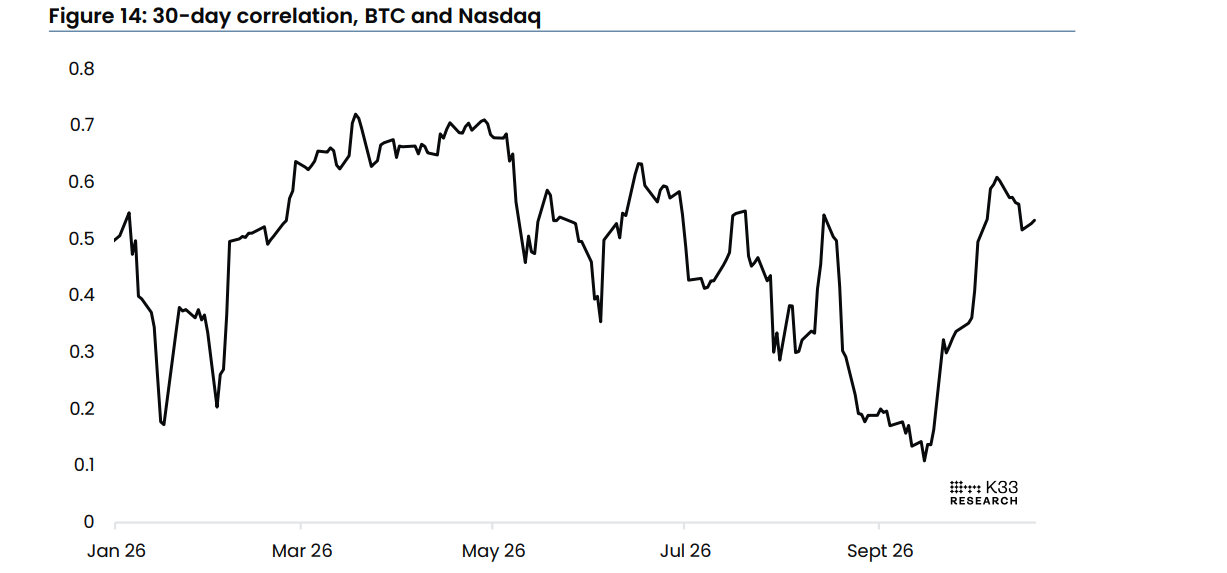
At current levels, Bitcoin remains attractively priced, the report maintained. However, subdued participation raises the prospect of further choppy trading.
Options linked to BlackRock’s iShares Bitcoin Trust (IBIT) were another focus of K33’s analysis. Their growing influence has increasingly challenged crypto exchange Deribit’s position as the leading venue for Bitcoin options.
Since the third quarter of 2025, Bitcoin options open interest has ranged from approximately 700,000 BTC to 1.1 million BTC. Around 60% of the increase has been attributable to IBIT.
Before the launch of IBIT options, Deribit accounted for 70% of open interest. Its share has since declined to 43%.
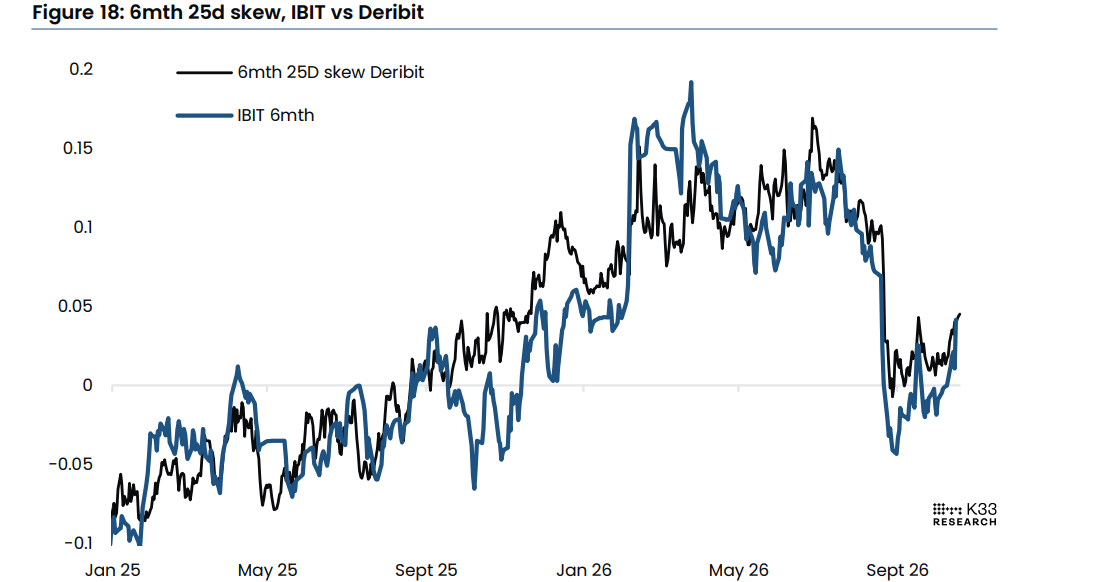
At 434,922 BTC, IBIT’s options open interest was equivalent to approximately 54% of its Bitcoin assets under management.
The report stated: “A ratio of 54% might seem extreme, but it is actually low compared to the largest ETFs on other assets,”
$82,500 support faces inflation risks
Bitcoin continues to defend $82,500 support despite its renewed Nasdaq correlation, according to Wintermute’s Tuesday market review. Upcoming macroeconomic events could trigger volatility, the firm said, potentially making this range difficult for Bitcoin to sustain.
Wintermute wrote: “The Fed next week, the midterms and Q3 earnings all land in the next few weeks, and we don’t think the range holds through them,”
A breakout would require a move through $87,000, according to the report. By contrast, a sustained breach of $82,500 could bring the low $70,000 range into view.
A less aggressive response from the Federal Reserve alongside strong third-quarter earnings could help Bitcoin rise above $87,000, Wintermute said. Higher yields and persistent weakness in technology shares, however, could weigh on the cryptocurrency.
Weakness was becoming more evident among altcoins, the report noted. Its broader altcoin cohort declined 5.69% over the week.
Wintermute added: “Altcoins are starting to feel heavy again, with the whole spectrum cohort selling off since topping around 14 days ago and down 5.69% on the week,”
As flows into altcoins weakened, capital increasingly shifted towards Bitcoin and Ethereum (ETH), the firm observed. Only higher-quality large-cap tokens bucked that trend, drawing some longer-term investors as liquidity increased.
Even a Bitcoin rally might not enable altcoins to recover, Wintermute cautioned. A wider market sell-off, meanwhile, could expose them to additional losses.
At the time of writing, Bitcoin stands at $82,600, a gain of 0.8% over the past 24 hours.
POPULAR ARTICLES
1ZEW Sentiment Misses Forecast, Euro Gains Remain Limited2Five-week high: pound gains on UK jobs and BoE talk318.42: Mexican Peso holds steady as Trump and Sheinbaum point to trade breakthrough4$82,500 support under threat as Bitcoin’s Nasdaq correlation returns amid macro pressures5Chinese Yuan: Appreciation outlook holds despite policy-rate adjustment – Commerzbank6Indonesian Rupiah: MUFG on equity reforms and downside hedging7$4,150 in Focus: Gold Struggles Amid Global Rate Hike Risks8Earnings and lower Crude Oil prices lift Dow Jones Industrial Average9Malaysian Ringgit holds stable range against US Dollar amid hawkish BNM bias – Commerzbank
LIVE QUOTES


ALL ABOUT TECHNICAL
What Is the Dark Cloud Cover Pattern and How Do You Trade It?
What Is the Piercing Line Candlestick Pattern and How Do You Trade It?
What Are Tweezer Top and Bottom Candlestick Patterns?
Inside Bar Candlestick Pattern: What It Is, How to Identify It, and How to Trade It
Hanging Man Candlestick Pattern: How to Identify and Trade It
How to Draw Fibonacci Retracement: Mastering the Golden Ratio in Trading
What is the Relative Strength Index (RSI)
What is Scalping in Trading & How Does It Work
Get Started!
Sign up and access the Global Markets in less than 3 minutes

Connect With Us









Contacts
Phone: +61 2 8036 8388
Fax: +61 2 8036 8388
Email: support@tmgm.com



The information provided on this website is of a general nature only and does not constitute personal financial advice. Before acting on any information on this website, you should consider the suitability of the information in relation to your objectives, financial situation and needs. Investing in CFDs and FX Margin Contracts carries significant risks and is not suitable for all investors. You may lose more than your initial deposit. You do not own, or have, any interest in the underlying asset. We recommend that you seek independent advice and ensure you fully understand the risks involved before trading. It is important that you read and consider the disclosure document before you acquire any product listed on the website. The information and advertisements offered on this website are not intended for use by any person in any country or jurisdiction where such use would be contrary to local laws and regulations. The Products and Services offered on this website are not intended for residents of the United States, Malaysia and Thailand.
TMGM is authorized and regulated in various jurisdictions.
Trademax Australia Limited, trading as TMGM, is regulated by the Australian Securities and Investments Commission (ASIC), AFSL no. 436416 and is located at Level 28, One International Tower, 100 Barangaroo Avenue, 2000 Sydney, NSW Australia.
Email: support@tmgm.com.au
Trademax Global Limited, trading as TMGM, is authorized and regulated by the Vanuatu Financial Services Commission (VFSC), registration number 40356 and registered at 1276, Kumul Highway, Port Vila, Vanuatu, Republic of Vanuatu.
Email: support@tmgm.com
Trademax Global Markets (SE) Limited, trading as TMGM, is authorized and regulated by the Financial Services Authority (FSA) of Seychelles, with license number SD224. The company is registered at Office No 13, Providence Estate ABIS Centre, Mahe, Seychelles.
Email: support@tmgm.com
Trademax Global Markets (International) Pty Ltd, trading as TMGM, is authorized and regulated by the Financial Services Commission, Mauritius (FSC) with license no. GB22201012, and registered at 33, Edith Cavell Street C/o IQ EQ Fund Services (Mauritius) Ltd Port Louis, 11324 Mauritius.
Email: support@tmgm.com
Copyright © TMGM. All rights reserved