

Trading
Explore a wide range of markets with competitive pricing, deep liquidity, and advanced trading tools.
Learn More 
Platform
Trade seamlessly with TMGM's powerful platform, built for speed, precision, and a superior trading experience.
Learn More Trading Platform
Academy
Learn the fundamentals of trading with beginner-friendly resources, including guides, webinars, and market insights.
Learn More News & Analysis
Get real-time market updates and expert analysis to stay ahead of trading opportunities
Learn More News & Analysis
About
Learn what sets TMGM apart — our global presence, regulatory strength, and commitment to innovation in trading.
Learn More Why Choose TMGM
Sponsorship
Bitcoin Price Forecast: Geopolitical uncertainty pushes BTC lower despite ETF inflows
- Over 2% is wiped off Bitcoin on Thursday. Most of its gains earlier this week are now at risk.
- $528.40 million flowed into US-listed Bitcoin on Wednesday, extending this week’s run of positive flows to three consecutive days.
- Risk appetite weakens as Middle East tensions intensify, limiting BTC’s recovery.
More than 2% is wiped off Bitcoin (BTC) on Thursday. Trading below $83,000 at the time of writing, it risks surrendering its gains from earlier this week. Institutional demand nevertheless continues to provide support: spot Bitcoin Exchange Traded Funds (ETFs) have attracted inflows for a third consecutive day so far this week.

Caution remains warranted for traders as mounting Middle East tensions curb risk appetite and constrain the Crypto King’s recovery.
$528.40 million inflow signals renewed institutional demand
Signs of renewed institutional demand have emerged this week. According to SoSoValue, BTC spot ETFs attracted $528.40 million on Wednesday, their third consecutive day of inflows so far this week. By Wednesday, weekly inflows had also surpassed $1 billion, ending two consecutive weeks of outflows. BTC could build on its rebound if inflows persist and accelerate over the remainder of the week.
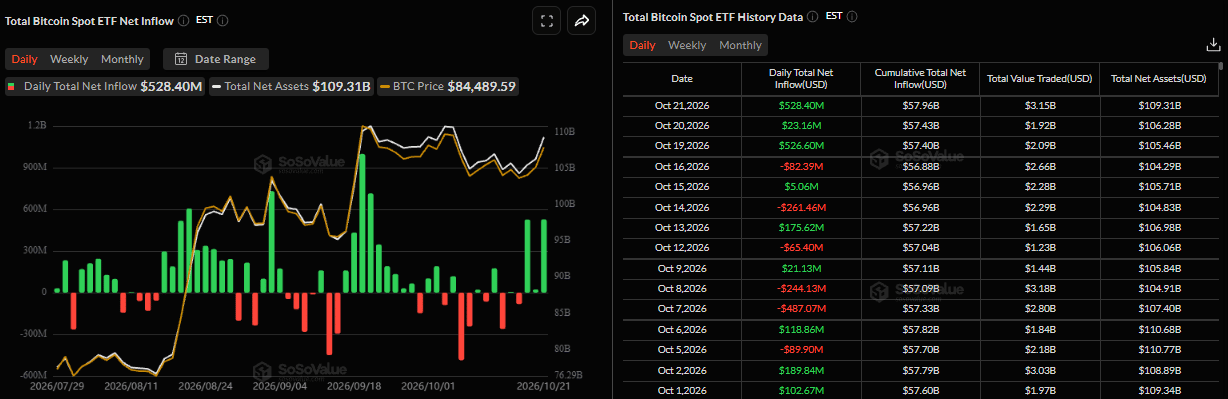
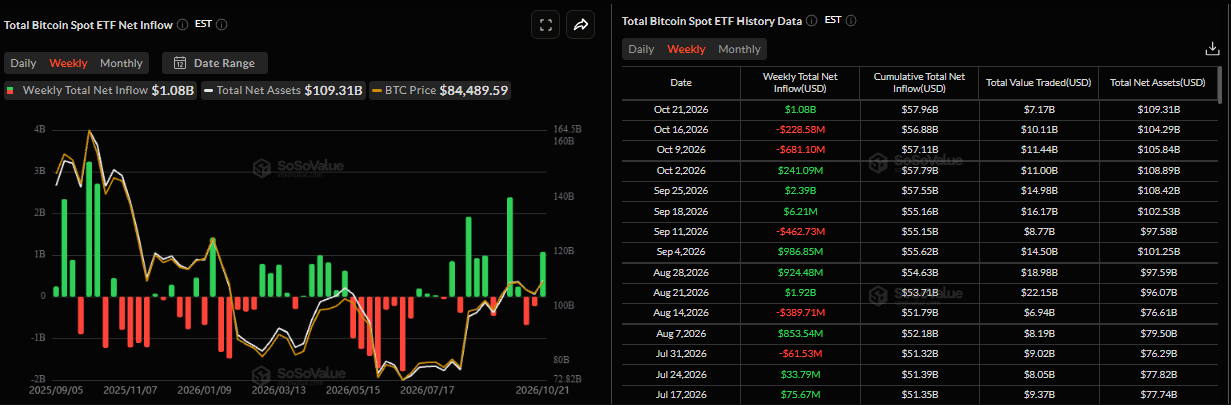
Separately, approval for the Bitcoin Fund ETF (BBIT) from the Swiss Financial Market Supervisory Authority (FINMA) was announced on Thursday by BIT Asset Management AG, BIT’s wholly owned Swiss asset management subsidiary.
FINMA confirmed that the fund is Switzerland’s first exchange-traded fund to invest directly in Bitcoin. Currently, it is also Europe’s only spot Bitcoin ETF. Trading on the SIX Swiss Exchange is expected to start in November.
By widening institutional access to BTC, the launch could support broader adoption and reinforce the Crypto King’s long-term prospects.
BTC rebound constrained by Middle East tensions
Four vessels involved in illegal oil transfers in the northern Persian Gulf were hit simultaneously and caught fire on Wednesday after being tracked by its forces, Iran’s Islamic Revolutionary Guard Corps (IRGC) Navy said on Thursday, according to Reuters.
Three additional vessels struck mines west of the Strait of Hormuz, the IRGC said. It also warned the US military that further provocations could prompt a broader response against its bases in the region.
Iran’s Foreign Minister, Abbas Araghchi, meanwhile said the country was ready for diplomacy, while stressing that it was also prepared to defend itself.
With the US showing no willingness to reach an understanding, there was little reason to anticipate progress now, Araghchi added.
In a separate report, The New York Times said the US and Israel had prepared plans for a brief but intensive military campaign against Iran following the US midterm elections.
The geopolitical risk premium remains in place as a result of these developments, weakening risk appetite and restricting BTC’s recovery.
$85,000 rejection shapes Bitcoin technical outlook
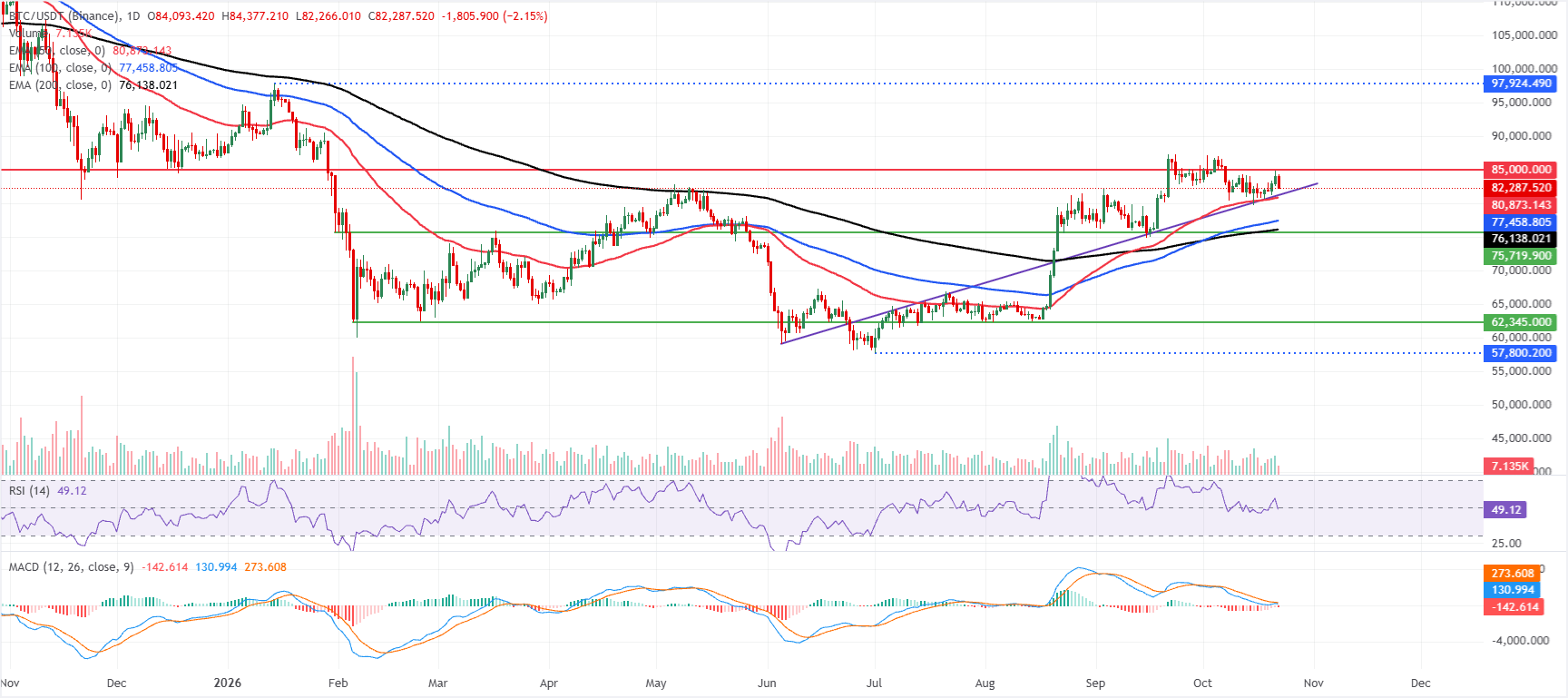
$82,287 is Bitcoin’s price at the time of writing on Thursday. The bias remains constructive, with the price above the 50-day, 100-day and 200-day Exponential Moving Averages (EMAs), which are grouped between approximately $80,900 and $76,100.
The broader uptrend appears intact given this stacked EMA alignment. However, a Relative Strength Index (RSI) near 49 and a negative Moving Average Convergence Divergence (MACD) histogram suggest cooling upward momentum, with BTC consolidating rather than advancing in a strong directional move.
The horizontal barrier around $85,000 provides immediate resistance. A break above it would open the way to fresh highs and could restore bullish momentum.
Initial downside support lies at the 50-day EMA around $80,873. Further below, the 100-day EMA near $77,458 and the 200-day EMA near $76,138 define a deeper demand zone. A failure of that zone would be needed to materially weaken the prevailing bullish structure.
(The technical analysis of this story was written with the help of an AI tool. Know more.)
FAQs on Bitcoin, altcoins and stablecoins
By market capitalisation, Bitcoin is the largest cryptocurrency. It is a virtual currency created to function as money. No single person, group or entity can control this payment method, removing the need for third parties to participate in financial transactions.
Any cryptocurrency other than Bitcoin is classified as an altcoin. Some, however, exclude Ethereum as well, since these two cryptocurrencies are the origins of forks. Under that interpretation, Litecoin is the first altcoin: it was forked from the Bitcoin protocol and is therefore an “improved” version of it.
Designed to maintain a stable price, stablecoins are cryptocurrencies backed by reserves of the assets they represent. Each stablecoin achieves this by pegging its value to a commodity or financial instrument, such as the US Dollar (USD). Its supply is regulated through an algorithm or demand. Their primary purpose is to give investors a route into and out of cryptocurrency trading and investment. They also offer a way to store value, as cryptocurrencies are generally prone to volatility.
The ratio of Bitcoin’s market capitalisation to the combined market capitalisation of all cryptocurrencies is known as Bitcoin dominance. This measure gives a clear indication of investor interest in Bitcoin. BTC dominance is typically high before and during a bull run, when investors favour relatively stable cryptocurrencies with large market capitalisations, such as Bitcoin. Falling BTC dominance generally signals that investors are shifting capital and/or profits into altcoins in pursuit of higher returns. This usually sparks a surge in altcoin rallies.
POPULAR ARTICLES
1$4,070 Key Support Test: Gold Price Forecast for XAU/USD Amid High Oil Prices2British Pound: High Carry Underpins Sterling Versus Euro – ING3Indian Rupee (INR) Advances Against US Dollar on Trade Optimism - Societe Generale4Bitcoin Price Forecast: Geopolitical uncertainty pushes BTC lower despite ETF inflows50.8200 in focus as Swiss Franc edges higher against US Dollar – UOB6$4,100 gold outlook: 3 forecasts weigh a bullish Arc rejection, a bearish Fed setup and a festival tiebreaker7Turkish Lira: Depreciation risks increase as rates are cut - Commerzbank8Silver price today: FXStreet data shows a decline91.3400: British Pound seeks to consolidate above this level as US Dollar weakens
LIVE QUOTES


ALL ABOUT TECHNICAL
What Is the Dark Cloud Cover Pattern and How Do You Trade It?
What Is the Piercing Line Candlestick Pattern and How Do You Trade It?
What Are Tweezer Top and Bottom Candlestick Patterns?
Inside Bar Candlestick Pattern: What It Is, How to Identify It, and How to Trade It
Hanging Man Candlestick Pattern: How to Identify and Trade It
How to Draw Fibonacci Retracement: Mastering the Golden Ratio in Trading
What is the Relative Strength Index (RSI)
What is Scalping in Trading & How Does It Work
Get Started!
Sign up and access the Global Markets in less than 3 minutes

Connect With Us









Contacts
Phone: +61 2 8036 8388
Fax: +61 2 8036 8388
Email: support@tmgm.com



The information provided on this website is of a general nature only and does not constitute personal financial advice. Before acting on any information on this website, you should consider the suitability of the information in relation to your objectives, financial situation and needs. Investing in CFDs and FX Margin Contracts carries significant risks and is not suitable for all investors. You may lose more than your initial deposit. You do not own, or have, any interest in the underlying asset. We recommend that you seek independent advice and ensure you fully understand the risks involved before trading. It is important that you read and consider the disclosure document before you acquire any product listed on the website. The information and advertisements offered on this website are not intended for use by any person in any country or jurisdiction where such use would be contrary to local laws and regulations. The Products and Services offered on this website are not intended for residents of the United States, Malaysia and Thailand.
TMGM is authorized and regulated in various jurisdictions.
Trademax Australia Limited, trading as TMGM, is regulated by the Australian Securities and Investments Commission (ASIC), AFSL no. 436416 and is located at Level 28, One International Tower, 100 Barangaroo Avenue, 2000 Sydney, NSW Australia.
Email: support@tmgm.com.au
Trademax Global Limited, trading as TMGM, is authorized and regulated by the Vanuatu Financial Services Commission (VFSC), registration number 40356 and registered at 1276, Kumul Highway, Port Vila, Vanuatu, Republic of Vanuatu.
Email: support@tmgm.com
Trademax Global Markets (SE) Limited, trading as TMGM, is authorized and regulated by the Financial Services Authority (FSA) of Seychelles, with license number SD224. The company is registered at Office No 13, Providence Estate ABIS Centre, Mahe, Seychelles.
Email: support@tmgm.com
Trademax Global Markets (International) Pty Ltd, trading as TMGM, is authorized and regulated by the Financial Services Commission, Mauritius (FSC) with license no. GB22201012, and registered at 33, Edith Cavell Street C/o IQ EQ Fund Services (Mauritius) Ltd Port Louis, 11324 Mauritius.
Email: support@tmgm.com
Copyright © TMGM. All rights reserved