

Trading
Explore a wide range of markets with competitive pricing, deep liquidity, and advanced trading tools.
Learn More 
Platform
Trade seamlessly with TMGM's powerful platform, built for speed, precision, and a superior trading experience.
Learn More Trading Platform
Academy
Learn the fundamentals of trading with beginner-friendly resources, including guides, webinars, and market insights.
Learn More News & Analysis
Get real-time market updates and expert analysis to stay ahead of trading opportunities
Learn More News & Analysis
About
Learn what sets TMGM apart — our global presence, regulatory strength, and commitment to innovation in trading.
Learn More Why Choose TMGM
Sponsorship
Surging US bond yields: Australian Dollar falls further against US Dollar
- Higher US bond yields weigh on riskier currencies, extending the Australian Dollar’s decline.
- Rate increases at the December, January and March Fed policy meetings are now expected by TD Securities.
- The RBA’s monetary tightening cycle appears to have reached its end.
The Australian Dollar (AUD) is down 0.15% against the US Dollar (USD). Trading near 0.6795 in Friday’s European session, the pair extends its run of losses. A surge in United States (US) Treasury yields has reduced demand for riskier assets, including the Australian Dollar, leaving the Aussie under pressure.

Nearly 5.5% has been added to 10-year US bond yields over the past two trading days. At the time of writing, the 10-year US Treasury yield remains close to a three-week high near $5.13%.
US inflation drives Treasury yield surge
The latest US inflation report was the main catalyst for the jump in Treasury yields, according to Deutsche Bank strategists. They note that “the monthly core CPI print for October was above consensus at +0.30% (vs. +0.2% expected).” The strategists emphasise that “it was the third consecutive month with core CPI at +0.3%, and if you take those three months together, the annualised pace for core CPI is running at +3.75%.” In Deutsche Bank’s assessment, “that’s the fastest pace on that measure since April 2024, so it made it increasingly difficult to dismiss this as a blip.”
With US inflation at risk of remaining elevated, market experts have been compelled to revisit their expectations for Federal Reserve (Fed) interest rate increases.
A more hawkish near-term policy outlook has been adopted by TD Securities, its strategists say. The firm now anticipates "25bp hikes in December, January, and March," replacing its previous forecast for increases in December and March only.
The Australian Dollar also faces pressure from market expectations that the Reserve Bank of Australia’s (RBA) interest rate cycle is over.
RBA tightening limits erode AUD support
Earlier support for the Aussie is fading, according to MUFG analysts. They acknowledge that the “pre-emptive nature of monetary tightening in Australia has benefitted the Australian Dollar,” but now believe that “time appears to have run out for providing support for the currency”. Investors increasingly see the RBA as “running out of scope for additional rate hikes at a time when investors are reappraising their views on additional Fed rate hikes.” To illustrate how front-loaded this cycle has been, the analysts point out that the RBA has already “hiked on five occasions this year and the policy rate at 4.85% is the highest since 2008 when the RBA was cutting rates into the Global Financial Crisis,”. Following that pre-emptive tightening, “the OIS curve through to Q4 2027 shows mostly a flat curve but a probability of a rate cut (-15bps priced) in Q3-Q4 next year,”. This reinforces the assessment that domestic rate support for the Aussie is largely spent, just as expectations for US rates are moving higher.
Attention now turns to Tuesday’s release of the minutes from the RBA’s October policy meeting.
AUD/USD Technical Outlook: 0.6930 Caps Recovery
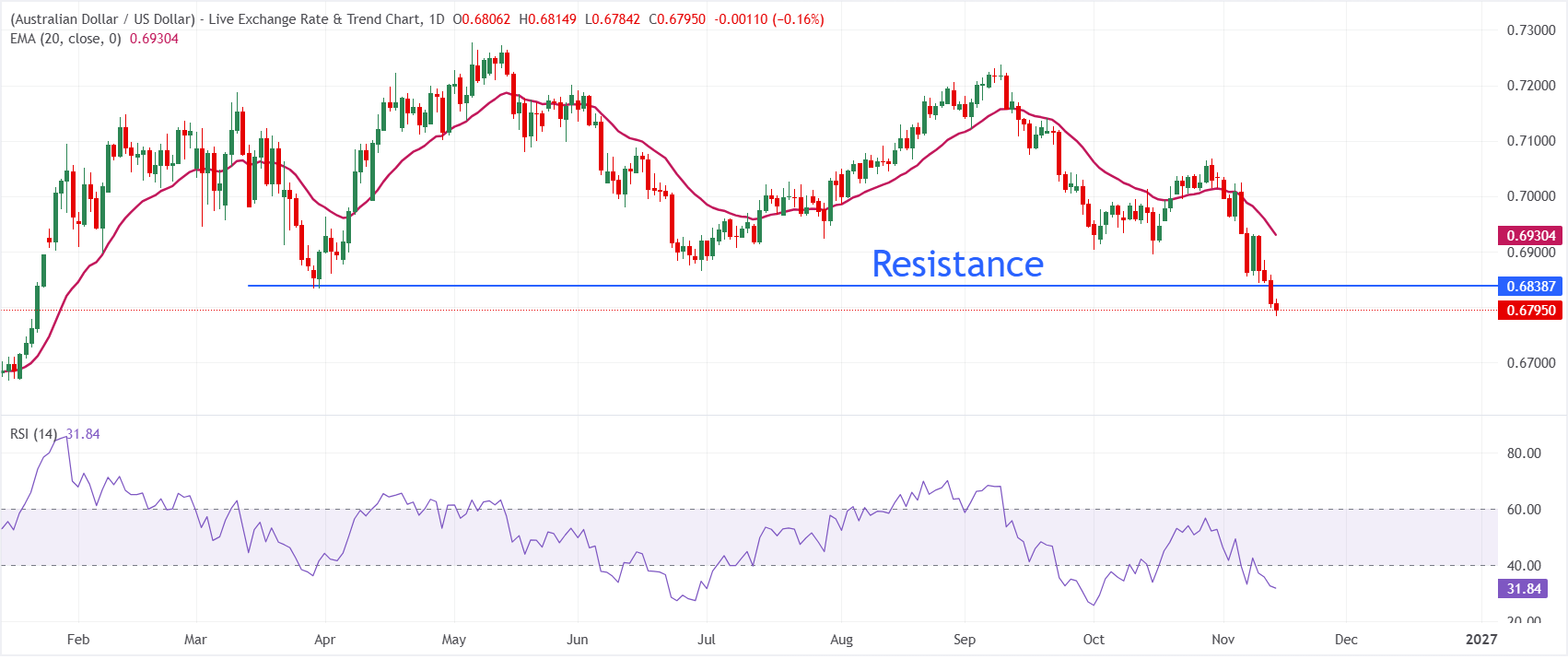
At 0.6795 on the daily chart, AUD/USD continues to retreat below its 20-day exponential moving average (EMA) of 0.6930. That average provides immediate overhead resistance, maintaining a bearish near-term outlook. Failure to recover above the EMA indicates that rallies are likely to attract selling. Meanwhile, the Relative Strength Index (14) stands at 31.8, just outside oversold territory. The reading points to continued downward pressure, with only a modest risk of a corrective rebound.
A daily close above the 20-day EMA near 0.6930, the first resistance level, would be required to soften the bearish outlook and allow a more sustained recovery. Below the market, the current dataset provides no clear technical support levels. Traders may therefore consider previous price lows and psychological levels below 0.6800 as possible demand zones. However, the prevailing price structure leaves those supports exposed for as long as the pair remains below the EMA.
(The technical analysis of this story was written with the help of an AI tool. Know more.)
Economic Data
RBA Policy Meeting Minutes
Two weeks after each interest rate decision, the Reserve Bank of Australia publishes its meeting minutes. These provide a comprehensive record of the policy debate, covering differing views and the votes cast by individual Committee members. A hawkish RBA assessment of the economy’s inflation outlook generally leads markets to assign a greater likelihood to a rate increase, which supports the AUD.
Read further.Upcoming release: Tue 17 Nov 2026 00:30
Release frequency: Every week
Market consensus: -
Prior reading: -
Data source: Reserve Bank of Australia
Two weeks after announcing its interest rate decision, the Reserve Bank of Australia (RBA) releases its monetary policy meeting minutes. With a significant impact on the AUD, the minutes detail board members’ discussions of monetary policy and the economic conditions behind their decision on changes to interest rates and/or bond purchases. They also set out the board’s considerations regarding international economic developments and the exchange rate.
POPULAR ARTICLES
1Eurozone Q3 GDP rises faster by 0.6% vs. flash estimates of 0.4%2Surging US bond yields: Australian Dollar falls further against US Dollar3Silver price today: FXStreet data show silver holding broadly steady4Crypto Today: Losses deepen for Bitcoin, Ethereum, XRP as sellers strengthen control5Swiss Franc Slides to Fresh Monthly Lows as Hawkish Fed and Higher US Yields Weigh6Below 1.1050: Euro faces renewed pressure against US Dollar as focus turns to US PPI7GBP/USD: Pound fails to gain despite strong UK data – Societe Generale81.4250 area: Canadian Dollar holds near one-month low as USD bulls look to US PPI9December BoJ hike: Japan’s trade and inflation data lend support – DBS


Get Started!
Sign up and access the Global Markets in less than 3 minutes

Connect With Us









Contacts
Phone: +61 2 8036 8388
Fax: +61 2 8036 8388
Email: support@tmgm.com



The information provided on this website is of a general nature only and does not constitute personal financial advice. Before acting on any information on this website, you should consider the suitability of the information in relation to your objectives, financial situation and needs. Investing in CFDs and FX Margin Contracts carries significant risks and is not suitable for all investors. You may lose more than your initial deposit. You do not own, or have, any interest in the underlying asset. We recommend that you seek independent advice and ensure you fully understand the risks involved before trading. It is important that you read and consider the disclosure document before you acquire any product listed on the website. The information and advertisements offered on this website are not intended for use by any person in any country or jurisdiction where such use would be contrary to local laws and regulations. The Products and Services offered on this website are not intended for residents of the United States, Malaysia and Thailand.
TMGM is authorized and regulated in various jurisdictions.
Trademax Australia Limited, trading as TMGM, is regulated by the Australian Securities and Investments Commission (ASIC), AFSL no. 436416 and is located at Level 28, One International Tower, 100 Barangaroo Avenue, 2000 Sydney, NSW Australia.
Email: support@tmgm.com.au
Trademax Global Limited, trading as TMGM, is authorized and regulated by the Vanuatu Financial Services Commission (VFSC), registration number 40356 and registered at 1276, Kumul Highway, Port Vila, Vanuatu, Republic of Vanuatu.
Email: support@tmgm.com
Trademax Global Markets (SE) Limited, trading as TMGM, is authorized and regulated by the Financial Services Authority (FSA) of Seychelles, with license number SD224. The company is registered at Office No 13, Providence Estate ABIS Centre, Mahe, Seychelles.
Email: support@tmgm.com
Trademax Global Markets (International) Pty Ltd, trading as TMGM, is authorized and regulated by the Financial Services Commission, Mauritius (FSC) with license no. GB22201012, and registered at 33, Edith Cavell Street C/o IQ EQ Fund Services (Mauritius) Ltd Port Louis, 11324 Mauritius.
Email: support@tmgm.com
Copyright © TMGM. All rights reserved