

Trading
Explore a wide range of markets with competitive pricing, deep liquidity, and advanced trading tools.
Learn More 
Platform
Trade seamlessly with TMGM's powerful platform, built for speed, precision, and a superior trading experience.
Learn More Trading Platform
Academy
Learn the fundamentals of trading with beginner-friendly resources, including guides, webinars, and market insights.
Learn More News & Analysis
Get real-time market updates and expert analysis to stay ahead of trading opportunities
Learn More News & Analysis
About
Learn what sets TMGM apart — our global presence, regulatory strength, and commitment to innovation in trading.
Learn More Why Choose TMGM
Sponsorship
BoJ recap: A pause for now... but Japan has entered a new inflation phase
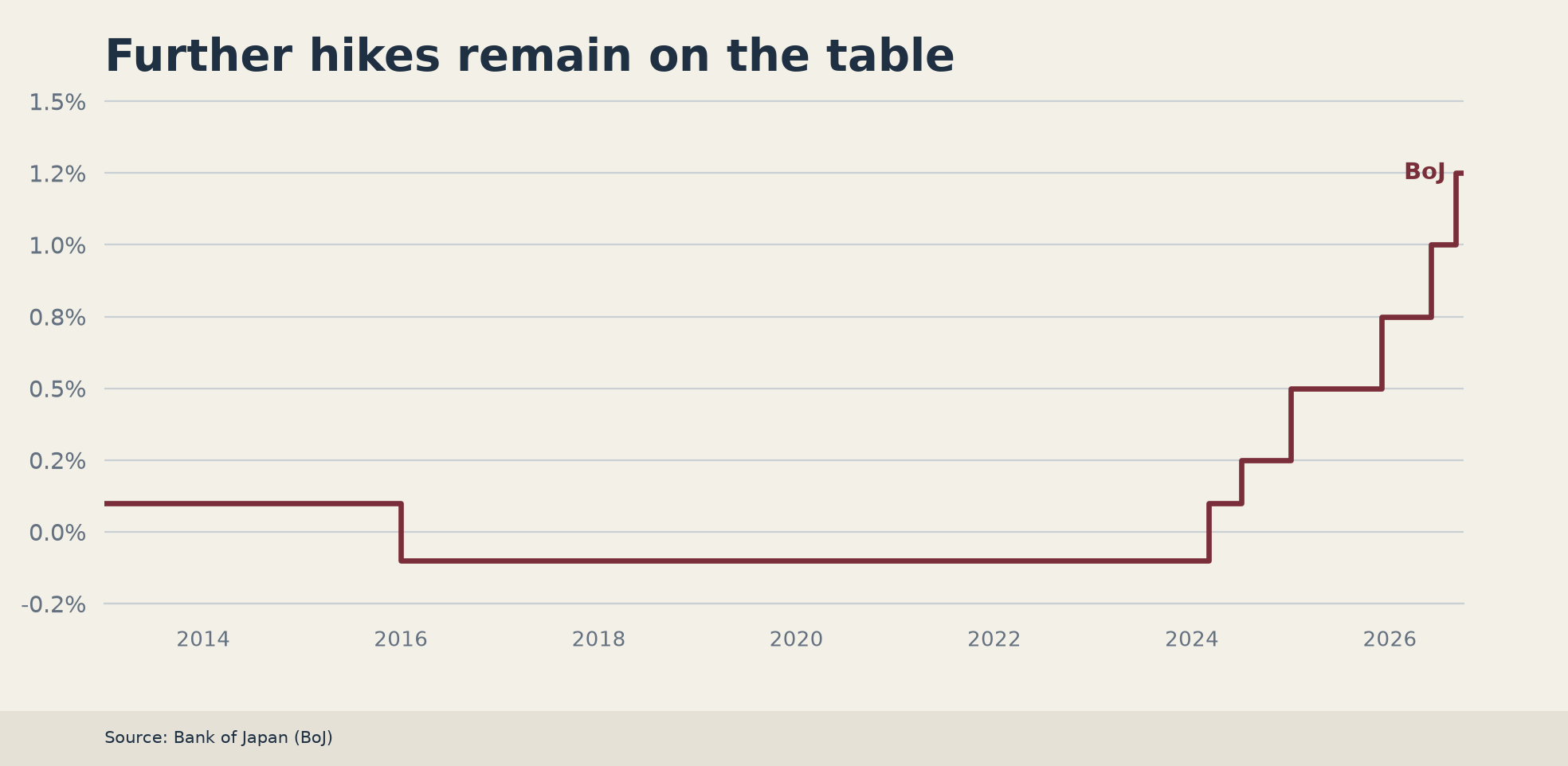
The Bank of Japan left its short-term policy rate unchanged at 1.25% but delivered a distinctly hawkish message on the risk of an inflation overshoot. The decision passed by 8-1, with board member Takata dissenting in favour of an increase to 1.5%, while Governor Kazuo Ueda stressed that the Bank would continue adjusting policy as needed.
The BoJ said underlying inflation had reached levels broadly consistent with its 2% price-stability target, while financial conditions remained accommodative and short-term real rates stayed low. It also raised its fiscal 2027 core CPI forecast to 2.6% from 2.4%, although the projection for fiscal 2028 remained at 2.0%. GDP growth forecasts were revised to 0.7% for fiscal 2026 and 0.7% for fiscal 2027.
The central bank said the balance of risks had shifted. Unlike in the past, when policymakers were primarily concerned about inflation undershooting the target, they must now guard against an overshoot. Risks from the Middle East conflict, stronger AI-related demand and FX volatility require close monitoring, while corporate funding demand is rising and lenders remain willing to extend credit.
Ueda said the BoJ would not wait passively for inflation to move higher but would adjust policy proactively if needed. At the same time, he stressed that the Bank could not yet declare victory because inflation must remain stable and sustainable around 2%. The timing and pace of future hikes will depend on the data, wage developments, financial conditions and the likelihood of the Bank’s economic outlook being realised. He gave no indication that increases would follow a fixed timetable.
Overall assessment
The BoJ delivered a hawkish hold. That said, it paused because it wanted more evidence that inflation and wages can remain sustainably around 2%, not because it has abandoned its tightening cycle. With one dissent for an immediate hike, an explicit warning about overshooting and a commitment to respond proactively, further rate increases remain firmly on the table.
Top Articles
1Fed’s Barkin favors gradual approach as inflation pressure spreads2Silver Price Forecast: XAG/USD slumps nearly 60% from January peak as as downturn deepens3British Pound hovers around 1.34 as BoE hike bets outshine Fed doubts4Breaking: Gold crashes below $3,900 eyes on YTD low5Bitcoin and Gold Outlook: BTC plunges to six-week low as XAU hits one-year low below $3,9506Canadian Dollar holds gains despite stalled domestic growth7Malaysia: Policy rate seen on hold – DBS8BoJ recap: A pause for now... but Japan has entered a new inflation phase9Japan: Goods inflation risks stay upside – Societe Generale


Get Started!
Sign up and access the Global Markets in less than 3 minutes

Connect With Us









Contacts
Phone: +61 2 8036 8388
Fax: +61 2 8036 8388
Email: support@tmgm.com



The information provided on this website is of a general nature only and does not constitute personal financial advice. Before acting on any information on this website, you should consider the suitability of the information in relation to your objectives, financial situation and needs. Investing in CFDs and FX Margin Contracts carries significant risks and is not suitable for all investors. You may lose more than your initial deposit. You do not own, or have, any interest in the underlying asset. We recommend that you seek independent advice and ensure you fully understand the risks involved before trading. It is important that you read and consider the disclosure document before you acquire any product listed on the website. The information and advertisements offered on this website are not intended for use by any person in any country or jurisdiction where such use would be contrary to local laws and regulations. The Products and Services offered on this website are not intended for residents of the United States, Malaysia and Thailand.
TMGM is authorized and regulated in various jurisdictions.
Trademax Australia Limited, trading as TMGM, is regulated by the Australian Securities and Investments Commission (ASIC), AFSL no. 436416 and is located at Level 28, One International Tower, 100 Barangaroo Avenue, 2000 Sydney, NSW Australia.
Email: support@tmgm.com.au
Trademax Global Limited, trading as TMGM, is authorized and regulated by the Vanuatu Financial Services Commission (VFSC), registration number 40356 and registered at 1276, Kumul Highway, Port Vila, Vanuatu, Republic of Vanuatu.
Email: support@tmgm.com
Trademax Global Markets (SE) Limited, trading as TMGM, is authorized and regulated by the Financial Services Authority (FSA) of Seychelles, with license number SD224. The company is registered at Office No 13, Providence Estate ABIS Centre, Mahe, Seychelles.
Email: support@tmgm.com
Trademax Global Markets (International) Pty Ltd, trading as TMGM, is authorized and regulated by the Financial Services Commission, Mauritius (FSC) with license no. GB22201012, and registered at 33, Edith Cavell Street C/o IQ EQ Fund Services (Mauritius) Ltd Port Louis, 11324 Mauritius.
Email: support@tmgm.com
Copyright © TMGM. All rights reserved