

Trading
Explore a wide range of markets with competitive pricing, deep liquidity, and advanced trading tools.
Learn More 
Platform
Trade seamlessly with TMGM's powerful platform, built for speed, precision, and a superior trading experience.
Learn More Trading Platform
Academy
Learn the fundamentals of trading with beginner-friendly resources, including guides, webinars, and market insights.
Learn More News & Analysis
Get real-time market updates and expert analysis to stay ahead of trading opportunities
Learn More News & Analysis
About
Learn what sets TMGM apart — our global presence, regulatory strength, and commitment to innovation in trading.
Learn More Why Choose TMGM
Sponsorship
US core PCE inflation set to rise in August, pressuring the Federal Reserve
- The core Personal Consumption Expenditures Price Index is forecast to rise 0.3% MoM and 3.4% YoY in August.
- Headline annual PCE inflation is expected to remain stable at 3.7%.
- EUR/USD is bearish near 2026 lows ahead of the critical data release.
The United States (US) Bureau of Economic Analysis (BEA) will publish the Personal Consumption Expenditures (PCE) Price Index data for August on Wednesday at 12:30 GMT. Market participants closely watch the PCE Price Index because it is the Federal Reserve’s (Fed) preferred measure of inflation and could influence its policy outlook.

PCE inflation: Insights into the Federal Reserve's key inflation metric
Market participants anticipate that the core PCE Price Index, which excludes volatile food and energy prices, advanced 0.3% month-over-month (MoM) in August, following the 0.2% increase recorded in July, while the annualized reading is foreseen at 3.4%, slightly higher than the 3.3% posted in the previous month.
As previously noted, PCE inflation data is critical as it’s the Fed’s preferred inflation gauge and will help market participants move bets on whatever the central bank may do in the last two meetings of the year. It’s worth remembering that policymakers delivered a 25 basis points (bps) interest rate hike when they met in September, the first one in three years, to a target range of 3.75%–4.00% in a unanimous decision.
The hike explains itself: the Middle East war maintains energy prices upward, pressuring the cost of living, while PCE inflation hit 4% in early 2026, doubling the central bank’s goal. Sure, inflationary pressures have receded from that level, but they are still far from the comfortable 2%.
At the same time, crude Oil prices are roughly 50% higher than pre-war, while the conflict is far from resolving and has become a regional crisis with more and more countries involved. On a positive note, Oil flows through the Strait of Hormuz recovered to about 80% of pre-war levels in September, despite continued military tensions in the region.
The risk of an escalation, however, remains high and market participants are far from pricing in easing energy prices in the foreseeable future. That means inflation is likely to hold above the preferred 2% and hence, result in some Fed action to tame it.
Ahead of the PCE Price Index release, market participants expect interest rate hikes both in October and December, according to the FedWatch Tool. The odds for an October hike stand at 72.5% at the time of writing.
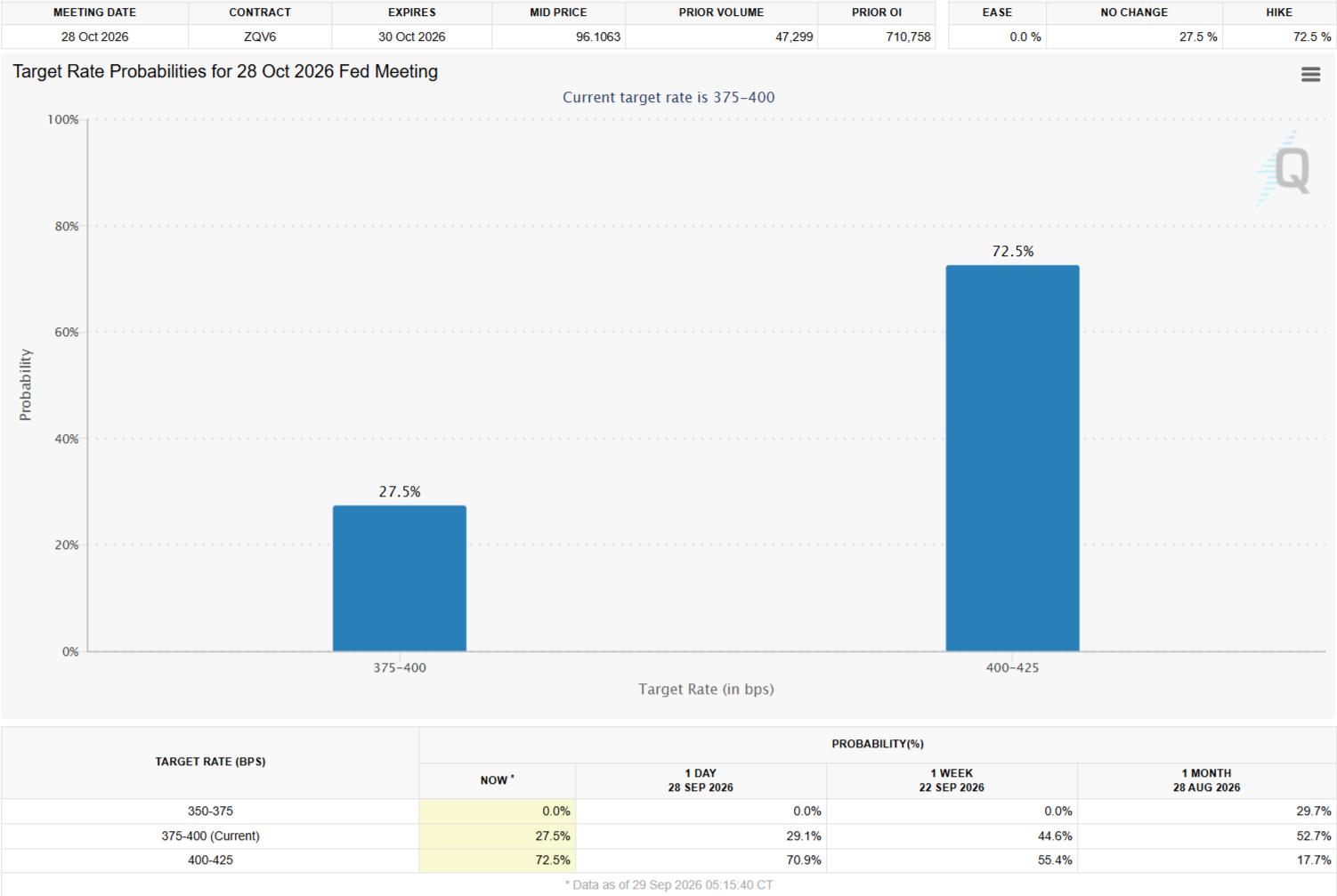
Generally, a higher-than-anticipated PCE Price Index result should boost the odds for upcoming rate hikes, increasing demand for the US Dollar (USD). A reading in line with the market’s expectation should have a limited impact on prices, yet maintain the USD on its bullish route. On the contrary, a lower-than-anticipated outcome should put some pressure on the Greenback, at least temporarily.
How will the Personal Consumption Expenditures Price Index affect EUR/USD?
As the release approaches, the US Dollar Index (DXY) trades not far below its yearly peak at 101.80, maintaining its positive momentum as investors bet on higher interest rates while seeing no easy way out of the Middle East conflict.
Valeria Bednarik, Chief Analyst at FXStreet, notes: “The EUR/USD pair trades in the 1.1350 price zone, with a clear bearish bias and without signs of downward exhaustion. The pair develops far below all its Simple Moving Averages (SMAs), while the 20-day SMA crosses below an also bearish 100-day SMA, usually a sign of strong selling interest. At the same time, technical indicators maintain their downward slopes well into negative territory, also reflecting sellers’ control.”
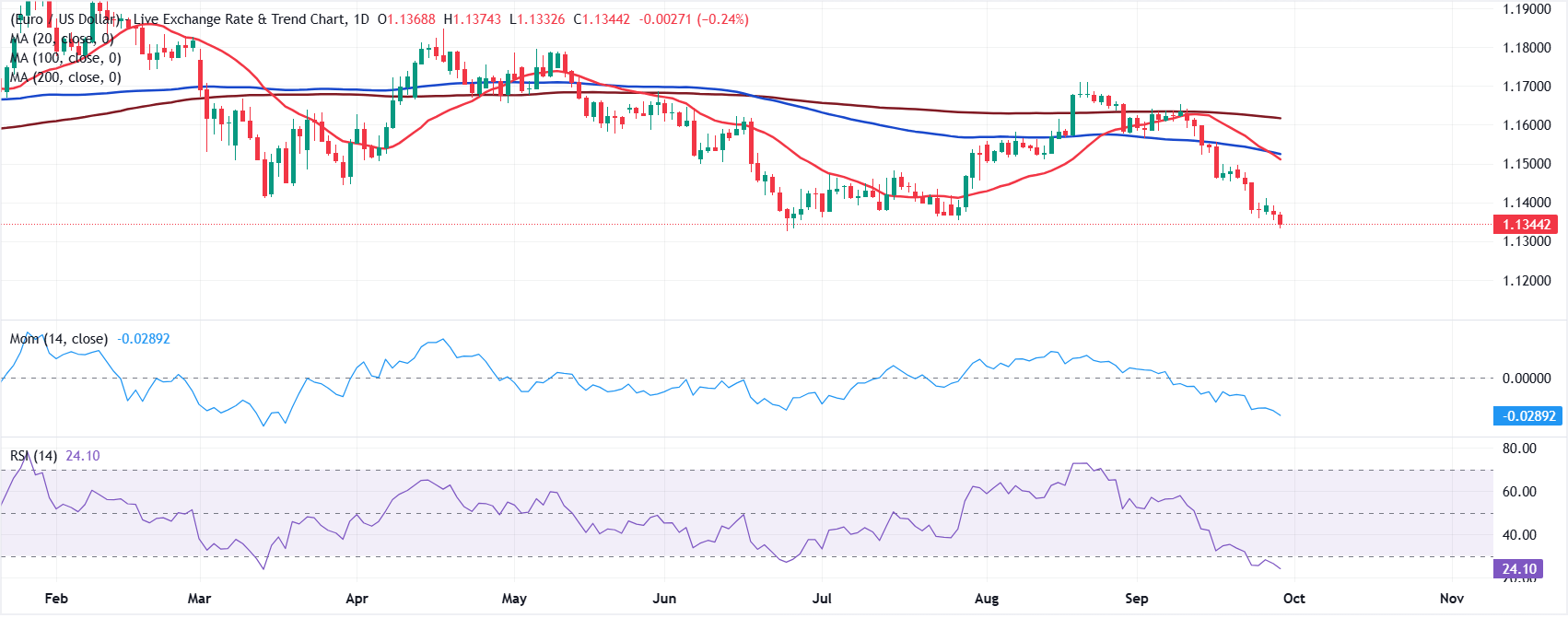
Bednarik adds: “June monthly low at 1.1324 provides immediate support ahead of the 1.1200 price zone, where the pair topped between August and September 2025 multiple times. Once below the area, the case for additional declines will strengthen. Resistance can be found at 1.1400, while additional gains expose a long-term static area around 1.1470. Sellers are likely to reappear around the latter if reached, limiting any additional bullish potential.”
Inflation FAQs
Inflation measures the rise in the price of a representative basket of goods and services. Headline inflation is usually expressed as a percentage change on a month-on-month (MoM) and year-on-year (YoY) basis. Core inflation excludes more volatile elements such as food and fuel which can fluctuate because of geopolitical and seasonal factors. Core inflation is the figure economists focus on and is the level targeted by central banks, which are mandated to keep inflation at a manageable level, usually around 2%.
The Consumer Price Index (CPI) measures the change in prices of a basket of goods and services over a period of time. It is usually expressed as a percentage change on a month-on-month (MoM) and year-on-year (YoY) basis. Core CPI is the figure targeted by central banks as it excludes volatile food and fuel inputs. When Core CPI rises above 2% it usually results in higher interest rates and vice versa when it falls below 2%. Since higher interest rates are positive for a currency, higher inflation usually results in a stronger currency. The opposite is true when inflation falls.
Although it may seem counter-intuitive, high inflation in a country pushes up the value of its currency and vice versa for lower inflation. This is because the central bank will normally raise interest rates to combat the higher inflation, which attract more global capital inflows from investors looking for a lucrative place to park their money.
Formerly, Gold was the asset investors turned to in times of high inflation because it preserved its value, and whilst investors will often still buy Gold for its safe-haven properties in times of extreme market turmoil, this is not the case most of the time. This is because when inflation is high, central banks will put up interest rates to combat it. Higher interest rates are negative for Gold because they increase the opportunity-cost of holding Gold vis-a-vis an interest-bearing asset or placing the money in a cash deposit account. On the flipside, lower inflation tends to be positive for Gold as it brings interest rates down, making the bright metal a more viable investment alternative.
Economic Indicator
Core Personal Consumption Expenditures - Price Index (YoY)
The Core Personal Consumption Expenditures (PCE), released by the US Bureau of Economic Analysis on a monthly basis, measures the changes in the prices of goods and services purchased by consumers in the United States (US). The PCE Price Index is also the Federal Reserve’s (Fed) preferred gauge of inflation. The YoY reading compares the prices of goods in the reference month to the same month a year earlier. The core reading excludes the so-called more volatile food and energy components to give a more accurate measurement of price pressures." Generally, a high reading is bullish for the US Dollar (USD), while a low reading is bearish.
Read more.Next release: Wed Sep 30, 2026 12:30
Frequency: Monthly
Consensus: 3.4%
Previous: 3.3%
Source: US Bureau of Economic Analysis
After publishing the GDP report, the US Bureau of Economic Analysis releases the Personal Consumption Expenditures (PCE) Price Index data alongside the monthly changes in Personal Spending and Personal Income. FOMC policymakers use the annual Core PCE Price Index, which excludes volatile food and energy prices, as their primary gauge of inflation. A stronger-than-expected reading could help the USD outperform its rivals as it would hint at a possible hawkish shift in the Fed’s forward guidance and vice versa.
POPULAR ARTICLES
1Mexican Peso: Carry trade unwind risks into Q4 – Societe Generale2EUR/USD: Range view holds as Dollar doubts grow – Deutsche Bank3Silver price today: Silver falls, according to FXStreet data4Softer Australia CPI but RBA still hawkish – Rabobank5US Dollar: Rally seen stretched into year-end – TD Securities6Euro: EUR/USD Bearish risks toward 1.10 – ING7Swiss Franc edges up from yearly lows despite tepid Economic Expectations data8Bitcoin Price Forecast: BTC consolidates below $85,000 amid rising US Treasury yields, derivatives deleveraging9WTI Price Forecast: Sticks to recovery gains below $89.00; lacks bullish conviction
LIVE QUOTES


ALL ABOUT FOREX
What Is an Islamic Account in Forex?
Best Indicators for Forex Trading and How to Use Them
The Top 10 Most Traded Currency Pairs in the World
What are the Major Forex Pairs? 7 Major Currency Pairs in the World
5 Best Forex Trading Apps In India In 2026
Top 15 Weakest Currencies in the World
Best Time to Trade Forex
Forex Trading Regulations in India
How to Start Forex Trading in India: A Guide for Beginners
Get Started!
Sign up and access the Global Markets in less than 3 minutes

Connect With Us









Contacts
Phone: +61 2 8036 8388
Fax: +61 2 8036 8388
Email: support@tmgm.com



The information provided on this website is of a general nature only and does not constitute personal financial advice. Before acting on any information on this website, you should consider the suitability of the information in relation to your objectives, financial situation and needs. Investing in CFDs and FX Margin Contracts carries significant risks and is not suitable for all investors. You may lose more than your initial deposit. You do not own, or have, any interest in the underlying asset. We recommend that you seek independent advice and ensure you fully understand the risks involved before trading. It is important that you read and consider the disclosure document before you acquire any product listed on the website. The information and advertisements offered on this website are not intended for use by any person in any country or jurisdiction where such use would be contrary to local laws and regulations. The Products and Services offered on this website are not intended for residents of the United States, Malaysia and Thailand.
TMGM is authorized and regulated in various jurisdictions.
Trademax Australia Limited, trading as TMGM, is regulated by the Australian Securities and Investments Commission (ASIC), AFSL no. 436416 and is located at Level 28, One International Tower, 100 Barangaroo Avenue, 2000 Sydney, NSW Australia.
Email: support@tmgm.com.au
Trademax Global Limited, trading as TMGM, is authorized and regulated by the Vanuatu Financial Services Commission (VFSC), registration number 40356 and registered at 1276, Kumul Highway, Port Vila, Vanuatu, Republic of Vanuatu.
Email: support@tmgm.com
Trademax Global Markets (SE) Limited, trading as TMGM, is authorized and regulated by the Financial Services Authority (FSA) of Seychelles, with license number SD224. The company is registered at Office No 13, Providence Estate ABIS Centre, Mahe, Seychelles.
Email: support@tmgm.com
Trademax Global Markets (International) Pty Ltd, trading as TMGM, is authorized and regulated by the Financial Services Commission, Mauritius (FSC) with license no. GB22201012, and registered at 33, Edith Cavell Street C/o IQ EQ Fund Services (Mauritius) Ltd Port Louis, 11324 Mauritius.
Email: support@tmgm.com
Copyright © TMGM. All rights reserved