

Trading
Explore a wide range of markets with competitive pricing, deep liquidity, and advanced trading tools.
Learn More 
Platform
Trade seamlessly with TMGM's powerful platform, built for speed, precision, and a superior trading experience.
Learn More Trading Platform
Academy
Learn the fundamentals of trading with beginner-friendly resources, including guides, webinars, and market insights.
Learn More News & Analysis
Get real-time market updates and expert analysis to stay ahead of trading opportunities
Learn More News & Analysis
About
Learn what sets TMGM apart — our global presence, regulatory strength, and commitment to innovation in trading.
Learn More Why Choose TMGM
Sponsorship
Bitcoin Price Forecast: Why is BTC stalling as persistent ETF outflows and hawkish Fed minutes dampen risk appetite?
- Bitcoin struggles to gain ground near $63,500 on Thursday, having fallen to the weekend low of $62,000 a day earlier.
- Outflows from US-listed spot ETFs reached $306.42 million on Wednesday, extending this week’s withdrawals to a second straight day.
- Risk appetite remains under pressure as the Federal Reserve’s hawkish FOMC minutes deepen concerns over interest rates staying higher for longer.
Investor sentiment remains subdued, leaving Bitcoin (BTC) struggling around $63,500 on Thursday after Wednesday’s decline to a low near $62,000, close to its weekend trough. Continued withdrawals from spot Bitcoin Exchange-Traded Funds (ETFs), alongside the hawkish tone of the Federal Reserve’s (Fed) latest Federal Open Market Committee (FOMC) minutes, are fuelling concerns about tighter liquidity and restraining the Crypto King’s recovery.
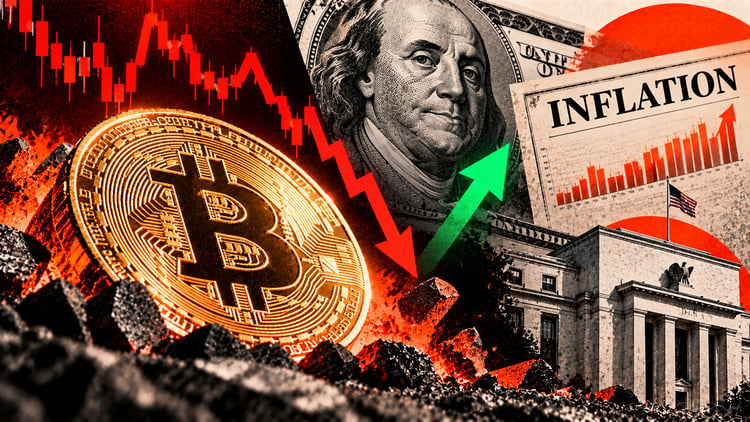
How is the hawkish Fed stance pressuring BTC?
A hawkish message emerged from the closely watched minutes of the Fed’s October monetary policy meeting, published late on Wednesday. Although most officials supported keeping rates unchanged in October, they viewed further increases as broadly acceptable on the basis of their September estimates. Inflation could require a tighter policy stance, some policymakers warned, while some were even considering a larger hike in December should the data deteriorate.
Within this macroeconomic setting, most participants noted a sharp expansion in AI-related debt, much of it channelled through complex and opaque financing structures. The concentration of AI exposure in a “small number” of companies also concerned some Fed officials.
Markets had already factored in a December rate hike, so these comments were not entirely unexpected. Nevertheless, the minutes suggested a slightly steeper and more prolonged path for rates. That outlook continues to underpin the US Dollar (USD) and weigh on Bitcoin, which slid towards the weekend low of $62,000 on Wednesday.
Can institutional demand for Bitcoin stabilise?
Selling pressure is building as institutional appetite for Bitcoin weakens further. According to SoSoValue, BTC spot ETFs saw net withdrawals of $306.42 million on Wednesday, their second successive day of outflows this week, after a billion-dollar withdrawal last week. A continuation and intensification of these outflows during the week could send BTC lower once again.
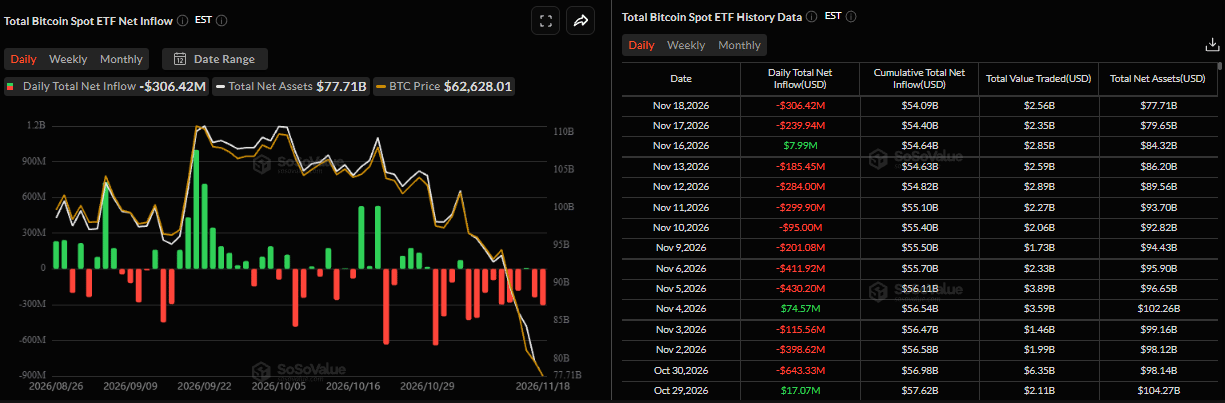
Third-quarter investors who gained Bitcoin exposure through ETFs are now sitting on sizeable unrealised losses, Bitfinex told FXStreet. Using the Bitfinex daily closing price to weight each day’s net flow produces an average entry price of about $80,070 for the period, leaving those third-quarter ETF buyers roughly 19% below their purchase price. Across the full quarter, meanwhile, the flow-weighted average entry price is $78,300, translating into an unrealised loss of approximately 17%.
According to the Bitfinex analyst, “We expect Bitcoin to remain inside the July Base, between about $60,100 and $68,600, the range implied by options for the 27 November expiry, with risks still skewed towards a retest of $62,029 and the $61,300 lower edge of the Base," The analyst added: "To the upside, three consecutive sessions of ETF inflows with CME OI stabilizing and STH-SOPR recovering towards 1 would indicate that institutional selling has ended and bring $69,400 and then $72,700 into view. To the downside, acceptance below $61,300 with ETF outflows above $300 million a day would point to the $57,803 cycle low,”
Could the $62,000–$65,000 long-term holder spending cluster offer support?
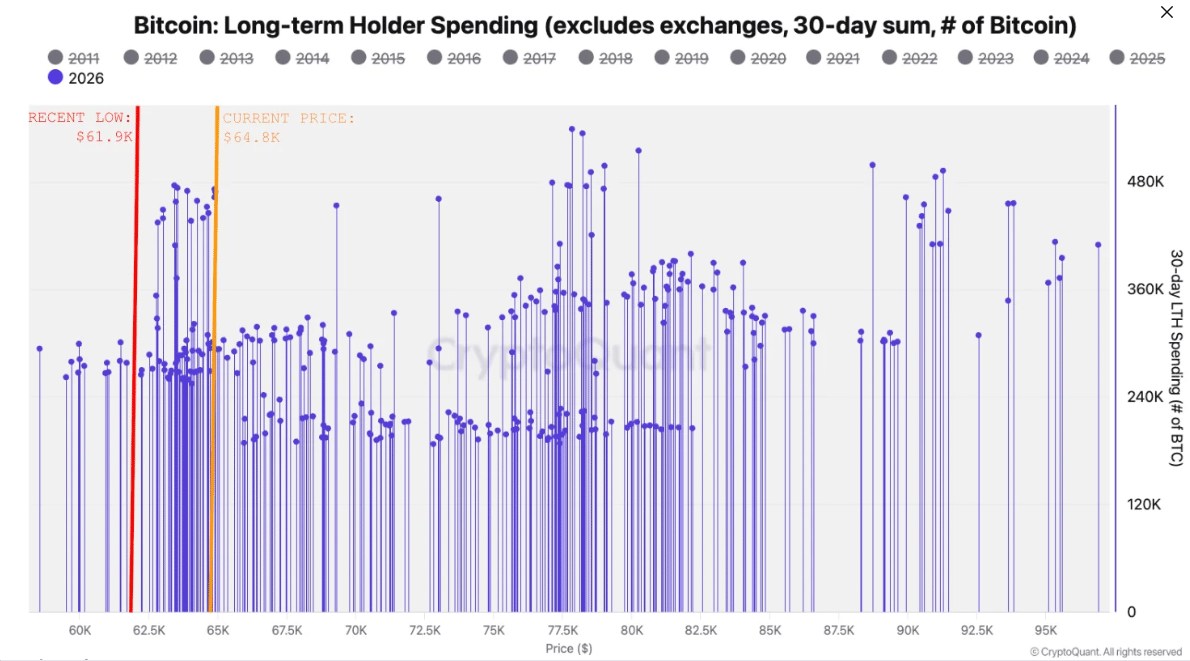
The $62,000 to $65,000 band could provide support for Bitcoin, according to CryptoQuant’s Tuesday report, which identified a substantial concentration of long-term holder spending, or purchases by new investors, within that zone.
Plotting the 30-day sum of long-term holder spending excluding exchanges against the prices at which it occurred during 2026, the chart below places each day’s reading at a separate point. The greatest density lies between $62,000 and $65,000. Bitcoin spent much of June to mid-August trading in this band before its rally got under way.
The CryptoQuant analyst explained: “Investors tend to defend their cost basis, which is why a dense cluster of this kind may act as a price support,”
Bitcoin technical outlook: Can bears retain their grip?
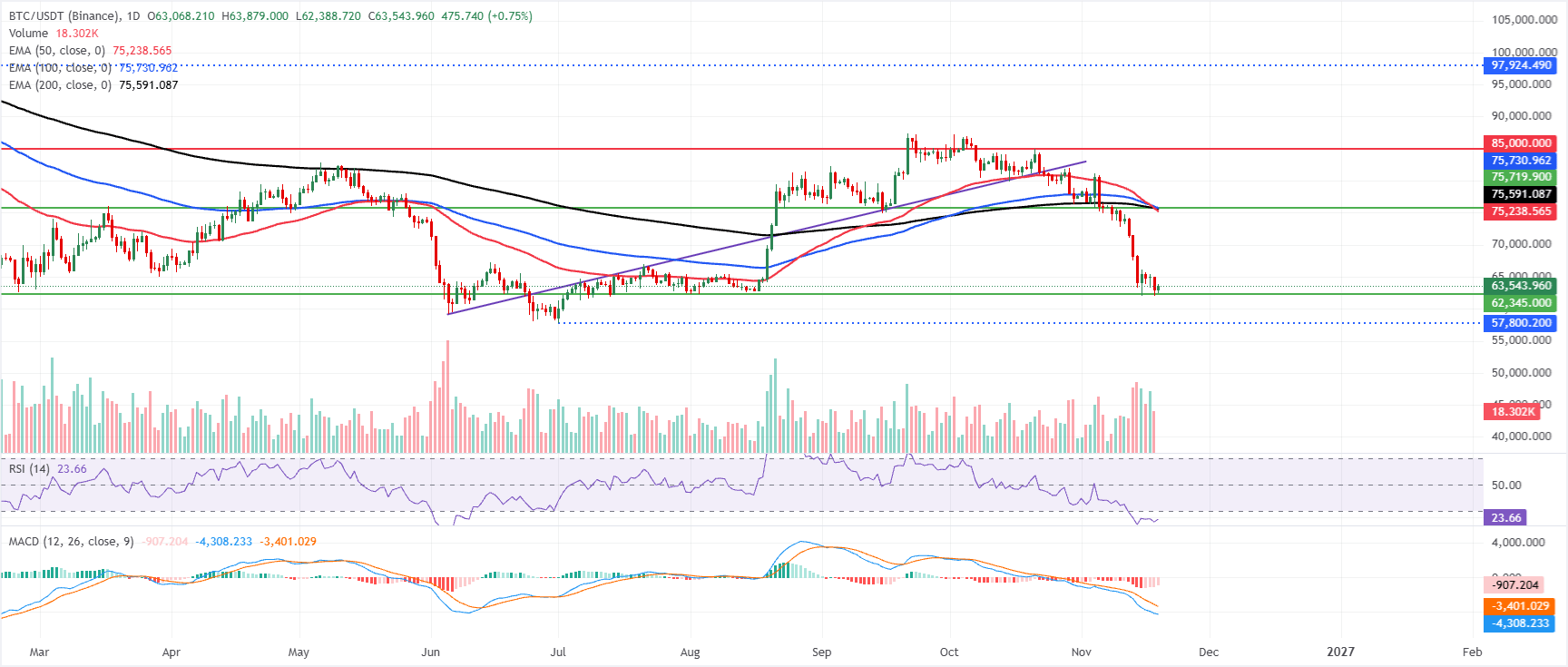
A bearish short-term bias persists as Bitcoin trades at $63,543 on Thursday, far beneath its 50-day, 100-day and 200-day Exponential Moving Averages (EMAs), grouped between roughly $75,200 and $75,700.
With its line below the signal line and both readings beneath zero, the Moving Average Convergence Divergence (MACD) remains firmly negative. At the same time, the Relative Strength Index (RSI) sits near 24 in oversold territory, suggesting that downward momentum remains strong, though stretched.
Any move higher would first encounter the 50-day EMA at $75,238, ahead of the 200-day EMA at $75,591 and the 100-day EMA at $75,730. Together, these averages form a tight resistance band above the prevailing price. Further up, horizontal resistance near $85,000 could attract stronger selling should a broader recovery take shape.
(The technical analysis of this story was written with the help of an AI tool. Know more.)
FAQs on Bitcoin, altcoins and stablecoins
Designed to function as money, Bitcoin is a virtual currency and the largest cryptocurrency by market capitalisation. No single individual, group or entity can control this payment method, removing the need for third-party involvement in financial transactions.
The term altcoin covers cryptocurrencies other than Bitcoin. However, some exclude Ethereum as well, on the grounds that forking originates from these two cryptocurrencies. Under that interpretation, Litecoin would be the first altcoin: it was forked from the Bitcoin protocol and is therefore an “improved” version of it.
A stablecoin is a cryptocurrency intended to maintain a steady price, backed by a reserve of the asset it represents. Its value is linked to a commodity or financial instrument, such as the US Dollar (USD), while an algorithm or demand regulates its supply. Primarily, stablecoins give investors a route into and out of cryptocurrency trading and investment. They also offer a means of storing value, since cryptocurrencies generally experience price volatility.
By comparing Bitcoin’s market capitalisation with the combined market capitalisation of all cryptocurrencies, Bitcoin dominance offers a clear measure of investor interest in Bitcoin. BTC dominance is generally high ahead of and during a bull run, when investors favour a relatively stable cryptocurrency with a large market capitalisation, such as Bitcoin. Conversely, declining BTC dominance usually signals that investors are shifting capital and/or profits into altcoins in pursuit of higher returns, often setting off a surge in altcoin rallies.
POPULAR ARTICLES
1The Euro faces a week dominated by US inflation with a rate hike already priced in2Why is the British Pound under pressure from softer inflation and slower pay growth ahead of PMI week?3Dow Jones Industrial Average extends losses to a fifth day amid broader AI sell-off4Chinese Yuan: Controls Triggered by Short-Lived Fall Against US Dollar - Commerzbank5Malaysian Ringgit: How are chip export curbs and yields weighing on MYR against US Dollar? – OCBC6Chinese Yuan: Gradual gains amid tight management – BNY7Why does the Australian Dollar remain under pressure amid diverging Fed and RBA outlooks?8Malaysian Ringgit: Why does range-bound trading persist as growth outpaces FX? – Commerzbank9Indonesian Rupiah: Losses against US Dollar limited by BI measures - OCBC

Get Started!
Sign up and access the Global Markets in less than 3 minutes

Connect With Us









Contacts
Phone: +61 2 8036 8388
Fax: +61 2 8036 8388
Email: support@tmgm.com



The information provided on this website is of a general nature only and does not constitute personal financial advice. Before acting on any information on this website, you should consider the suitability of the information in relation to your objectives, financial situation and needs. Investing in CFDs and FX Margin Contracts carries significant risks and is not suitable for all investors. You may lose more than your initial deposit. You do not own, or have, any interest in the underlying asset. We recommend that you seek independent advice and ensure you fully understand the risks involved before trading. It is important that you read and consider the disclosure document before you acquire any product listed on the website. The information and advertisements offered on this website are not intended for use by any person in any country or jurisdiction where such use would be contrary to local laws and regulations. The Products and Services offered on this website are not intended for residents of the United States, Malaysia and Thailand.
TMGM is authorized and regulated in various jurisdictions.
Trademax Australia Limited, trading as TMGM, is regulated by the Australian Securities and Investments Commission (ASIC), AFSL no. 436416 and is located at Level 28, One International Tower, 100 Barangaroo Avenue, 2000 Sydney, NSW Australia.
Email: support@tmgm.com.au
Trademax Global Limited, trading as TMGM, is authorized and regulated by the Vanuatu Financial Services Commission (VFSC), registration number 40356 and registered at 1276, Kumul Highway, Port Vila, Vanuatu, Republic of Vanuatu.
Email: support@tmgm.com
Trademax Global Markets (SE) Limited, trading as TMGM, is authorized and regulated by the Financial Services Authority (FSA) of Seychelles, with license number SD224. The company is registered at Office No 13, Providence Estate ABIS Centre, Mahe, Seychelles.
Email: support@tmgm.com
Trademax Global Markets (International) Pty Ltd, trading as TMGM, is authorized and regulated by the Financial Services Commission, Mauritius (FSC) with license no. GB22201012, and registered at 33, Edith Cavell Street C/o IQ EQ Fund Services (Mauritius) Ltd Port Louis, 11324 Mauritius.
Email: support@tmgm.com
Copyright © TMGM. All rights reserved