

Trading
Explore a wide range of markets with competitive pricing, deep liquidity, and advanced trading tools.
Learn More 
Platform
Trade seamlessly with TMGM's powerful platform, built for speed, precision, and a superior trading experience.
Learn More Trading Platform
Academy
Learn the fundamentals of trading with beginner-friendly resources, including guides, webinars, and market insights.
Learn More News & Analysis
Get real-time market updates and expert analysis to stay ahead of trading opportunities
Learn More News & Analysis
About
Learn what sets TMGM apart — our global presence, regulatory strength, and commitment to innovation in trading.
Learn More Why Choose TMGM
Sponsorship
Australian Dollar stabilises at a 10-month low following split RBA minutes
- Can AUD/USD stabilise after five consecutive declines take it to its lowest since January?
- With its policy rate already above the Fed's, the RBA offered no signal of a further increase.
- Markets await Australian wage data on Wednesday, followed by October employment figures on Thursday.
The Australian Dollar has steadied with little recovery after five consecutive sessions of losses took it to its weakest level since January. Having slipped to a 10-month low just above 0.6700, AUD/USD is trading marginally below 0.6750, largely unchanged from Monday's close. By comparison, the Pound has recovered more following the same five-session losing streak.

Traders have abandoned expectations of a December RBA rate increase after the Reserve Bank of Australia (RBA) released minutes that contained no reference to additional tightening. At the November 3 meeting, three of the nine board members opposed the increase to 4.85%. Despite Australia's cash rate standing at an 18-year high and exceeding the upper end of the Fed's range by 0.85 percentage points, the Aussie is at a 10-month low.
A retreat in the Dollar Index from a 19-month high halted the Aussie's decline, following a 0.4% contraction in US industrial production. Markets have fully priced in a December Fed rate increase. Should the RBA leave rates unchanged on December 8, Australia's interest-rate advantage would shrink to 0.60 percentage points.
Which upcoming releases matter for AUD/USD?
Wage and employment data will inform the RBA's December 8 decision, when its divided board faces another policy choice. Australia's third-quarter Wage Price Index, scheduled for 00:30 GMT on Wednesday, is forecast to rise 1% quarter-on-quarter, following 0.8%. At 00:30 GMT on Thursday, October employment figures are expected to show a 25.2K increase in jobs after a 39.3K decline, while the unemployment rate is forecast to remain at 4.7%.
Wednesday also brings the Fed's October meeting minutes at 19:00 GMT. On Friday at 01:15 GMT, the People's Bank of China (PBoC) will announce its rate decision, with the rate forecast to stay at 3%. While the Fed minutes concern the US side of the interest-rate differential, the PBoC decision relates to demand from Australia's largest customer.
What does the AUD/USD chart show?
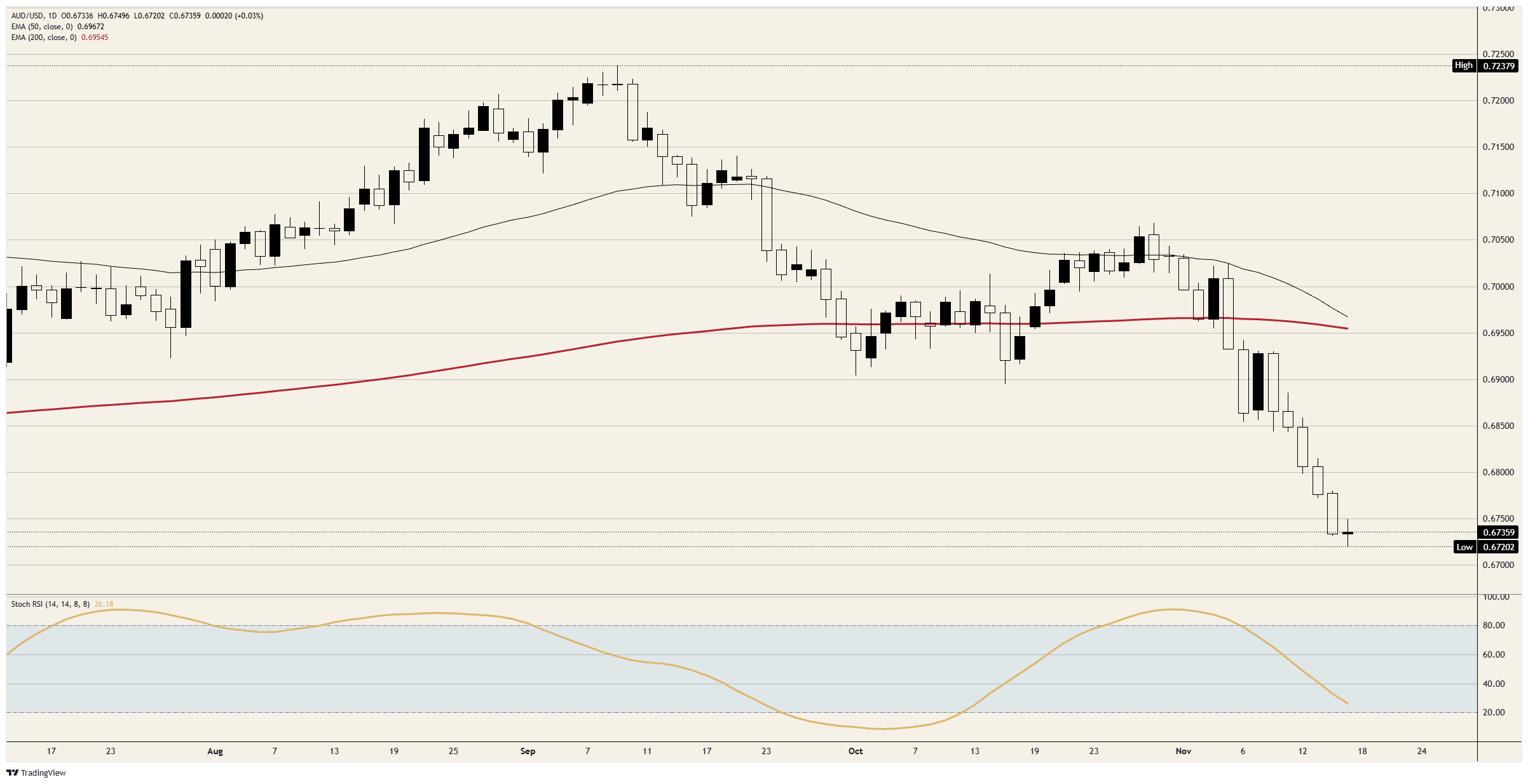
Tuesday has produced the narrowest trading range in AUD/USD's decline from just below 0.6950 on November 10. On the chart beginning in July, no level is below Tuesday's low; the September high, meanwhile, was just short of 0.7250. Both the 50-day Exponential Moving Average (EMA) and the 200-day average sit slightly above 0.6950, with the former having dropped almost to the latter.
Daily price chart for AUD/USD
Australian Dollar: frequently asked questions
Interest rates set by the Reserve Bank of Australia (RBA) are among the strongest influences on the Australian Dollar (AUD). Australia's abundant natural resources also make the price of iron ore, its largest export, an important driver. Other influences include economic conditions in China, Australia's biggest trading partner, alongside domestic inflation, economic growth and the trade balance. Investor sentiment matters too: a willingness to buy riskier assets (risk-on) supports the AUD, while a preference for safe havens characterises risk-off conditions.
By setting the interest rate at which Australian banks can lend to one another, the Reserve Bank of Australia (RBA) affects borrowing rates across the wider economy and, in turn, the Australian Dollar (AUD). It raises or lowers rates primarily to keep inflation stable within a 2-3% range. When Australian rates are relatively high compared with those of other major central banks, they support the AUD; relatively low rates have the reverse effect. Quantitative easing and quantitative tightening offer the RBA additional ways to influence credit conditions. Easing is negative for the AUD, whereas tightening is positive.
As Australia's biggest trading partner, China has a substantial influence on the Australian Dollar (AUD). A strong Chinese economy buys more Australian raw materials, goods and services, increasing demand for the AUD and lifting its value. When China's growth falls short of expectations, the reverse occurs. This is why upside or downside surprises in Chinese growth figures often directly affect the Australian Dollar and its currency pairs.
With China its main destination, iron ore is Australia's biggest export, worth $118 billion annually according to 2021 data. Its price can therefore influence the Australian Dollar. A rise in iron ore prices generally lifts overall demand for the currency and strengthens the AUD; falling prices tend to have the reverse effect. Higher iron ore prices also make an Australian trade surplus more likely, providing another source of support for the AUD.
Another influence on the Australian Dollar is the trade balance: the difference between a country's export earnings and its import spending. Strong overseas demand for Australian exports can lift the currency when demand from foreign buyers exceeds Australia's spending on imports. A net trade surplus consequently supports the AUD, while a trade deficit has the reverse effect.
POPULAR ARTICLES
1Indonesian Rupiah: Does BI’s hawkish turn point to further tightening risks? – Commerzbank2Forex Today: How will Japan CPI and UK consumer spending data shape market sentiment?3Oil rebound lifts Canadian Dollar, with gains capped by hawkish Fed4Why is the Australian Dollar plunging to a fresh yearly low as a jobs shock prompts an RBA policy rethink?5Gold slides to 14-month low as markets step up bets on Fed rate hikes6Ether.fi Price Forecast: Can ETFFI Bulls Build on the Recovery Above $0.50?7Why is the euro struggling to recover as the Fed outlook turns increasingly hawkish?8Why is the pound sliding to fresh lows despite weak US data?9Norwegian Krone: Oil-Led Gains Leave Limited Room for Further Upside – Commerzbank

Get Started!
Sign up and access the Global Markets in less than 3 minutes

Connect With Us









Contacts
Phone: +61 2 8036 8388
Fax: +61 2 8036 8388
Email: support@tmgm.com



The information provided on this website is of a general nature only and does not constitute personal financial advice. Before acting on any information on this website, you should consider the suitability of the information in relation to your objectives, financial situation and needs. Investing in CFDs and FX Margin Contracts carries significant risks and is not suitable for all investors. You may lose more than your initial deposit. You do not own, or have, any interest in the underlying asset. We recommend that you seek independent advice and ensure you fully understand the risks involved before trading. It is important that you read and consider the disclosure document before you acquire any product listed on the website. The information and advertisements offered on this website are not intended for use by any person in any country or jurisdiction where such use would be contrary to local laws and regulations. The Products and Services offered on this website are not intended for residents of the United States, Malaysia and Thailand.
TMGM is authorized and regulated in various jurisdictions.
Trademax Australia Limited, trading as TMGM, is regulated by the Australian Securities and Investments Commission (ASIC), AFSL no. 436416 and is located at Level 28, One International Tower, 100 Barangaroo Avenue, 2000 Sydney, NSW Australia.
Email: support@tmgm.com.au
Trademax Global Limited, trading as TMGM, is authorized and regulated by the Vanuatu Financial Services Commission (VFSC), registration number 40356 and registered at 1276, Kumul Highway, Port Vila, Vanuatu, Republic of Vanuatu.
Email: support@tmgm.com
Trademax Global Markets (SE) Limited, trading as TMGM, is authorized and regulated by the Financial Services Authority (FSA) of Seychelles, with license number SD224. The company is registered at Office No 13, Providence Estate ABIS Centre, Mahe, Seychelles.
Email: support@tmgm.com
Trademax Global Markets (International) Pty Ltd, trading as TMGM, is authorized and regulated by the Financial Services Commission, Mauritius (FSC) with license no. GB22201012, and registered at 33, Edith Cavell Street C/o IQ EQ Fund Services (Mauritius) Ltd Port Louis, 11324 Mauritius.
Email: support@tmgm.com
Copyright © TMGM. All rights reserved