
News & AnalysisCareer

A 25 basis point increase in the Overnight Cash Rate (OCR), from 2.75% to 3%, is expected when the Reserve Bank of New Zealand (RBNZ), headed by Governor Anna Breman, announces its decision on Wednesday, 28 October at 01:00 GMT. Money markets assign a 100% probability to the rise.

The increase would mark the RBNZ’s third rate rise, with the probability of a further increase in December standing at nearly 50%.
At its September meeting, the Committee unanimously agreed to raise the OCR and withdraw monetary stimulus, seeking to bring inflation towards the 2% target while supporting economic growth and the labour market. The move was intended to limit the risk of more aggressive rate adjustments, with the Committee keeping an open mind about subsequent changes to the OCR.
A further increase would notably take the OCR nearer to the RBNZ’s neutral range. Speaking at the press conference after the decision, Governor Breman said the committee was moving rates towards neutral while retaining an accommodative stance.
Breman also indicated that another OCR increase was likely and that the impact of the rate rises already delivered would be assessed.
Taken together, these remarks point to a central bank inclined towards additional increases, although their timing remains unclear.
The latest figures leave room for more rate rises. New Zealand’s Q2 GDP growth came in at 2.6% YoY, ahead of the 2.3% forecast. Q3 CPI inflation, meanwhile, eased to 3.7% YoY, below expectations of 3.8% but still above the RBNZ’s 2% inflation target.
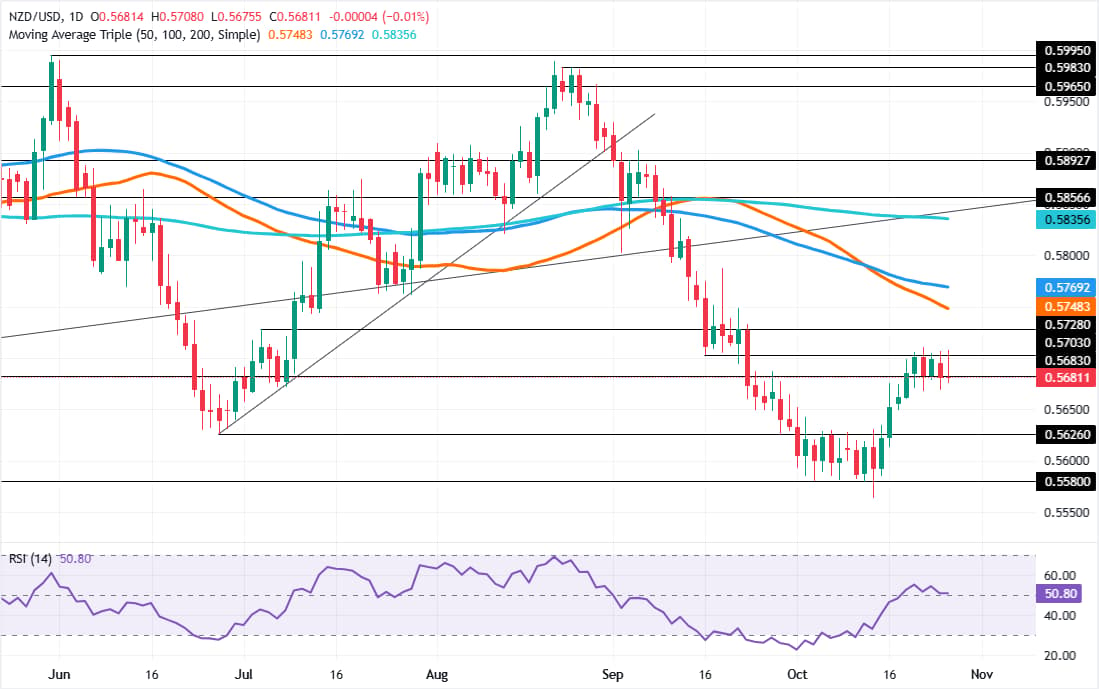
Near the lower end of its 0.5675-0.5708 daily trading range, NZD/USD is holding comfortably as traders await a potential two-stage reaction, with the Federal Reserve’s decision also in focus.
A hawkish stance from the RBNZ could lift the pair towards the confluence of its 50-day and 100-day Simple Moving Averages (SMAs), at 0.5748 and 0.5769 respectively. A break above that area would make a potential advance towards 0.5800 likely.
Conversely, a dovish message from the RBNZ could open the way for tests of 0.5650 and the psychologically significant 0.5600 level. Traders are defending the latter after the pair has traded on either side of it for at least 14 days. Further losses would bring the year-to-date (YTD) low of 0.5564 into focus.
As New Zealand’s central bank, the Reserve Bank of New Zealand (RBNZ) has economic objectives of securing and preserving price stability and supporting maximum sustainable employment. Price stability is achieved when inflation, as measured by the Consumer Price Index (CPI), is within the 1% to 3% range.
Guided by its objectives, the Reserve Bank of New Zealand’s (RBNZ) Monetary Policy Committee (MPC) sets the appropriate Official Cash Rate (OCR). Inflation above target prompts the bank to try to curb price pressures by increasing the OCR. This raises borrowing costs for households and businesses, helping to cool the economy. By lifting yields and making New Zealand more attractive to investors, higher interest rates generally support the New Zealand Dollar (NZD). Lower rates, by contrast, tend to weigh on NZD.
A tight labour market can generate inflationary pressure, which makes employment an important consideration for the Reserve Bank of New Zealand (RBNZ). Its objective of “maximum sustainable employment” means the greatest use of labour resources that can be maintained over time without accelerating inflation. As the bank explains: “When employment is at its maximum sustainable level, there will be low and stable inflation. However, if employment is above the maximum sustainable level for too long, it will eventually cause prices to rise more and more quickly, requiring the MPC to raise interest rates to keep inflation under control,”
When conditions are extreme, the Reserve Bank of New Zealand (RBNZ) can turn to Quantitative Easing as a monetary policy tool. Under QE, the RBNZ prints domestic currency to purchase assets, typically government or corporate bonds, from banks and other financial institutions. The intention is to expand the domestic money supply and stimulate economic activity. A weaker New Zealand Dollar (NZD) is the usual result. Reserved as a last resort when interest rate cuts alone are unlikely to meet the central bank’s objectives, QE was used by the RBNZ during the Covid-19 pandemic.







Phone: +61 2 8036 8388
Fax: +61 2 8036 8388
Email: support@tmgm.com



The information provided on this website is of a general nature only and does not constitute personal financial advice. Before acting on any information on this website, you should consider the suitability of the information in relation to your objectives, financial situation and needs. Investing in CFDs and FX Margin Contracts carries significant risks and is not suitable for all investors. You may lose more than your initial deposit. You do not own, or have, any interest in the underlying asset. We recommend that you seek independent advice and ensure you fully understand the risks involved before trading. It is important that you read and consider the disclosure document before you acquire any product listed on the website. The information and advertisements offered on this website are not intended for use by any person in any country or jurisdiction where such use would be contrary to local laws and regulations. The Products and Services offered on this website are not intended for residents of the United States, Malaysia and Thailand.
TMGM is authorized and regulated in various jurisdictions.
Trademax Australia Limited, trading as TMGM, is regulated by the Australian Securities and Investments Commission (ASIC), AFSL no. 436416 and is located at Level 28, One International Tower, 100 Barangaroo Avenue, 2000 Sydney, NSW Australia.
Email: support@tmgm.com.au
Trademax Global Limited, trading as TMGM, is authorized and regulated by the Vanuatu Financial Services Commission (VFSC), registration number 40356 and registered at 1276, Kumul Highway, Port Vila, Vanuatu, Republic of Vanuatu.
Email: support@tmgm.com
Trademax Global Markets (SE) Limited, trading as TMGM, is authorized and regulated by the Financial Services Authority (FSA) of Seychelles, with license number SD224. The company is registered at Office No 13, Providence Estate ABIS Centre, Mahe, Seychelles.
Email: support@tmgm.com
Trademax Global Markets (International) Pty Ltd, trading as TMGM, is authorized and regulated by the Financial Services Commission, Mauritius (FSC) with license no. GB22201012, and registered at 33, Edith Cavell Street C/o IQ EQ Fund Services (Mauritius) Ltd Port Louis, 11324 Mauritius.
Email: support@tmgm.com
Copyright © TMGM. All rights reserved


