
News & AnalysisCareer

October’s preliminary United States (US) S&P Global Purchasing Managers Indices (PMIs), due on Friday, will offer a fresh assessment of the world’s largest economy before next week’s Federal Reserve (Fed) monetary policy meeting.

Private-sector business activity is tracked through the report’s Manufacturing PMI, Services PMI and Composite PMI. A reading above 50 signals expansion; a figure below that level indicates contraction.
Resilient activity has remained a feature of recent US economic data, despite continuing inflationary pressures and high borrowing costs, setting the backdrop for October’s surveys. Investors will scrutinise the releases for evidence of weaker growth and renewed price pressures, either of which could shape the Fed’s policy outlook and the US Dollar (USD).
September’s Manufacturing PMI reading of 55.9 is expected to slip to 55.6 in October, as markets anticipate a moderate cooling in US private-sector activity after particularly strong September results. The S&P Global Services PMI is forecast to fall from 58.8 to 57.9. The Composite PMI, meanwhile, reached 58.4 in September, underlining the strength of growth across the US private sector.
Even with momentum expected to weaken in both sectors, forecasts remain comfortably above the 50 mark. Those readings would suggest that the US economy is still expanding at a healthy rate.
Persistent inflationary pressures lend particular significance to the release. Inflation has exceeded expectations in recent US data, while Retail Sales and labour market indicators continue to point to resilient domestic demand.
Following September’s 25-basis-point (bps) increase, the Fed is widely expected to hold interest rates steady at its October 28 meeting. Nevertheless, the CME FedWatch tool shows that investors have fully priced in a further rate rise in December.
Friday at 13:45 GMT is the scheduled release time for October’s S&P Global Manufacturing, Services and Composite PMIs. As investors adjust positions before the Fed’s October 28 policy decision, the figures could prompt volatility in both the US Dollar and EUR/USD.
Expectations of further Fed rate increases over the coming months could strengthen if the report beats forecasts. US Treasury yields and the US Dollar would likely benefit in that event, potentially putting pressure on EUR/USD.
By contrast, concerns over the durability of US economic growth could mount if business activity slows more sharply than forecast, especially in services. Softer PMI results could lead investors to reconsider the prospect of further monetary tightening, weighing on the Greenback while lending support to EUR/USD.
A release broadly in line with forecasts, however, could produce a relatively muted market response, as manufacturing and services activity are both expected to stay firmly in expansion territory.
With markets already largely pricing in another Fed rate increase for December, Friday’s PMI readings will be examined closely for confirmation of US economic resilience or evidence of a slowdown. Results above expectations could strengthen the case for further monetary tightening. Disappointing figures, by contrast, could raise questions about the strength of growth and put the US Dollar under pressure.
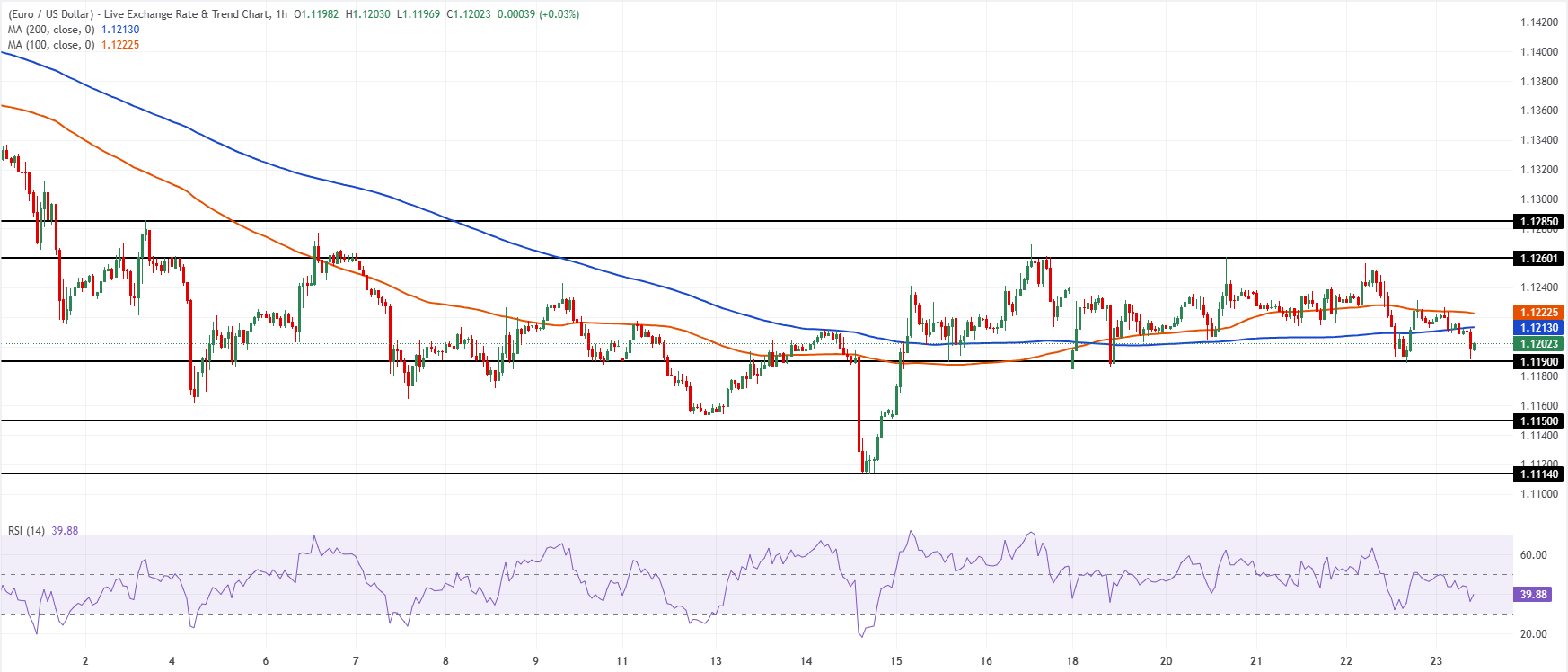
Trading below its 100-period Simple Moving Average (SMA) at 1.1223 and 200-period SMA at 1.1213, EUR/USD retains a mildly bearish bias on the one-hour chart. The pair is edging along just above nearby price support. With the Relative Strength Index (14) near 40, the signal is one of fading bullish momentum rather than outright oversold conditions. Downside risks therefore persist while these moving averages constrain gains.
The horizontal level around 1.1190 provides the first downside support, with further floors at 1.1150 and 1.1114. For any recovery, the 200-period SMA at 1.1213 offers immediate resistance, ahead of the 100-period SMA at 1.1223. A return above the more substantial barriers at 1.1260 and 1.1285 would be needed to alleviate the prevailing bearish bias.
(The technical analysis of this story was written with the help of an AI tool. Know more.)







Phone: +61 2 8036 8388
Fax: +61 2 8036 8388
Email: support@tmgm.com



The information provided on this website is of a general nature only and does not constitute personal financial advice. Before acting on any information on this website, you should consider the suitability of the information in relation to your objectives, financial situation and needs. Investing in CFDs and FX Margin Contracts carries significant risks and is not suitable for all investors. You may lose more than your initial deposit. You do not own, or have, any interest in the underlying asset. We recommend that you seek independent advice and ensure you fully understand the risks involved before trading. It is important that you read and consider the disclosure document before you acquire any product listed on the website. The information and advertisements offered on this website are not intended for use by any person in any country or jurisdiction where such use would be contrary to local laws and regulations. The Products and Services offered on this website are not intended for residents of the United States, Malaysia and Thailand.
TMGM is authorized and regulated in various jurisdictions.
Trademax Australia Limited, trading as TMGM, is regulated by the Australian Securities and Investments Commission (ASIC), AFSL no. 436416 and is located at Level 28, One International Tower, 100 Barangaroo Avenue, 2000 Sydney, NSW Australia.
Email: support@tmgm.com.au
Trademax Global Limited, trading as TMGM, is authorized and regulated by the Vanuatu Financial Services Commission (VFSC), registration number 40356 and registered at 1276, Kumul Highway, Port Vila, Vanuatu, Republic of Vanuatu.
Email: support@tmgm.com
Trademax Global Markets (SE) Limited, trading as TMGM, is authorized and regulated by the Financial Services Authority (FSA) of Seychelles, with license number SD224. The company is registered at Office No 13, Providence Estate ABIS Centre, Mahe, Seychelles.
Email: support@tmgm.com
Trademax Global Markets (International) Pty Ltd, trading as TMGM, is authorized and regulated by the Financial Services Commission, Mauritius (FSC) with license no. GB22201012, and registered at 33, Edith Cavell Street C/o IQ EQ Fund Services (Mauritius) Ltd Port Louis, 11324 Mauritius.
Email: support@tmgm.com
Copyright © TMGM. All rights reserved


