
News & AnalysisCareer

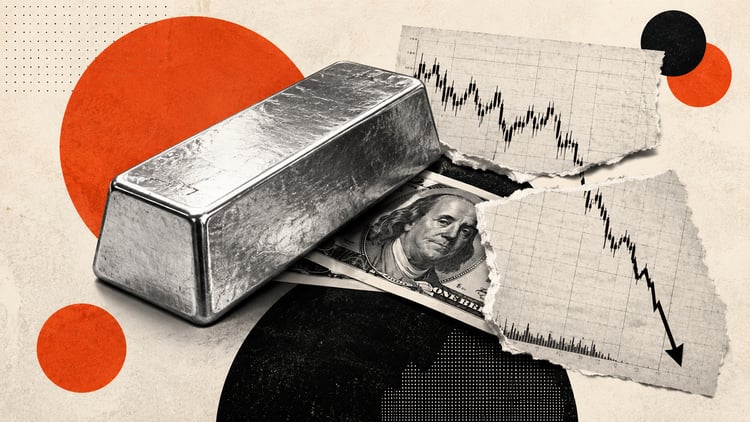
At $42.32 per troy ounce on Friday, Silver (XAG/USD) is trading 3.65% below Thursday’s $43.93, FXStreet data show.
Since the start of the year, Silver has lost 40.46% of its value.
Unit of measurement | Today’s Silver Price in USD |
|---|---|
Per Troy Ounce | 42.32 |
Per 1 Gram | 1.36 |
Friday’s Gold/Silver ratio reached 84.38, compared with 83.33 on Thursday. The ratio measures how many ounces of Silver are required to match the value of one ounce of Gold.
Widely traded by investors, Silver is a precious metal with a long history as both a store of value and a means of exchange. Gold remains more popular, but traders may choose Silver for its intrinsic value, to diversify their portfolios or as a possible hedge when inflation is high. Physical holdings can take the form of Silver coins or bars. Alternatively, investors can gain exposure through instruments such as exchange-traded funds, which follow the metal’s price on international markets.
A broad range of influences can drive Silver prices. Its safe-haven status means geopolitical uncertainty or concerns about a severe recession can push prices higher, though the effect is less pronounced than for Gold. Lower interest rates also tend to support Silver because it pays no yield. With the metal quoted in dollars (XAG/USD), movements in the US Dollar (USD) are another important influence: a stronger Dollar tends to restrain Silver prices, while a weaker currency is likely to lift them. Investment demand, recycling rates and mining supply can also affect prices, with Silver far more abundant than Gold.
Among metals, Silver has one of the highest levels of electrical conductivity, exceeding both Copper and Gold. This makes it widely used in industry, notably in electronics and solar energy. A sharp increase in demand can lift prices, whereas falling demand tends to depress them. Economic developments in the US, China and India can also cause price fluctuations. Large industrial sectors in the US and, especially, China use Silver in a variety of processes, while Indian consumer demand for Silver jewellery is another key influence on prices.
Given their similar standing as safe-haven assets, Silver generally moves in line with Gold, typically rising when Gold prices advance. Investors may use the Gold/Silver ratio to assess the metals’ relative valuations. This ratio expresses the number of ounces of Silver equivalent in value to one ounce of Gold. A high reading may be interpreted by some investors as a sign that Silver is undervalued or Gold overvalued. A low reading, by contrast, might indicate that Gold is undervalued against Silver.
(This post was created with the help of an automation tool.)







Phone: +61 2 8036 8388
Fax: +61 2 8036 8388
Email: support@tmgm.com



The information provided on this website is of a general nature only and does not constitute personal financial advice. Before acting on any information on this website, you should consider the suitability of the information in relation to your objectives, financial situation and needs. Investing in CFDs and FX Margin Contracts carries significant risks and is not suitable for all investors. You may lose more than your initial deposit. You do not own, or have, any interest in the underlying asset. We recommend that you seek independent advice and ensure you fully understand the risks involved before trading. It is important that you read and consider the disclosure document before you acquire any product listed on the website. The information and advertisements offered on this website are not intended for use by any person in any country or jurisdiction where such use would be contrary to local laws and regulations. The Products and Services offered on this website are not intended for residents of the United States, Malaysia and Thailand.
TMGM is authorized and regulated in various jurisdictions.
Trademax Australia Limited, trading as TMGM, is regulated by the Australian Securities and Investments Commission (ASIC), AFSL no. 436416 and is located at Level 28, One International Tower, 100 Barangaroo Avenue, 2000 Sydney, NSW Australia.
Email: support@tmgm.com.au
Trademax Global Limited, trading as TMGM, is authorized and regulated by the Vanuatu Financial Services Commission (VFSC), registration number 40356 and registered at 1276, Kumul Highway, Port Vila, Vanuatu, Republic of Vanuatu.
Email: support@tmgm.com
Trademax Global Markets (SE) Limited, trading as TMGM, is authorized and regulated by the Financial Services Authority (FSA) of Seychelles, with license number SD224. The company is registered at Office No 13, Providence Estate ABIS Centre, Mahe, Seychelles.
Email: support@tmgm.com
Trademax Global Markets (International) Pty Ltd, trading as TMGM, is authorized and regulated by the Financial Services Commission, Mauritius (FSC) with license no. GB22201012, and registered at 33, Edith Cavell Street C/o IQ EQ Fund Services (Mauritius) Ltd Port Louis, 11324 Mauritius.
Email: support@tmgm.com
Copyright © TMGM. All rights reserved


