
News & AnalysisCareer

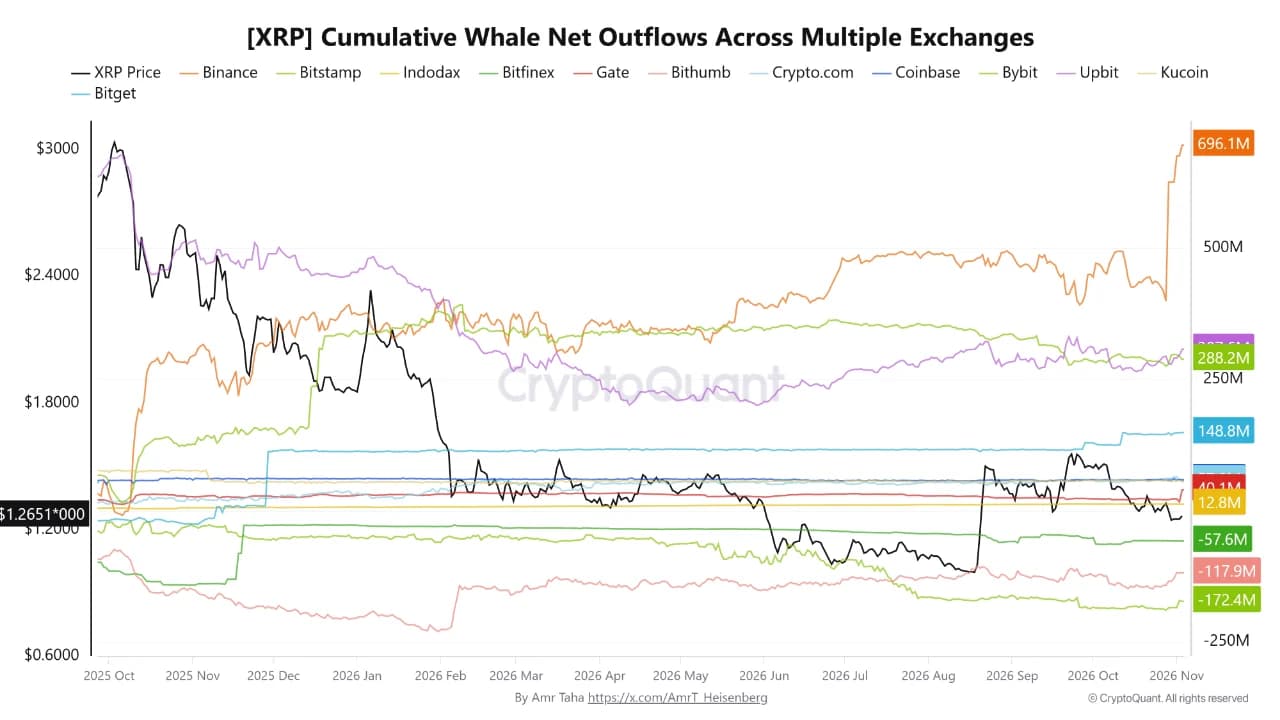
With cumulative whale net outflows reaching 696 million XRP, Ripple (XRP) trades slightly higher near $1.30 on Wednesday as the wider crypto market recovers. The advance coincides with the United States (US) midterm elections, where the Democratic Party has secured victory in the Senate and is on course to take control of Congress.

Following the Binance hack-driven sell-off that took Bitcoin (BTC) to a six-week low near $76,000, the cryptocurrency remains above $78,000, with signs that its recovery could persist.
Although the short-term path of least resistance appears to favour further gains, XRP needs to reclaim key structural levels, including major moving averages, before it can move onto firmer ground.
By Wednesday, cumulative whale net outflows measured across several cryptocurrency exchanges had reached 696 million XRP, compared with 399 million XRP on 28 October. The sharp rise in withdrawals amounts to a 74.5% increase over the last seven days.
If exchange outflows persist, they can draw down XRP reserves and limit the supply readily available for spot sales, potentially relieving selling pressure.
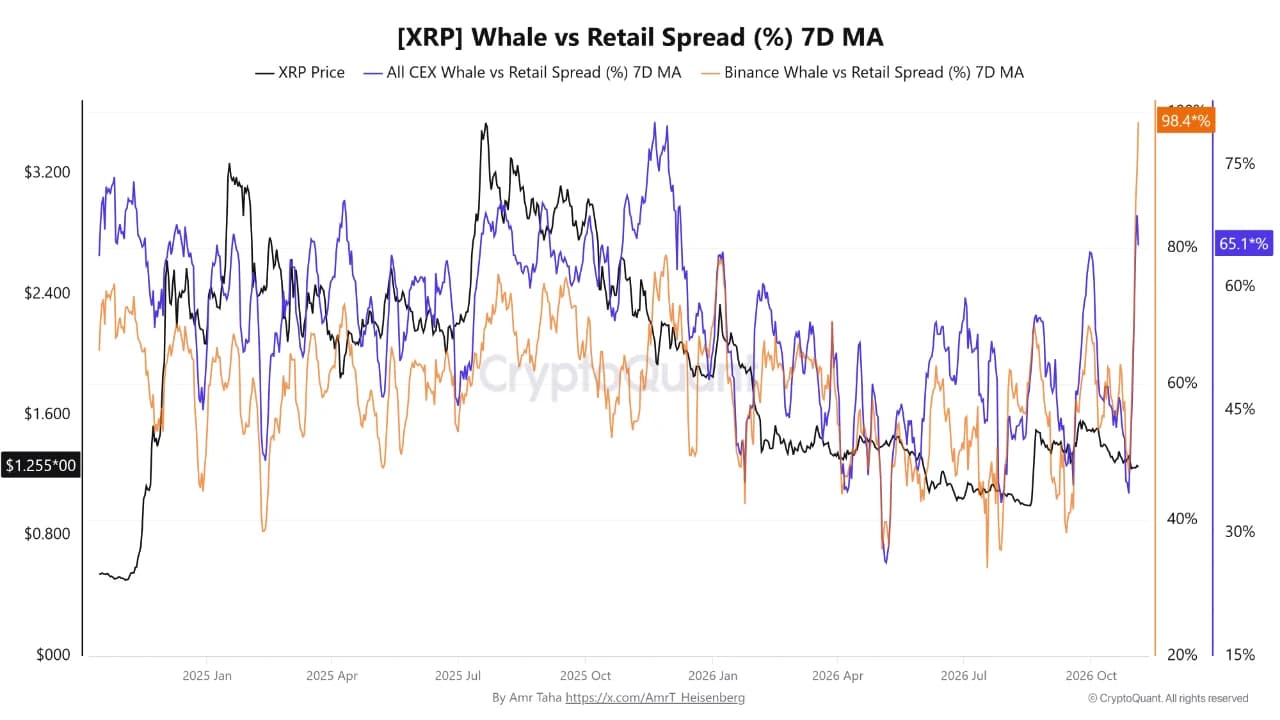
CryptoQuant also reports that the XRP Whale vs Retail Spread on Binance jumped to 98.4% on Tuesday, the highest level since 15 October 2024. That compares with 65.1% across all centralised exchanges.
These measures alone, however, do not establish a strong and lasting source of support for XRP’s recovery over the coming sessions. They should be assessed alongside key technical indicators and patterns of retail and institutional demand.
Despite trading above $1.29, XRP retains a bearish near-term bias beneath a cluster of Exponential Moving Averages (EMAs) and the SuperTrend line. With the pair just below the Bollinger Bands’ middle boundary around $1.30, resistance remains close to the prevailing price. Further overhead, the 50-day, 100-day and 200-day EMAs stand at $1.34, $1.32 and $1.37, respectively, reinforcing the view that the market is still in a corrective phase.
The momentum picture remains uneven: Moving Average Convergence Divergence (MACD) has edged into positive territory, while the Relative Strength Index (RSI) sits near 46. Together, these readings suggest that upward pressure is improving but remains fragile.
The Bollinger middle band near $1.30 presents the first resistance, ahead of the 100-day EMA at $1.32 and the 50-day EMA at $1.34. Should XRP close above these levels on a daily basis, the next upside targets would be the Bollinger upper band at $1.36, followed by the 200-day EMA at $1.37. The SuperTrend line near $1.40 poses a more substantial obstacle to a lasting recovery. Conversely, the next significant support area is the Bollinger lower band around $1.23. A break beneath it would be likely to revive bearish momentum and leave XRP vulnerable to further losses over the coming days.
(The technical analysis of this story was written with the help of an AI tool. Know more.)
Specialising in cross-border remittances, payments company Ripple uses blockchain technology to carry out transfers. Its payments transfer network, RippleNet, was created by Ripple Labs Inc. and is available to financial institutions around the world. Ripple also makes use of the XRP token.
As the native token of the decentralised XRPLedger blockchain, XRP is used by Ripple Labs to enable transactions on the network. This allows financial institutions to transfer value across borders. By supporting instant, trustless payments on the XRPLedger chain, XRP helps financial firms reduce the cost of transactions worldwide.
Built on distributed ledger technology and blockchain, XRPLedger uses XRP to power transactions. Unlike other blockchains, the ledger incorporates an inflammatory protocol designed to counter spam and distributed denial-of-service (DDOS) attacks. A peer-to-peer network called the global XRP Ledger community maintains XRPL.
The interledger standard used by XRP is a blockchain protocol that enables payments between different networks. XRP’s blockchain can, for example, link the ledgers of two or more banks, effectively eliminating intermediaries and the need for centralisation within the system. Developed by Jed McCaleb, Arthur Britto and David Schwartz, the XRPLedger blockchain uses XRP as its native token.







Phone: +61 2 8036 8388
Fax: +61 2 8036 8388
Email: support@tmgm.com



The information provided on this website is of a general nature only and does not constitute personal financial advice. Before acting on any information on this website, you should consider the suitability of the information in relation to your objectives, financial situation and needs. Investing in CFDs and FX Margin Contracts carries significant risks and is not suitable for all investors. You may lose more than your initial deposit. You do not own, or have, any interest in the underlying asset. We recommend that you seek independent advice and ensure you fully understand the risks involved before trading. It is important that you read and consider the disclosure document before you acquire any product listed on the website. The information and advertisements offered on this website are not intended for use by any person in any country or jurisdiction where such use would be contrary to local laws and regulations. The Products and Services offered on this website are not intended for residents of the United States, Malaysia and Thailand.
TMGM is authorized and regulated in various jurisdictions.
Trademax Australia Limited, trading as TMGM, is regulated by the Australian Securities and Investments Commission (ASIC), AFSL no. 436416 and is located at Level 28, One International Tower, 100 Barangaroo Avenue, 2000 Sydney, NSW Australia.
Email: support@tmgm.com.au
Trademax Global Limited, trading as TMGM, is authorized and regulated by the Vanuatu Financial Services Commission (VFSC), registration number 40356 and registered at 1276, Kumul Highway, Port Vila, Vanuatu, Republic of Vanuatu.
Email: support@tmgm.com
Trademax Global Markets (SE) Limited, trading as TMGM, is authorized and regulated by the Financial Services Authority (FSA) of Seychelles, with license number SD224. The company is registered at Office No 13, Providence Estate ABIS Centre, Mahe, Seychelles.
Email: support@tmgm.com
Trademax Global Markets (International) Pty Ltd, trading as TMGM, is authorized and regulated by the Financial Services Commission, Mauritius (FSC) with license no. GB22201012, and registered at 33, Edith Cavell Street C/o IQ EQ Fund Services (Mauritius) Ltd Port Louis, 11324 Mauritius.
Email: support@tmgm.com
Copyright © TMGM. All rights reserved


