
News & AnalysisCareer

Key support at $1.30 draws closer for Ripple (XRP) on Thursday, while Stellar (XLM) surrenders part of its recent advance. Both remain under pressure, with bearish positioning in derivatives markets and on-chain signals undermining sentiment.

At its two-day October policy meeting, the Federal Reserve (Fed) left interest rates at 3.75%-4.00%. The cautious decision to hold, accompanied by a hawkish undertone and concerns over inflation, reinforces the subdued market backdrop, weighing on risk assets including XRP and XLM.
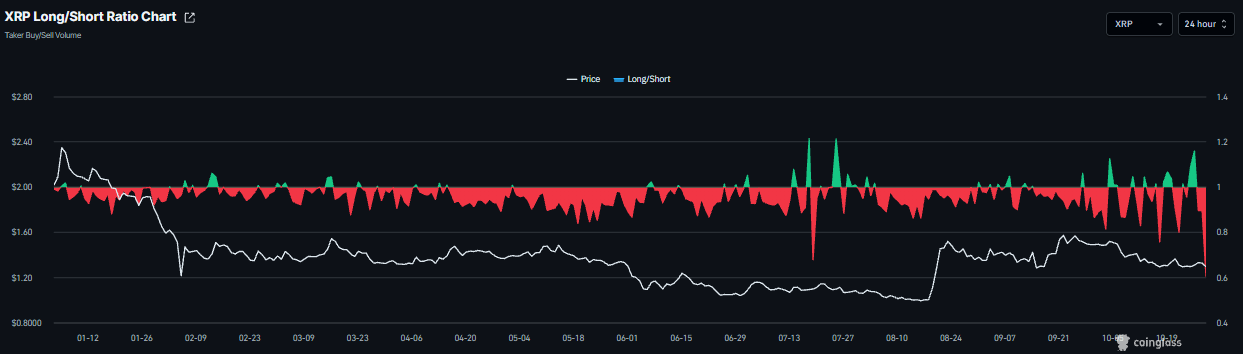
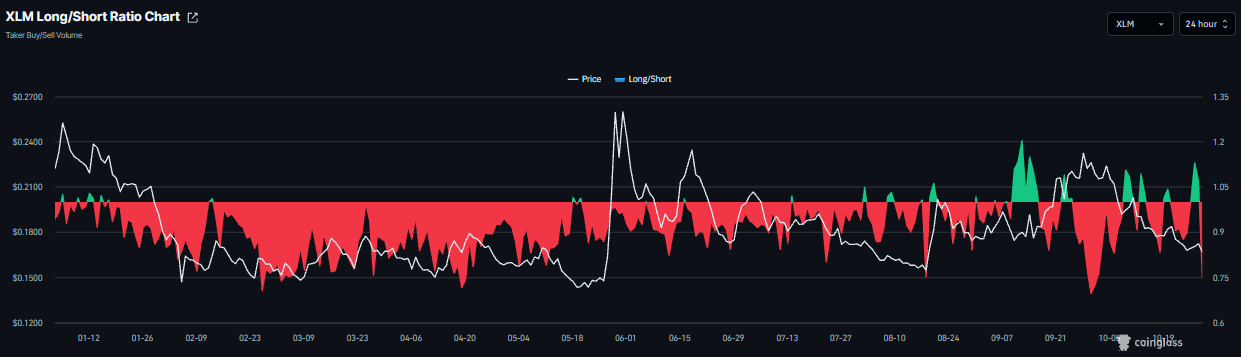
Conditions for Ripple and Stellar are deteriorating, according to derivatives data. On Thursday, CoinGlass’ long-to-short ratios stand at 0.60 for XRP and 0.74 for XLM, approaching their lowest readings in over a month. Readings below one signal bearish sentiment, reflecting traders’ bets on falling asset prices.
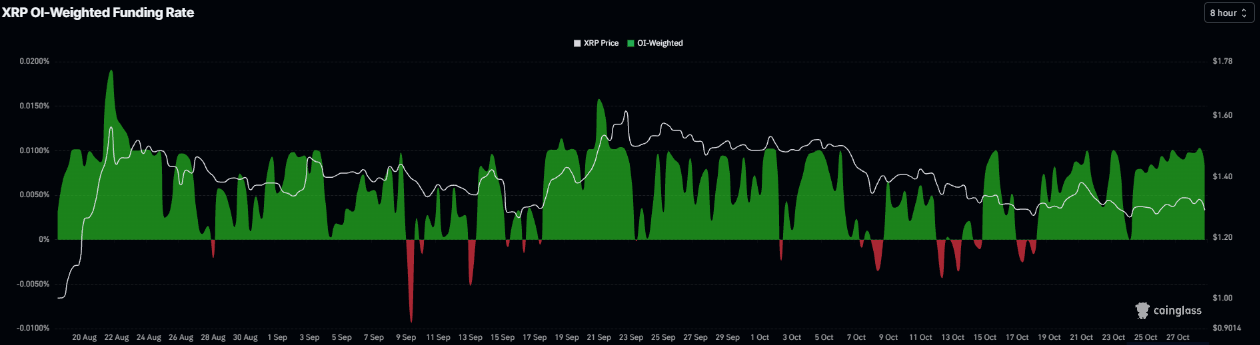
XRP funding rates offer a contrast, having moved into positive territory on 16 October. Thursday’s reading of 0.0080% means long position holders are paying those holding shorts, pointing to a mildly bullish outlook.
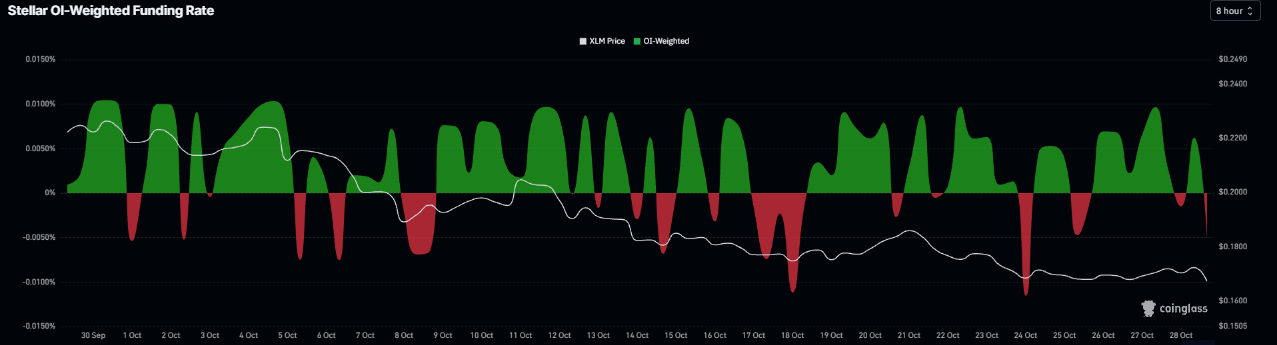
XLM funding rates, by comparison, turned negative on Thursday to reach -0.0051%. Short position holders are therefore paying those holding longs, signalling a bearish bias.
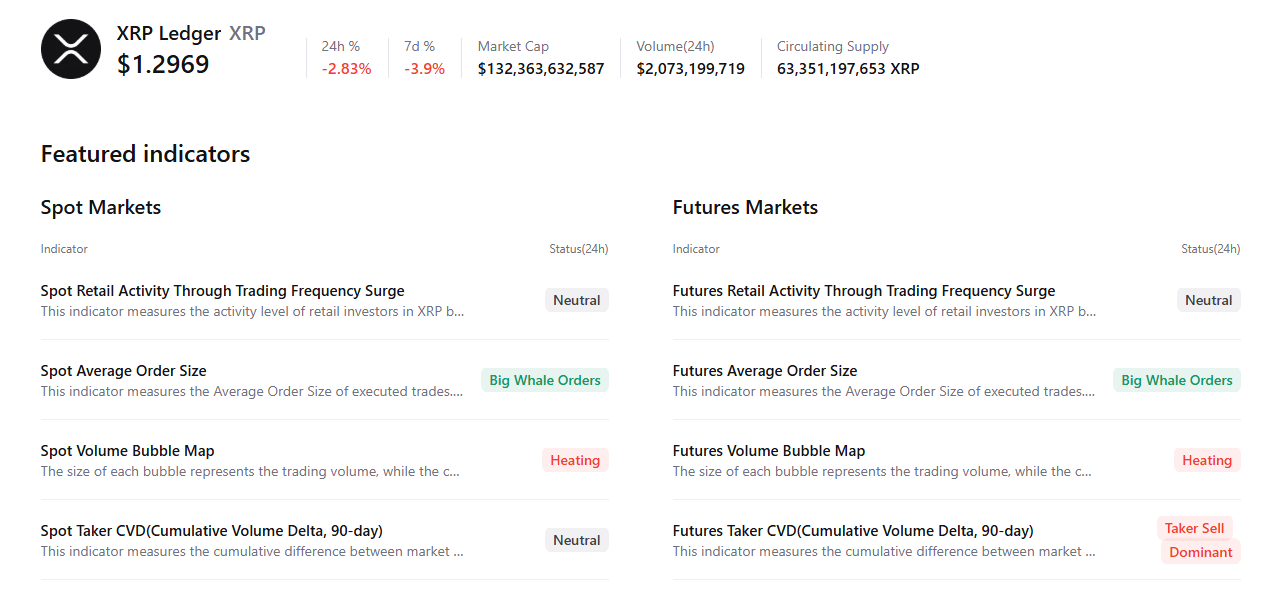
A bearish picture for both altcoins emerges from CryptoQuant’s summary data. In XRP’s spot and futures markets, sizeable whale orders coincide with heating market conditions and seller dominance. Taken together, these signals point to a cautious, bearish bias among Ripple traders.
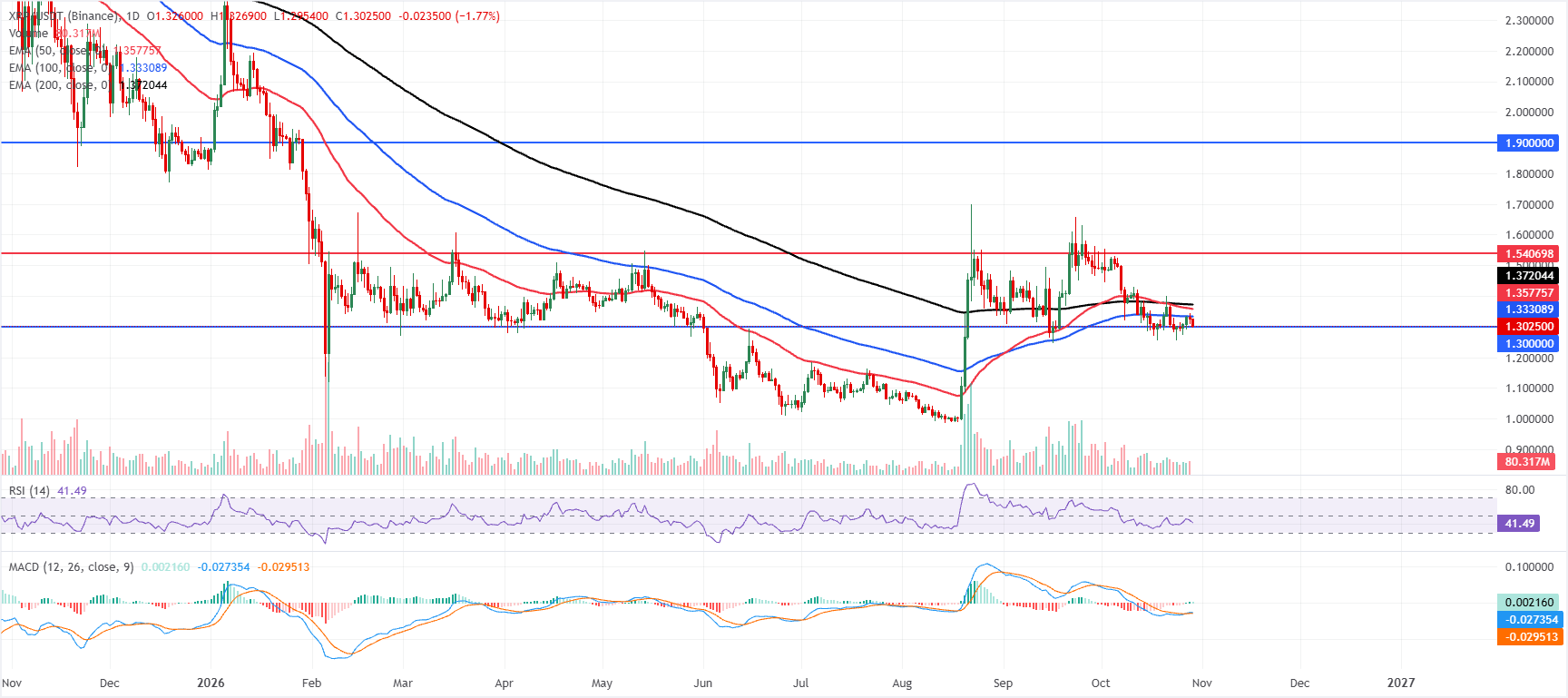
Seller dominance is also evident across XLM’s spot and futures markets, pointing to a negative outlook among Stellar traders.
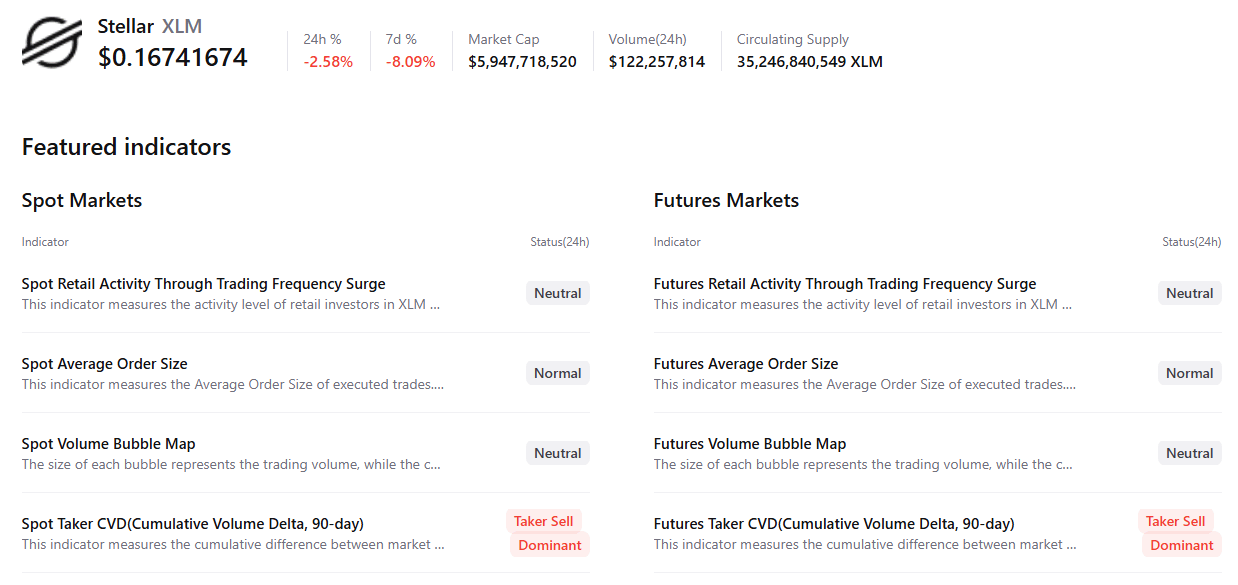
At $1.302 on Thursday, XRP sits just above horizontal support at $1.300, but its short-term bias remains bearish as the price stays well beneath the key Exponential Moving Averages (EMAs). Overhead resistance comes from the 100-day EMA at $1.333, the 50-day EMA at $1.357 and the 200-day EMA at $1.372. This tightly packed band of trend resistance suggests limited scope for the recent recovery.
A Relative Strength Index (RSI) reading of 41 points to persistent downside pressure and subdued momentum. That is despite a modest improvement in the Moving Average Convergence Divergence (MACD), which has edged into positive territory above the zero line.
The recently defended horizontal floor near $1.300 provides immediate downside support. A clear break beneath it would likely leave XRP vulnerable to a deeper correction over the coming sessions.
The first upside hurdle is the 100-day EMA around $1.333, ahead of the 50-day EMA near $1.357 and the 200-day EMA at $1.372. Bulls would need to regain this key zone to temper the bearish bias. Further up, $1.540 presents a more substantial obstacle before major resistance at $1.900, where earlier selling supply is likely to return should the pair sustain its recovery.
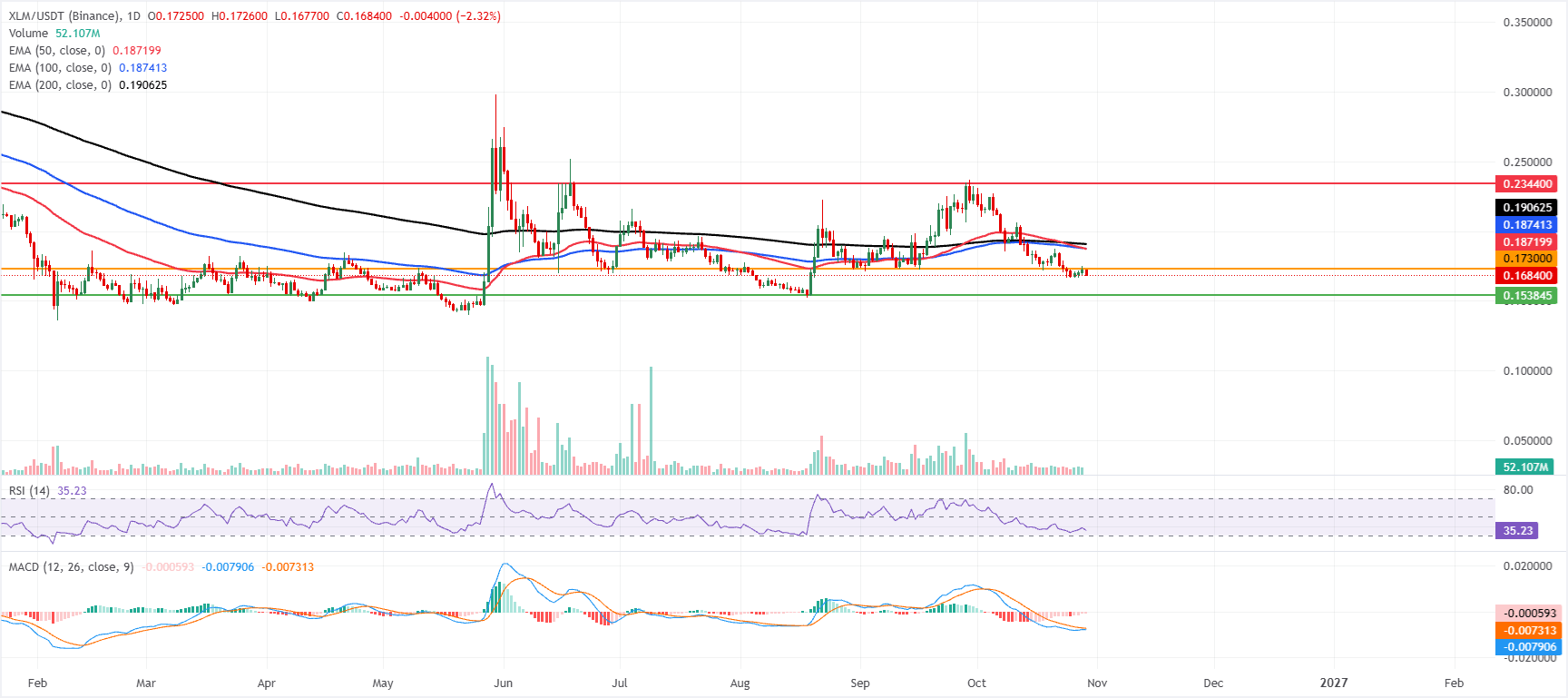
Trading at $0.168 on Thursday, XLM remains below the key EMAs, maintaining its bearish short-term bias. The 50-day and 100-day EMAs, both around $0.187, and the 200-day EMA at $0.190 form overhead barriers. Although the pair has stabilised above recent lows, these levels suggest the broader trend remains constrained.
With the RSI near 35 and the MACD line still below zero, momentum remains weak. Selling pressure therefore appears dominant despite easing volatility.
Any recovery first encounters horizontal resistance around $0.173, followed by a closely grouped band of EMAs between $0.187 and $0.190 that is likely to constrain further gains. A stronger bullish move would then meet the next significant horizontal barrier at $0.234.
Immediate downside support lies at $0.153. A convincing break beneath that floor would leave room for a deeper retreat; holding above it, however, may allow XLM to consolidate before making another attempt at the $0.173 area.
(The technical analysis of this story was written with the help of an AI tool. Know more.)







Phone: +61 2 8036 8388
Fax: +61 2 8036 8388
Email: support@tmgm.com



The information provided on this website is of a general nature only and does not constitute personal financial advice. Before acting on any information on this website, you should consider the suitability of the information in relation to your objectives, financial situation and needs. Investing in CFDs and FX Margin Contracts carries significant risks and is not suitable for all investors. You may lose more than your initial deposit. You do not own, or have, any interest in the underlying asset. We recommend that you seek independent advice and ensure you fully understand the risks involved before trading. It is important that you read and consider the disclosure document before you acquire any product listed on the website. The information and advertisements offered on this website are not intended for use by any person in any country or jurisdiction where such use would be contrary to local laws and regulations. The Products and Services offered on this website are not intended for residents of the United States, Malaysia and Thailand.
TMGM is authorized and regulated in various jurisdictions.
Trademax Australia Limited, trading as TMGM, is regulated by the Australian Securities and Investments Commission (ASIC), AFSL no. 436416 and is located at Level 28, One International Tower, 100 Barangaroo Avenue, 2000 Sydney, NSW Australia.
Email: support@tmgm.com.au
Trademax Global Limited, trading as TMGM, is authorized and regulated by the Vanuatu Financial Services Commission (VFSC), registration number 40356 and registered at 1276, Kumul Highway, Port Vila, Vanuatu, Republic of Vanuatu.
Email: support@tmgm.com
Trademax Global Markets (SE) Limited, trading as TMGM, is authorized and regulated by the Financial Services Authority (FSA) of Seychelles, with license number SD224. The company is registered at Office No 13, Providence Estate ABIS Centre, Mahe, Seychelles.
Email: support@tmgm.com
Trademax Global Markets (International) Pty Ltd, trading as TMGM, is authorized and regulated by the Financial Services Commission, Mauritius (FSC) with license no. GB22201012, and registered at 33, Edith Cavell Street C/o IQ EQ Fund Services (Mauritius) Ltd Port Louis, 11324 Mauritius.
Email: support@tmgm.com
Copyright © TMGM. All rights reserved


