
News & AnalysisCareer

With the US Dollar (USD) gaining 0.28% to around 158.30 against the Japanese Yen (JPY) on Tuesday, the Yen is also weaker against its other major counterparts, apart from the Australian Dollar (AUD).
Today's percentage moves in the Japanese Yen (JPY) against the major currencies listed appear in the table below. The Yen recorded its weakest performance against the Canadian Dollar.
| USD | EUR | GBP | JPY | CAD | AUD | NZD | CHF | |
|---|---|---|---|---|---|---|---|---|
| USD | 0.13% | 0.03% | 0.25% | -0.28% | 0.21% | -0.12% | 0.17% | |
| EUR | -0.13% | -0.09% | 0.11% | -0.42% | 0.07% | -0.25% | 0.04% | |
| GBP | -0.03% | 0.09% | 0.19% | -0.34% | 0.17% | -0.17% | 0.13% | |
| JPY | -0.25% | -0.11% | -0.19% | -0.52% | -0.03% | -0.36% | -0.06% | |
| CAD | 0.28% | 0.42% | 0.34% | 0.52% | 0.50% | 0.16% | 0.46% | |
| AUD | -0.21% | -0.07% | -0.17% | 0.03% | -0.50% | -0.34% | -0.04% | |
| NZD | 0.12% | 0.25% | 0.17% | 0.36% | -0.16% | 0.34% | 0.30% | |
| CHF | -0.17% | -0.04% | -0.13% | 0.06% | -0.46% | 0.04% | -0.30% |
Percentage movements between the major currencies are displayed in the heat map. Select the base currency in the left-hand column and the quote currency in the top row. Selecting the Japanese Yen on the left and following its row across to the US Dollar, for instance, gives the percentage change for JPY (base)/USD (quote) in the intersecting cell.

Last week's decision by the Bank of Japan (BoJ) to hold interest rates at 1.25%, by an 8–1 majority, has left financial markets expecting further monetary tightening. Those expectations have not prevented the Asia-Pacific currency from lagging its peers.
According to Commerzbank analysts, the BoJ's most recent assessment “suggested underlying inflation is broadly consistent with the 2% target,” and Governor Kazuo Ueda “emphasised upside inflation risks and the need for further policy normalisation.” Expectations of gradual yet sustained tightening are also evident in rate markets. Commerzbank notes that “the OIS market is pricing in 20bp hike by end-2026 and a total hike of 69bp by September 2027,” reinforcing that outlook.
Japan stands ready to counter disorderly currency moves
In a note, Commerzbank described stronger language from Japanese authorities on currency stability. Finance Minister Satsuki Katayama was explicitly “signal[ling] readiness to intervene in currency markets if movements become disorderly.” The bank also draws attention to her warning that “If there are disorderly movements or excessively speculative moves, we will take action,” reflecting a firmer policy stance on limiting excessive Yen volatility.
Ahead of the US midterm elections later in the North American session, the US Dollar remains under broad pressure. At the time of writing, the US Dollar Index (DXY) is little changed at around 101.85. The index, which measures the Greenback against six major currencies, nevertheless remains near Monday's monthly low of 101.43.
Setting out their expectations, ING strategists say that “we don’t expect today’s US midterm results to cause structural shifts in FX, but the Dollar may face some short-term pressure should the Democrats secure both the House (widely expected) and the Senate (close call).” They base that assessment on the view that “markets fully price in a Republican loss of the House, but only partially a Democratic clean sweep,” adding that “a blue sweep can put some pressure on the Dollar.”
On the potential risks, ING cautions that “fears of tougher regulation could weigh on AI stocks (we’ve recently seen how that can hit the greenback), while markets could price in greater risks of decision-making gridlock around issues such as government funding and the debt ceiling.” The strategists nevertheless temper that warning, stressing that “we doubt that’s enough to trigger a structural directional shift in the Dollar.”
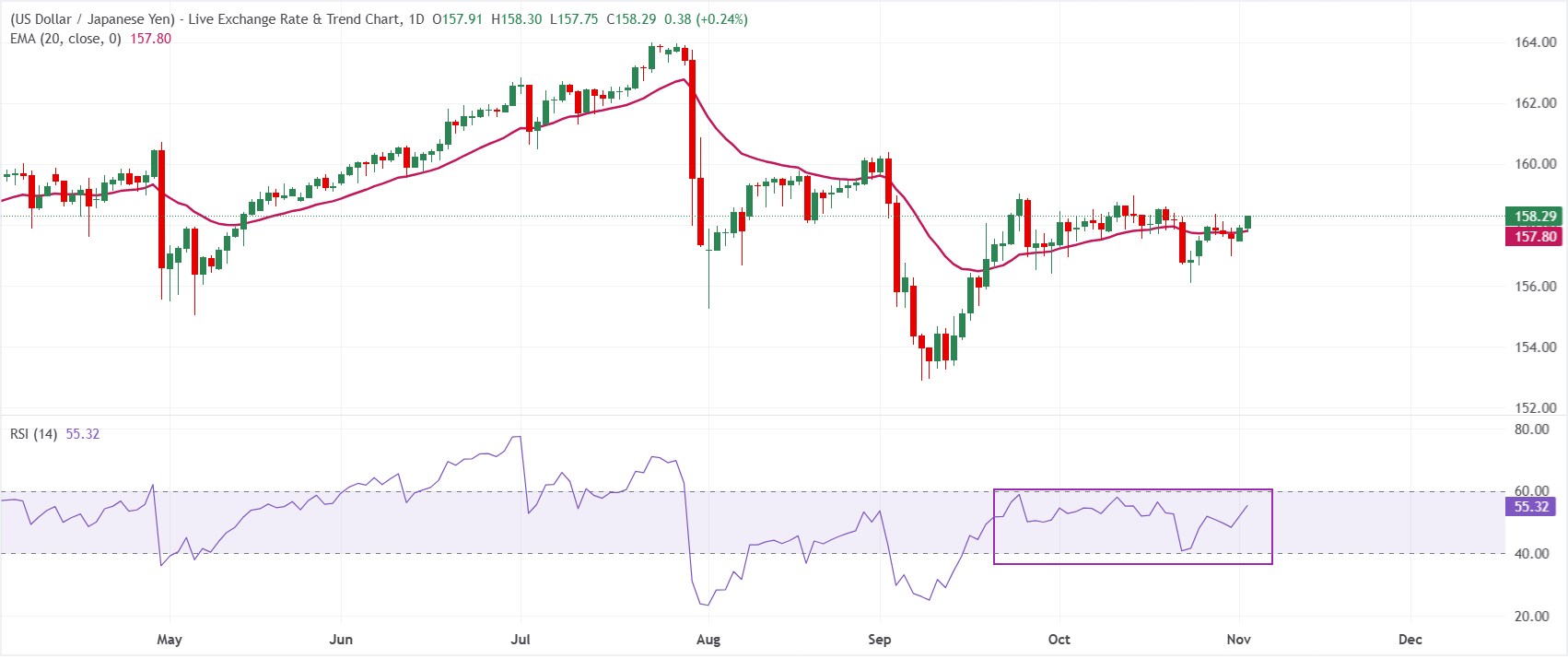
At 158.29 on the daily chart, USD/JPY remains above its 20-day Exponential Moving Average (EMA) of 157.80. Respect for this trend support leaves the near-term outlook mildly bullish. A rising 20-day EMA below the spot price points to a constructive underlying trend, while the Relative Strength Index (RSI), at 55.33, sits in neutral-to-positive territory. Together, these signals suggest steady upward pressure rather than an overstretched advance.
The 158.29 area provides the first downside support and a near-term pivot, ahead of the 20-day EMA at 157.80. Buyers are likely to defend the broader upward trend at that moving average. This dataset shows no significant technical resistance immediately above the current price, leaving scope for further tests of higher levels provided spot remains above the 157.80 region and momentum holds steady.
(The technical analysis of this story was written with the help of an AI tool. Know more.)
After each of its eight scheduled meetings a year, the Bank of Japan (BoJ) publishes its interest rate decision. A hawkish assessment of the economy's inflation outlook accompanied by a rate rise is generally positive for the Japanese Yen (JPY). Conversely, a dovish assessment of the Japanese economy, alongside unchanged or lower interest rates, is usually negative for JPY.
Find out more.Latest release: Fri 30 Oct 2026 03:03
Release frequency: Irregular
Reported figure: 1.25%
Consensus forecast: 1.25%
Previous figure: 1.25%
Data source: Bank of Japan







Phone: +61 2 8036 8388
Fax: +61 2 8036 8388
Email: support@tmgm.com



The information provided on this website is of a general nature only and does not constitute personal financial advice. Before acting on any information on this website, you should consider the suitability of the information in relation to your objectives, financial situation and needs. Investing in CFDs and FX Margin Contracts carries significant risks and is not suitable for all investors. You may lose more than your initial deposit. You do not own, or have, any interest in the underlying asset. We recommend that you seek independent advice and ensure you fully understand the risks involved before trading. It is important that you read and consider the disclosure document before you acquire any product listed on the website. The information and advertisements offered on this website are not intended for use by any person in any country or jurisdiction where such use would be contrary to local laws and regulations. The Products and Services offered on this website are not intended for residents of the United States, Malaysia and Thailand.
TMGM is authorized and regulated in various jurisdictions.
Trademax Australia Limited, trading as TMGM, is regulated by the Australian Securities and Investments Commission (ASIC), AFSL no. 436416 and is located at Level 28, One International Tower, 100 Barangaroo Avenue, 2000 Sydney, NSW Australia.
Email: support@tmgm.com.au
Trademax Global Limited, trading as TMGM, is authorized and regulated by the Vanuatu Financial Services Commission (VFSC), registration number 40356 and registered at 1276, Kumul Highway, Port Vila, Vanuatu, Republic of Vanuatu.
Email: support@tmgm.com
Trademax Global Markets (SE) Limited, trading as TMGM, is authorized and regulated by the Financial Services Authority (FSA) of Seychelles, with license number SD224. The company is registered at Office No 13, Providence Estate ABIS Centre, Mahe, Seychelles.
Email: support@tmgm.com
Trademax Global Markets (International) Pty Ltd, trading as TMGM, is authorized and regulated by the Financial Services Commission, Mauritius (FSC) with license no. GB22201012, and registered at 33, Edith Cavell Street C/o IQ EQ Fund Services (Mauritius) Ltd Port Louis, 11324 Mauritius.
Email: support@tmgm.com
Copyright © TMGM. All rights reserved


