
News & AnalysisCareer

After reaching an intraday high of $3,886, Gold (XAU/USD) has slipped back on Tuesday and is finding little upward momentum. Elevated US Treasury yields and a resilient US Dollar (USD) continue to weigh on the metal, with hawkish Fed comments underpinning expectations that interest rates will stay higher for longer.

Trading at roughly $3,853 at the time of writing, XAU/USD sits only marginally above Monday’s 13-month low of $3,832.
A December rate increase is fully reflected in market pricing, while traders assign a nearly 70% probability to a further rise in January, according to the CME FedWatch Tool. These expectations follow comments over the past week from several Fed officials indicating that further action is needed to return inflation to the central bank’s 2% target.
Although Cleveland Fed President Beth Hammack expressed a preference for smaller rate increases on Monday, she did not rule out larger steps should the Fed fall behind in tackling inflation.
Uncertainty also surrounds the prospects of a US-Iran agreement. More frequent attacks on tankers in the Strait of Hormuz sustain the risk of energy-led inflation. At the same time, a recovery in Middle East exports and anticipated excess supply are putting pressure on oil prices.
While gold is widely regarded as a hedge against inflation, rising borrowing costs generally weigh on it by increasing the appeal of interest-bearing assets. Dollar strength adds to that pressure, raising the cost of the metal for purchasers in other currencies. Around 103.50, the US Dollar Index (DXY) is trading close to a 19-month high; the index measures the dollar against a basket of six major currencies.
Citing support from "central-bank diversification, investment demand, geopolitical uncertainty and longer-term fiscal concerns.", OCBC strategists describe their view on gold as "cautiously optimistic over the medium term". They nevertheless warn that "elevated real yields and USD resilience may continue to constrain the sustainability of near-term rebounds," as prices seek to stabilise following recent technical weakness.
Later in the US session, investors will look to US Retail Sales and further Fed comments, before the minutes of the Fed’s October meeting are released on Wednesday. Also on the watchlist are Nvidia’s earnings, due after Tuesday’s US market close. Those results could alter risk appetite and drive movements in the US Dollar, with implications for gold.
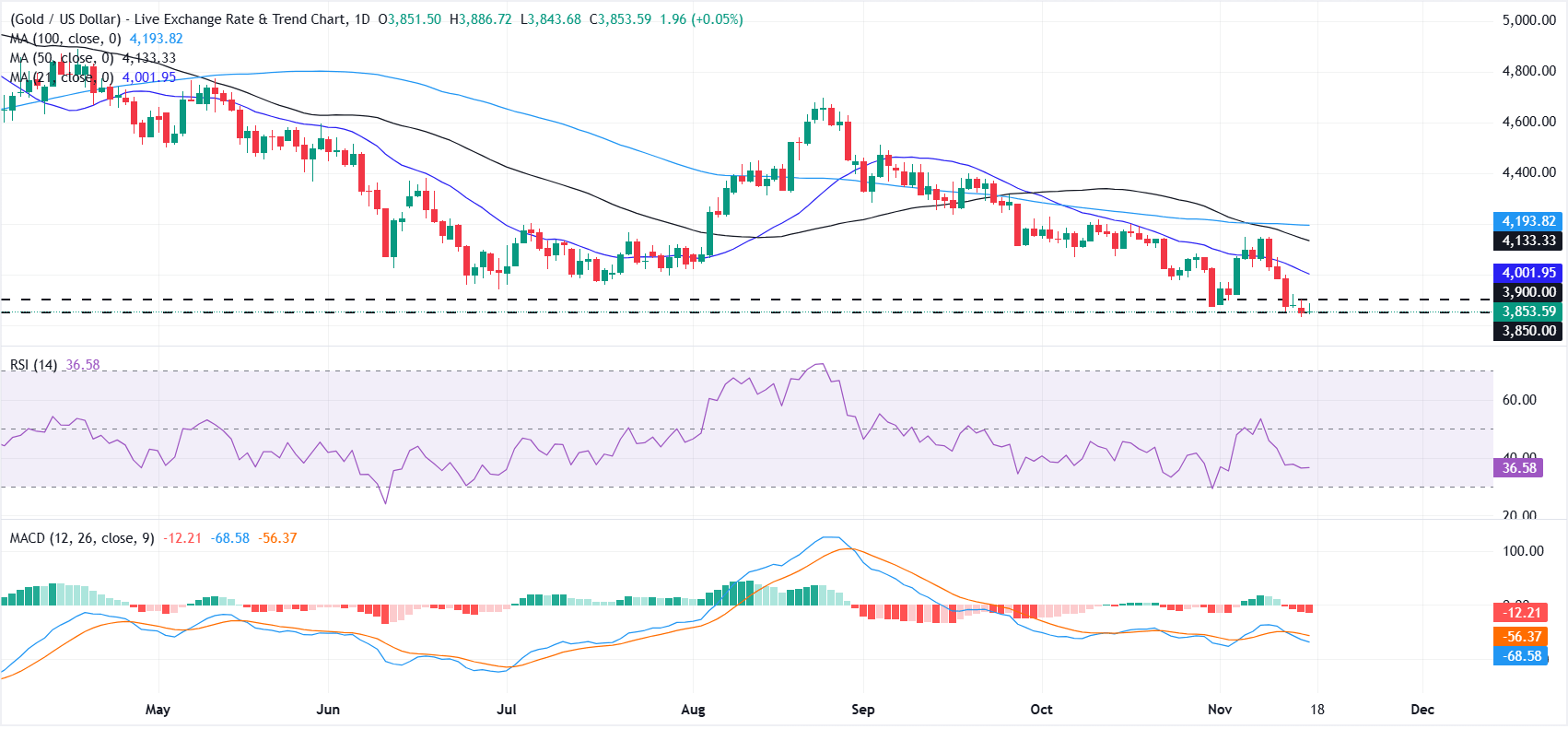
A cluster of moving averages above the spot price keeps the near-term daily chart outlook for XAU/USD bearish. Momentum readings offer little encouragement: the Relative Strength Index (14) remains in the high 30s, while the Moving Average Convergence Divergence (MACD) line retains a negative alignment. Together, these signals suggest rallies are likely to attract selling as long as those resistance barriers hold.
The first upside hurdle is the nearby horizontal resistance around $3,900, followed by the 21-day Simple Moving Average (SMA) at $4,002. Only a daily close above these levels would relieve the immediate downward pressure and clear a path towards the 50-day SMA at $4,133, with the 100-day SMA at $4,194 beyond that.
The horizontal level near $3,850 provides immediate support. A daily close beneath it would probably extend the established downtrend and leave fresh lows in view, with momentum still subdued.
(The technical analysis of this story was written with the help of an AI tool. Know more.)
Throughout human history, gold has served extensively as both a store of value and a medium of exchange, giving it an important role. Today, its appeal extends beyond its lustre and use in jewellery: the precious metal is commonly regarded as a safe-haven asset, or an investment considered attractive during periods of turmoil. Because gold is not dependent on a particular issuer or government, it is also widely used as a hedge against inflation and currency depreciation.
The largest holders of gold are central banks. To underpin their currencies during unsettled periods, they typically diversify their reserves and purchase gold, reinforcing perceptions of economic and currency strength. Substantial gold reserves can bolster confidence in a country’s solvency. According to World Gold Council data, central banks increased their reserves by 1,136 tonnes of gold, valued at approximately $70 billion, in 2022. That marked the largest annual purchase on record. Emerging-economy central banks, including those in China, India and Turkey, are expanding their gold reserves rapidly.
Both the US Dollar and US Treasuries are major reserve and safe-haven assets, and gold has an inverse correlation with them. A fall in the dollar tends to be accompanied by a rise in gold, allowing investors and central banks to diversify their holdings during turbulent periods. The metal also has an inverse relationship with risk assets: equity market gains generally put pressure on gold prices, whereas selling in riskier markets tends to support the precious metal.
Numerous factors influence gold prices. Its safe-haven appeal means geopolitical upheaval or concerns about a severe recession can trigger rapid price gains. Since gold offers no yield, lower interest rates tend to support it, while higher borrowing costs usually weigh on the metal. However, movements in the US Dollar (USD) account for much of its price behaviour because gold is quoted in dollars (XAU/USD). Dollar strength tends to restrain gold prices, while a weaker dollar is likely to lift them.







Phone: +61 2 8036 8388
Fax: +61 2 8036 8388
Email: support@tmgm.com



The information provided on this website is of a general nature only and does not constitute personal financial advice. Before acting on any information on this website, you should consider the suitability of the information in relation to your objectives, financial situation and needs. Investing in CFDs and FX Margin Contracts carries significant risks and is not suitable for all investors. You may lose more than your initial deposit. You do not own, or have, any interest in the underlying asset. We recommend that you seek independent advice and ensure you fully understand the risks involved before trading. It is important that you read and consider the disclosure document before you acquire any product listed on the website. The information and advertisements offered on this website are not intended for use by any person in any country or jurisdiction where such use would be contrary to local laws and regulations. The Products and Services offered on this website are not intended for residents of the United States, Malaysia and Thailand.
TMGM is authorized and regulated in various jurisdictions.
Trademax Australia Limited, trading as TMGM, is regulated by the Australian Securities and Investments Commission (ASIC), AFSL no. 436416 and is located at Level 28, One International Tower, 100 Barangaroo Avenue, 2000 Sydney, NSW Australia.
Email: support@tmgm.com.au
Trademax Global Limited, trading as TMGM, is authorized and regulated by the Vanuatu Financial Services Commission (VFSC), registration number 40356 and registered at 1276, Kumul Highway, Port Vila, Vanuatu, Republic of Vanuatu.
Email: support@tmgm.com
Trademax Global Markets (SE) Limited, trading as TMGM, is authorized and regulated by the Financial Services Authority (FSA) of Seychelles, with license number SD224. The company is registered at Office No 13, Providence Estate ABIS Centre, Mahe, Seychelles.
Email: support@tmgm.com
Trademax Global Markets (International) Pty Ltd, trading as TMGM, is authorized and regulated by the Financial Services Commission, Mauritius (FSC) with license no. GB22201012, and registered at 33, Edith Cavell Street C/o IQ EQ Fund Services (Mauritius) Ltd Port Louis, 11324 Mauritius.
Email: support@tmgm.com
Copyright © TMGM. All rights reserved

