
News & AnalysisCareer

Below $62,000 on Friday, Bitcoin (BTC) remains under selling pressure as risk aversion across the crypto market weighs on prices. Repeated efforts by buyers to engineer a rebound have gained little traction, keeping BTC exposed to growing headwinds.

After testing 14-month lows of $3,515, Gold (XAU/USD) is settling around $3,560, although sellers retain control. Weak sentiment is evident in the technical outlook for both Bitcoin and Gold, with investors holding back before December’s crucial interest rate decision.
A December increase in Federal Reserve (Fed) interest rates to the 4.00-4.25% range now carries a 95% probability in derivatives markets. Behind those expectations is stubborn inflation in the United States (US), aggravated by continuing geopolitical tensions in the Middle East that have sustained high Oil and energy prices.
At the same time, the central bank faces difficulties in fulfilling its dual mandate of supporting maximum employment and stabilising the economy. Bringing inflation back to its long-term 2% target therefore remains necessary.
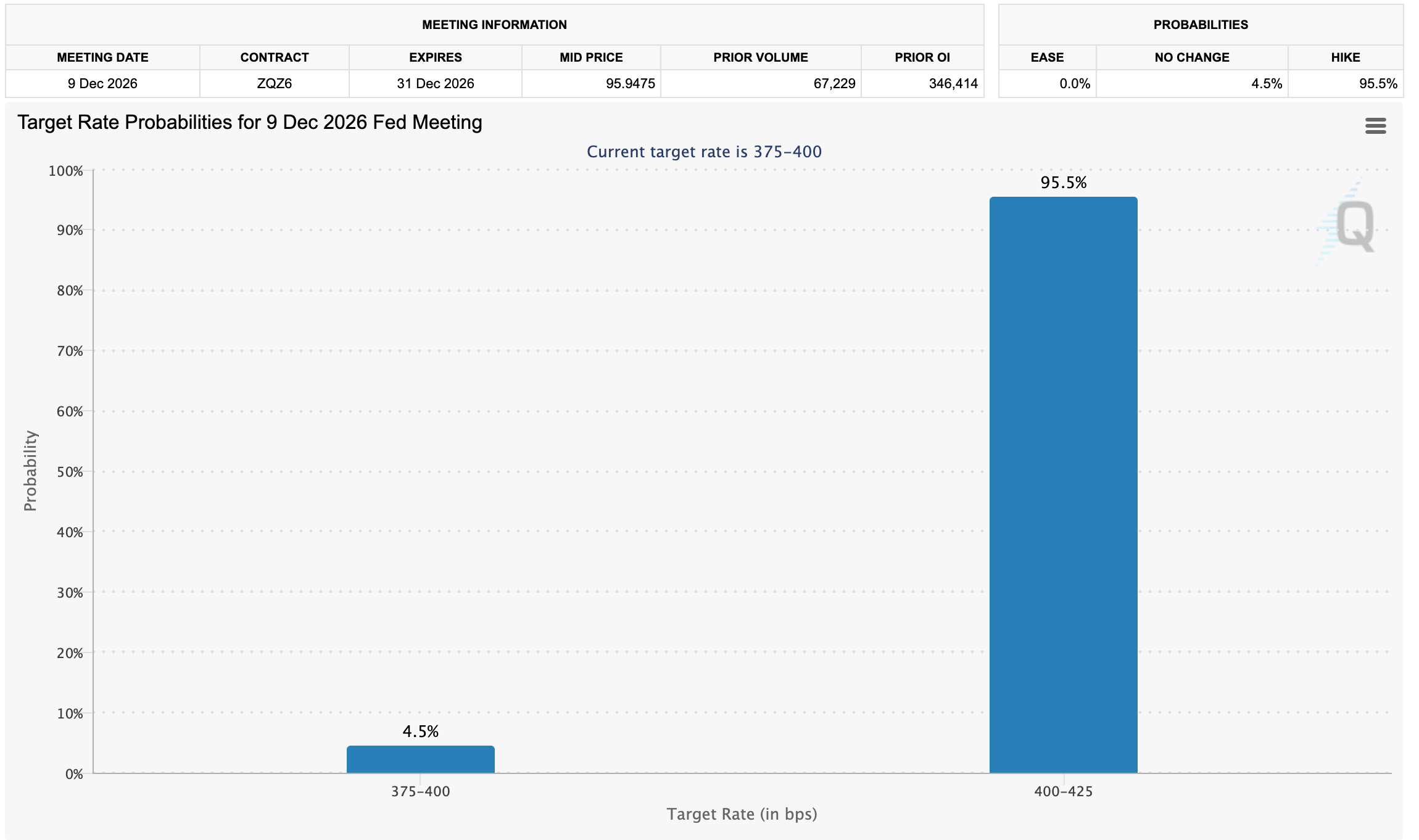
With ten-year US Treasury yields still above 5%, tighter monetary policy could draw liquidity away from risk assets, particularly crypto, and towards more stable investments backed by governments.
In an analysis report sent by email, Crypt Finance said, “Markets are now pricing an approximately 96% probability of a 25-basis-point Fed hike in December,” and added, “The US Dollar (USD) has strengthened accordingly, with the DXY near a 19-month high around 103.9. Meanwhile, the US 10-year Treasury yield declined roughly 13 basis points this week toward 5.0%, supported by safe-haven demand amid the equity selloff.”
SoSoValue data show that withdrawals from Bitcoin spot exchange-traded funds (ETFs) reached $1.12 billion through Thursday, as the funds continued to experience outflows.
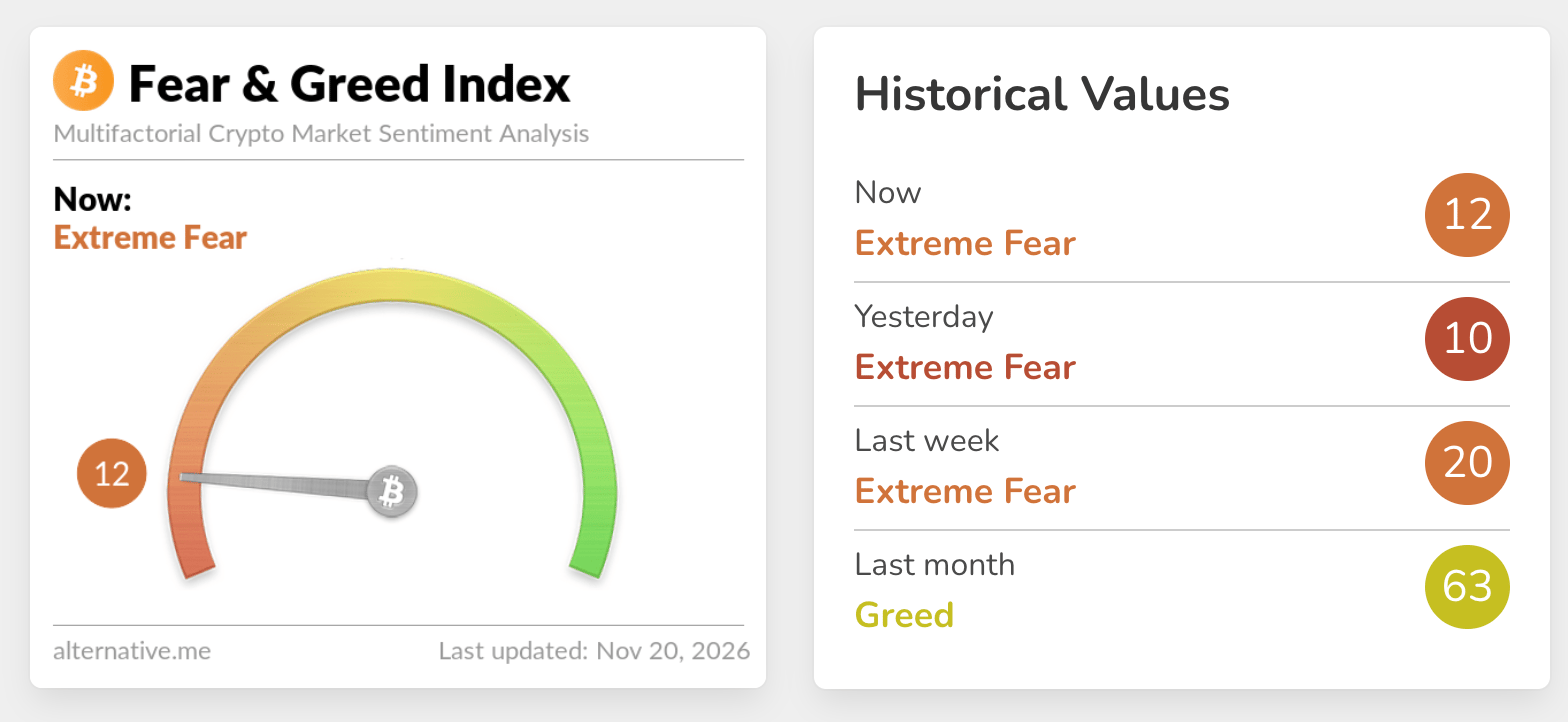
At 12 on Friday, the Fear & Greed Index remained in Extreme Fear territory, barely above the previous day’s reading of 10 in the same category. The readings underline the notably weak appetite for crypto assets, pointing to muted demand and little support for a recovery.
At $61,471, Bitcoin is extending its decline far below the short- and medium-term exponential moving averages (EMAs), leaving the near-term outlook bearish. Well above the price are the 50-day EMA at $74,640, the 100-day EMA at $75,418 and the 200-day EMA at $75,881. Their position suggests rebounds are more likely to encounter selling than support for an uptrend, while the SuperTrend line at $69,730 adds to the broader ceiling on gains.
An RSI reading around 20 points to oversold conditions, but a meaningful rebound has yet to emerge. Momentum is still weak: the Moving Average Convergence Divergence (MACD) indicator remains firmly negative, alongside the depressed Relative Strength Index (RSI).
The SuperTrend level around $69,730 presents the first resistance. Clearing it would bring the cluster of dynamic resistance into view, running from the 50-day EMA at $74,640 to the 100-day and 200-day EMAs at $75,418 and $75,881, respectively. The available daily-chart indicators reveal no evident nearby technical support. As long as the pair stays below this crowded resistance band, it remains exposed to an extension of losses below $60,000. Any bounce is likely to be treated as corrective while the price remains under $69,730.
Trading at $3,567, Gold remains deep below its key moving averages as its bearish phase continues. A substantial ceiling is formed by the 50-day EMA around $4,050, the 100-day EMA near $4,164 and the 200-day EMA close to $4,221, suggesting that rebounds are likely to face difficulty.
With the MACD firmly in negative territory and the RSI moving into oversold territory near 25, momentum continues to favour sellers. Even so, those readings suggest an increasing risk of brief corrective rebounds within the dominant downtrend.
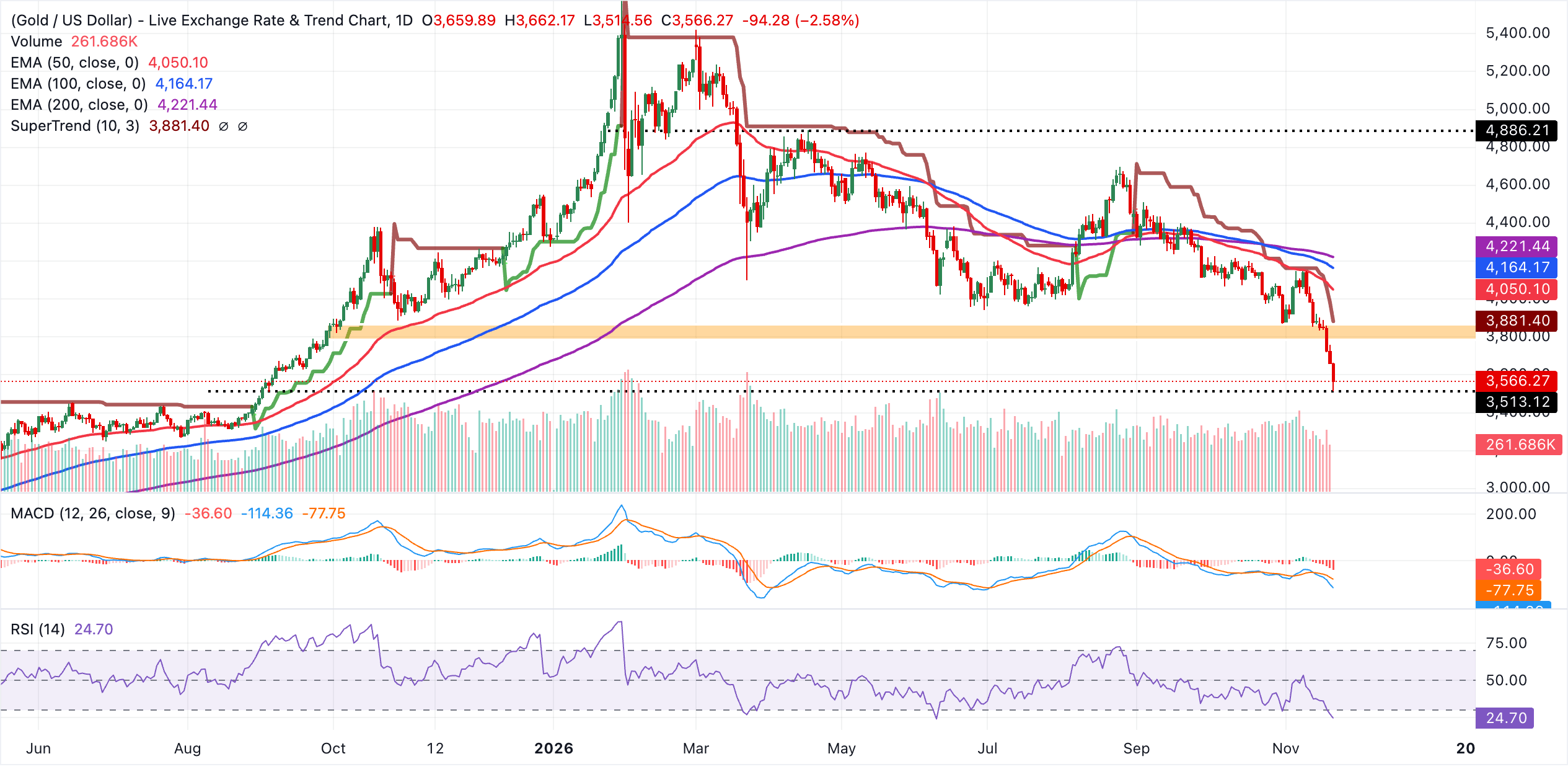
The SuperTrend line around $3,881 is the first resistance to watch, followed by the 50-day EMA near $4,050, where selling could intensify again. Beyond those levels, the 100-day EMA at roughly $4,164 and the 200-day EMA around $4,221 create a wider resistance zone. A move back above that band would be needed to temper the prevailing bearish outlook.
The daily-chart indicators offer no clear structural support nearby. XAU/USD consequently remains exposed to additional losses until buyers establish a floor and sustain a recovery above at least the first EMA hurdle.
(The technical analysis of this story was written with the help of an AI tool. Know more.)
Designed to function as money, Bitcoin is a virtual currency and the largest cryptocurrency by market capitalisation. No single individual, group or entity can control this means of payment, removing the need for a third party to participate in financial transactions.
The term altcoin covers any cryptocurrency other than Bitcoin. Some, however, also exclude Ethereum, on the grounds that forks originate from these two cryptocurrencies. Under that interpretation, Litecoin is the first altcoin: it was forked from the Bitcoin protocol and is therefore an “improved” version of it.
A stablecoin is a cryptocurrency intended to maintain a stable price, backed by a reserve of the asset it represents. Its value is therefore pegged to a commodity or financial instrument, such as the US Dollar (USD), and its supply is governed by an algorithm or by demand. Primarily, stablecoins give investors a way to enter and exit cryptocurrency trading and investment. They also provide a means of storing value, since cryptocurrencies are generally subject to price volatility.
Measured as Bitcoin’s market capitalisation divided by the combined market capitalisation of all cryptocurrencies, Bitcoin dominance indicates the degree of investor interest in Bitcoin. BTC dominance is typically high before and during a bull run, when investors turn to relatively stable cryptocurrencies with large market capitalisations, such as Bitcoin. Conversely, falling BTC dominance generally signals that investors are shifting capital and/or profits into altcoins in pursuit of better returns, a move that usually sparks a surge in altcoin rallies.







Phone: +61 2 8036 8388
Fax: +61 2 8036 8388
Email: support@tmgm.com



The information provided on this website is of a general nature only and does not constitute personal financial advice. Before acting on any information on this website, you should consider the suitability of the information in relation to your objectives, financial situation and needs. Investing in CFDs and FX Margin Contracts carries significant risks and is not suitable for all investors. You may lose more than your initial deposit. You do not own, or have, any interest in the underlying asset. We recommend that you seek independent advice and ensure you fully understand the risks involved before trading. It is important that you read and consider the disclosure document before you acquire any product listed on the website. The information and advertisements offered on this website are not intended for use by any person in any country or jurisdiction where such use would be contrary to local laws and regulations. The Products and Services offered on this website are not intended for residents of the United States, Malaysia and Thailand.
TMGM is authorized and regulated in various jurisdictions.
Trademax Australia Limited, trading as TMGM, is regulated by the Australian Securities and Investments Commission (ASIC), AFSL no. 436416 and is located at Level 28, One International Tower, 100 Barangaroo Avenue, 2000 Sydney, NSW Australia.
Email: support@tmgm.com.au
Trademax Global Limited, trading as TMGM, is authorized and regulated by the Vanuatu Financial Services Commission (VFSC), registration number 40356 and registered at 1276, Kumul Highway, Port Vila, Vanuatu, Republic of Vanuatu.
Email: support@tmgm.com
Trademax Global Markets (SE) Limited, trading as TMGM, is authorized and regulated by the Financial Services Authority (FSA) of Seychelles, with license number SD224. The company is registered at Office No 13, Providence Estate ABIS Centre, Mahe, Seychelles.
Email: support@tmgm.com
Trademax Global Markets (International) Pty Ltd, trading as TMGM, is authorized and regulated by the Financial Services Commission, Mauritius (FSC) with license no. GB22201012, and registered at 33, Edith Cavell Street C/o IQ EQ Fund Services (Mauritius) Ltd Port Louis, 11324 Mauritius.
Email: support@tmgm.com
Copyright © TMGM. All rights reserved

