
News & AnalysisCareer

With the US Personal Consumption Expenditures (PCE) Price Index due at 13:30 GMT, caution among traders leaves Gold (XAU/USD) consolidating its losses on Wednesday. The pair is trading at around $3,531 at the time of writing, only slightly above the 14-month low of roughly $3,502 reached last week.

All of the metal’s gains from the start of the week have now been erased. Early enthusiasm surrounding Jensen Huang’s return as Nvidia CEO has waned, while renewed questions over the sustainability of the AI boom are weighing on global equities again.
Fading risk appetite has prompted some investors to sell Gold to generate cash and cover margin calls. Others are shifting into US government bonds, driving Treasury yields down. Yet lower yields are offering bullion little support while the US Dollar (USD) remains resilient.
At 4.85%, the benchmark 10-year US Treasury yield has fallen to its lowest level since 9 November. Meanwhile, the US Dollar Index (DXY) remains around 104.00, not far below Monday’s 20-month peak of 104.59.
For Gold, the more significant obstacle remains the hawkish outlook for the Federal Reserve (Fed). Warnings from policymakers about lingering inflation risks have led markets to price in consecutive rate increases. Wednesday’s PCE release therefore takes on particular importance: it is the last reading of the Fed’s preferred inflation gauge before the December policy meeting.
According to analysts at Commerzbank, “the focus today will be on the October PCE deflator.” On the expected readings, they say “the Bloomberg consensus expects headline PCE inflation to pick up to 3.8% yoy from 3.6% in September,” adding that “the core PCE deflator is expected at 3.2% yoy from 3.1% previously.” Even with the risk posed by the release, Commerzbank observes that “the Fed funds futures continue to fully price in a 25bp rate hike in December” and that “they are pricing in a total hike of 62bp by end-2027.”
Should PCE inflation exceed forecasts, expectations of additional rate rises beyond December could strengthen, supporting the US Dollar and increasing the pressure on Gold. A weaker reading, by contrast, could ease those expectations and allow bullion some scope to recover. Investors will also scrutinise the first estimate of US third-quarter Gross Domestic Product (GDP). Annualised growth is forecast at 3.4%, unchanged from the preceding quarter.
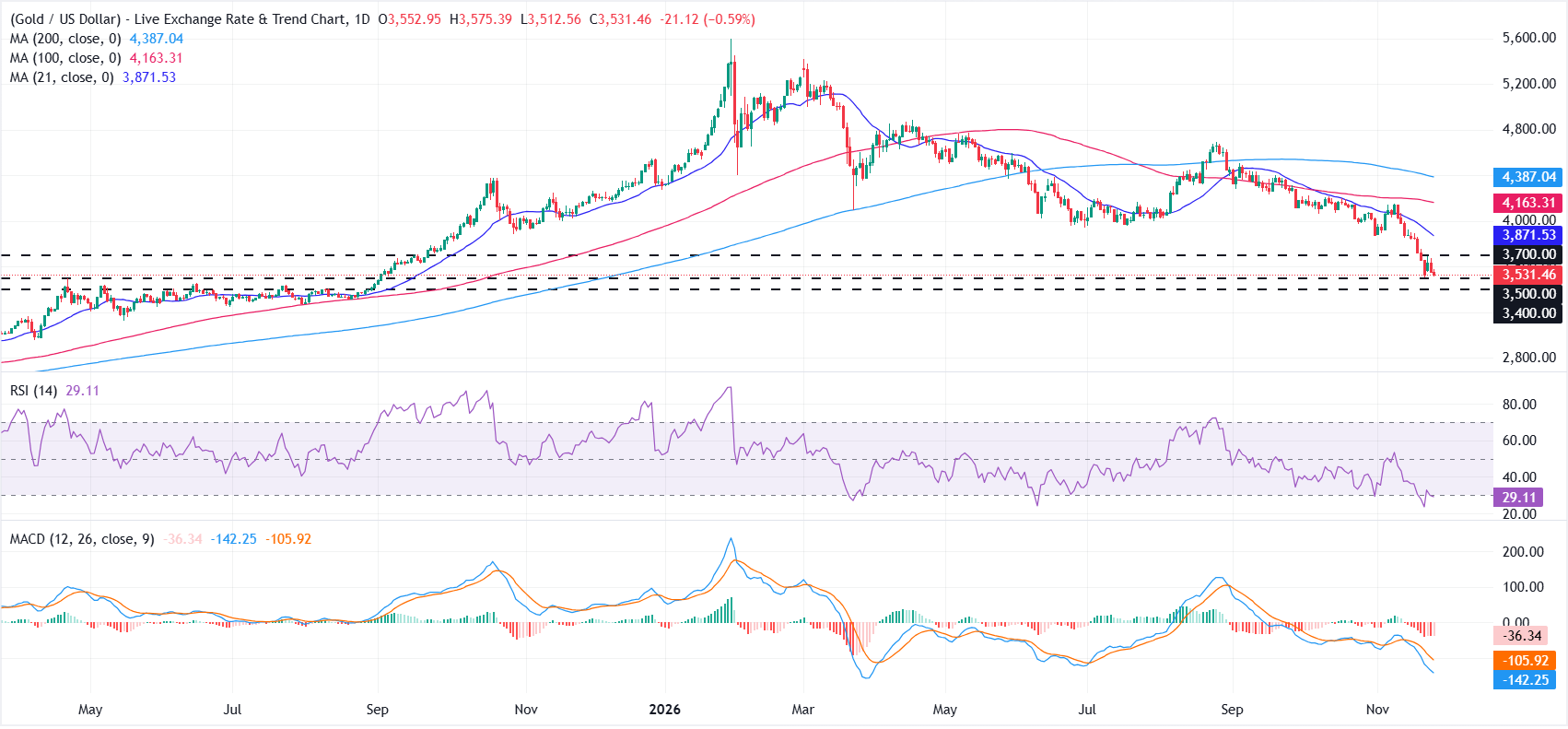
Trading well beneath its 21-day, 100-day and 200-day Simple Moving Averages (SMAs), XAU/USD retains a distinctly bearish bias on the daily chart. Those moving averages form a cluster above the price, limiting the scope for gains. A Relative Strength Index (RSI) reading of 29 places the pair in oversold territory, suggesting that the latest decline is stretched, although there is no convincing sign of a recovery yet. Meanwhile, the Moving Average Convergence Divergence (MACD) indicator is still negative. Its weak momentum indicates that downward pressure continues to prevail despite the oversold conditions.
The horizontal barrier around $3,700 offers the first resistance, followed by the 21-day SMA at $3,871. Beyond that lie the 100-day SMA at $4,163 and the 200-day SMA at $4,387. Support is immediately available at $3,500, with a more substantial structural floor near $3,400 further down. A clear breach of this zone would leave room for additional declines; remaining above it, however, could permit a corrective recovery towards resistance around $3,700.
(The technical analysis of this story was written with the help of an AI tool. Learn more.)
A rise in the cost of a representative basket of goods and services is measured as inflation. The headline rate is generally reported as a percentage change both month on month (MoM) and year on year (YoY). To calculate core inflation, more volatile components, including food and fuel, are removed because geopolitical developments and seasonal influences can cause their prices to fluctuate. Economists concentrate on this core measure, which is also the rate targeted by central banks. Their mandate is to maintain inflation at a manageable level, typically around 2%.
By tracking a basket of goods and services over time, the Consumer Price Index (CPI) captures changes in prices. It is generally presented as a percentage movement month on month (MoM) and year on year (YoY). Central banks target Core CPI, which strips out volatile food and fuel components. A Core CPI reading above 2% generally leads to higher interest rates, while a reading below 2% tends to have the reverse effect. As higher rates support a currency, rising inflation usually strengthens it; falling inflation typically has the opposite effect.
A country’s currency tends to appreciate when inflation is high and weaken when it is low, despite how counter-intuitive that may appear. The explanation lies in the central bank’s usual response: raising interest rates to curb stronger inflation. Those higher rates draw in more capital from overseas investors seeking an attractive return on their money.
Historically, investors sought Gold during periods of high inflation because it retained its value. They still often buy the metal for its safe-haven qualities during extreme market turmoil, but this is not the usual pattern most of the time. High inflation generally prompts central banks to raise interest rates in an effort to contain it. For Gold, higher rates are a headwind: they raise the opportunity cost of holding the metal rather than an interest-bearing asset or cash in a deposit account. Conversely, lower inflation generally supports Gold by bringing interest rates down, improving its appeal as an alternative investment.







Phone: +61 2 8036 8388
Fax: +61 2 8036 8388
Email: support@tmgm.com



The information provided on this website is of a general nature only and does not constitute personal financial advice. Before acting on any information on this website, you should consider the suitability of the information in relation to your objectives, financial situation and needs. Investing in CFDs and FX Margin Contracts carries significant risks and is not suitable for all investors. You may lose more than your initial deposit. You do not own, or have, any interest in the underlying asset. We recommend that you seek independent advice and ensure you fully understand the risks involved before trading. It is important that you read and consider the disclosure document before you acquire any product listed on the website. The information and advertisements offered on this website are not intended for use by any person in any country or jurisdiction where such use would be contrary to local laws and regulations. The Products and Services offered on this website are not intended for residents of the United States, Malaysia and Thailand.
TMGM is authorized and regulated in various jurisdictions.
Trademax Australia Limited, trading as TMGM, is regulated by the Australian Securities and Investments Commission (ASIC), AFSL no. 436416 and is located at Level 28, One International Tower, 100 Barangaroo Avenue, 2000 Sydney, NSW Australia.
Email: support@tmgm.com.au
Trademax Global Limited, trading as TMGM, is authorized and regulated by the Vanuatu Financial Services Commission (VFSC), registration number 40356 and registered at 1276, Kumul Highway, Port Vila, Vanuatu, Republic of Vanuatu.
Email: support@tmgm.com
Trademax Global Markets (SE) Limited, trading as TMGM, is authorized and regulated by the Financial Services Authority (FSA) of Seychelles, with license number SD224. The company is registered at Office No 13, Providence Estate ABIS Centre, Mahe, Seychelles.
Email: support@tmgm.com
Trademax Global Markets (International) Pty Ltd, trading as TMGM, is authorized and regulated by the Financial Services Commission, Mauritius (FSC) with license no. GB22201012, and registered at 33, Edith Cavell Street C/o IQ EQ Fund Services (Mauritius) Ltd Port Louis, 11324 Mauritius.
Email: support@tmgm.com
Copyright © TMGM. All rights reserved


