
News & AnalysisCareer

September’s strong United Kingdom (UK) Consumer Price Index (CPI) figures have reinforced expectations of a hawkish Bank of England (BoE), lifting GBP/USD. During Thursday’s European trading, the British Pound (GBP) remains firm against the US Dollar (USD), close to its monthly high at around 1.3410.

UK inflation overshoot reinforces focus on BoE tightening
Renewed upward pressure was evident in the latest UK inflation figures, according to analysts at Nomura, who describe “both headline and services inflation” in September as “above consensus expectations.” Underlying price pressures remain persistent on the BoE’s core gauge, the analysts add, noting that “the BoE’s core measure service prices momentum has been sticky over the past few months.”
Price pressures further up the supply chain are also a concern for Nomura, which notes that “upstream prices also surprised on the upside.” The analysts attribute wholesale goods price increases mainly to energy, describing them as “dominated by a rise in energy costs,” while noting that “core prices rose at a more modest pace.” They also caution that “upstream service prices are signalling a further increase in consumer prices,” highlighting the risk that households will face renewed cost pass-through.
Explaining its revised BoE outlook, Nomura says that “a combination of sticky inflation, a resilient labour market, strong economic growth and persistently elevated energy prices has led us to change our view on the BoE.” Further policy tightening is now the bank’s expectation: “We now see rate hikes in November and February, which is still a more dovish outcome than markets are pricing.”
Friday’s releases will bring September’s UK Retail Sales figures into focus, alongside the preliminary UK-United States (US) S&P Global PMI readings for October.
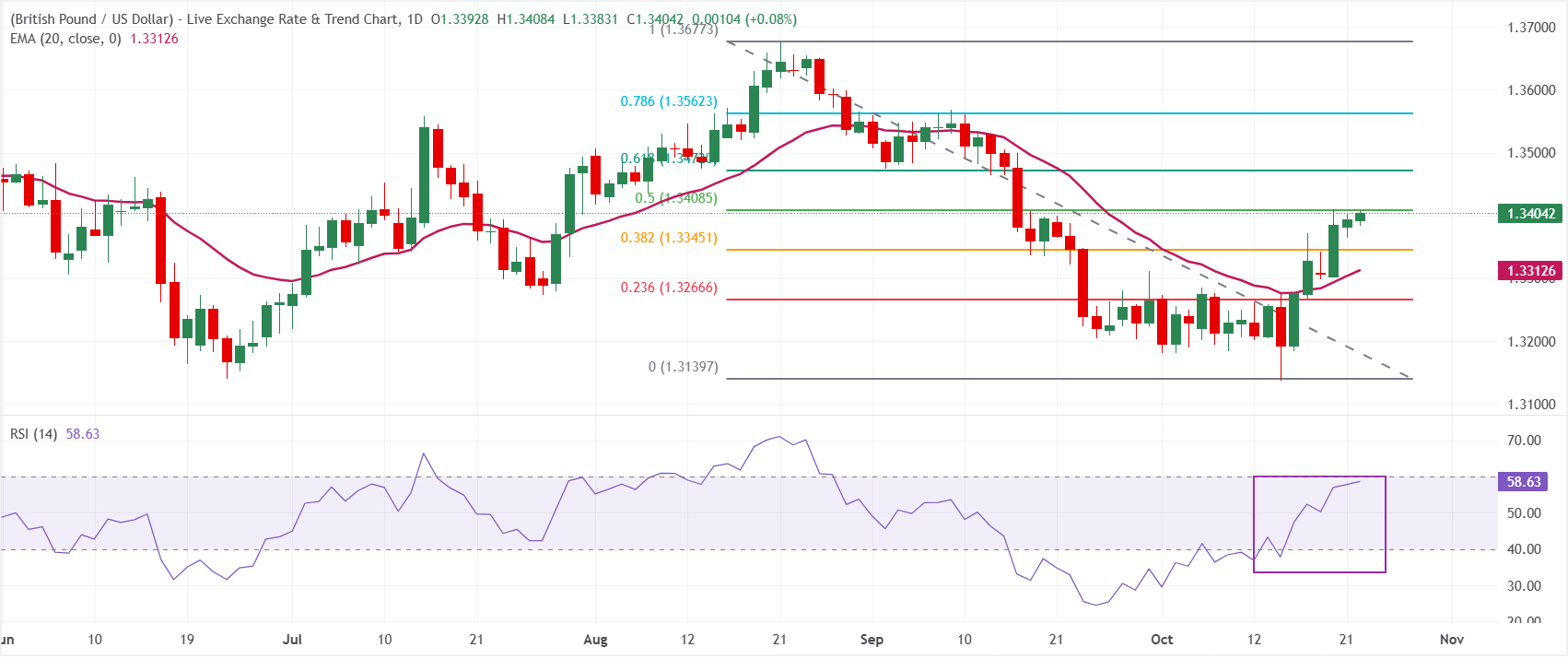
At 1.3404 on the daily chart, GBP/USD has recovered a near-term bullish bias. The pair remains above its 20-day Exponential Moving Average (EMA) at 1.3313, trading between the 38.2% and 50.0% Fibonacci retracements of the recent decline. The latter, at 1.3409, lies just above the current price. As this key retracement resistance is tested, the Relative Strength Index (RSI) is edging into positive territory at 58.6, suggesting that upward momentum is recovering.
The first upside barrier is the 50.0% Fibonacci retracement at 1.3409. Beyond it lie the 61.8% level near 1.3472 and the 78.6% retracement around 1.3562, before the more distant recent swing high at 1.3677. Support initially comes from the 38.2% Fibonacci retracement at 1.3345, followed by the 23.6% level around 1.3267. A more pronounced decline would bring the structural floor near 1.3140 into view.
(The technical analysis of this story was written with the help of an AI tool. Know more.)
Published monthly by the Office for National Statistics, the United Kingdom (UK) Consumer Price Index (CPI) measures consumer price inflation to international standards. It tracks the rate at which prices of goods and services purchased by households rise or fall and serves as the inflation measure for the government’s target. The YoY figure compares prices in the reference month with those a year earlier. A high reading is generally regarded as bullish for the Pound Sterling (GBP); a low reading is generally considered bearish.
Find out more.Latest release: Wed 21 Oct 2026 06:00
Release frequency: Every month
Reported figure: 3.5%
Consensus forecast: 3.4%
Prior reading: 3.1%
Data source: Office for National Statistics
The headline Consumer Price Index (CPI) measures inflation against the Bank of England’s target of around 2%, making its monthly publication important for traders. Rising inflation implies that the BOE will raise interest rates sooner and at a faster pace, or scale back bond purchases, thereby tightening the supply of pounds. By contrast, slower price growth points to looser monetary policy. A reading above expectations tends to support GBP.







Phone: +61 2 8036 8388
Fax: +61 2 8036 8388
Email: support@tmgm.com



The information provided on this website is of a general nature only and does not constitute personal financial advice. Before acting on any information on this website, you should consider the suitability of the information in relation to your objectives, financial situation and needs. Investing in CFDs and FX Margin Contracts carries significant risks and is not suitable for all investors. You may lose more than your initial deposit. You do not own, or have, any interest in the underlying asset. We recommend that you seek independent advice and ensure you fully understand the risks involved before trading. It is important that you read and consider the disclosure document before you acquire any product listed on the website. The information and advertisements offered on this website are not intended for use by any person in any country or jurisdiction where such use would be contrary to local laws and regulations. The Products and Services offered on this website are not intended for residents of the United States, Malaysia and Thailand.
TMGM is authorized and regulated in various jurisdictions.
Trademax Australia Limited, trading as TMGM, is regulated by the Australian Securities and Investments Commission (ASIC), AFSL no. 436416 and is located at Level 28, One International Tower, 100 Barangaroo Avenue, 2000 Sydney, NSW Australia.
Email: support@tmgm.com.au
Trademax Global Limited, trading as TMGM, is authorized and regulated by the Vanuatu Financial Services Commission (VFSC), registration number 40356 and registered at 1276, Kumul Highway, Port Vila, Vanuatu, Republic of Vanuatu.
Email: support@tmgm.com
Trademax Global Markets (SE) Limited, trading as TMGM, is authorized and regulated by the Financial Services Authority (FSA) of Seychelles, with license number SD224. The company is registered at Office No 13, Providence Estate ABIS Centre, Mahe, Seychelles.
Email: support@tmgm.com
Trademax Global Markets (International) Pty Ltd, trading as TMGM, is authorized and regulated by the Financial Services Commission, Mauritius (FSC) with license no. GB22201012, and registered at 33, Edith Cavell Street C/o IQ EQ Fund Services (Mauritius) Ltd Port Louis, 11324 Mauritius.
Email: support@tmgm.com
Copyright © TMGM. All rights reserved


