
News & AnalysisCareer

With US third-quarter GDP growth exceeding expectations, the Euro (EUR) has surrendered most of Friday’s early advance against the US Dollar (USD). Having failed to push beyond 1.1215, EUR/USD has pulled back to around 1.1188 in European trading, although it remains 0.11% higher.
A recovery in the US Dollar, which has recouped most of its earlier losses, is weighing on the pair. Strong economic growth in the United States (US), alongside concerns about high inflation, has reinforced the case for an interest rate rise by the Federal Reserve (Fed) in December.

Having rebounded from an intraday low of 101.59, the US Dollar Index (DXY) stands near 101.72 at the time of writing, still down 0.1%. The index measures the greenback against a basket of six major currencies.
Thursday’s preliminary US Gross Domestic Product (GDP) release for Q3 surpassed expectations. According to Commerzbank economists, the US economy “expanded strongly by 3.4% in the third quarter of 2026,” with the advance Q3 GDP estimate at “3.4% qoq annualised (Bloomberg consensus: 3.2%) vs 2.2% in Q2.” Explaining the strength of the figures, they observe that “private consumption was the main driver and expanded 3.8%, at the same pace as Q2,” and that “business investment, particularly in IT,” also made a significant contribution.
Separately, US core PCE inflation accelerated to 3.1% year-on-year (YoY) from August’s 3%, matching expectations. This measure excludes volatile food and energy items and is a preferred inflation gauge of the Fed.
For the Euro, attention now turns to Germany’s preliminary Harmonised Index of Consumer Prices (HICP) release for October, due at 13:00 GMT. Annual headline HICP inflation is forecast to ease to 3.1% year-on-year (YoY), compared with 3.3% in September.
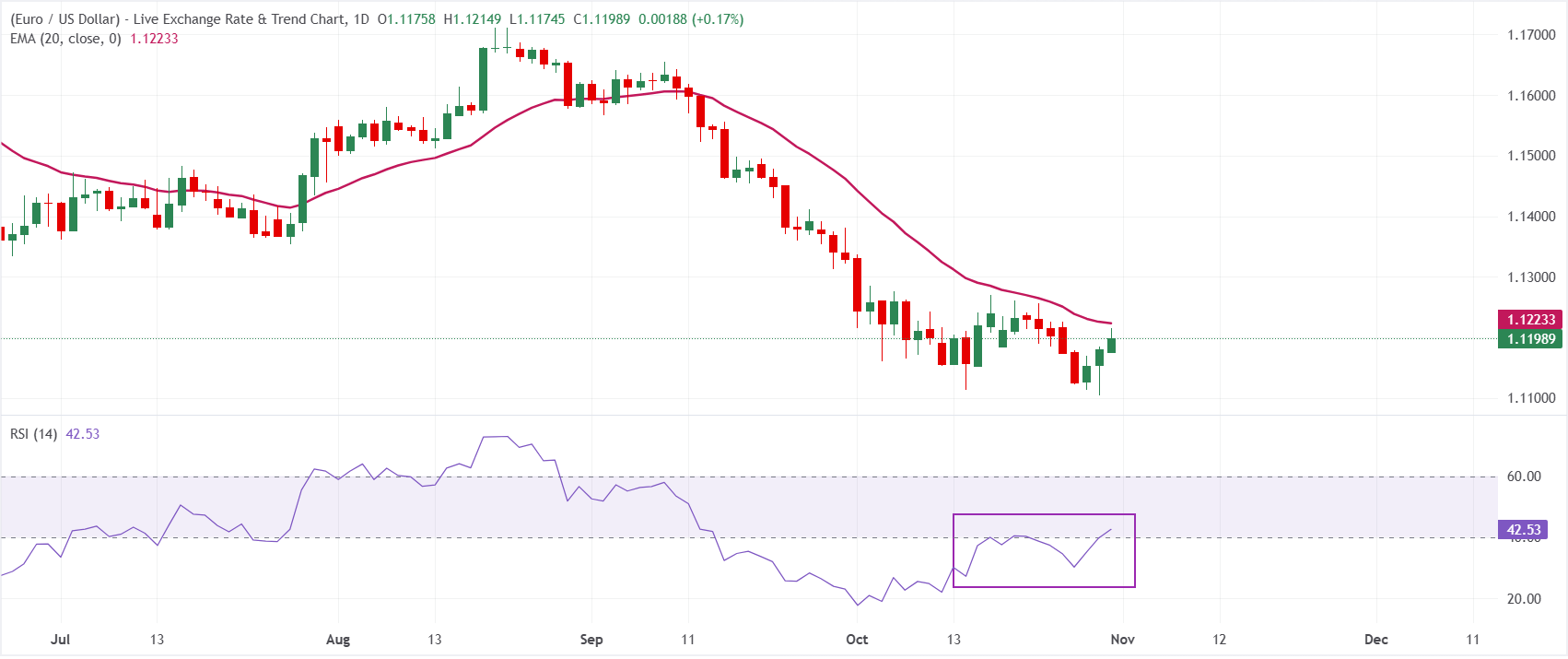
Trading at 1.1199 on the daily chart, EUR/USD retains a modestly bearish short-term bias beneath its 20-period exponential moving average (EMA) of 1.1223. Failure to regain this EMA indicates that the scope for gains remains limited for now. Although the Relative Strength Index (RSI) has recently stabilised after oversold readings, its level of 42 remains below the neutral threshold of 50, signalling muted bullish momentum.
The 20-period EMA near 1.1223 provides the first resistance on any advance. Continued rejection there would probably preserve the bearish bias, favouring either further consolidation or another test of recent lows. To alleviate selling pressure and allow a more pronounced corrective rebound, the pair would need a decisive daily close above this average; momentum indicators would then be likely to improve alongside the price.
(The technical analysis of this story was written with the help of an AI tool. Know more.)
Published each month by Germany’s statistics office, Destatis, the Harmonised Index of Consumer Prices (HICP) measures inflation using a statistical methodology harmonised across all European Union (EU) member states, allowing comparisons between them. Its year-on-year reading compares prices in the reference month with those a year earlier. A higher reading is generally supportive of the Euro (EUR), whereas a lower figure tends to weigh on the currency.
Continue reading.Next scheduled release: Fri 30 Oct 2026 13:00 (Prel)
Publication frequency: Monthly
Consensus forecast: 3.1%
Previous reading: 3.3%
Data source: Federal Statistics Office of Germany







Phone: +61 2 8036 8388
Fax: +61 2 8036 8388
Email: support@tmgm.com



The information provided on this website is of a general nature only and does not constitute personal financial advice. Before acting on any information on this website, you should consider the suitability of the information in relation to your objectives, financial situation and needs. Investing in CFDs and FX Margin Contracts carries significant risks and is not suitable for all investors. You may lose more than your initial deposit. You do not own, or have, any interest in the underlying asset. We recommend that you seek independent advice and ensure you fully understand the risks involved before trading. It is important that you read and consider the disclosure document before you acquire any product listed on the website. The information and advertisements offered on this website are not intended for use by any person in any country or jurisdiction where such use would be contrary to local laws and regulations. The Products and Services offered on this website are not intended for residents of the United States, Malaysia and Thailand.
TMGM is authorized and regulated in various jurisdictions.
Trademax Australia Limited, trading as TMGM, is regulated by the Australian Securities and Investments Commission (ASIC), AFSL no. 436416 and is located at Level 28, One International Tower, 100 Barangaroo Avenue, 2000 Sydney, NSW Australia.
Email: support@tmgm.com.au
Trademax Global Limited, trading as TMGM, is authorized and regulated by the Vanuatu Financial Services Commission (VFSC), registration number 40356 and registered at 1276, Kumul Highway, Port Vila, Vanuatu, Republic of Vanuatu.
Email: support@tmgm.com
Trademax Global Markets (SE) Limited, trading as TMGM, is authorized and regulated by the Financial Services Authority (FSA) of Seychelles, with license number SD224. The company is registered at Office No 13, Providence Estate ABIS Centre, Mahe, Seychelles.
Email: support@tmgm.com
Trademax Global Markets (International) Pty Ltd, trading as TMGM, is authorized and regulated by the Financial Services Commission, Mauritius (FSC) with license no. GB22201012, and registered at 33, Edith Cavell Street C/o IQ EQ Fund Services (Mauritius) Ltd Port Louis, 11324 Mauritius.
Email: support@tmgm.com
Copyright © TMGM. All rights reserved


