
News & AnalysisCareer

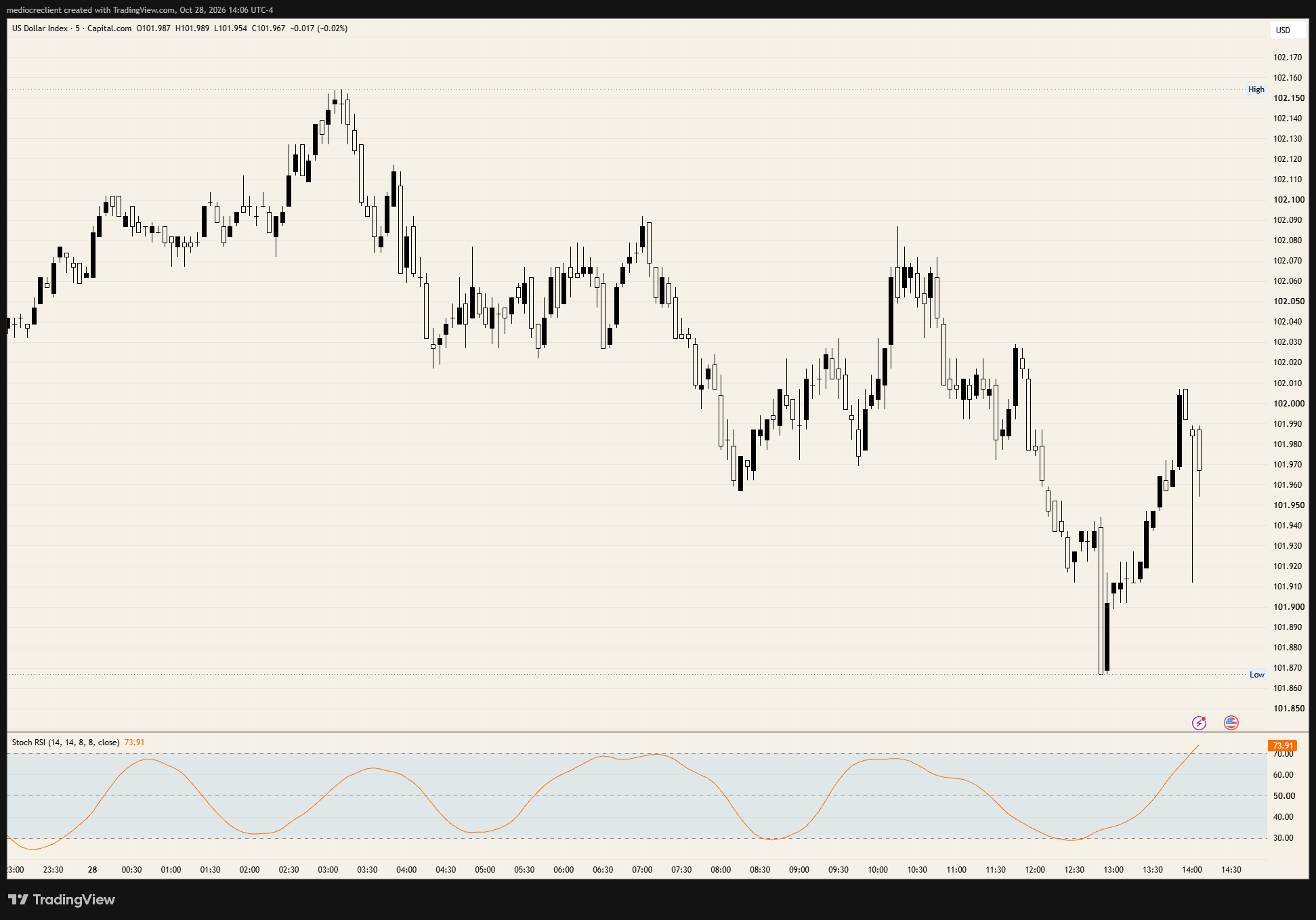
At 3.75%-4.00%, the Fed's rate was unchanged on Wednesday, although two officials voted for an increase. December is now the final meeting this year at which the rise projected by most officials could be delivered. In the five-minute bar covering the statement, the Dollar Index slipped to just above 101.90 before recovering within the same bar. It did not reach the pre-decision session low near 101.85 and is now trading just below 102.00.

A quarter-point increase was favoured by Fed Governor Cook and Cleveland Fed President Hammack. MUFG had said that this type of dissent would reinforce expectations of a December rise. While describing inflation as still elevated, the statement offers no timetable for the next policy change, saying only that further information will help determine the policy stance. Following the announcement, the Dollar Index remained within its pre-decision trading range.
At least one further rate rise this year featured in the September projections of 16 of the Fed's 18 officials, with four forecasting two increases. Now that October has passed, December is the sole remaining meeting for either outcome. Delivering two rises at that meeting would require a half-point increase, a move the Fed last made in December 2022. Before the decision, traders priced the probability of a December increase at close to 80%, backing the outlook of the 16 rather than the four.
Thursday's releases of third-quarter Gross Domestic Product (GDP) and the September Personal Consumption Expenditures Price Index (PCE), both due at 12:30 GMT, will provide the first US data since the decision to hold with implications for December. Also on Thursday, the European Central Bank (ECB) announces its decision at 13:15 GMT, followed by the Bank of Japan (BoJ) on Friday. Those decisions concern the Euro and Yen, which together account for about 71% of the index.
At 18:30 GMT on Wednesday, Fed Chair Warsh begins his press conference. Speaking in Bangkok on 16 October, he said he does not pre-judge meetings. With two colleagues having already voted for a rise, his responses on December will bear directly on the expectations underpinning the Dollar Index.
After reaching a session high just above 102.15 in the first half of Wednesday, the index declined to its low. By the time of the statement, it had recouped about half of that fall. The dip and rebound within the decision bar still left it below its opening level for the day. The advance ahead of the announcement had taken intraday momentum into overbought territory.
Responsibility for US monetary policy rests with the Federal Reserve (Fed), whose dual mandate is to maintain stable prices and promote full employment. Adjustments to interest rates are its main means of pursuing these objectives. If prices climb too rapidly and inflation exceeds the Fed’s 2% target, the central bank raises rates, pushing up borrowing costs across the economy. The resulting increase in the appeal of the US as a destination for international investment strengthens the US Dollar (USD). Conversely, inflation below 2% or an excessively high Unemployment Rate may prompt the Fed to cut rates to stimulate borrowing, putting downward pressure on the Greenback.
Eight times a year, the Federal Reserve (Fed) convenes policy meetings at which the Federal Open Market Committee (FOMC) reviews the economy and decides on monetary policy. Twelve Fed officials take part in the FOMC: all seven members of the Board of Governors, the president of the Federal Reserve Bank of New York and four of the other eleven regional Reserve Bank presidents. The latter serve rotating one-year terms.
When conditions become extreme, Quantitative Easing (QE) is one policy the Federal Reserve may deploy. Through QE, the Fed sharply expands the supply of credit in a financial system that has become blocked. This unconventional measure is used in crises or periods of exceptionally low inflation. During the Great Financial Crisis in 2008, it was the Fed’s preferred policy response. The process involves creating more Dollars to purchase high-grade bonds from financial institutions, and generally leads to a weaker US Dollar.
Reversing QE, quantitative tightening (QT) involves the Federal Reserve halting bond purchases from financial institutions. It also refrains from using principal repaid on its maturing bond holdings to buy new bonds. This policy usually supports the value of the US Dollar.







Phone: +61 2 8036 8388
Fax: +61 2 8036 8388
Email: support@tmgm.com



The information provided on this website is of a general nature only and does not constitute personal financial advice. Before acting on any information on this website, you should consider the suitability of the information in relation to your objectives, financial situation and needs. Investing in CFDs and FX Margin Contracts carries significant risks and is not suitable for all investors. You may lose more than your initial deposit. You do not own, or have, any interest in the underlying asset. We recommend that you seek independent advice and ensure you fully understand the risks involved before trading. It is important that you read and consider the disclosure document before you acquire any product listed on the website. The information and advertisements offered on this website are not intended for use by any person in any country or jurisdiction where such use would be contrary to local laws and regulations. The Products and Services offered on this website are not intended for residents of the United States, Malaysia and Thailand.
TMGM is authorized and regulated in various jurisdictions.
Trademax Australia Limited, trading as TMGM, is regulated by the Australian Securities and Investments Commission (ASIC), AFSL no. 436416 and is located at Level 28, One International Tower, 100 Barangaroo Avenue, 2000 Sydney, NSW Australia.
Email: support@tmgm.com.au
Trademax Global Limited, trading as TMGM, is authorized and regulated by the Vanuatu Financial Services Commission (VFSC), registration number 40356 and registered at 1276, Kumul Highway, Port Vila, Vanuatu, Republic of Vanuatu.
Email: support@tmgm.com
Trademax Global Markets (SE) Limited, trading as TMGM, is authorized and regulated by the Financial Services Authority (FSA) of Seychelles, with license number SD224. The company is registered at Office No 13, Providence Estate ABIS Centre, Mahe, Seychelles.
Email: support@tmgm.com
Trademax Global Markets (International) Pty Ltd, trading as TMGM, is authorized and regulated by the Financial Services Commission, Mauritius (FSC) with license no. GB22201012, and registered at 33, Edith Cavell Street C/o IQ EQ Fund Services (Mauritius) Ltd Port Louis, 11324 Mauritius.
Email: support@tmgm.com
Copyright © TMGM. All rights reserved


