
News & AnalysisCareer

A 10–2 vote left Federal Reserve (Fed) interest rates unchanged at 3.75%–4.00% on Wednesday, as Bitcoin (BTC) advanced beyond $81,000. The policy decision coincided with a decline in the leading cryptocurrency’s realised volatility to levels last recorded in the summer of 2023.

Bitcoin’s one-month realised volatility has fallen to around 25%, below its usual range over the past year, according to Glassnode’s Wednesday report. Only around 5% of days since 2015 have seen lower Bitcoin volatility.
Sharp price movements followed the previous two volatility lows, Glassnode observed. An August 2023 fall in volatility to 18% was followed by a steep Bitcoin decline; by contrast, an August 2026 drop to 22% came ahead of a price rise.
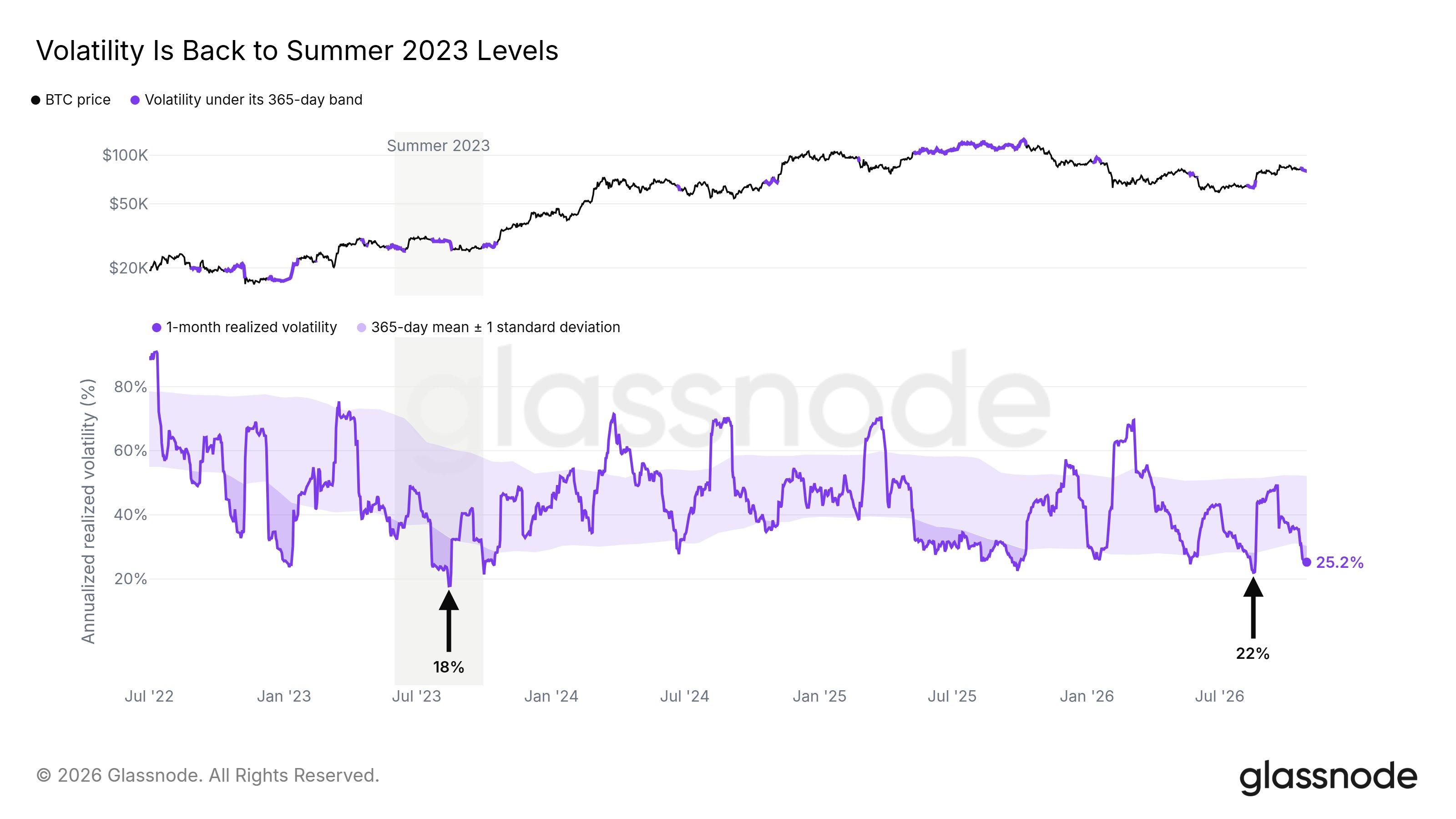
Ahead of the Fed announcement, Glassnode cautioned that a prolonged period of low volatility could leave Bitcoin exposed to a sizeable move after the policy decision.
Alongside the drop in volatility, realised losses have also diminished. Investors have crystallised smaller losses during recent market pullbacks, indicating a considerable easing in selling pressure from holders at a loss compared with earlier downturns.
At the August low, daily net realised losses stood at around $630 million, according to Glassnode. The largest daily net loss during Bitcoin’s 24 October decline was $27 million.
After $80,000 bids on Binance’s spot order book failed to reappear following the 24 October sell-off, Glassnode highlighted 78,000-79,000 as Bitcoin’s next significant support zone.
Buy orders at $80,000 had dwindled to just $3.4 million. In contrast, bids in the $78,000 to $79,000 range amounted to roughly $42 million, compared with $24 million in mid-October.
Accumulation by short-term holders (STH) around $77,000 provides another possible support level should prices fall further, the report found. Another cluster of coins acquired around $64,000 represents buying close to the 2026 lows.
On Hyperliquid, daily trading volumes in stock and commodity perpetual futures have overtaken those in Bitcoin perpetuals, pointing to a shift in speculative activity beyond cryptocurrencies.
Over the past week, daily turnover in Hyperliquid’s HIP-3 markets averaged around $2.6 billion, Glassnode reported. These markets offer perpetual futures contracts for speculation on stocks, indices and commodities. By comparison, average daily volume in the platform’s Bitcoin perpetual futures was about $2.4 billion.
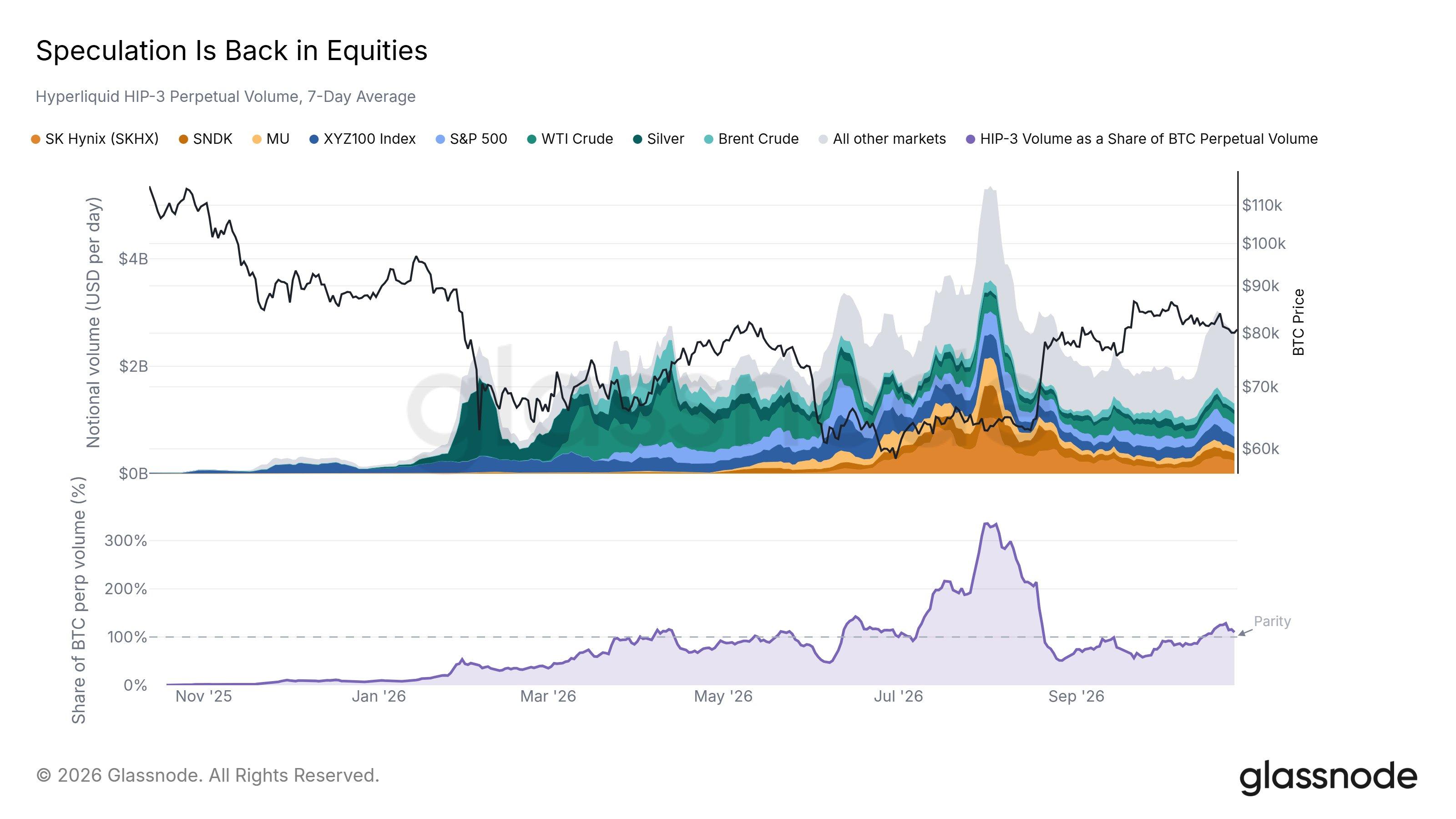
HIP-3 activity has therefore recovered from the volume decline that followed an August market squeeze. Having exceeded Bitcoin perpetual volume by more than three times at the beginning of that month, HIP-3 turnover fell to around half the Bitcoin level by late August.
Among the busiest individual markets were SK Hynix, the S&P 500, a technology index and Crude Oil.
The report stated: “Should this volume keep growing while Bitcoin perpetual volume stays flat, it would show speculative money still favoring stocks,”







Phone: +61 2 8036 8388
Fax: +61 2 8036 8388
Email: support@tmgm.com



The information provided on this website is of a general nature only and does not constitute personal financial advice. Before acting on any information on this website, you should consider the suitability of the information in relation to your objectives, financial situation and needs. Investing in CFDs and FX Margin Contracts carries significant risks and is not suitable for all investors. You may lose more than your initial deposit. You do not own, or have, any interest in the underlying asset. We recommend that you seek independent advice and ensure you fully understand the risks involved before trading. It is important that you read and consider the disclosure document before you acquire any product listed on the website. The information and advertisements offered on this website are not intended for use by any person in any country or jurisdiction where such use would be contrary to local laws and regulations. The Products and Services offered on this website are not intended for residents of the United States, Malaysia and Thailand.
TMGM is authorized and regulated in various jurisdictions.
Trademax Australia Limited, trading as TMGM, is regulated by the Australian Securities and Investments Commission (ASIC), AFSL no. 436416 and is located at Level 28, One International Tower, 100 Barangaroo Avenue, 2000 Sydney, NSW Australia.
Email: support@tmgm.com.au
Trademax Global Limited, trading as TMGM, is authorized and regulated by the Vanuatu Financial Services Commission (VFSC), registration number 40356 and registered at 1276, Kumul Highway, Port Vila, Vanuatu, Republic of Vanuatu.
Email: support@tmgm.com
Trademax Global Markets (SE) Limited, trading as TMGM, is authorized and regulated by the Financial Services Authority (FSA) of Seychelles, with license number SD224. The company is registered at Office No 13, Providence Estate ABIS Centre, Mahe, Seychelles.
Email: support@tmgm.com
Trademax Global Markets (International) Pty Ltd, trading as TMGM, is authorized and regulated by the Financial Services Commission, Mauritius (FSC) with license no. GB22201012, and registered at 33, Edith Cavell Street C/o IQ EQ Fund Services (Mauritius) Ltd Port Louis, 11324 Mauritius.
Email: support@tmgm.com
Copyright © TMGM. All rights reserved


