
News & AnalysisCareer

A decline of nearly 2% on Wednesday leaves Bitcoin (BTC) below $76,000 as it tests the 200-day Exponential Moving Average (EMA) baseline near $76,501. The retreat comes alongside a weaker US Dollar (DXY), a development that would normally favour risk-sensitive assets. Selling pressure coincides with the US midterm elections, with early results showing Democrats making gains in both houses.

Democrats are leading gains in both the US Senate and the House of Representatives, according to early midterm election results. An outright majority requires Democrats to secure 218 seats in the House of Representatives and 51 seats in the Senate.
A Democratic sweep also has the backing of social sentiment in these midterm elections. Kalshi’s forecast puts the probability of Trump losing control of both houses at 100%.

A fall to 101.3 takes the US Dollar Index to a fresh 30-day low on Wednesday as selling pressure emerges. Lower US Treasury yields are also weighing on the US Dollar: the 2-year bond yield has dropped 5 basis points (bps) to 4.566%, while the benchmark 10-year yield has declined 6 bps to 4.90%, according to earlier reporting by FXStreet. Uncertainty over the US midterms accompanies this weakness, as Republicans lose control and President Trump's fiscal and economic agenda faces gridlock.
Although a softer US Dollar would normally favour risk-sensitive assets such as Bitcoin, BTC is also under selling pressure, falling 2% on Wednesday to trade below $76,000. The failure to benefit from dollar weakness suggests that midterm election risks are outweighing the currency’s decline.
A close below the 200-day EMA at $76,500 remains a risk for BTC and could reinforce bearish control. The horizontal level near $75,545 provides immediate downside support. A break beneath it would bring the next bearish targets of $70,505 and $67,292 into view.
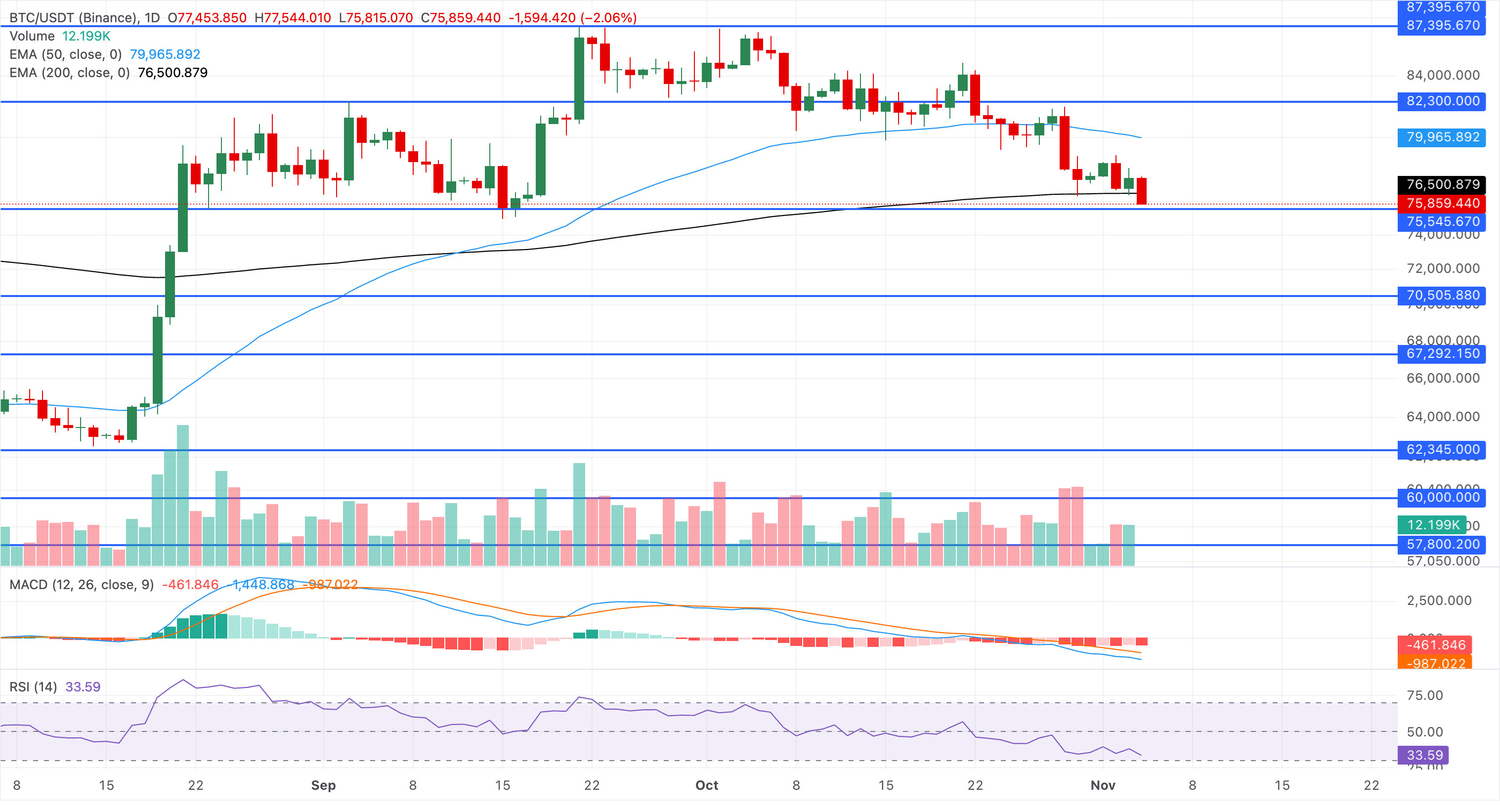
Conversely, the first indication that selling pressure is easing would be a daily close above the 200-day EMA at $76,500. The 50-day EMA at $79,965 would, however, present stronger resistance.
(The technical analysis of this story was written with the help of an AI tool. Know more.)
Held at the halfway point of a president's four-year term, the US midterms are federal elections. All 435 seats in the House of Representatives and about one-third of Senate seats are contested. In many states, voters also elect governors and other state and local officials.
Tuesday, 3 November 2026 is Election Day, in line with federal law requiring elections on the Tuesday following the first Monday in November. Many states already have early voting and postal voting under way.
Control of each congressional chamber during the final two years of President Donald Trump's term is determined by these elections. The party holding the majority directs the legislative agenda and selects committee leaders. In the Senate, it also controls the confirmation of judges and senior officials.
The president is not on the ballot: presidential elections take place every four years, with the next due in November 2028. Midterms are frequently treated as a referendum on the incumbent president's party, which has historically tended to lose seats in the House.
Rather than a sustained trend, most analysts anticipate a limited, brief response in the US Dollar. Markets widely regard a divided Congress as the base case and have already priced it in to some extent. The reaction in Treasury yields could be more pronounced. Results that increase expectations of fiscal stimulus generally push yields and the US Dollar higher; by contrast, legislative gridlock that constrains new spending can weigh on both. Funding disputes or debt-ceiling stand-offs may also temporarily support the Dollar through safe-haven demand. Over six to twelve months, economic growth and Federal Reserve policy carry more weight than the election outcome.
Historically, US equities have tended to struggle ahead of midterms before strengthening afterwards. In all 19 out of 19 midterm elections since 1950, the S&P 500 has stood higher 12 months later, recording an average rise of about 15%. Analysts attribute this pattern to uncertainty receding after the results become clear. Past performance does not guarantee future returns, and some strategists note that high valuations in 2026 could test the streak.
Divided government has often found favour with markets, as legislative deadlock reduces the likelihood of far-reaching changes to taxation, spending and regulation. With a Republican president in office, the S&P 500 has historically performed well in the years after midterms that divided control of Congress. Funding deadlines, disputes over the debt ceiling and congressional investigations nevertheless pose risks that can increase short-term volatility.







Phone: +61 2 8036 8388
Fax: +61 2 8036 8388
Email: support@tmgm.com



The information provided on this website is of a general nature only and does not constitute personal financial advice. Before acting on any information on this website, you should consider the suitability of the information in relation to your objectives, financial situation and needs. Investing in CFDs and FX Margin Contracts carries significant risks and is not suitable for all investors. You may lose more than your initial deposit. You do not own, or have, any interest in the underlying asset. We recommend that you seek independent advice and ensure you fully understand the risks involved before trading. It is important that you read and consider the disclosure document before you acquire any product listed on the website. The information and advertisements offered on this website are not intended for use by any person in any country or jurisdiction where such use would be contrary to local laws and regulations. The Products and Services offered on this website are not intended for residents of the United States, Malaysia and Thailand.
TMGM is authorized and regulated in various jurisdictions.
Trademax Australia Limited, trading as TMGM, is regulated by the Australian Securities and Investments Commission (ASIC), AFSL no. 436416 and is located at Level 28, One International Tower, 100 Barangaroo Avenue, 2000 Sydney, NSW Australia.
Email: support@tmgm.com.au
Trademax Global Limited, trading as TMGM, is authorized and regulated by the Vanuatu Financial Services Commission (VFSC), registration number 40356 and registered at 1276, Kumul Highway, Port Vila, Vanuatu, Republic of Vanuatu.
Email: support@tmgm.com
Trademax Global Markets (SE) Limited, trading as TMGM, is authorized and regulated by the Financial Services Authority (FSA) of Seychelles, with license number SD224. The company is registered at Office No 13, Providence Estate ABIS Centre, Mahe, Seychelles.
Email: support@tmgm.com
Trademax Global Markets (International) Pty Ltd, trading as TMGM, is authorized and regulated by the Financial Services Commission, Mauritius (FSC) with license no. GB22201012, and registered at 33, Edith Cavell Street C/o IQ EQ Fund Services (Mauritius) Ltd Port Louis, 11324 Mauritius.
Email: support@tmgm.com
Copyright © TMGM. All rights reserved


