

Trading
Explore a wide range of markets with competitive pricing, deep liquidity, and advanced trading tools.
Learn More 
Platform
Trade seamlessly with TMGM's powerful platform, built for speed, precision, and a superior trading experience.
Learn More Trading Platform
Academy
Learn the fundamentals of trading with beginner-friendly resources, including guides, webinars, and market insights.
Learn More News & Analysis
Get real-time market updates and expert analysis to stay ahead of trading opportunities
Learn More News & Analysis
About
Learn what sets TMGM apart — our global presence, regulatory strength, and commitment to innovation in trading.
Learn More Why Choose TMGM
Sponsorship
Crypto Today: Bitcoin, Ethereum, XRP rebound loses momentum as capital inflows return
- Below $81,000, Bitcoin’s rebound pauses. Spot ETF inflows help absorb selling pressure.
- $53 million in ETF inflows supports Ethereum bulls as they look to the 50-day EMA for near-term support.
- Above $1.32, XRP posts a third successive day of gains even as ETF trading activity remains subdued.
Bitcoin (BTC) trades near $80,600 on Thursday. Its recent rebound has stalled below $81,000 as cryptocurrency prices broadly consolidate. With recovery momentum easing, Ethereum (ETH) holds above $2,400 and retains a neutral-to-bullish bias. Ripple (XRP) trades above $1.32, showing signs that its uptrend is continuing for a third successive day.

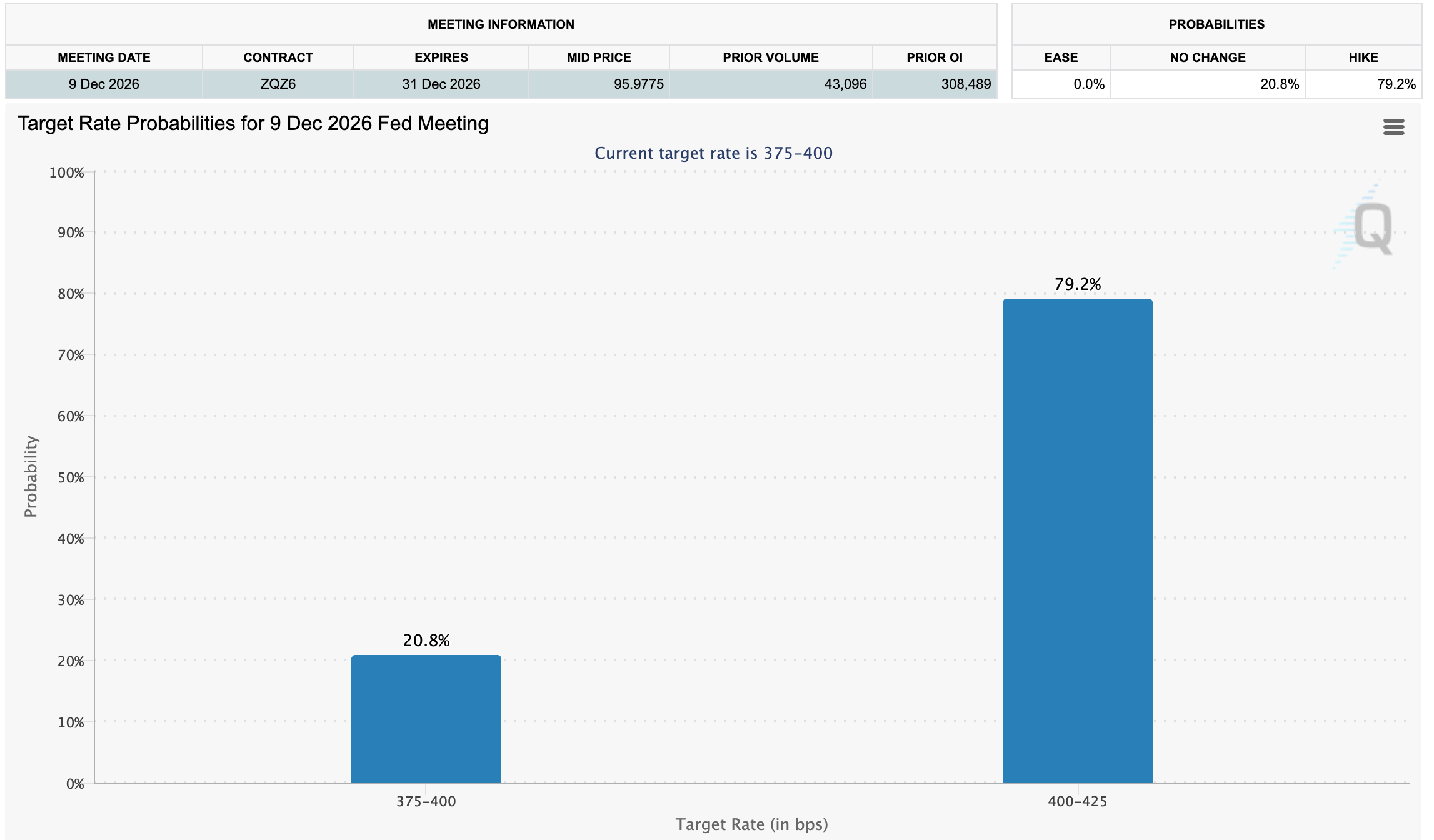
The United States (US) midterm elections, which gave the Democrats a majority in Congress, provided momentum for the crypto market. Macroeconomic uncertainty nevertheless clouds the recovery outlook. Market pricing puts the probability of a 25 basis point interest rate increase by the Federal Reserve (Fed) in December at 79%. Just 21% of traders anticipate no change to the central bank’s 3.75-4.00% rate range.
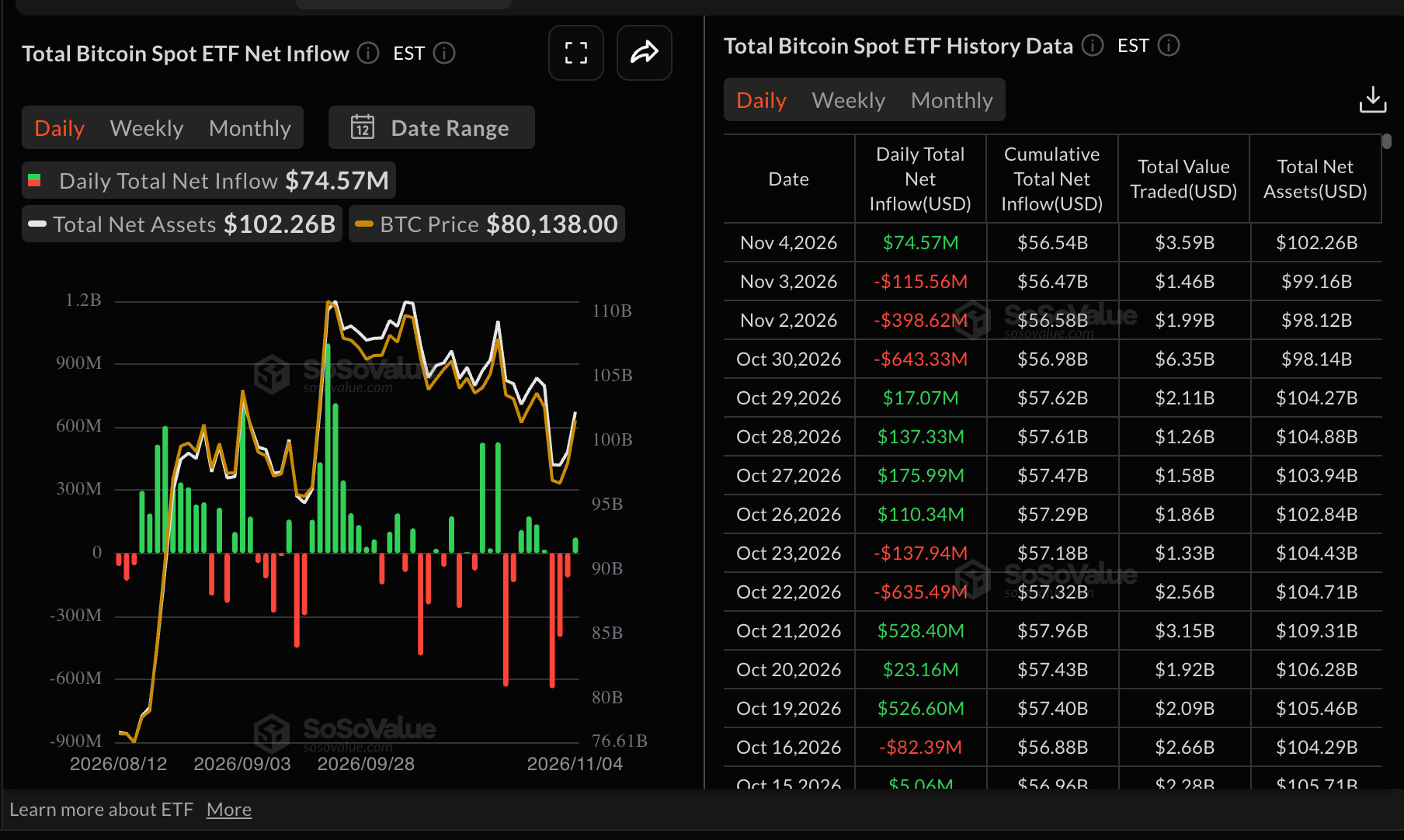
$75 million in Bitcoin ETF inflows leads fresh crypto demand
After the market absorbed the Binance hack, demand for digital investment products, including spot Exchange-Traded Funds (ETFs), started to recover. The attack affected approximately $6.3 billion in assets, prompting concerns over the security of investor funds held on centralised exchanges (CEXs).
Wednesday brought approximately $75 million in inflows into Bitcoin spot ETFs, ending a three-day bearish run. This reversal alone, however, does not provide a sufficient measure of institutional appetite. Whether the current bullish outlook holds or is invalidated will depend heavily on flows over the days and weeks ahead.
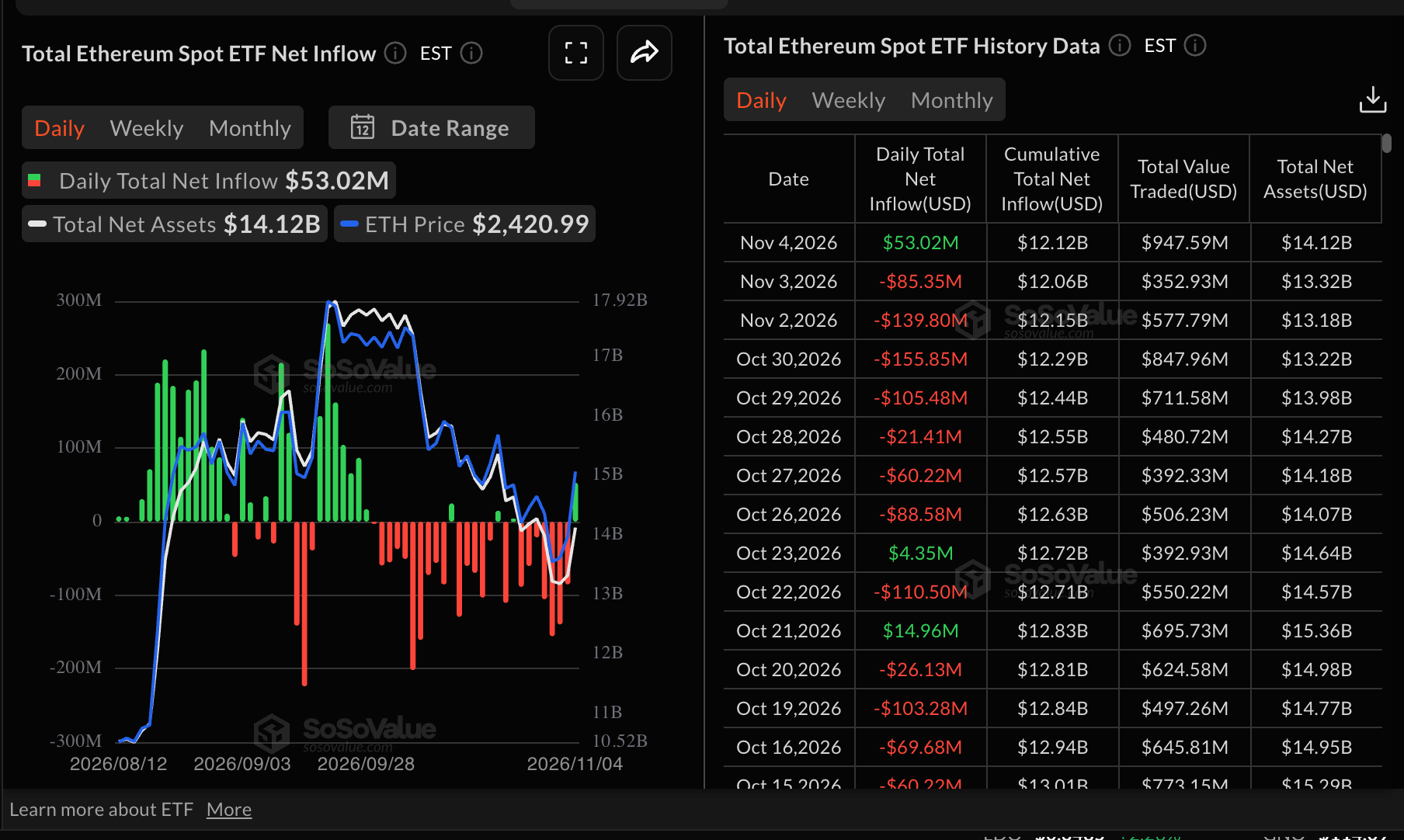
A seven-day run of withdrawals from Ethereum spot ETFs ended on Wednesday with around $53 million in inflows. The renewed capital suggests investors may be prepared to take on more risk in anticipation of a gradual price advance towards short-term resistance at $2,600 and the medium-term barrier at $2,800.
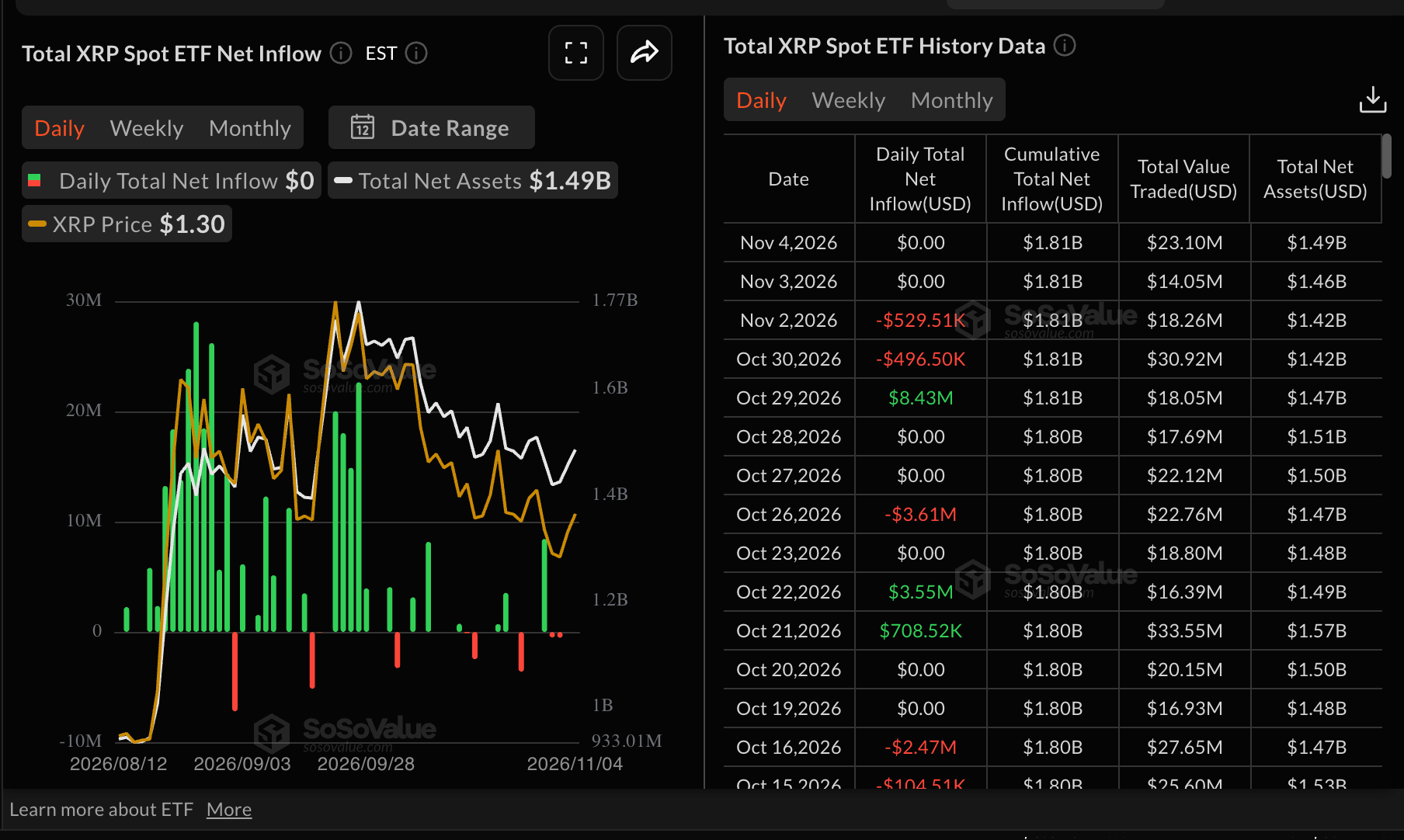
XRP spot ETFs remain subdued, with little activity for two days following modest withdrawals of $530,000 on Monday and $497,000 last Friday. Even so, cumulative inflows stand at a positive $1.8 billion and net assets under management total $1.5 billion. These figures suggest investors retain a long-term bullish view of the underlying XRP token.
$80,615: Bitcoin technical analysis signals renewed bullish strength
At $80,615, Bitcoin maintains a modest bullish bias above its 50-day, 100-day and 200-day Exponential Moving Averages (EMAs). Having recovered the short-term EMA cluster, the pair is now consolidating. The 50-day EMA at $80,166 supports the advance, while the SuperTrend line at $82,920 restricts further upside.
Buyers retain the near-term initiative but show limited conviction for a breakout. The Moving Average Convergence Divergence (MACD) has moved into positive territory, signalling firmer momentum, while the Relative Strength Index (RSI) sits slightly above 50.
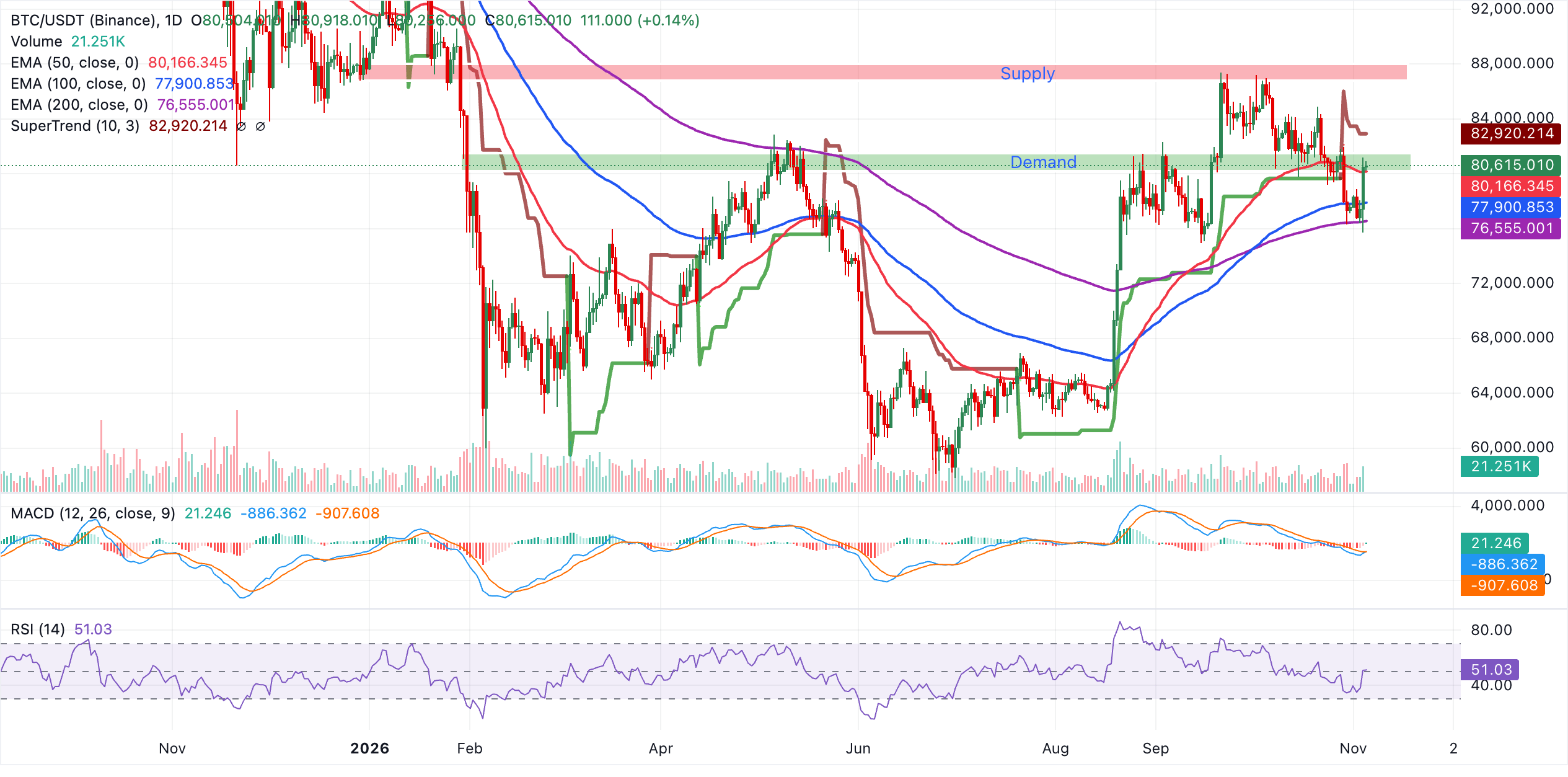
A daily close above the immediate SuperTrend resistance near $82,920 would pave the way for a stronger extension of the uptrend. Support starts at the 50-day EMA around $80,166, ahead of the 100-day EMA at $77,901 and the 200-day EMA near $76,555. Losing the 50-day EMA again would undermine the positive technical picture and leave room for a deeper retracement towards the longer-term averages.
$2,423: Ethereum technical analysis shows recovery pause as bulls seek gains
At $2,423, Ethereum retains a positive bias above the 50-day, 100-day and 200-day EMAs, grouped between approximately $2,400 and $2,310. The broader uptrend therefore appears intact. Rather than signalling a reversal, the recent retreat from the highs looks like consolidation above the long-term base near the 200-day EMA at $2,316.
A positive MACD moving above the zero line reinforces the bullish bias. Meanwhile, the RSI near 54 points to modest buying pressure, rather than overbought conditions.
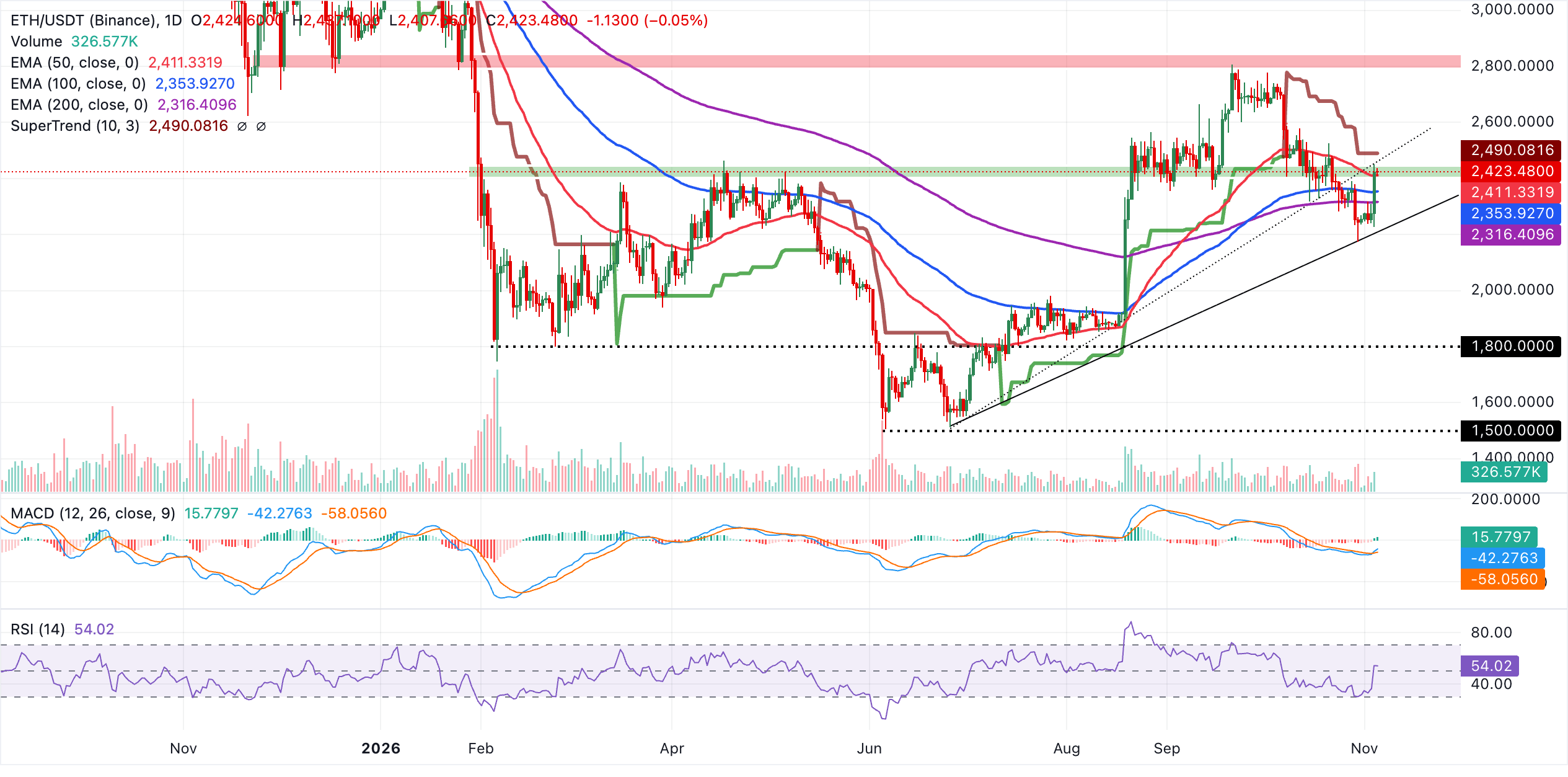
The former rising trend support, now a barrier near $2,463, provides immediate resistance. Next is the SuperTrend line at $2,490, where sellers may try to contain further advances. Initial demand sits at the 50-day EMA at $2,411, followed by support at the 100-day EMA at $2,354 and the 200-day EMA at $2,316. Only a decisive loss of the full EMA cluster would bring a deeper decline towards the second, lower uptrend line around $2,211 into focus.
$1.32: XRP technical analysis shows recovery extending
At $1.32, XRP is edging up for a third consecutive day. Although it has recovered the 100-day EMA as nearby support, the token remains constrained beneath the 50-day and 200-day EMAs. Momentum is firming: the MACD is marginally positive, while the RSI around 51 has moved into neutral-to-bullish territory. The prevailing technical structure nevertheless suggests that rallies face selling pressure at the overhead averages and the active SuperTrend line.
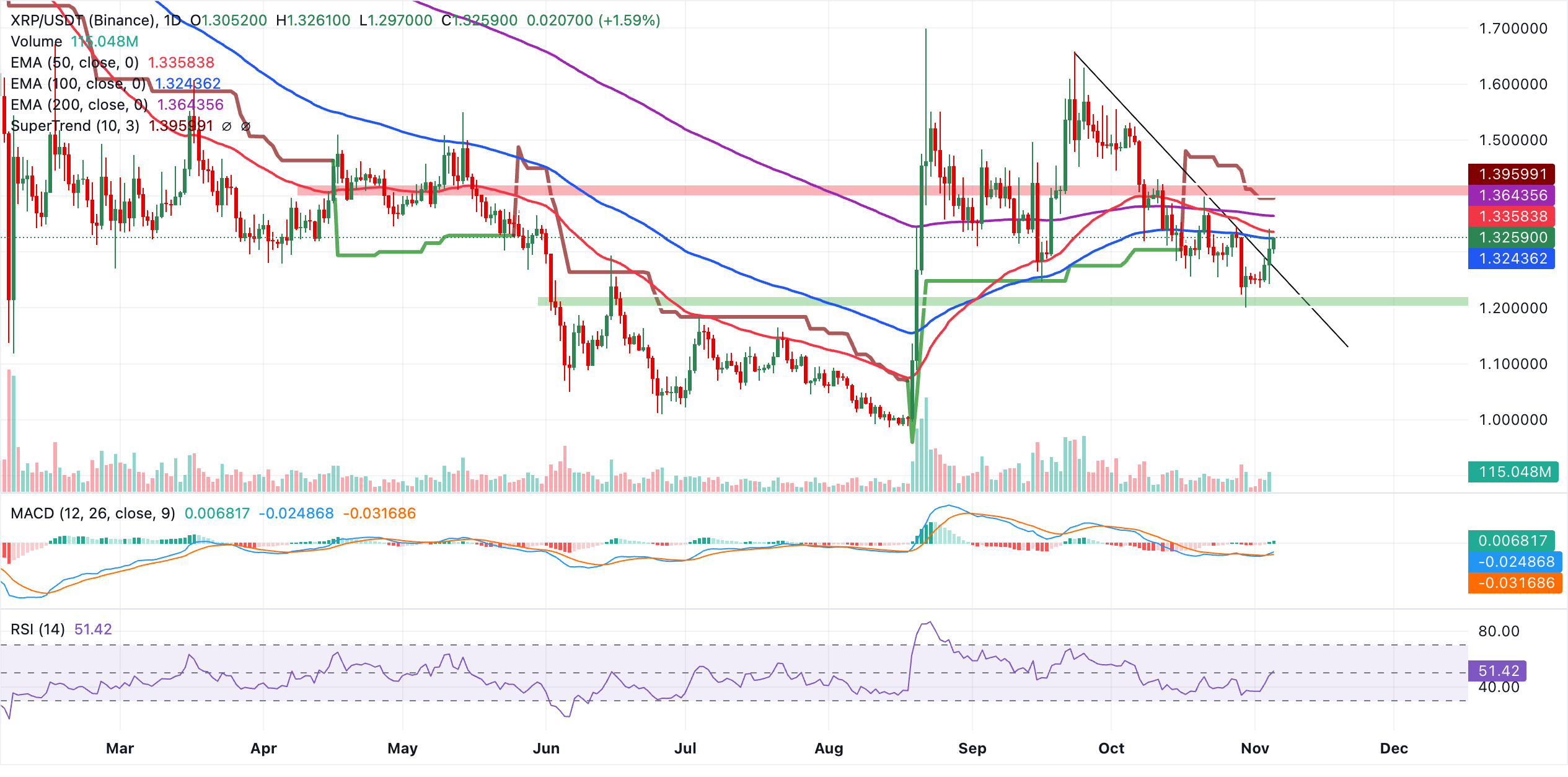
The 50-day EMA around $1.34 presents the first resistance, with the 200-day EMA near $1.36 adding to the broader supply zone. A stronger confirmation of bullish strength would require overcoming the SuperTrend line at approximately $1.40. Immediate support rests at the 100-day EMA at $1.32. A sustained move below it would expose the previous trendline break area near $1.27 as the next significant demand zone.
(The technical analysis of this story was written with the help of an AI tool. Know more.)
Cryptocurrency prices: common questions
Demand and adoption among market participants are influenced by new token launches. When an asset is listed on a crypto exchange, liquidity increases and more participants join its network. These developments are generally positive for the digital asset’s price.
During a hack, an attacker uses exploits, bugs or other methods to seize a large quantity of an asset from a DeFi bridge, an exchange’s hot wallet or another crypto platform. The stolen tokens are then moved off exchange platforms, ultimately to be sold or exchanged for other cryptocurrencies or stablecoins. Widespread panic often follows, triggering a sell-off in the affected assets.
The direct effect on the US Dollar is the main channel through which macroeconomic events, such as the US Federal Reserve’s interest rate decisions, influence crypto assets. Higher interest rates generally weigh on Bitcoin and altcoin prices, while lower rates typically have the opposite effect. A decline in the US Dollar index makes risk assets and the leverage used to trade them cheaper, in turn lifting cryptocurrency prices.
By cutting miners’ block rewards in half, halvings restrict the asset’s supply and are generally viewed as bullish events. With demand unchanged, a reduction in supply lifts the asset’s price.
POPULAR ARTICLES
1Norwegian Krone: Rate cuts delayed by slow disinflation – Nomura2Swiss Franc weakens as US employment data comes into focus3US Dollar rebound after election shock erodes Japanese Yen gains4Czech Koruna: CNB hike fails to relieve CZK pressure – Commerzbank50.5660: New Zealand Dollar pulls back as US Dollar recovers ground6XRP advances as Ripple CEO urges clear rules and says US crypto users will stay beyond midterms7Japanese Yen: Broad range persists against US Dollar despite volatility – UOB8US Dollar Index (DXY) trims losses as the aftermath of the US midterm elections becomes clearer9December rate rise a strong possibility, says ECB’s Zigman


Get Started!
Sign up and access the Global Markets in less than 3 minutes

Connect With Us









Contacts
Phone: +61 2 8036 8388
Fax: +61 2 8036 8388
Email: support@tmgm.com



The information provided on this website is of a general nature only and does not constitute personal financial advice. Before acting on any information on this website, you should consider the suitability of the information in relation to your objectives, financial situation and needs. Investing in CFDs and FX Margin Contracts carries significant risks and is not suitable for all investors. You may lose more than your initial deposit. You do not own, or have, any interest in the underlying asset. We recommend that you seek independent advice and ensure you fully understand the risks involved before trading. It is important that you read and consider the disclosure document before you acquire any product listed on the website. The information and advertisements offered on this website are not intended for use by any person in any country or jurisdiction where such use would be contrary to local laws and regulations. The Products and Services offered on this website are not intended for residents of the United States, Malaysia and Thailand.
TMGM is authorized and regulated in various jurisdictions.
Trademax Australia Limited, trading as TMGM, is regulated by the Australian Securities and Investments Commission (ASIC), AFSL no. 436416 and is located at Level 28, One International Tower, 100 Barangaroo Avenue, 2000 Sydney, NSW Australia.
Email: support@tmgm.com.au
Trademax Global Limited, trading as TMGM, is authorized and regulated by the Vanuatu Financial Services Commission (VFSC), registration number 40356 and registered at 1276, Kumul Highway, Port Vila, Vanuatu, Republic of Vanuatu.
Email: support@tmgm.com
Trademax Global Markets (SE) Limited, trading as TMGM, is authorized and regulated by the Financial Services Authority (FSA) of Seychelles, with license number SD224. The company is registered at Office No 13, Providence Estate ABIS Centre, Mahe, Seychelles.
Email: support@tmgm.com
Trademax Global Markets (International) Pty Ltd, trading as TMGM, is authorized and regulated by the Financial Services Commission, Mauritius (FSC) with license no. GB22201012, and registered at 33, Edith Cavell Street C/o IQ EQ Fund Services (Mauritius) Ltd Port Louis, 11324 Mauritius.
Email: support@tmgm.com
Copyright © TMGM. All rights reserved