

Trading
Explore a wide range of markets with competitive pricing, deep liquidity, and advanced trading tools.
Learn More 
Platform
Trade seamlessly with TMGM's powerful platform, built for speed, precision, and a superior trading experience.
Learn More Trading Platform
Academy
Learn the fundamentals of trading with beginner-friendly resources, including guides, webinars, and market insights.
Learn More News & Analysis
Get real-time market updates and expert analysis to stay ahead of trading opportunities
Learn More News & Analysis
About
Learn what sets TMGM apart — our global presence, regulatory strength, and commitment to innovation in trading.
Learn More Why Choose TMGM
Sponsorship
The Euro gets the PMIs first and France's credit rating over the weekend
- EUR/USD flatlines under 1.1250 as France's 10-year yield tops 5%.
- Four October rallies, each stopping below the one before.
- Moody's reviews France's credit rating on Friday.
France's 10-year government bond yield went above 5% on Wednesday for the first time since 2002, and the Euro hardly moved on it. EUR/USD trades just under 1.1250, and each of its four rallies since October 2 has stopped lower than the one before. The French spread is a weight on the currency, and the rate gap with the US isn't moving to offset it: the Fed and the European Central Bank (ECB) are both expected to hold in October and raise rates in December.

France now pays 1.6 points more than Germany to borrow for a decade
The French 10-year yield touched just over 5% before slipping back under it, and the gap over Germany's 10-year, near 3.4%, widened to about 1.6 points, the widest since 2012. The cost of insuring French debt for five years is at its highest since 2013. Government debt is close to 120% of the economy, and parliament's debate on the 2027 budget resumes on October 27 after more than 2K amendments held it up.
A wider French spread is a cost the whole Euro carries, because it raises the chance that the ECB has to choose between its inflation target and one member's bond market. The ECB's Transmission Protection Instrument (TPI), built in 2022 for that choice, has never been used, and ECB President Lagarde said on October 14 that France's fix lies at home, in its own fiscal policy.
Part of the spread is politics. Student protests have brought partial curfews in Paris, Bordeaux and Nice, and troops are due to support police for marches planned on Saturday, the day after Moody's reviews France's rating.
The rate gap that sets EUR/USD is booked solid until December
The ECB's deposit rate is 2.50% after hikes in June and September, and traders price about a 95% chance it holds on October 29. Euro area inflation was 3.8% in September, with energy up 18.9% from a year earlier, while inflation excluding energy, food, alcohol and tobacco was 2.5%. A rate hike does little about an energy bill set by the US-Iran war.
ECB Chief Economist Lane signalled caution on further moves on Wednesday while energy inflation stays high, and Bundesbank President Nagel, on October 16, said he can't rule out another hike. The Fed's range is 3.75%-4.00%, and prediction markets put an October 28 hold near 86%. With both banks expected to sit out October and move in December, the gap between US and euro area rates has nowhere to go before then. Chief Economist Lane also said wider use of the Euro outside Europe could help the ECB control prices, on a day when the biggest risk to the currency came from inside it.
Friday has the PMIs before Moody's and the weekend after
Bank of Italy Governor Panetta speaks at 12:15 GMT on Thursday, and the euro area's preliminary consumer confidence reading at 14:00 GMT is forecast at -17 after -16.5. Hamburg Commercial Bank (HCOB) Purchasing Managers Index (PMI) figures come at 08:00 GMT on Friday, forecast at 52.8 for manufacturing after 52.9 and at 52.8 for services after 53.0. ECB Executive Board member Cipollone speaks at 14:00 GMT.
S&P Global's US PMIs follow at 13:45 GMT on Friday, forecast at 55.6 for factories and 57.9 for services, above anything the euro area is expected to report. The Dollar Index is just under 102.00, down from the 18-month high near 103.00 it reached in October, and EUR/USD has barely gained from the softer Dollar. Moody's reviews France on the same day as the PMIs, and EU rules have agencies publish sovereign decisions after European markets shut, so EUR/USD trades the PMIs without the rating and opens on Monday with it.
The Euro's levels under a run of lower highs
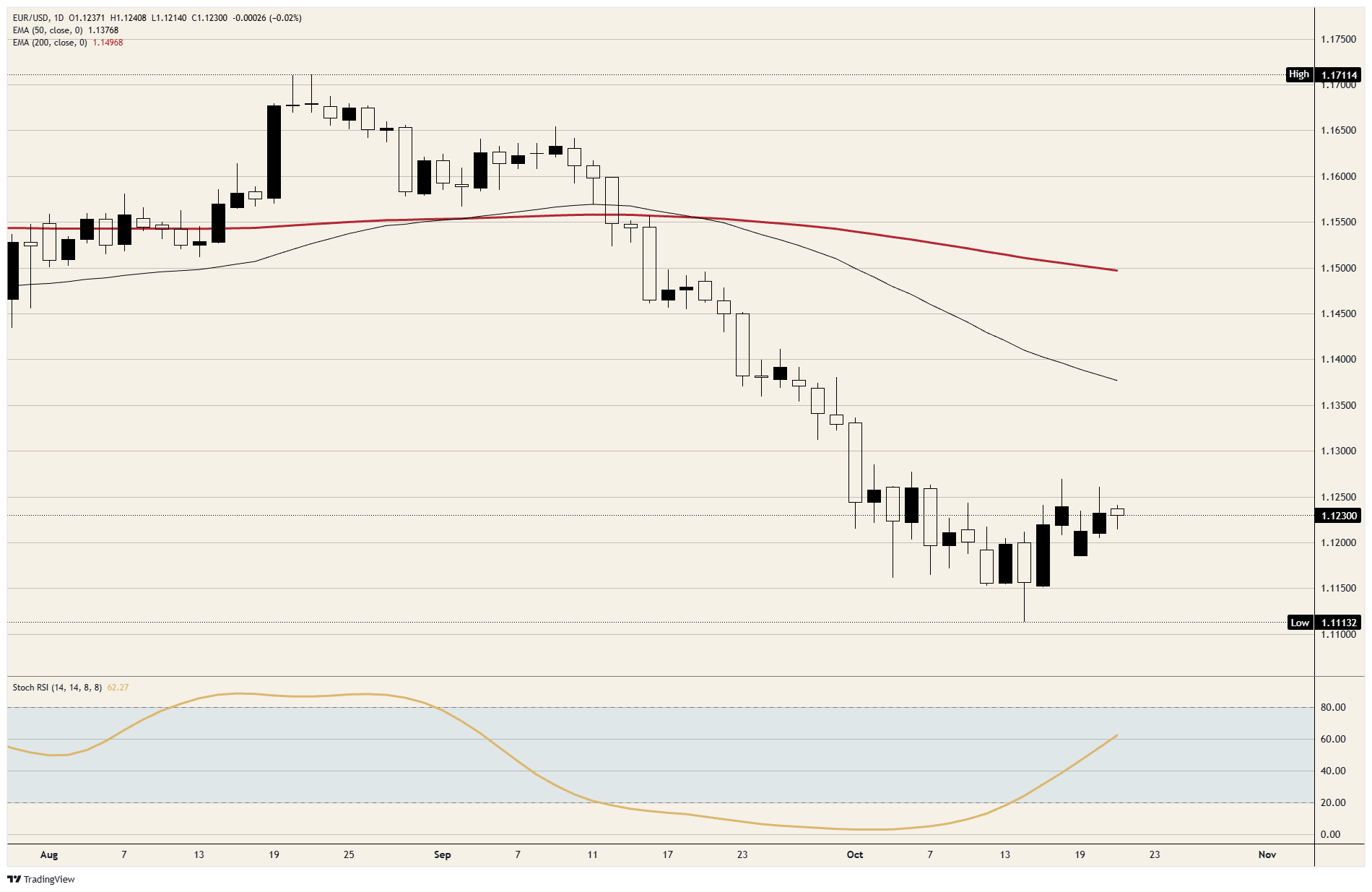
Resistance: 1.1250 capped Wednesday after Tuesday's high only just cleared it, and the October highs have stepped down from just under 1.1300 on October 2. EUR/USD hasn't traded above 1.1300 since October 1.
Support: 1.1200 has held since Monday's dip to just under it. 1.1150 was the floor on October 12 and October 15, and the October 14 low just above 1.1100 is the bottom of the range.
Bias: Lean short below 1.1250 on a closing basis, targeting 1.1150 and then 1.1100. The daily Stochastic Relative Strength Index (Stoch RSI) has climbed from near zero to about 62 since mid-October and is still rising, which is what could break the run of lower highs. A daily close above 1.1300 ends the short.
EUR/USD daily chart
Euro FAQs
The Euro is the currency for the 20 European Union countries that belong to the Eurozone. It is the second most heavily traded currency in the world behind the US Dollar. In 2022, it accounted for 31% of all foreign exchange transactions, with an average daily turnover of over $2.2 trillion a day. EUR/USD is the most heavily traded currency pair in the world, accounting for an estimated 30% off all transactions, followed by EUR/JPY (4%), EUR/GBP (3%) and EUR/AUD (2%).
The European Central Bank (ECB) in Frankfurt, Germany, is the reserve bank for the Eurozone. The ECB sets interest rates and manages monetary policy. The ECB’s primary mandate is to maintain price stability, which means either controlling inflation or stimulating growth. Its primary tool is the raising or lowering of interest rates. Relatively high interest rates – or the expectation of higher rates – will usually benefit the Euro and vice versa. The ECB Governing Council makes monetary policy decisions at meetings held eight times a year. Decisions are made by heads of the Eurozone national banks and six permanent members, including the President of the ECB, Christine Lagarde.
Eurozone inflation data, measured by the Harmonized Index of Consumer Prices (HICP), is an important econometric for the Euro. If inflation rises more than expected, especially if above the ECB’s 2% target, it obliges the ECB to raise interest rates to bring it back under control. Relatively high interest rates compared to its counterparts will usually benefit the Euro, as it makes the region more attractive as a place for global investors to park their money.
Data releases gauge the health of the economy and can impact on the Euro. Indicators such as GDP, Manufacturing and Services PMIs, employment, and consumer sentiment surveys can all influence the direction of the single currency. A strong economy is good for the Euro. Not only does it attract more foreign investment but it may encourage the ECB to put up interest rates, which will directly strengthen the Euro. Otherwise, if economic data is weak, the Euro is likely to fall. Economic data for the four largest economies in the euro area (Germany, France, Italy and Spain) are especially significant, as they account for 75% of the Eurozone’s economy.
Another significant data release for the Euro is the Trade Balance. This indicator measures the difference between what a country earns from its exports and what it spends on imports over a given period. If a country produces highly sought after exports then its currency will gain in value purely from the extra demand created from foreign buyers seeking to purchase these goods. Therefore, a positive net Trade Balance strengthens a currency and vice versa for a negative balance.
Top Articles
1The Japanese Yen barely moves as a Bank of Japan deputy talks up inflation risk2AUD/JPY Price Forecast: Double bottom puts 113.50 in bulls' sights3Chinese Yuan: Gradual gains toward 6.6640 against US Dollar – UOB4GBP/JPY Price Forecast: Doji tests bulls’ resolve below 212.005The Euro gets the PMIs first and France's credit rating over the weekend6Australian Dollar defies Iran war jitters as RBA hike bets double7The British Pound goes into retail sales with its November hike already priced8New Zealand's CPI inflation eases to 3.7% YoY in Q3, vs 3.8% expected9Indonesian Rupiah: Depreciation bias with MSCI risk – MUFG
LIVE QUOTES


ALL ABOUT FOREX
Margin Call Meaning: What It Is, What Triggers It and How to Avoid One
Top 15 Weakest Currencies in the World
Top 15 Strongest Currencies in the World
Is Forex Trading Halal?
Best Time to Trade Forex
Forex Trading vs Futures Trading
Forex Trading vs Stock Trading
Forex Trading vs Crypto Trading
Is Forex Trading Profitable In 2026?
Get Started!
Sign up and access the Global Markets in less than 3 minutes

Connect With Us









Contacts
Phone: +61 2 8036 8388
Fax: +61 2 8036 8388
Email: support@tmgm.com



The information provided on this website is of a general nature only and does not constitute personal financial advice. Before acting on any information on this website, you should consider the suitability of the information in relation to your objectives, financial situation and needs. Investing in CFDs and FX Margin Contracts carries significant risks and is not suitable for all investors. You may lose more than your initial deposit. You do not own, or have, any interest in the underlying asset. We recommend that you seek independent advice and ensure you fully understand the risks involved before trading. It is important that you read and consider the disclosure document before you acquire any product listed on the website. The information and advertisements offered on this website are not intended for use by any person in any country or jurisdiction where such use would be contrary to local laws and regulations. The Products and Services offered on this website are not intended for residents of the United States, Malaysia and Thailand.
TMGM is authorized and regulated in various jurisdictions.
Trademax Australia Limited, trading as TMGM, is regulated by the Australian Securities and Investments Commission (ASIC), AFSL no. 436416 and is located at Level 28, One International Tower, 100 Barangaroo Avenue, 2000 Sydney, NSW Australia.
Email: support@tmgm.com.au
Trademax Global Limited, trading as TMGM, is authorized and regulated by the Vanuatu Financial Services Commission (VFSC), registration number 40356 and registered at 1276, Kumul Highway, Port Vila, Vanuatu, Republic of Vanuatu.
Email: support@tmgm.com
Trademax Global Markets (SE) Limited, trading as TMGM, is authorized and regulated by the Financial Services Authority (FSA) of Seychelles, with license number SD224. The company is registered at Office No 13, Providence Estate ABIS Centre, Mahe, Seychelles.
Email: support@tmgm.com
Trademax Global Markets (International) Pty Ltd, trading as TMGM, is authorized and regulated by the Financial Services Commission, Mauritius (FSC) with license no. GB22201012, and registered at 33, Edith Cavell Street C/o IQ EQ Fund Services (Mauritius) Ltd Port Louis, 11324 Mauritius.
Email: support@tmgm.com
Copyright © TMGM. All rights reserved