


UK CPI set to accelerate, paving the way for a BoE interest rate hike in November
- UK CPI is expected to accelerate to 3.4% YoY in September from 3.1% in August, the hottest level since December last year.
- Core inflation is also seen accelerating as the impact of high energy prices spills over into the broader economy.
- These figures might provide the BoE with the definitive argument to tighten its monetary policy at November’s meeting.
The United Kingdom (UK) Office for National Statistics (ONS) is expected to release September’s Consumer Price Index (CPI) on Wednesday at 06:00 GMT. These figures will be accompanied by the Producer Price Index (PPI) and the Retail Sales report.
Consumer inflation figures are expected to be closely watched by investors to shed more light on the outcome of the Bank of England’s (BoE) next monetary policy meeting. Some BoE officials, including Governor Andrew Bailey, have flagged the need to hike interest rates to tame inflationary pressures, although they have been vague about the timing of the next move. If UK inflation data confirms market expectations, it might cement hopes of a rate hike in November, which would increase speculative demand for the British Pound (GBP).

What to expect from the next UK inflation report?
The market consensus anticipates a 0.3% increase in consumer inflation in September, down from August’s 0.5% rise, but with the year-on-year rate accelerating to 3.4% from 3.1% in the previous month.
Core inflation, which excludes the volatile energy, food, alcohol and tobacco components, is also seen accelerating, although at a more moderate pace. September's Core CPI is seen picking up to a 2.8% pace from 2.6% in August, adding to evidence that the impact of the energy shock stemming from the Middle East conflict is spreading through the broader economy.
Crude prices have risen more than 10% so far in October and have appreciated nearly 50% since July. The barrel of Brent Oil trades at five-month highs above $108.00 at the time of writing, and is unlikely to return to pre-war levels anytime soon, given the ever-growing entanglement among regional powers. The scenario points to high inflation pressures for a protracted period of time and the risk that central banks will fall behind the curve if they fail to react promptly.
Against this backdrop, the Bank of England has been one of the few major central banks that have not tightened its monetary policy in 2026. Some BoE officials have called for an interest rate hike, and Governor Bailey expressed his frustration with above-target inflation at the International Monetary Fund (IMF) summit in Bangkok last week, which fuelled investors’ confidence in some monetary tightening before year-end.
Recent UK data has endorsed those views. The ILO Unemployment Rate, released on Tuesday, reflected a resilient labour market, despite a decline in vacancies and a larger-than-expected increase in claimants. Last week, monthly Gross Domestic Product (GDP) came in as a positive surprise, growing unexpectedly in August, amid a strong performance of the industrial sector. All this sets a favourable scenario for a quarter-point rate hike at next month’s meeting.
How will the UK Consumer Price Index report affect GBP/USD?
The British Pound is showing one of the strongest performances among the major currencies this week. Bright UK data has boosted confidence in the economic outlook and has eased concerns about the cost of the tax-relief measures promised by Prime Minister Andy Burnham’s cabinet.
Analysts at Commerzbank assess that recent economic data “gives the Bank of England room to raise rates without running the risk of putting additional pressure on an already weakening economy (...) Also takes some pressure off the Chancellor, who remains committed to reducing the budget deficit.”
“How this can be achieved while at the same time providing relief to households and businesses facing high energy costs should become clearer when the budget is presented at the end of the month,” says Commerzbank in a note.
With those concerns in the rearview, at least for now, strong UK data and rising hopes that the BoE will finally hike rates in November remain the key Pound drivers this week. In contrast, the US Dollar languishes as investors pare back bets of back-to-back Federal Reserve (Fed) hikes, and the Euro suffers as protests in Paris turn violent, forcing the government to impose curfews in several cities.
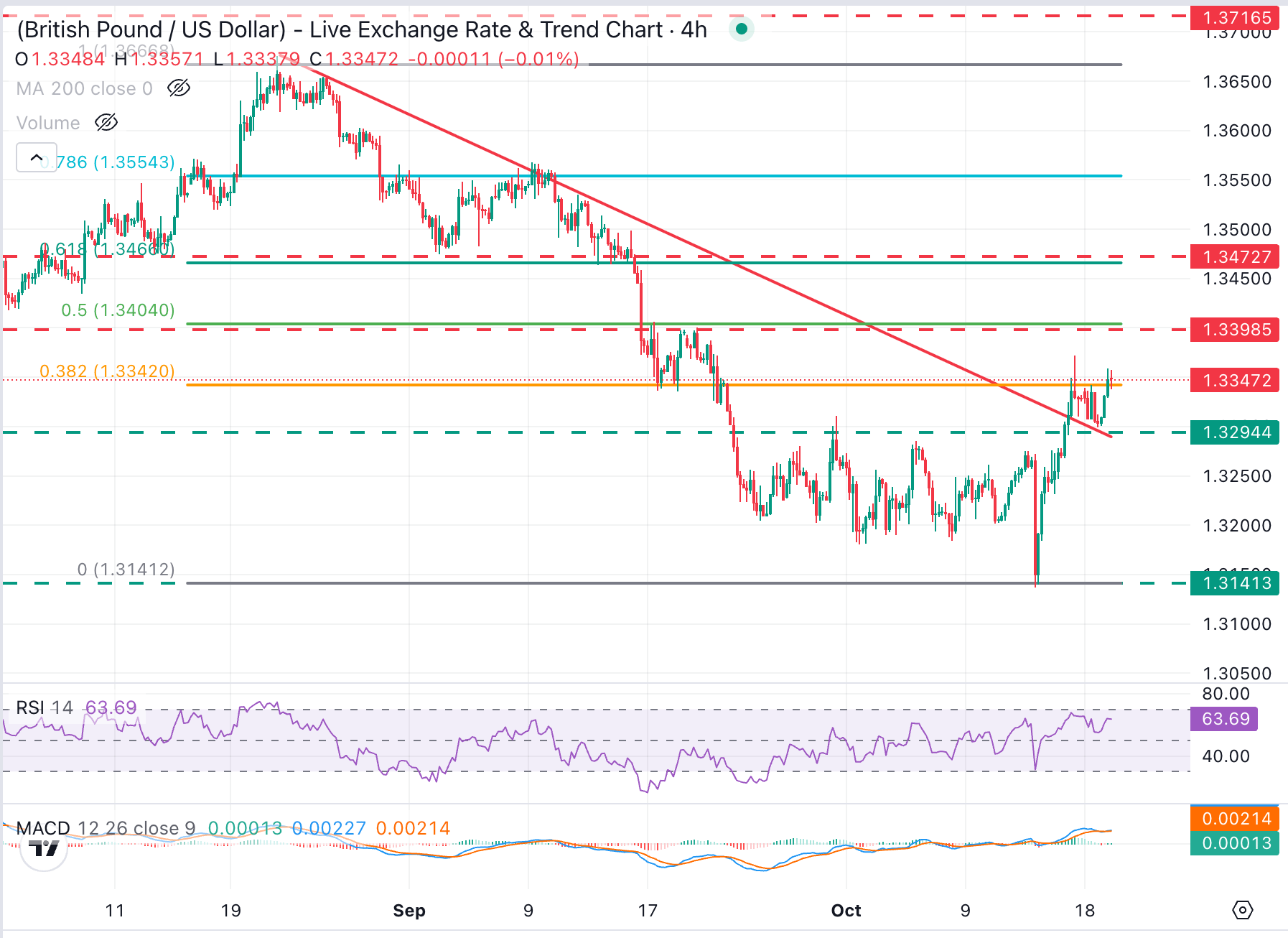
From a technical perspective, the GBP/USD 4-hour chart shows an immediate bullish trend, confirmed by the successful break of the downtrend resistance line from the late August highs, which was retested on Monday. Momentum indicators are supportive, with the Relative Strength Index (14) above 60, although the Moving Average Convergence Divergence (MACD), practically flat around zero, suggests that the uptrend is still frail.
Bulls’ conviction is likely to be challenged in the area between Friday’s high at 1.3370 and the September 22 high near the 1.3400 area. A confirmation above those levels would bring the 61.8% Fibonacci retracement of the August-October downtrend, at 1.3467, and the previous support zone just above 1.3470 (September 2 and 4 lows), into focus.
On the downside, the confluence of the mentioned trendline and the previous range top, around 1.3295, is keeping bears away for now. A reversal below that level would expose the year-to-date lows in the 1.3140 area.
Interest rates FAQs
Interest rates are charged by financial institutions on loans to borrowers and are paid as interest to savers and depositors. They are influenced by base lending rates, which are set by central banks in response to changes in the economy. Central banks normally have a mandate to ensure price stability, which in most cases means targeting a core inflation rate of around 2%. If inflation falls below target the central bank may cut base lending rates, with a view to stimulating lending and boosting the economy. If inflation rises substantially above 2% it normally results in the central bank raising base lending rates in an attempt to lower inflation.
Higher interest rates generally help strengthen a country’s currency as they make it a more attractive place for global investors to park their money.
Higher interest rates overall weigh on the price of Gold because they increase the opportunity cost of holding Gold instead of investing in an interest-bearing asset or placing cash in the bank. If interest rates are high that usually pushes up the price of the US Dollar (USD), and since Gold is priced in Dollars, this has the effect of lowering the price of Gold.
The Fed funds rate is the overnight rate at which US banks lend to each other. It is the oft-quoted headline rate set by the Federal Reserve at its FOMC meetings. It is set as a range, for example 4.75%-5.00%, though the upper limit (in that case 5.00%) is the quoted figure. Market expectations for future Fed funds rate are tracked by the CME FedWatch tool, which shapes how many financial markets behave in anticipation of future Federal Reserve monetary policy decisions.
Economic Indicator
Core Consumer Price Index (YoY)
The United Kingdom (UK) Core Consumer Price Index (CPI), released by the Office for National Statistics on a monthly basis, is a measure of consumer price inflation – the rate at which the prices of goods and services bought by households rise or fall – produced to international standards. The YoY reading compares prices in the reference month to a year earlier. Core CPI excludes the volatile components of food, energy, alcohol and tobacco. The Core CPI is a key indicator to measure inflation and changes in purchasing trends. Generally, a high reading is seen as bullish for the Pound Sterling (GBP), while a low reading is seen as bearish.
Read more.Next release: Wed Oct 21, 2026 06:00
Frequency: Monthly
Consensus: 2.8%
Previous: 2.6%
Source: Office for National Statistics
The Bank of England is tasked with keeping inflation, as measured by the headline Consumer Price Index (CPI) at around 2%, giving the monthly release its importance. An increase in inflation implies a quicker and sooner increase of interest rates or the reduction of bond-buying by the BOE, which means squeezing the supply of pounds. Conversely, a drop in the pace of price rises indicates looser monetary policy. A higher-than-expected result tends to be GBP bullish.
实时报价














本网站提供的信息仅具有一般性质,不构成个人财务建议。在根据本网站上的任何信息采取行动之前,您应结合自身的目标、财务状况和需求,考虑该信息是否适合您。投资差价合约(CFD)和外汇保证金合约具有重大风险,并不适合所有投资者。您的亏损可能超过初始入金。您并不拥有,也不享有任何相关标的资产的权益。我们建议您寻求独立意见,并在交易前确保您已充分了解所涉及的风险。在购买本网站列出的任何产品之前,务必阅读并考虑相关披露文件。本网站提供的信息和广告并非面向任何在其所在国家或司法管辖区使用此类信息会违反当地法律法规的人士。本网站提供的产品和服务不面向美国、马来西亚和泰国居民。
TMGM 是由多家金融监管机构授权。
TMGM 集团下的 Trademax Australia Limited 公司(交易名称为TMGM),是由澳大利亚证券和投资委员(ASIC)监管的金融服务公司,金融服务牌照号为 436416,公司地址为 Level 28, One International Tower, 100 Barangaroo Avenue, 2000 Sydney, NSW Australia.
邮箱:support@tmgm.com.au
TMGM 集团下的 Trademax Global Limited公司(交易名称为TMGM),是由瓦努阿图金融服务委员会(VFSC)监管的金融服务公司,金融牌照号为 40356,注册地址为 1276, Kumul Highway, Port Vila, Vanuatu, Republic of Vanuatu.
邮箱:support@tmgm.com
Trademax Global Markets (SE) Limited,以 TMGM 名义经营,获塞舌尔金融服务管理局(FSA)授权并监管,许可证号为 SD224。公司注册地址为塞舌尔马埃岛 Providence Estate ABIS 中心13号办公室。
邮箱:support@tmgm.com
TMGM集团下的Trademax Global Markets (International) Pty Ltd公司(交易名称为TMGM),是由毛里求斯金融服务委员会监管的金融服务公司. 牌照号为 GB22201012,注册地址为33, Edith Cavell Street C/o IQ EQ Fund Services (Mauritius) Ltd Port Louis, 11324 Mauritius.
邮箱:support@tmgm.com
版权所有 © TMGM。保留所有权利