


Dow Jones Industrial Average drops for a fifth day as AI rout widens
- DJIA falls for a fifth straight session to its lowest since April, near 48,000.
- Reuters says the SEC is examining Nvidia's accounting, and Anthropic sinks.
- US core PCE and third-quarter GDP land Wednesday, a day before Thanksgiving.
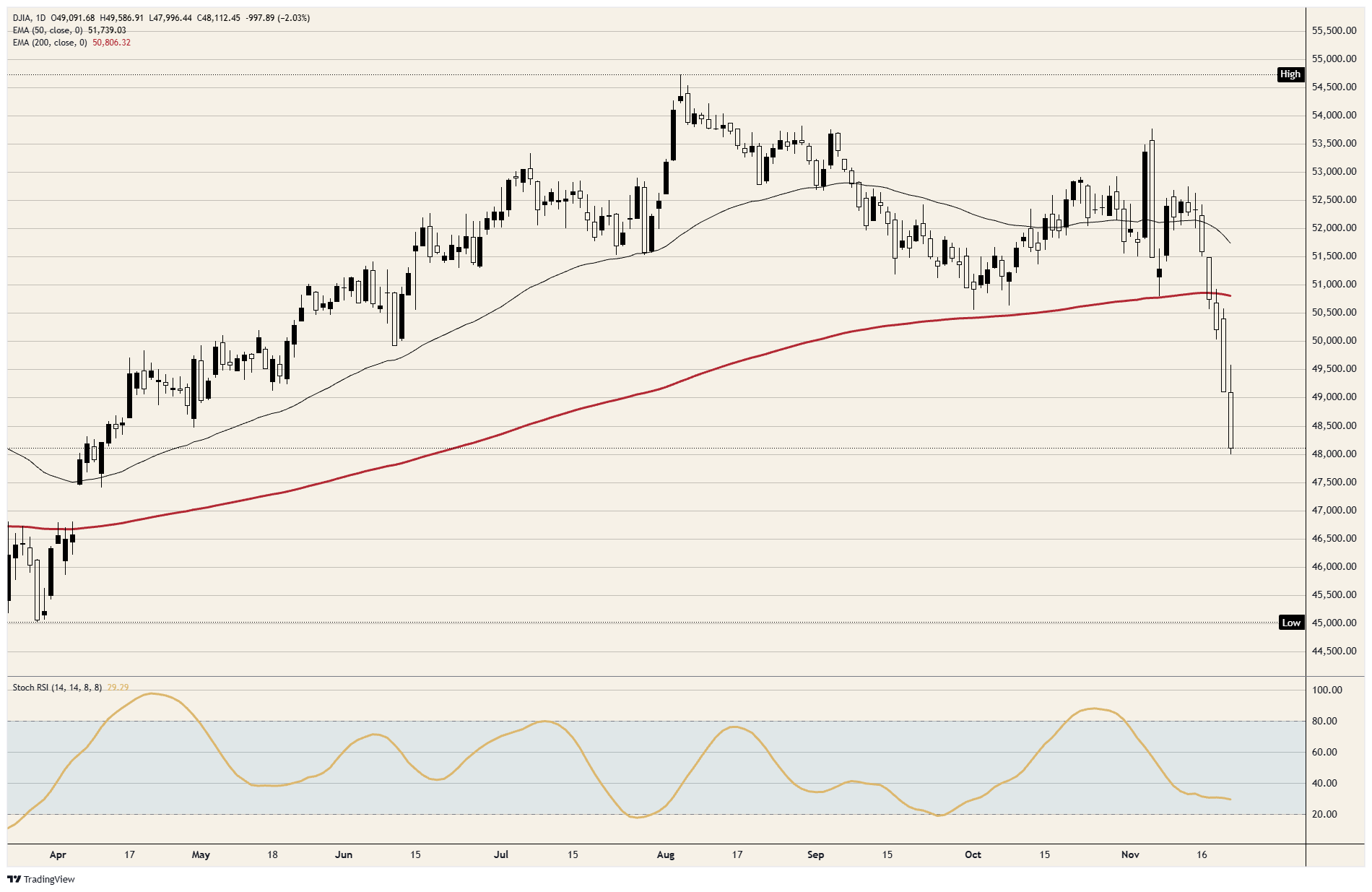
Five falls in five sessions have taken the Dow Jones Industrial Average more than 10% below its August record close, and the selling is no longer confined to artificial intelligence (AI) stocks. The index dropped to just under 48,000, its lowest since April, and is trading near 48,100. Thursday's close under 50,000 was its first since June, and the run is on track to be its worst week since April 2025.

Nvidia (NVDA), a Dow member, is on track for a seventh straight fall after Reuters reported that Securities and Exchange Commission (SEC) enforcement staff are examining its accounting. The shares were lower before the report and doubled the loss after it. The Dow is weighted by share price, so Nvidia near $127 counts for less in it than Goldman Sachs (GS) and Caterpillar (CAT), two of its highest-priced members, which also led the fall.
Anthropic (ANT), whose listing was meant to steady AI stocks, rose 17% on its Thursday debut and traded within 5 cents of its $83 offer price a day later. Fed Governor Cook said September's rate hike wasn't enough to curb inflation, which adds higher borrowing costs to the doubts over AI spending. Walmart (WMT), Johnson & Johnson (JNJ) and Procter & Gamble (PG) rose, which is why the Dow has fallen less than the NASDAQ 100.
On the calendar
US Purchasing Managers Index (PMI) surveys for November come at 14:45 GMT on Monday, before New York Fed President Williams speaks at 21:00 GMT. Traders no longer fully price a Fed hike on December 9, so each Fed speaker now bears on whether one comes at all.
Wednesday, November 25 has October core Personal Consumption Expenditures Price Index (PCE) inflation and the first Gross Domestic Product (GDP) figure for the third quarter at 13:30 GMT, then the Fed's Beige Book at 19:00 GMT. US stock markets are shut on Thursday for Thanksgiving.
On the charts
At Friday's low the index had given back about two-thirds of the climb from April's low near 45,000 to August's peak just under 54,750, and the five-session run accounts for most of that fall. During the run it went through its 200-day Exponential Moving Average (EMA), near 50,750, for the first time since April. The 50-day EMA has turned down near 51,750.
Dow Jones daily chart
Dow Jones FAQs
The Dow Jones Industrial Average, one of the oldest stock market indices in the world, is compiled of the 30 most traded stocks in the US. The index is price-weighted rather than weighted by capitalization. It is calculated by summing the prices of the constituent stocks and dividing them by a factor, currently 0.152. The index was founded by Charles Dow, who also founded the Wall Street Journal. In later years it has been criticized for not being broadly representative enough because it only tracks 30 conglomerates, unlike broader indices such as the S&P 500.
Many different factors drive the Dow Jones Industrial Average (DJIA). The aggregate performance of the component companies revealed in quarterly company earnings reports is the main one. US and global macroeconomic data also contributes as it impacts on investor sentiment. The level of interest rates, set by the Federal Reserve (Fed), also influences the DJIA as it affects the cost of credit, on which many corporations are heavily reliant. Therefore, inflation can be a major driver as well as other metrics which impact the Fed decisions.
Dow Theory is a method for identifying the primary trend of the stock market developed by Charles Dow. A key step is to compare the direction of the Dow Jones Industrial Average (DJIA) and the Dow Jones Transportation Average (DJTA) and only follow trends where both are moving in the same direction. Volume is a confirmatory criteria. The theory uses elements of peak and trough analysis. Dow’s theory posits three trend phases: accumulation, when smart money starts buying or selling; public participation, when the wider public joins in; and distribution, when the smart money exits.
There are a number of ways to trade the DJIA. One is to use ETFs which allow investors to trade the DJIA as a single security, rather than having to buy shares in all 30 constituent companies. A leading example is the SPDR Dow Jones Industrial Average ETF (DIA). DJIA futures contracts enable traders to speculate on the future value of the index and Options provide the right, but not the obligation, to buy or sell the index at a predetermined price in the future. Mutual funds enable investors to buy a share of a diversified portfolio of DJIA stocks thus providing exposure to the overall index.














本网站提供的信息仅具有一般性质,不构成个人财务建议。在根据本网站上的任何信息采取行动之前,您应结合自身的目标、财务状况和需求,考虑该信息是否适合您。投资差价合约(CFD)和外汇保证金合约具有重大风险,并不适合所有投资者。您的亏损可能超过初始入金。您并不拥有,也不享有任何相关标的资产的权益。我们建议您寻求独立意见,并在交易前确保您已充分了解所涉及的风险。在购买本网站列出的任何产品之前,务必阅读并考虑相关披露文件。本网站提供的信息和广告并非面向任何在其所在国家或司法管辖区使用此类信息会违反当地法律法规的人士。本网站提供的产品和服务不面向美国、马来西亚和泰国居民。
TMGM 是由多家金融监管机构授权。
TMGM 集团下的 Trademax Australia Limited 公司(交易名称为TMGM),是由澳大利亚证券和投资委员(ASIC)监管的金融服务公司,金融服务牌照号为 436416,公司地址为 Level 28, One International Tower, 100 Barangaroo Avenue, 2000 Sydney, NSW Australia.
邮箱:support@tmgm.com.au
TMGM 集团下的 Trademax Global Limited公司(交易名称为TMGM),是由瓦努阿图金融服务委员会(VFSC)监管的金融服务公司,金融牌照号为 40356,注册地址为 1276, Kumul Highway, Port Vila, Vanuatu, Republic of Vanuatu.
邮箱:support@tmgm.com
Trademax Global Markets (SE) Limited,以 TMGM 名义经营,获塞舌尔金融服务管理局(FSA)授权并监管,许可证号为 SD224。公司注册地址为塞舌尔马埃岛 Providence Estate ABIS 中心13号办公室。
邮箱:support@tmgm.com
TMGM集团下的Trademax Global Markets (International) Pty Ltd公司(交易名称为TMGM),是由毛里求斯金融服务委员会监管的金融服务公司. 牌照号为 GB22201012,注册地址为33, Edith Cavell Street C/o IQ EQ Fund Services (Mauritius) Ltd Port Louis, 11324 Mauritius.
邮箱:support@tmgm.com
版权所有 © TMGM。保留所有权利