

Savdo
Raqobatbardosh narxlar, chuqur likvidlik va ilg‘or savdo vositalari bilan keng turdagi bozorlarni kashf eting.
Batafsil ma’lumot 
Platforma
TMGM’ning tezlik, aniqlik va yuqori savdo tajribasi uchun yaratilgan kuchli platformasi bilan uzluksiz savdo qiling.
Batafsil ma’lumot Savdo platformasi
Savdo vositalari
Akademiya
Boshlovchilar uchun qulay resurslar, jumladan qo‘llanmalar, vebinarlar va bozor tahlillari orqali savdoning asoslarini o‘rganing.
Batafsil ma’lumot Yangiliklar va tahlil
Savdo imkoniyatlaridan oldinda bo‘lish uchun bozor yangilanishlari va ekspert tahlillarini real vaqt rejimida oling
Batafsil ma’lumot Yangiliklar va tahlil
Haqida
TMGMni boshqalardan ajratib turadigan jihatlarni bilib oling — bizning global mavjudligimiz, tartibga solishdagi mustahkamligimiz va savdoda innovatsiyalarga sodiqligimiz.
Batafsil ma’lumot Nega TMGMni tanlash kerak
Silver Price Forecast: XAG/USD recovers strongly as traders price out Fed bigger rate hike bets
- Silver price recovers strongly to near $42.55 as Fed bigger rate hike expectations wane.
- TD Securities see the Fed delivering three consecutive interest rate hikes.
- Investors keenly await the US PCE Inflation data for October.
The price ofSilver (XAG/USD) starts the week on a strong note, ahead ofthe United States (US) Personal Consumption Expenditure (PCE) Price Index data for October. The white metal snaps a three-day losing spree and is significantly higher almost 3.85% at around $42.55 in the European trade.

Silver bounces back as financial markets have priced out the possibility of that theFederal Reservewould deliver alarge hike in interest rates (Fed) at its December policy meeting.
According to the CME FedWatch tool, there was a marginal possibility of 50 basis points (bps) Fed interest rate hike at the December meeting a week ago.
However, the outlook for Silver is expected to remain bearish as financial markets are confident of back-to-back Fed interest rate hikes in the near term.
TD Securities looks for three straight Fed hikes as resilient US data keeps pressure on inflation
According to TD Securities, “most officials would support consecutive 25bp hikes in December and January,” with the bank also looking for “a third hike in March.” The economists note that “data last week and our expectations for data this week are in line with recent trends,” arguing that “inflation remains above target and is moving in the wrong direction.” At the same time, they point out that “the labor market has stabilized, with some signs of strengthening, and activity data has been robust.” In their view, “the economy can handle more restriction, and the Fed is likely to provide it,” with “the evolution of inflation data” set to determine “the extent and pace of hikes later in the cycle.”
This week, investors will pay attention to the US PCE Inflation data for October, which is scheduled for Wednesday.
Commerzbank points out that the inflation backdrop is unlikely to ease the Fed’s dilemma in the near term, reminding clients that the PCE deflator isthe Fed's preferred price index.. The bank expects the data to underscore persistent price pressures, with “the inflation rate… expected to rise to 3.8% in October, and even without food and energy prices, the inflation rate is expected to be too high at 3.2%.”
Silver Technical Analysis
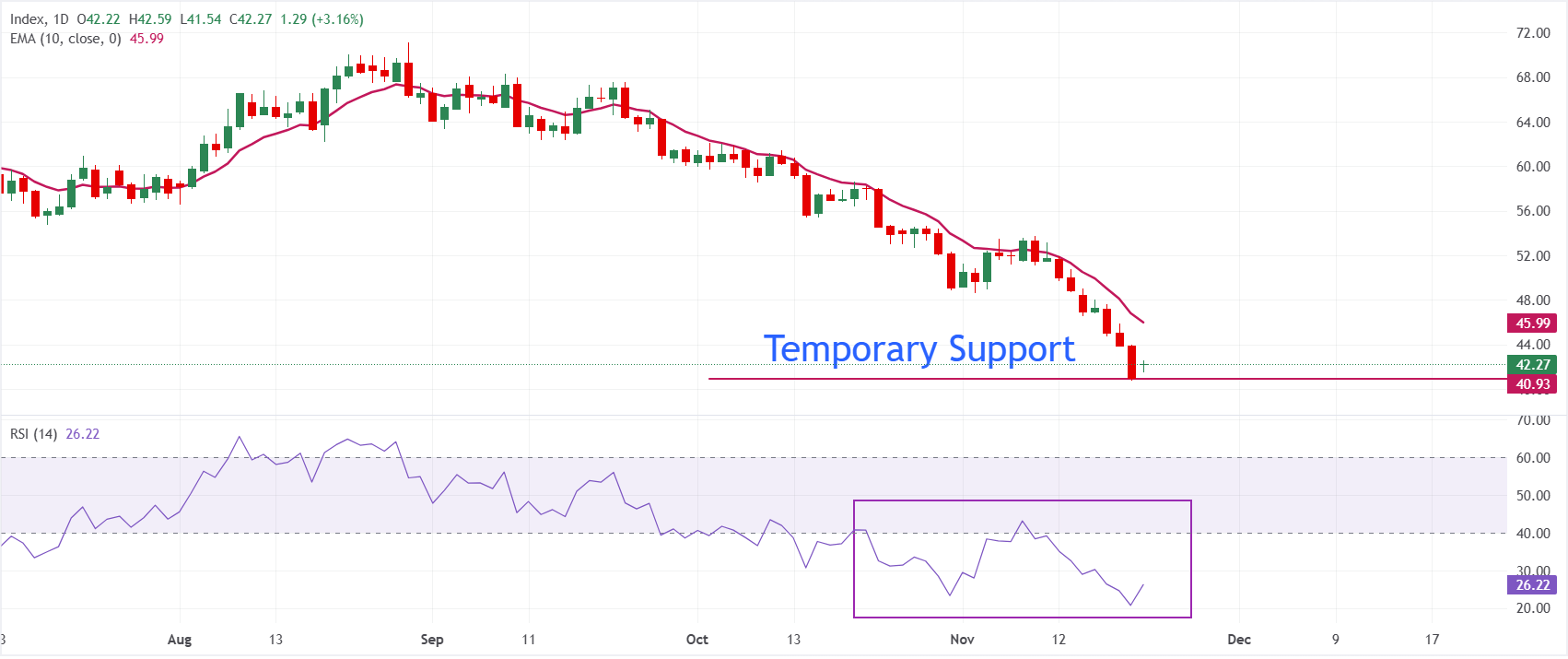
In the daily chart, XAG/USD trades at $42.27, extending a bearish near-term bias as spot holds below the 10-period exponential moving average (EMA) at $45.99. The location of price under this short-term trend gauge suggests that rallies remain vulnerable, while the Relative Strength Index (RSI) near 26 hovers in oversold territory, hinting that any rebound would likely be corrective within a still-pressured backdrop.
On the topside, initial resistance is defined by the 10-day EMA at $45.99, and a daily close above this level would be needed to ease immediate downside pressure and signal a more sustained recovery phase. Looking down, the previous week low at $40.78 is the immediate support zone; a break below this would expose the Silver price to $40.00.
(The technical analysis of this story was written with the help of an AI tool. Know more.)
Silver FAQs
Silver is a precious metal highly traded among investors. It has been historically used as a store of value and a medium of exchange. Although less popular than Gold, traders may turn to Silver to diversify their investment portfolio, for its intrinsic value or as a potential hedge during high-inflation periods. Investors can buy physical Silver, in coins or in bars, or trade it through vehicles such as Exchange Traded Funds, which track its price on international markets.
Silver prices can move due to a wide range of factors. Geopolitical instability or fears of a deep recession can make Silver price escalate due to its safe-haven status, although to a lesser extent than Gold's. As a yieldless asset, Silver tends to rise with lower interest rates. Its moves also depend on how the US Dollar (USD) behaves as the asset is priced in dollars (XAG/USD). A strong Dollar tends to keep the price of Silver at bay, whereas a weaker Dollar is likely to propel prices up. Other factors such as investment demand, mining supply – Silver is much more abundant than Gold – and recycling rates can also affect prices.
Silver is widely used in industry, particularly in sectors such as electronics or solar energy, as it has one of the highest electric conductivity of all metals – more than Copper and Gold. A surge in demand can increase prices, while a decline tends to lower them. Dynamics in the US, Chinese and Indian economies can also contribute to price swings: for the US and particularly China, their big industrial sectors use Silver in various processes; in India, consumers’ demand for the precious metal for jewellery also plays a key role in setting prices.
Silver prices tend to follow Gold's moves. When Gold prices rise, Silver typically follows suit, as their status as safe-haven assets is similar. The Gold/Silver ratio, which shows the number of ounces of Silver needed to equal the value of one ounce of Gold, may help to determine the relative valuation between both metals. Some investors may consider a high ratio as an indicator that Silver is undervalued, or Gold is overvalued. On the contrary, a low ratio might suggest that Gold is undervalued relative to Silver.
Eng yaxshi maqolalar
1USD/IDR: AQSh PMI va PCE maʼlumotlari oldidan rupiya BI koʻmagi va MSCI haqidagi xabarlar taʼsirida Rp18 190 gacha mustahkamlandi2Yevro: 6–12 oylik istiqbolda AQSh dollariga nisbatan asta-sekin pasayishi kutilmoqda – Danske Bank3Pi Network narxi prognozi: PI tarixiy minimumdan V shaklidagi tiklanishni davom ettirmoqda4Germaniyada ishlab chiqarish sektorining dastlabki PMI indeksi noyabr oyida kutilmaganda 55,0 gacha koʻtarilib, oʻsish surʼati tezlashganini koʻrsatdi5Markaziy va Sharqiy Yevropa valyuta bozori: mintaqa valyutalariga pasayish bosimi saqlanib qolmoqda – ING6Ishbilarmonlik faolligi maʼlumotlari diqqat markazida ekan, yevro Britaniya funtiga nisbatan oʻsishini saqlab turibdi7Britaniya funti: AQSH dollariga nisbatan 1,3010 gacha pasayish xavfi mavjud - UOB8WTI narxi prognozi: Yaqin Sharqdagi xavotirlarga qaramay, 83,00 dollardan pastda pasayishga moyil koʻrinmoqda9Bugun Forex bozorida: oltin narxi tiklanib, $3 600 dan oshdi, AQSh dollari esa PMI maʼlumotlari eʼlon qilinishi oldidan pasaymoqda


Boshlang!
Ro‘yxatdan o‘ting va 3 daqiqadan kamroq vaqt ichida Global bozorlariga kirish imkoniga ega bo‘ling

Biz bilan bog‘laning









Kontaktlar
Telefon: +61 2 8036 8388
Faks: +61 2 8036 8388
Email: support@tmgm.com



Ushbu veb-saytda taqdim etilgan ma’lumotlar faqat umumiy xususiyatga ega bo‘lib, shaxsiy moliyaviy maslahat hisoblanmaydi. Ushbu veb-saytdagi har qanday ma’lumot asosida harakat qilishdan oldin, ma’lumotning sizning maqsadlaringiz, moliyaviy ahvolingiz va ehtiyojlaringizga mosligini ko‘rib chiqishingiz kerak. CFD va FX Margin shartnomalariga sarmoya kiritish sezilarli xavflarni o‘z ichiga oladi va barcha investorlar uchun mos emas. Siz boshlang‘ich depozitingizdan ko‘proq yo‘qotishingiz mumkin. Siz asosiy aktivga egalik qilmaysiz va unda hech qanday manfaatga ega emassiz. Savdo qilishdan oldin mustaqil maslahat olishni va ishtirok etuvchi xavflarni to‘liq tushunishingizni tavsiya qilamiz. Veb-saytda keltirilgan har qanday mahsulotni xarid qilishdan oldin oshkor qilish hujjatini o‘qib chiqishingiz va ko‘rib chiqishingiz muhimdir. Ushbu veb-saytda taklif etilgan ma’lumotlar va reklama materiallari bunday foydalanish mahalliy qonunlar va qoidalarga zid bo‘ladigan har qanday mamlakat yoki yurisdiksiyadagi shaxslar tomonidan foydalanish uchun mo‘ljallanmagan. Ushbu veb-saytda taklif etilgan Mahsulotlar va Xizmatlar AQSh, Malayziya va Tailand rezidentlari uchun mo‘ljallanmagan.
TMGM turli yurisdiksiyalarda vakolatli va tartibga solinadi.
Trademax Australia Limited, TMGM nomi ostida faoliyat yuritadi, Avstraliya Qimmatli qog‘ozlar va investitsiyalar komissiyasi (ASIC) tomonidan tartibga solinadi, AFSL raqami 436416 va manzili: Level 28, One International Tower, 100 Barangaroo Avenue, 2000 Sydney, NSW Australia.
Email: support@tmgm.com.au
Trademax Global Limited, TMGM nomi ostida faoliyat yuritadi, Vanuatu Moliyaviy Xizmatlar Komissiyasi (VFSC) tomonidan vakolatli va tartibga solinadi, ro‘yxatga olish raqami 40356 va ro‘yxatdan o‘tgan manzili: 1276, Kumul Highway, Port Vila, Vanuatu, Vanuatu Respublikasi.
Email: support@tmgm.com
Trademax Global Markets (SE) Limited, TMGM nomi ostida faoliyat yuritadi, Seyshel orollari Moliyaviy Xizmatlar Boshqarmasi (FSA) tomonidan 224-sonli SD litsenziyasi bilan vakolatli va tartibga solinadi. Kompaniya Office No 13, Providence Estate ABIS Centre, Mahe, Seychelles manzilida ro‘yxatdan o‘tgan.
Email: support@tmgm.com
Trademax Global Markets (International) Pty Ltd, TMGM nomi ostida faoliyat yuritadi, Mauritius Moliyaviy Xizmatlar Komissiyasi (FSC) tomonidan GB22201012 litsenziya raqami bilan vakolatli va tartibga solinadi hamda 33, Edith Cavell Street C/o IQ EQ Fund Services (Mauritius) Ltd Port Louis, 11324 Mauritius manzilida ro‘yxatdan o‘tgan.
Email: support@tmgm.com
Mualliflik huquqi © TMGM. Barcha huquqlar himoyalangan