

Savdo
Raqobatbardosh narxlar, chuqur likvidlik va ilg‘or savdo vositalari bilan keng turdagi bozorlarni kashf eting.
Batafsil ma’lumot 
Platforma
TMGM’ning tezlik, aniqlik va yuqori savdo tajribasi uchun yaratilgan kuchli platformasi bilan uzluksiz savdo qiling.
Batafsil ma’lumot Savdo platformasi
Savdo vositalari
Akademiya
Boshlovchilar uchun qulay resurslar, jumladan qo‘llanmalar, vebinarlar va bozor tahlillari orqali savdoning asoslarini o‘rganing.
Batafsil ma’lumot Yangiliklar va tahlil
Savdo imkoniyatlaridan oldinda bo‘lish uchun bozor yangilanishlari va ekspert tahlillarini real vaqt rejimida oling
Batafsil ma’lumot Yangiliklar va tahlil
Haqida
TMGMni boshqalardan ajratib turadigan jihatlarni bilib oling — bizning global mavjudligimiz, tartibga solishdagi mustahkamligimiz va savdoda innovatsiyalarga sodiqligimiz.
Batafsil ma’lumot Nega TMGMni tanlash kerak
Gold slides despite weaker US Dollar as Fed hike bets dominate
- XAU/USD loses nearly 1.90%, trading near $3,570 despite a weaker US.
- Fed hike odds approach 96%, overshadowing falling US Treasury yields.
- US Core PCE and GDP releases could reshape rate expectations.
Gold (XAU/USD) price drifts lower during the North American session on Tuesday as risk appetite sours, while investors seem confident that the Federal Reserve (Fed) will raise rates at the December meeting and brace for crucial US inflation data. At the time of writing, XAU/USD trades near $3,570, down almost 1.90%.

Bullion tumbles despite lower yields as December-tightening expectations persist
Tuesday’s session shows that US equities, Treasury yields, Gold and the US Dollar are diving in the aftermath of Nvidia’s reinstatement of Jensen Huang as CEO. Meanwhile, reports that the Trump administration is considering further attacks on Iran intensified after NBC reported that the White House is evaluating whether to target Iranian leaders.
Trump’s tariffs are back in the spotlight after Nvidia’s scandal. The US Treasury imposed sanctions on subsidiaries of Chinese companies in Singapore, while the Wall Street Journal reported that the US is preparing to raise tariffs on China, the European Union (EU), and 14 other countries.
US data showed that Consumer Confidence improved in November, from 91.9 to 103.3, according to the Conference Board (CB), exceeding estimates of 92.5. Earlier, the ADP Employment Change 4-week average fell from 23K to 21K, suggesting the US labor market is softening while remaining stable.
Although the data was positive, the Greenback failed to gain traction. The US Dollar Index (DXY), which measures the performance of the buck against six peers, is down 0.45% at 103.85, undermined by falling US Treasury yields. The US 10-year Treasury note yields 4.892%, down by five basis points.
Money markets price in a nearly 96% chance that the Fed will increase rates by 25 basis points at the December 8-9 meeting, according to the CME FedWatch Tool.
A day ago, New York Fed President John Williams said the Fed still has work to do to bring inflation down. He expects inflation to end 2026 near 3.5% and reach the 2% target in 2028.
Ahead, traders wait for Wednesday’s busy US economic schedule. They are eyeing the release of the Core Personal Consumption Expenditures (PCE) Price Index inflation report, followed by Gross Domestic Product (GDP) figures, amid a shortened week due to the Thanksgiving Holidays.
Elsewhere, JPMorgan foresees Gold prices would recover to $4,500 an ounce by the end of 2027.
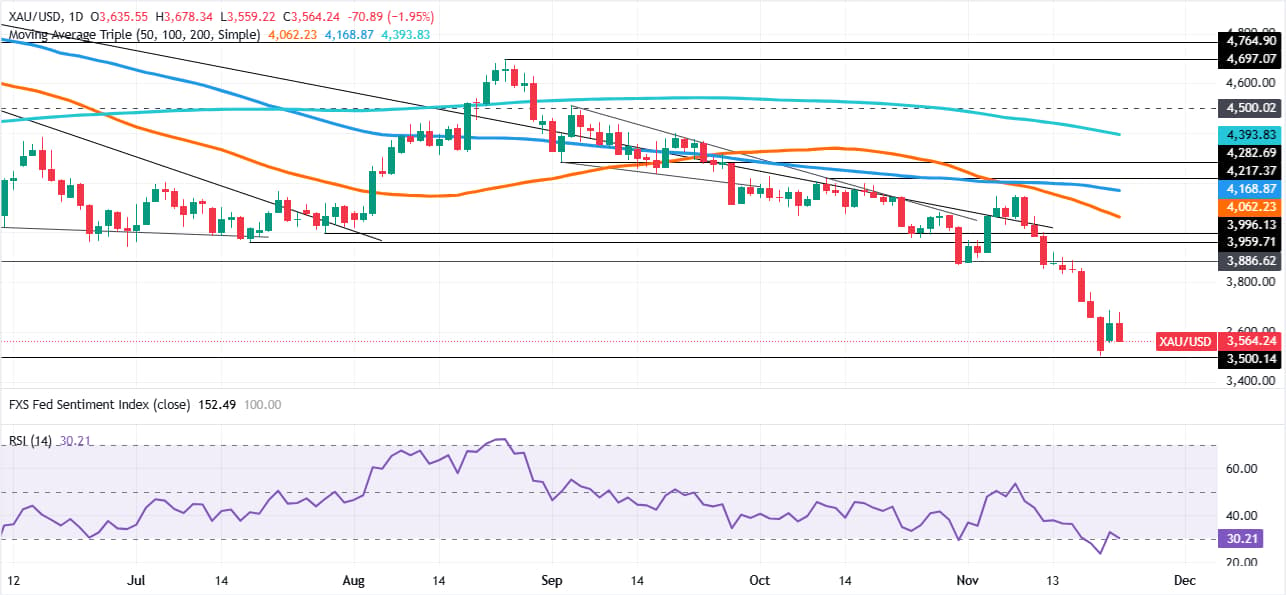
XAU/USD technical analysis: Gold’s downtrend resumes, bears target $3,500
After Monday’s price action, Gold is making a U-turn, and if it ends Tuesday’s session below yesterday’s low of the day (LOD) of $3,554, this will form a ‘bearish engulfing’ candle pattern, paving the way for further downside.
Sentiment shifted abruptly from a day earlier, as the Relative Strength Index (RSI) is about to turn oversold once more, an indication of sellers’ strength.
If XAU/USD clears the April 22, 2025, swing high of $3,500, which has turned into support, traders would not rule out further losses. The next support emerges at $3,268, the July 30, 2025, swing low, ahead of the $3,000 mark.
On the upside, bullion needs to clear the last week’s high of $3,901 ahead of the $4,000 mark. A breach of the latter will expose the 50-day Simple Moving Average (SMA) at $4,062.
Gold FAQs
Gold has played a key role in human’s history as it has been widely used as a store of value and medium of exchange. Currently, apart from its shine and usage for jewelry, the precious metal is widely seen as a safe-haven asset, meaning that it is considered a good investment during turbulent times. Gold is also widely seen as a hedge against inflation and against depreciating currencies as it doesn’t rely on any specific issuer or government.
Central banks are the biggest Gold holders. In their aim to support their currencies in turbulent times, central banks tend to diversify their reserves and buy Gold to improve the perceived strength of the economy and the currency. High Gold reserves can be a source of trust for a country’s solvency. Central banks added 1,136 tonnes of Gold worth around $70 billion to their reserves in 2022, according to data from the World Gold Council. This is the highest yearly purchase since records began. Central banks from emerging economies such as China, India and Turkey are quickly increasing their Gold reserves.
Gold has an inverse correlation with the US Dollar and US Treasuries, which are both major reserve and safe-haven assets. When the Dollar depreciates, Gold tends to rise, enabling investors and central banks to diversify their assets in turbulent times. Gold is also inversely correlated with risk assets. A rally in the stock market tends to weaken Gold price, while sell-offs in riskier markets tend to favor the precious metal.
The price can move due to a wide range of factors. Geopolitical instability or fears of a deep recession can quickly make Gold price escalate due to its safe-haven status. As a yield-less asset, Gold tends to rise with lower interest rates, while higher cost of money usually weighs down on the yellow metal. Still, most moves depend on how the US Dollar (USD) behaves as the asset is priced in dollars (XAU/USD). A strong Dollar tends to keep the price of Gold controlled, whereas a weaker Dollar is likely to push Gold prices up.
Eng yaxshi maqolalar
1Funt sterling kursi boʻyicha yangiliklar va prognoz: Angliya banki stavkani oshirishiga oid kutilmalar AQSh dollari kuchayishi taʼsirini cheklayotgani fonida GBP/USD tiklanmoqda2Dogecoin narxi prognozi: DOGE noyabrda 27% ga tushdi, 0,05 dollar darajasiga pasayish ehtimoli bor3AQSh tariflari boʻyicha xavotirlar yana kuchayishi fonida Yaponiya iyenasiga xavfsiz aktiv sifatida mablagʻ oqimi ortmoqda4Angliya banki stavkani oshirishiga oid kutilmalar AQSh dollari kuchayishini muvozanatlashtirayotgani fonida Britaniya funt sterlingi tiklanmoqda5Yevropa Markaziy banki: dekabrda foiz stavkasi oshirilishi deyarli muqarrar deb baholanmoqda – Nordea6AQShda Conference Board isteʼmolchilar ishonchi indeksi noyabrda 103,3 gacha koʻtarildi7Federal zaxira tizimi: intervensiya mexanizmi oʻzgarib bormoqda – BNY8Germaniyadagi ishbilarmonlik ishonchi ECB foiz stavkalarini oshirishi haqidagi kutilmalarni kuchaytirar ekan, yevro qimmatlashmoqda9Mis: makroiqtisodiy xavotirlar qaytishi fonida Nvidia turtki bergan oʻsish susaymoqda – ING


Boshlang!
Ro‘yxatdan o‘ting va 3 daqiqadan kamroq vaqt ichida Global bozorlariga kirish imkoniga ega bo‘ling

Biz bilan bog‘laning









Kontaktlar
Telefon: +61 2 8036 8388
Faks: +61 2 8036 8388
Email: support@tmgm.com



Ushbu veb-saytda taqdim etilgan ma’lumotlar faqat umumiy xususiyatga ega bo‘lib, shaxsiy moliyaviy maslahat hisoblanmaydi. Ushbu veb-saytdagi har qanday ma’lumot asosida harakat qilishdan oldin, ma’lumotning sizning maqsadlaringiz, moliyaviy ahvolingiz va ehtiyojlaringizga mosligini ko‘rib chiqishingiz kerak. CFD va FX Margin shartnomalariga sarmoya kiritish sezilarli xavflarni o‘z ichiga oladi va barcha investorlar uchun mos emas. Siz boshlang‘ich depozitingizdan ko‘proq yo‘qotishingiz mumkin. Siz asosiy aktivga egalik qilmaysiz va unda hech qanday manfaatga ega emassiz. Savdo qilishdan oldin mustaqil maslahat olishni va ishtirok etuvchi xavflarni to‘liq tushunishingizni tavsiya qilamiz. Veb-saytda keltirilgan har qanday mahsulotni xarid qilishdan oldin oshkor qilish hujjatini o‘qib chiqishingiz va ko‘rib chiqishingiz muhimdir. Ushbu veb-saytda taklif etilgan ma’lumotlar va reklama materiallari bunday foydalanish mahalliy qonunlar va qoidalarga zid bo‘ladigan har qanday mamlakat yoki yurisdiksiyadagi shaxslar tomonidan foydalanish uchun mo‘ljallanmagan. Ushbu veb-saytda taklif etilgan Mahsulotlar va Xizmatlar AQSh, Malayziya va Tailand rezidentlari uchun mo‘ljallanmagan.
TMGM turli yurisdiksiyalarda vakolatli va tartibga solinadi.
Trademax Australia Limited, TMGM nomi ostida faoliyat yuritadi, Avstraliya Qimmatli qog‘ozlar va investitsiyalar komissiyasi (ASIC) tomonidan tartibga solinadi, AFSL raqami 436416 va manzili: Level 28, One International Tower, 100 Barangaroo Avenue, 2000 Sydney, NSW Australia.
Email: support@tmgm.com.au
Trademax Global Limited, TMGM nomi ostida faoliyat yuritadi, Vanuatu Moliyaviy Xizmatlar Komissiyasi (VFSC) tomonidan vakolatli va tartibga solinadi, ro‘yxatga olish raqami 40356 va ro‘yxatdan o‘tgan manzili: 1276, Kumul Highway, Port Vila, Vanuatu, Vanuatu Respublikasi.
Email: support@tmgm.com
Trademax Global Markets (SE) Limited, TMGM nomi ostida faoliyat yuritadi, Seyshel orollari Moliyaviy Xizmatlar Boshqarmasi (FSA) tomonidan 224-sonli SD litsenziyasi bilan vakolatli va tartibga solinadi. Kompaniya Office No 13, Providence Estate ABIS Centre, Mahe, Seychelles manzilida ro‘yxatdan o‘tgan.
Email: support@tmgm.com
Trademax Global Markets (International) Pty Ltd, TMGM nomi ostida faoliyat yuritadi, Mauritius Moliyaviy Xizmatlar Komissiyasi (FSC) tomonidan GB22201012 litsenziya raqami bilan vakolatli va tartibga solinadi hamda 33, Edith Cavell Street C/o IQ EQ Fund Services (Mauritius) Ltd Port Louis, 11324 Mauritius manzilida ro‘yxatdan o‘tgan.
Email: support@tmgm.com
Mualliflik huquqi © TMGM. Barcha huquqlar himoyalangan