

Торговля
Изучите широкий спектр рынков с конкурентными ценами, высокой ликвидностью и передовыми торговыми инструментами.
Узнать больше 
Платформа
Торгуйте без сбоев на мощной платформе TMGM, созданной для скорости, точности и превосходного торгового опыта.
Узнать больше Торговая платформа
Торговые инструменты
Академия
Изучите основы торговли с помощью материалов для начинающих, включая руководства, вебинары и аналитические обзоры рынка.
Узнать больше Новости и аналитика
Получайте актуальные рыночные обновления и экспертную аналитику, чтобы быть на шаг впереди торговых возможностей
Узнать больше Новости и аналитика
О нас
Узнайте, что отличает TMGM — наше глобальное присутствие, надежное регулирование и приверженность инновациям в трейдинге.
Узнать больше Почему выбирают TMGM
Спонсорство
Silver Price Forecast: XAG/USD turns upside down as global AI stocks make strong comeback
- Silver price falls back as traders underpin global AI trade, following Jensen Huang’s return to Nvidia’s board.
- Nvidia’s share jumped over 31% after board reinstated Jensen Huang.
- The US Dollar gains due to hawkish Fed prospects and rallying US tech stocks.
Silver price (XAG/USD) gives back its early gains and turns negative in the European trade on Tuesday. As of writing, the Silver price is down 1.58% to near $42.45 after retreating from day’s high at $44.00.
The white metal comes under pressure as global capital seems returning to Artificial Intelligence (AI) stocks, following the announcement that Nvidia has reinstated Jense Huang as CEO, an unexpected reversal as board explicitly denied his return after confirmation of his extra-marital affairs, including one with alleged Chinese spy.
Nvidia surge reignites AI trade but masks narrow US sector gains
Analysts at Danske Bank highlight the extraordinary corporate and market drama around Nvidia, noting that in the US the company “reinstated Jensen Huang as CEO, less than a week after the board had ruled out his return.” The board indicated it had received input from “senior levels” of the US government and saw no national security risk, while President Donald Trump said he had personally convinced the board.
Danske Bank describes the market reaction as a “stunning reversal” that sent Nvidia shares “31.5% higher” and lifted the broader indices, with the S&P 500 up “4.7%” and the Nasdaq up “6.9%.” They caution, however, that Nvidia “still faces SEC and Justice Department investigations over issues ranging from potential accounting irregularities to alleged chip smuggling,” and point out that senior Democrats “have also pledged to investigate the matter once they take control of Congress in January.”
The bank notes that “the AI trade is carrying through to Asia this morning,” with “Taiwan up 9% and South Korea up 7% at the time of writing.” In contrast, “European equity futures are flat, and US futures point to a slightly higher open,” underscoring the regional divergence in the immediate follow-through.
Danske Bank also “take issue with calling yesterday a broad rally.” They stress that “US tech rose 9%, while energy and consumer staples both fell,” adding that “gaps of around 10 percentage points between sectors are rare and not broad rally in our opinion.” In their view, “yesterday’s move” is best seen as “a partial reversal of the AI sell-off over the past month,” with the volatility backdrop still elevated as “the VIX fell from 36 to 26.”
Meanwhile, increasing US Dollar’s (USD) strength due to improving flows into US stocks and hawkish Federal Reserve (Fed) prospects has also weighed on the Silver price. Technically, a higher US Dollar makes the Silver price an unfavorable risk-reward bet for investors.
As of writing, the US Dollar Index (DXY), trades slightly higher to near 104.38. The DXY is close to its 20-month high of 104.53 posted the previous day.
Silver Technical Analysis
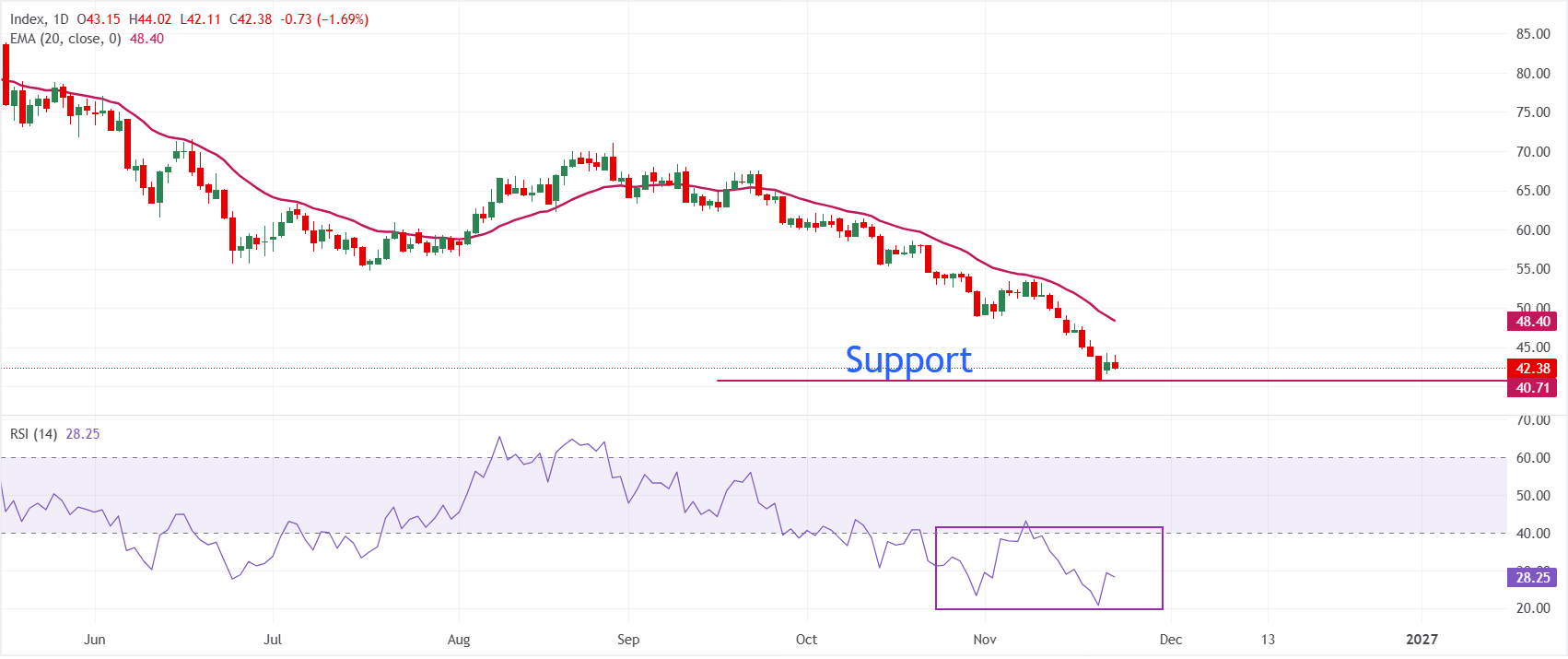
In the daily chart, XAG/USD trades at $42.38, maintaining a bearish near-term bias as it holds well below the 20-day Moving Average Exponential (EMA) at $48.40. The metal remains pressured after a sharp slide from recent highs, while the Relative Strength Index (RSI) at 28.25 sits in oversold territory, hinting that downside momentum is stretched but not yet decisively reversing.
On the topside, immediate resistance aligns with the 20-day EMA at $48.40, where any recovery would likely meet initial supply and test the durability of a rebound. On the downside, the oversold RSI reading near 28 suggests that sellers could begin to hesitate at current levels, but as long as XAG/USD trades beneath the EMA barrier at $48.40, rallies are likely to be viewed as corrective within a broader bearish phase.
(The technical analysis of this story was written with the help of an AI tool. Know more.)
Silver FAQs
Silver is a precious metal highly traded among investors. It has been historically used as a store of value and a medium of exchange. Although less popular than Gold, traders may turn to Silver to diversify their investment portfolio, for its intrinsic value or as a potential hedge during high-inflation periods. Investors can buy physical Silver, in coins or in bars, or trade it through vehicles such as Exchange Traded Funds, which track its price on international markets.
Silver prices can move due to a wide range of factors. Geopolitical instability or fears of a deep recession can make Silver price escalate due to its safe-haven status, although to a lesser extent than Gold's. As a yieldless asset, Silver tends to rise with lower interest rates. Its moves also depend on how the US Dollar (USD) behaves as the asset is priced in dollars (XAG/USD). A strong Dollar tends to keep the price of Silver at bay, whereas a weaker Dollar is likely to propel prices up. Other factors such as investment demand, mining supply – Silver is much more abundant than Gold – and recycling rates can also affect prices.
Silver is widely used in industry, particularly in sectors such as electronics or solar energy, as it has one of the highest electric conductivity of all metals – more than Copper and Gold. A surge in demand can increase prices, while a decline tends to lower them. Dynamics in the US, Chinese and Indian economies can also contribute to price swings: for the US and particularly China, their big industrial sectors use Silver in various processes; in India, consumers’ demand for the precious metal for jewellery also plays a key role in setting prices.
Silver prices tend to follow Gold's moves. When Gold prices rise, Silver typically follows suit, as their status as safe-haven assets is similar. The Gold/Silver ratio, which shows the number of ounces of Silver needed to equal the value of one ounce of Gold, may help to determine the relative valuation between both metals. Some investors may consider a high ratio as an indicator that Silver is undervalued, or Gold is overvalued. On the contrary, a low ratio might suggest that Gold is undervalued relative to Silver.
Лучшие статьи
1Акции: восстановление технологического сектора увеличивает разрыв в динамике секторов - Danske Bank2Прогноз цен ведущих альткоинов: Ripple, Cardano и Solana сводят на нет отскок на фоне оптимизма вокруг Nvidia3Австралийский доллар укрепляется выше 0,6600 на фоне роста аппетита к риску, трейдеры готовятся к публикации данных по индексу цен PCE в США4Индийская рупия: Резервный банк Индии повышает ставки для поддержки укрепления к доллару США - Commerzbank5Евро: слабость к доллару США сохраняется на фоне риска перепроданности – UOB6Прогноз курса USD/CAD: пара снижается к 1,4350, сохраняя бычий настрой в зоне перекупленности7Швейцарский франк стабилен к доллару США, в центре внимания данные PCE8Прогноз цены Cardano: ADA остается вблизи минимумов на фоне продолжающихся продаж со стороны китов9Прогноз по EUR/USD: пара немного растет выше 1,0900, но сохраняет медвежий настрой на фоне перепроданности


Начать!
Зарегистрируйтесь и получите доступ к глобальным рынкам менее чем за 3 минуты

Свяжитесь с нами









Контакты
Телефон: +61 2 8036 8388
Факс: +61 2 8036 8388
Эл. почта: support@tmgm.com
Веб-сайт: https://www.tmgmsea.com



Информация, представленная на этом веб-сайте, носит исключительно общий характер и не является персональной финансовой консультацией. Прежде чем действовать на основании любой информации на этом веб-сайте, вам следует оценить ее уместность с учетом ваших целей, финансового положения и потребностей. Инвестирование в CFD и маржинальные контракты на FX сопряжено со значительными рисками и подходит не всем инвесторам. Вы можете потерять больше, чем ваш первоначальный депозит. Вы не владеете базовым активом и не имеете в нем какой-либо доли. Мы рекомендуем вам обратиться за независимой консультацией и убедиться, что вы полностью понимаете связанные с этим риски, прежде чем начинать торговлю. Важно прочитать и принять во внимание документ с раскрытием информации, прежде чем приобретать любой продукт, указанный на веб-сайте. Информация и рекламные материалы, предлагаемые на этом веб-сайте, не предназначены для использования любым лицом в любой стране или юрисдикции, где такое использование противоречило бы местным законам и нормативным актам. Продукты и услуги, предлагаемые на этом веб-сайте, не предназначены для резидентов США, Малайзии и Таиланда.
TMGM уполномочена и регулируется в различных юрисдикциях.
Trademax Australia Limited, работающая под брендом TMGM, регулируется Australian Securities and Investments Commission (ASIC), AFSL № 436416 и находится по адресу: Level 28, One International Tower, 100 Barangaroo Avenue, 2000 Sydney, NSW Australia.
Email: support@tmgm.com.au
Trademax Global Limited, работающая под брендом TMGM, уполномочена и регулируется Vanuatu Financial Services Commission (VFSC), регистрационный номер 40356, и зарегистрирована по адресу: 1276, Kumul Highway, Port Vila, Vanuatu, Republic of Vanuatu.
Email: support@tmgm.com
Trademax Global Markets (SE) Limited, работающая под брендом TMGM, уполномочена и регулируется Financial Services Authority (FSA) Сейшельских Островов, номер лицензии SD224. Компания зарегистрирована по адресу: Office No 13, Providence Estate ABIS Centre, Mahe, Seychelles.
Email: support@tmgm.com
Trademax Global Markets (International) Pty Ltd, работающая под брендом TMGM, уполномочена и регулируется Financial Services Commission, Mauritius (FSC), лицензия № GB22201012, и зарегистрирована по адресу: 33, Edith Cavell Street C/o IQ EQ Fund Services (Mauritius) Ltd Port Louis, 11324 Mauritius.
Email: support@tmgm.com
Авторское право © TMGM. Все права защищены