

Торговля
Изучите широкий спектр рынков с конкурентными ценами, высокой ликвидностью и передовыми торговыми инструментами.
Узнать больше 
Платформа
Торгуйте без сбоев на мощной платформе TMGM, созданной для скорости, точности и превосходного торгового опыта.
Узнать больше Торговая платформа
Торговые инструменты
Академия
Изучите основы торговли с помощью материалов для начинающих, включая руководства, вебинары и аналитические обзоры рынка.
Узнать больше Новости и аналитика
Получайте актуальные рыночные обновления и экспертную аналитику, чтобы быть на шаг впереди торговых возможностей
Узнать больше Новости и аналитика
О нас
Узнайте, что отличает TMGM — наше глобальное присутствие, надежное регулирование и приверженность инновациям в трейдинге.
Узнать больше Почему выбирают TMGM
Спонсорство
Euro rebounds from a 19-month low before ECB minutes and US inflation
- EUR/USD rebounds from just under 1.0900, its lowest since April 2025.
- Dollar Index gives back its Monday gain as doubts about AI stocks return.
- ECB's October meeting account is due Thursday, after US PCE on Wednesday.
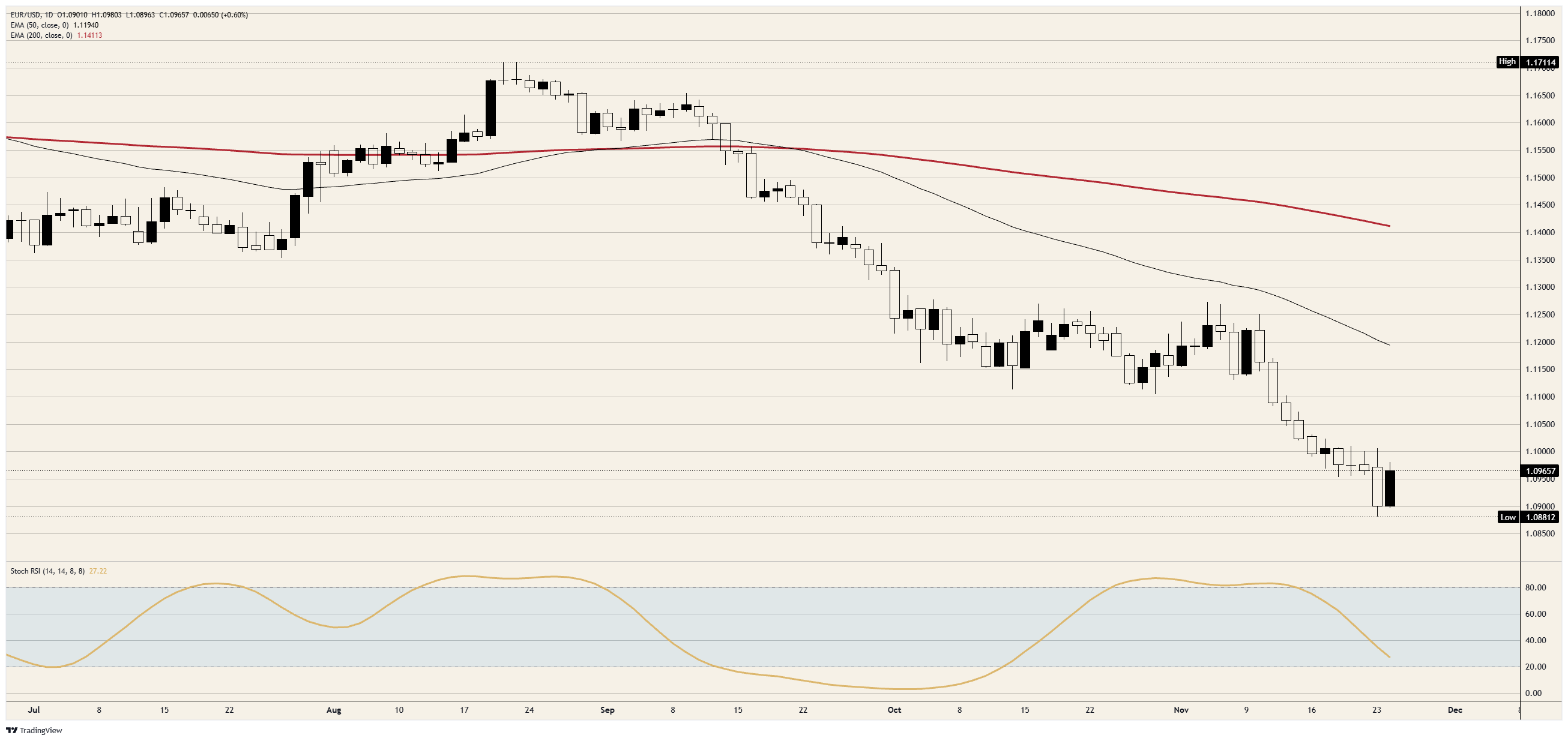
The Dollar Index has given back nearly all of Monday's rise to its highest since April 2025, and the Euro has come off a 19-month low with it. EUR/USD fell to just under 1.0900 before turning higher. It's now trading just above 1.0950 after stalling short of 1.1000.

Nvidia (NVDA) brought back Chief Executive Huang, which lifted US stocks and the Dollar on Monday. That faded as Nvidia and other artificial intelligence (AI) shares fell again, which took the Dollar down and the Euro up. The Fed's December 9 hike is still more than 95% priced, so the rate gap that pushed the Euro to its low hasn't narrowed.
Euro-area business activity was broadly unchanged in November, and France's contraction deepened as its political and budget disputes continued. Markets are pricing in two more quarter-point European Central Bank (ECB) hikes by March 2027 after two this year, which hasn't lifted the Euro while US rates are higher and the Fed is priced to move first. German private-sector activity grew at its fastest pace since 2022 in November, the month the Euro fell to its lowest in 19 months.
On the calendar
The US figures come first: the October Personal Consumption Expenditures Price Index (PCE) and a revised third-quarter Gross Domestic Product (GDP) reading are out at 13:30 GMT on Wednesday, a day before Thanksgiving shuts US markets. Both feed pricing for the Fed's meetings in December and January.
The ECB's account of its October 29 meeting is due at 12:30 GMT on Thursday, and flash November inflation figures for France and Spain follow on Friday. ECB President Lagarde said on November 7 that she couldn't promise a hike on December 17, and both releases feed pricing for that decision.
On the charts
The Euro is about 9% below its January high, just under 1.2100, and about 200 pips below the 1.1100 level that held as a floor for six weeks through November 11. The 50-day Exponential Moving Average (EMA) is just under 1.1200 and the 200-day is just above 1.1400. The shorter average has been below the longer one since mid-September.
EUR/USD daily chart
Euro FAQs
The Euro is the currency for the 20 European Union countries that belong to the Eurozone. It is the second most heavily traded currency in the world behind the US Dollar. In 2022, it accounted for 31% of all foreign exchange transactions, with an average daily turnover of over $2.2 trillion a day. EUR/USD is the most heavily traded currency pair in the world, accounting for an estimated 30% off all transactions, followed by EUR/JPY (4%), EUR/GBP (3%) and EUR/AUD (2%).
The European Central Bank (ECB) in Frankfurt, Germany, is the reserve bank for the Eurozone. The ECB sets interest rates and manages monetary policy. The ECB’s primary mandate is to maintain price stability, which means either controlling inflation or stimulating growth. Its primary tool is the raising or lowering of interest rates. Relatively high interest rates – or the expectation of higher rates – will usually benefit the Euro and vice versa. The ECB Governing Council makes monetary policy decisions at meetings held eight times a year. Decisions are made by heads of the Eurozone national banks and six permanent members, including the President of the ECB, Christine Lagarde.
Eurozone inflation data, measured by the Harmonized Index of Consumer Prices (HICP), is an important econometric for the Euro. If inflation rises more than expected, especially if above the ECB’s 2% target, it obliges the ECB to raise interest rates to bring it back under control. Relatively high interest rates compared to its counterparts will usually benefit the Euro, as it makes the region more attractive as a place for global investors to park their money.
Data releases gauge the health of the economy and can impact on the Euro. Indicators such as GDP, Manufacturing and Services PMIs, employment, and consumer sentiment surveys can all influence the direction of the single currency. A strong economy is good for the Euro. Not only does it attract more foreign investment but it may encourage the ECB to put up interest rates, which will directly strengthen the Euro. Otherwise, if economic data is weak, the Euro is likely to fall. Economic data for the four largest economies in the euro area (Germany, France, Italy and Spain) are especially significant, as they account for 75% of the Eurozone’s economy.
Another significant data release for the Euro is the Trade Balance. This indicator measures the difference between what a country earns from its exports and what it spends on imports over a given period. If a country produces highly sought after exports then its currency will gain in value purely from the extra demand created from foreign buyers seeking to purchase these goods. Therefore, a positive net Trade Balance strengthens a currency and vice versa for a negative balance.
Лучшие статьи
1Фунт вновь выше 1,31: на очереди данные по инфляции в США2Реализованные убытки по биткоину достигли уровней времен FTX, а BTC рискует упасть до 53 200 долларов3Индекс Dow Jones Industrial Average вновь на отметке 50 000, а Nvidia возглавляет снижение в технологическом секторе4Прогноз цены Ethereum: ETH опускается ниже $1 700 на фоне давления на крипторынок из-за опасений по поводу пошлин5Данные по инфляции в Австралии, вероятно, станут головной болью для Резервного банка Австралии6Китайский юань: потенциал роста к доллару США ограничен – UOB7Сегодня на рынке Форекс: инфляция в Австралии в центре внимания перед насыщенным днем публикаций в США накануне Дня благодарения8Прогноз цен на серебро: поддержка на уровне $40 под угрозой на фоне падения XAG/USD9Канадский доллар укрепляется на фоне предупреждения главы Банка Канады о сохраняющихся инфляционных рисках


Начать!
Зарегистрируйтесь и получите доступ к глобальным рынкам менее чем за 3 минуты

Свяжитесь с нами









Контакты
Телефон: +61 2 8036 8388
Факс: +61 2 8036 8388
Эл. почта: support@tmgm.com
Веб-сайт: https://www.tmgmsea.com



Информация, представленная на этом веб-сайте, носит исключительно общий характер и не является персональной финансовой консультацией. Прежде чем действовать на основании любой информации на этом веб-сайте, вам следует оценить ее уместность с учетом ваших целей, финансового положения и потребностей. Инвестирование в CFD и маржинальные контракты на FX сопряжено со значительными рисками и подходит не всем инвесторам. Вы можете потерять больше, чем ваш первоначальный депозит. Вы не владеете базовым активом и не имеете в нем какой-либо доли. Мы рекомендуем вам обратиться за независимой консультацией и убедиться, что вы полностью понимаете связанные с этим риски, прежде чем начинать торговлю. Важно прочитать и принять во внимание документ с раскрытием информации, прежде чем приобретать любой продукт, указанный на веб-сайте. Информация и рекламные материалы, предлагаемые на этом веб-сайте, не предназначены для использования любым лицом в любой стране или юрисдикции, где такое использование противоречило бы местным законам и нормативным актам. Продукты и услуги, предлагаемые на этом веб-сайте, не предназначены для резидентов США, Малайзии и Таиланда.
TMGM уполномочена и регулируется в различных юрисдикциях.
Trademax Australia Limited, работающая под брендом TMGM, регулируется Australian Securities and Investments Commission (ASIC), AFSL № 436416 и находится по адресу: Level 28, One International Tower, 100 Barangaroo Avenue, 2000 Sydney, NSW Australia.
Email: support@tmgm.com.au
Trademax Global Limited, работающая под брендом TMGM, уполномочена и регулируется Vanuatu Financial Services Commission (VFSC), регистрационный номер 40356, и зарегистрирована по адресу: 1276, Kumul Highway, Port Vila, Vanuatu, Republic of Vanuatu.
Email: support@tmgm.com
Trademax Global Markets (SE) Limited, работающая под брендом TMGM, уполномочена и регулируется Financial Services Authority (FSA) Сейшельских Островов, номер лицензии SD224. Компания зарегистрирована по адресу: Office No 13, Providence Estate ABIS Centre, Mahe, Seychelles.
Email: support@tmgm.com
Trademax Global Markets (International) Pty Ltd, работающая под брендом TMGM, уполномочена и регулируется Financial Services Commission, Mauritius (FSC), лицензия № GB22201012, и зарегистрирована по адресу: 33, Edith Cavell Street C/o IQ EQ Fund Services (Mauritius) Ltd Port Louis, 11324 Mauritius.
Email: support@tmgm.com
Авторское право © TMGM. Все права защищены