

Сауда
Бәсекеге қабілетті бағалар, жоғары өтімділік және озық сауда құралдары арқылы нарықтардың кең ауқымын зерттеңіз.
Толығырақ 
Платформа
TMGM-нің жылдамдыққа, дәлдікке және жоғары деңгейлі сауда тәжірибесіне арналған қуатты платформасымен сауданы кедергісіз жүргізіңіз.
Толығырақ Сауда платформасы
Академия
Бастауыштарға арналған нұсқаулықтар, вебинарлар және нарық талдаулары сияқты ресурстар арқылы сауданың негіздерін үйреніңіз.
Толығырақ TMGM Академиясы
Жаңалықтар және талдау
Сауда мүмкіндіктерінен алда болу үшін нақты уақыттағы нарық жаңартулары мен сараптамалық талдауды алыңыз
Толығырақ Жаңалықтар және талдау
Туралы
TMGM-ді ерекшелендіретін жайттарды біліңіз — біздің жаһандық ауқымымыз, реттеушілік беріктігіміз және трейдингтегі инновацияларға деген адалдығымыз.
Толығырақ Неліктен TMGM-ді таңдау керек
Indian Rupee outperforms amid strong foreign inflows, shrugging off surging US Dollar
- The Indian Rupee hits a fresh six-month high against the US Dollar.
- FIIs continue to raise their stake in the Indian stock market.
- The US Dollar outperforms its other peers as hopes of Fed’s bigger rate hike come into picture.
The Indian Rupee (INR) rises further against the US Dollar (USD) on Thursday, posting a fresh six-month low. The USD/INR pair falls to near 93.65 as the Indian currency outperforms on the back of strong inflows of overseas investment into the Indian stock market.

Foreign Institutional Investors (FIIs) continue to increase their investment in the Indian equity market as fresh headwinds in the global Artificial Intelligence (AI) stocks and falling energy prices have underpinned “India” as a competitive bet.
So far in November, FIIs have remained net buyers on all trading days, except Diwali Muhurat session, that fell on Sunday, November 08. Foreign investors have made a cumulative investment of Rs. 65,735.57 crore.
What are the fresh headwinds in global AI sector?
Concerns about the continuation of spending on AI infrastructure, following the victory of Democrats in the United States (US) midterm elections, pushed AI-related stocks into turmoil.
And now fears of replacement of Nvidia’s CEO Jensen Huang after reports from New York Times (NYT) of his extramarital affair with alleged Chinese spy Alice Huang and rumours of a relationship with his subordinate Kimberly Powell, Nvidia's vice president of health care, could put AI stocks under pressure.
The Wall Street Journal (WSJ) has reported that Nvidia's board was preparing to oust the CEO, adding that the next 48 hours as potentially volatile.
Lower oil prices – a tailwind for net energy importers
Falling oil prices due to hopes that the US and Iran would prefer a deal rather than renewing military attacks have improved the appeal of currencies from economies, such as India, which rely heavily on oil imports to meet their energy needs.
As of writing, the MCX Crude Oil contract expiring on November 19 is down 2.42%, slightly below Rs. 8,000.
Investors ignore US Dollar’s outperformance
The Indian currency continues to outperform the US Dollar even as the latter has surged significantly in the past few trading days. In the Asian trade, the US Dollar Index (DXY), which gauges the Greenback’s value against six major currencies, posts a fresh 18-month high at around 103.06.
The US Dollar strengthens as financial markets take the possibility of a bigger interest rate hike by the Federal Reserve (Fed) in the December policy meeting into consideration.
According to TD Securities, the “strong upside surprise in the Consumer Price Index (CPI) data makes a December hike all but certain,” with the bank reiterating that the data “certainly seals a Dec rate hike by the Fed.” Strategists note that “after Waller's speech on Tuesday, the debate has now shifted to whether the FOMC will go 25 or 50bps,” as Governor Waller’s pre-CPI remarks have sharpened the focus on the need for a potential “catch-up” move. TD Securities writes that the discussion will now centre on whether the Fed should implement a “catch-up 50bps rate hike in December, or whether to maintain course with a 25bps rate increase and provide strong guidance toward a potential January follow-through.” For now, they emphasize that “we still favor a 25bp hike with a rising risk of another hike in January.”
USD/INR Technical Analysis
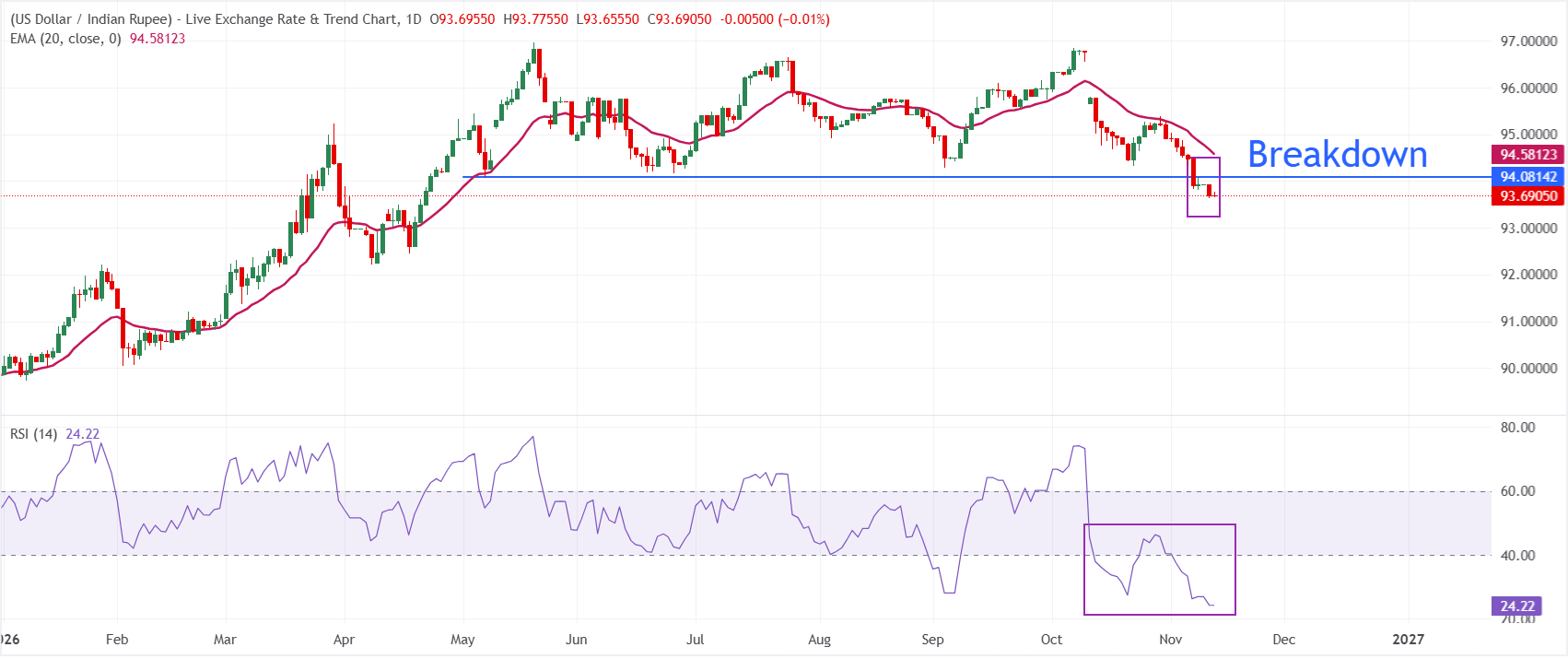
In the daily chart, USD/INR trades at 93.69, maintaining a bearish near-term bias as spot holds below the 20-period exponential moving average (EMA) at 94.58.
The pair’s slide under this short-term trend benchmark suggests sellers remain in control, while the Relative Strength Index (14) around 24 signals oversold conditions that could slow the downside without yet implying a confirmed reversal.
On the topside, immediate resistance aligns with the 20-day EMA at 94.5812, which caps recovery attempts and defines the first hurdle for any meaningful rebound. Looking down, the pair could extend its decline to near 93.00
(The technical analysis of this story was written with the help of an AI tool. Know more.)
Indian Rupee FAQs
The Indian Rupee (INR) is one of the most sensitive currencies to external factors. The price of Crude Oil (the country is highly dependent on imported Oil), the value of the US Dollar – most trade is conducted in USD – and the level of foreign investment, are all influential. Direct intervention by the Reserve Bank of India (RBI) in FX markets to keep the exchange rate stable, as well as the level of interest rates set by the RBI, are further major influencing factors on the Rupee.
The Reserve Bank of India (RBI) actively intervenes in forex markets to maintain a stable exchange rate, to help facilitate trade. In addition, the RBI tries to maintain the inflation rate at its 4% target by adjusting interest rates. Higher interest rates usually strengthen the Rupee. This is due to the role of the ‘carry trade’ in which investors borrow in countries with lower interest rates so as to place their money in countries’ offering relatively higher interest rates and profit from the difference.
Macroeconomic factors that influence the value of the Rupee include inflation, interest rates, the economic growth rate (GDP), the balance of trade, and inflows from foreign investment. A higher growth rate can lead to more overseas investment, pushing up demand for the Rupee. A less negative balance of trade will eventually lead to a stronger Rupee. Higher interest rates, especially real rates (interest rates less inflation) are also positive for the Rupee. A risk-on environment can lead to greater inflows of Foreign Direct and Indirect Investment (FDI and FII), which also benefit the Rupee.
Higher inflation, particularly, if it is comparatively higher than India’s peers, is generally negative for the currency as it reflects devaluation through oversupply. Inflation also increases the cost of exports, leading to more Rupees being sold to purchase foreign imports, which is Rupee-negative. At the same time, higher inflation usually leads to the Reserve Bank of India (RBI) raising interest rates and this can be positive for the Rupee, due to increased demand from international investors. The opposite effect is true of lower inflation.
Үздік мақалалар
1Қытайдың сауда профициті қазанда қысқарған тұста австралиялық доллар әлсіз күйде қалды.2Қытайдың сауда профициті қазанда күтілгеннен де көп қысқарып, CNY 712,72 млрд болды.3АҚШ долларының индексі (DXY) 101,70 маңында өзгеріссіз қалып, Иранға қатысты белгісіздік аясында АҚШ-тың CPI есебін күтуде4Қытай экспорты қазанда жылдық мәнде 35,2%-ға өсіп, 33,5% болған болжамнан асып түсті.5Қытай импортының жылдық өсімі қазанда күтілгеннен жоғары болды (32%): нақты көрсеткіш — 41,6%6Қытайдың сауда балансы қазан айында $105.28B болды, бұл күтілген $125.8B көрсеткішінен төмен.7Қытайдың қазан айындағы сауда балансының көрсеткіші 712,78 млрд юань болды, бұл 859 млрд юаньдық болжамнан төмен.8Қытай экспорты (ж/ж), CNY: қазанда алдыңғы 29,6%-дан 28,7%-ға дейін төмендеді.9Иранмен келіссөздер NZD/USD бағамын көтере алмаған соң, Жаңа Зеландия доллары тұрақтанды.

Бастау!
Тіркеліп, 3 минуттан аз уақытта жаһандық нарықтарға қол жеткізіңіз

Бізбен байланысыңыз









Байланыстар
Телефон: +61 2 8036 8388
Факс: +61 2 8036 8388
Эл. пошта: support@tmgm.com



Осы веб-сайтта берілген ақпарат тек жалпы сипатта ғана ұсынылады және жеке қаржылық кеңес болып табылмайды. Осы веб-сайттағы кез келген ақпаратқа сүйенбес бұрын, оның сіздің мақсаттарыңызға, қаржылық жағдайыңызға және қажеттіліктеріңізге сәйкестігін бағалауыңыз керек. CFD және FX Margin Contracts-қа инвестиция салу елеулі тәуекелдермен байланысты және барлық инвесторлар үшін қолайлы емес. Сіз бастапқы салымыңыздан артық қаражат жоғалтуыңыз мүмкін. Сіз базалық активке ешқандай меншік құқығына немесе үлеске ие болмайсыз. Сауда жасамас бұрын тәуелсіз кеңес алуды және тәуекелдерді толық түсінуді ұсынамыз. Веб-сайтта көрсетілген кез келген өнімді сатып алмас бұрын, ақпараттық құжатты оқып, оны мұқият қарастыру маңызды. Осы веб-сайтта ұсынылған ақпарат пен жарнамалар жергілікті заңдар мен ережелерге қайшы келетін кез келген елде немесе юрисдикцияда тұратын адамдардың пайдалануына арналмаған. Осы веб-сайтта ұсынылатын Өнімдер мен Қызметтер Америка Құрама Штаттары, Малайзия және Таиланд тұрғындарына арналмаған.
TMGM әртүрлі юрисдикцияларда уәкілетті және реттеледі.
Trademax Australia Limited, TMGM атауымен жұмыс істейді, Австралияның Бағалы қағаздар және инвестициялар жөніндегі комиссиясымен (ASIC) реттеледі, AFSL № 436416 және мына мекенжайда орналасқан: Level 28, One International Tower, 100 Barangaroo Avenue, 2000 Sydney, NSW Australia.
Электрондық пошта: support@tmgm.com.au
Trademax Global Limited, TMGM атауымен жұмыс істейді, Вануату Қаржылық қызметтер комиссиясымен (VFSC) уәкілетті және реттеледі, тіркеу нөмірі 40356, тіркелген мекенжайы: 1276, Kumul Highway, Port Vila, Vanuatu, Republic of Vanuatu.
Электрондық пошта: support@tmgm.com
Trademax Global Markets (SE) Limited, TMGM атауымен жұмыс істейді, Сейшел аралдарының Қаржылық қызметтер басқармасы (FSA) тарапынан уәкілетті және реттеледі, лицензия нөмірі SD224. Компания мына мекенжайда тіркелген: Office No 13, Providence Estate ABIS Centre, Mahe, Seychelles.
Электрондық пошта: support@tmgm.com
Trademax Global Markets (International) Pty Ltd, TMGM атауымен жұмыс істейді, Mauritius Қаржылық қызметтер комиссиясымен (FSC) № GB22201012 лицензиясы бойынша уәкілетті және реттеледі, тіркелген мекенжайы: 33, Edith Cavell Street C/o IQ EQ Fund Services (Mauritius) Ltd Port Louis, 11324 Mauritius.
Электрондық пошта: support@tmgm.com
Авторлық құқық © TMGM. Барлық құқықтар қорғалған