

Trading
Explorez une large gamme de marchés avec des prix compétitifs, une liquidité profonde et des outils de trading avancés.
En savoir plus 
Plateforme
Tradez en toute fluidité avec la plateforme puissante de TMGM, conçue pour la vitesse, la précision et une expérience de trading supérieure.
En savoir plus Plateforme de trading
Outils de trading
Académie
Apprenez les fondamentaux du trading avec des ressources adaptées aux débutants, incluant des guides, des webinaires et des analyses de marché.
En savoir plus Actualités et analyses
Obtenez des mises à jour de marché en temps réel et des analyses d'experts pour anticiper les opportunités de trading
En savoir plus Actualités et analyses
À propos
Découvrez ce qui distingue TMGM — notre présence mondiale, notre solidité réglementaire et notre engagement envers l'innovation dans le trading.
En savoir plus Pourquoi choisir TMGM
Euro gives up early gains amid higher oil prices, French fiscal risks
- Euro surrenders early gains against the US Dollar due to multiple headwinds.
- Elevated oil prices and French fiscal risks continue to keep the Euro under pressure.
- Both the Fed and the ECB are expected to leave interest rates unchanged next week.
The Euro (EUR) gives back its early gains against the US Dollar (USD) and flattens at around 1.1234 during the European trade on Thursday. The major currency pair comes under pressure as the Euro faces multiple headwinds.
Euro sentiment pressured by energy costs and French debt concerns

Strategists at Danske Bank observe that the latest move lower in the Euro has been primarily a sentiment-driven story, stressing that “the decline in the pair is driven by the combination of high energy prices and EUR-pessimism on the back of French debt worries.” They note that these factors have reinforced existing caution toward the single currency, keeping investors wary of adding Euro exposure despite the absence of a clear directional catalyst from broader markets.
Higher oil prices bode poorly for the Euro, given that the continent relies heavily on its imports to meet its energy demands. As of writing, the WTI Oil price trades 2% higher to near $99.50.
Meanwhile, investors await the flash Eurozone-United States (US) PMI data for October, which is scheduled for Friday. In both the Eurozone and the US, overall business activity is expected to have expanded again, but at a moderate pace.
Going forward, key triggers for the Euro and US Dollar will be monetary policy announcements by the European Central Bank (ECB) and the Federal Reserve (Fed) next week, in which both are expected to leave interest rates unchanged.
EUR/USD Technical Analysis
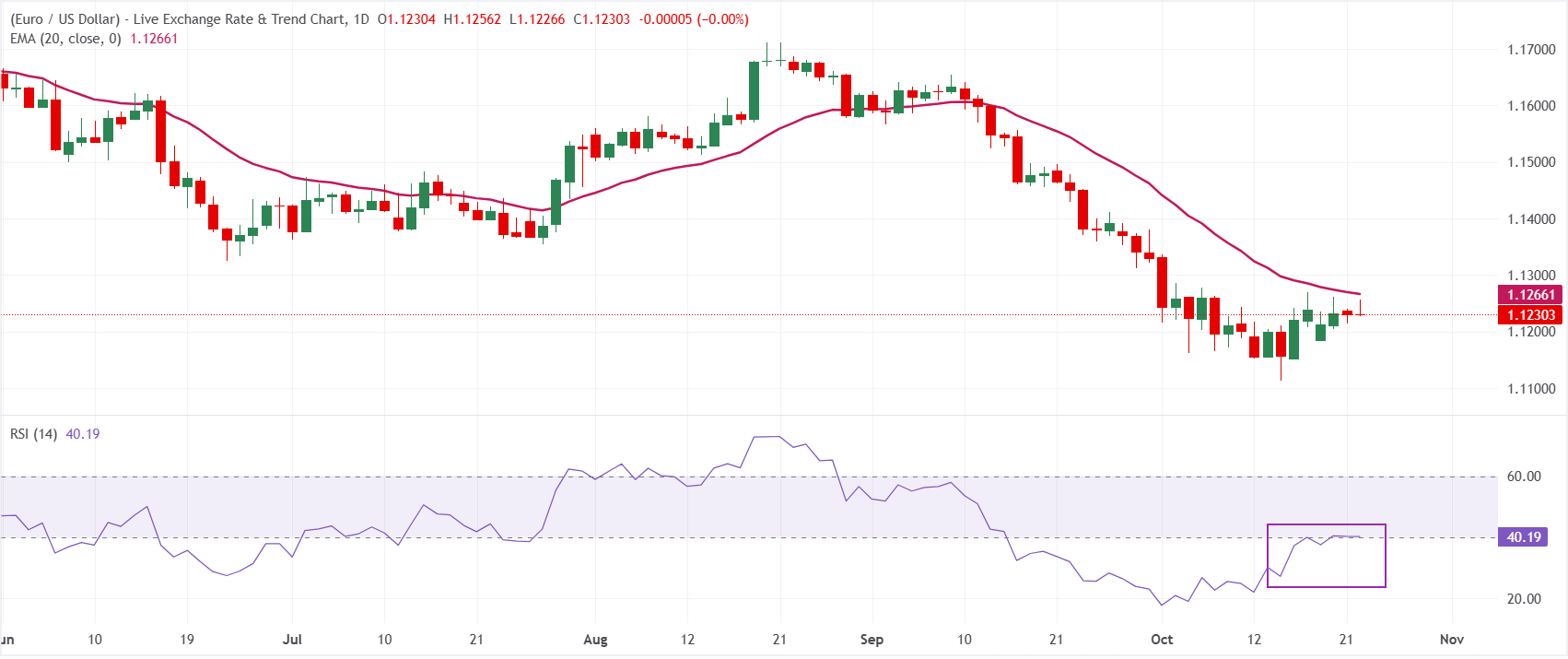
In the daily chart, EUR/USD trades at 1.1231, holding below the 20-day Exponential Moving Average (EMA) at 1.1266 and keeping a mild bearish bias in place. The pair remains capped by this short-term EMA, suggesting rallies are still being sold, while the Relative Strength Index (RSI) near 40 hints at weak but stabilizing downside momentum rather than outright oversold conditions.
On the topside, the 20-day EMA at 1.1266 is the immediate resistance that bulls need to reclaim to ease the current pressure and open the way for a more sustained recovery. On the downside, the absence of nearby measured supports in the data set leaves spot vulnerable to further slippage toward prior price lows, with sentiment likely to stay fragile while EUR/USD trades beneath the short-term EMA.
(The technical analysis of this story was written with the help of an AI tool. Know more.)
Euro FAQs
The Euro is the currency for the 20 European Union countries that belong to the Eurozone. It is the second most heavily traded currency in the world behind the US Dollar. In 2022, it accounted for 31% of all foreign exchange transactions, with an average daily turnover of over $2.2 trillion a day. EUR/USD is the most heavily traded currency pair in the world, accounting for an estimated 30% off all transactions, followed by EUR/JPY (4%), EUR/GBP (3%) and EUR/AUD (2%).
The European Central Bank (ECB) in Frankfurt, Germany, is the reserve bank for the Eurozone. The ECB sets interest rates and manages monetary policy. The ECB’s primary mandate is to maintain price stability, which means either controlling inflation or stimulating growth. Its primary tool is the raising or lowering of interest rates. Relatively high interest rates – or the expectation of higher rates – will usually benefit the Euro and vice versa. The ECB Governing Council makes monetary policy decisions at meetings held eight times a year. Decisions are made by heads of the Eurozone national banks and six permanent members, including the President of the ECB, Christine Lagarde.
Eurozone inflation data, measured by the Harmonized Index of Consumer Prices (HICP), is an important econometric for the Euro. If inflation rises more than expected, especially if above the ECB’s 2% target, it obliges the ECB to raise interest rates to bring it back under control. Relatively high interest rates compared to its counterparts will usually benefit the Euro, as it makes the region more attractive as a place for global investors to park their money.
Data releases gauge the health of the economy and can impact on the Euro. Indicators such as GDP, Manufacturing and Services PMIs, employment, and consumer sentiment surveys can all influence the direction of the single currency. A strong economy is good for the Euro. Not only does it attract more foreign investment but it may encourage the ECB to put up interest rates, which will directly strengthen the Euro. Otherwise, if economic data is weak, the Euro is likely to fall. Economic data for the four largest economies in the euro area (Germany, France, Italy and Spain) are especially significant, as they account for 75% of the Eurozone’s economy.
Another significant data release for the Euro is the Trade Balance. This indicator measures the difference between what a country earns from its exports and what it spends on imports over a given period. If a country produces highly sought after exports then its currency will gain in value purely from the extra demand created from foreign buyers seeking to purchase these goods. Therefore, a positive net Trade Balance strengthens a currency and vice versa for a negative balance.
ARTICLES POPULAIRES
1Les contrats à terme sur le Dow Jones reculent alors que le rallye porté par les valeurs technologiques s’essouffle2Actions : Tesla assombrit le rallye technologique malgré les résultats de Meta supérieurs aux attentes - Deutsche Bank3Le yen japonais se replie légèrement après avoir atteint un nouveau plus haut mensuel face à un dollar globalement affaibli4Le dollar néo-zélandais recule sur fond de ralentissement de l’inflation au troisième trimestre5Roupie indienne : le ton restrictif de la RBI soutient l’INR – DBS6Livre turque : reprise du cycle d’assouplissement monétaire, le portage tient bon – ING7La roupie indienne ne parvient pas à prolonger sa série de hausses face au dollar américain jeudi8Prévisions du cours de l’argent : le XAG/USD décroche et se rapproche de son plus bas de l’année à 54,77 $9Prévisions de cours de l’indice du dollar américain : nouveau plus bas de trois semaines autour de 101,45
COTATIONS EN DIRECT


Commencez !
Inscrivez-vous et accédez aux Marchés Mondiaux en moins de 3 minutes

Connectez-vous avec Nous









Contacts
Téléphone: +61 2 8036 8388
Fax: +61 2 8036 8388
Email: support@tmgm.com



Les informations fournies sur ce site web sont de nature générale uniquement et ne constituent pas un conseil financier personnalisé. Avant d’agir sur la base de toute information figurant sur ce site web, vous devez évaluer la pertinence de ces informations au regard de vos objectifs, de votre situation financière et de vos besoins. Investir dans les CFD et les contrats de marge sur le Forex comporte des risques importants et ne convient pas à tous les investisseurs. Vous pouvez perdre plus que votre dépôt initial. Vous ne détenez pas, et n’avez, aucun droit de propriété ou intérêt sur l’actif sous-jacent. Nous vous recommandons de solliciter un avis indépendant et de vous assurer que vous comprenez pleinement les risques encourus avant de trader. Il est important que vous lisiez et preniez en considération le document d’information avant d’acquérir tout produit présenté sur le site web. Les informations et publicités proposées sur ce site web ne sont pas destinées à être utilisées par toute personne dans tout pays ou toute juridiction où une telle utilisation serait contraire aux lois et réglementations locales. Les Produits et Services proposés sur ce site web ne sont pas destinés aux résidents des États-Unis, de la Malaisie et de la Thaïlande.
TMGM est autorisé et réglementé dans diverses juridictions.
Trademax Australia Limited, opérant sous le nom de TMGM, est réglementé par l'Australian Securities and Investments Commission (ASIC), AFSL no. 436416 et est situé au Level 28, One International Tower, 100 Barangaroo Avenue, 2000 Sydney, NSW Australie.
Email: support@tmgm.com.au
Trademax Global Limited, opérant sous le nom de TMGM, est autorisé et réglementé par la Vanuatu Financial Services Commission (VFSC), numéro d'enregistrement 40356 et enregistré au 1276, Kumul Highway, Port Vila, Vanuatu, République de Vanuatu.
Email: support@tmgm.com
Trademax Global Markets (SE) Limited, exerçant sous le nom TMGM, est autorisée et régulée par la Financial Services Authority (FSA) des Seychelles, sous le numéro de licence SD224. La société est enregistrée au bureau n° 13, Providence Estate ABIS Centre, Mahé, Seychelles.
Email: support@tmgm.com
Trademax Global Markets (International) Pty Ltd, opérant sous le nom de TMGM, est autorisé et réglementé par la Financial Services Commission, Maurice (FSC) avec la licence no. GB22201012, et enregistré au 33, Edith Cavell Street C/o IQ EQ Fund Services (Mauritius) Ltd Port Louis, 11324 Maurice.
Email: support@tmgm.com
Copyright © TMGM. Tous droits réservés