

Trading
Explora una amplia gama de mercados con precios competitivos, liquidez profunda y herramientas de trading avanzadas.
Más información 
Plataforma
Opera sin interrupciones con la potente plataforma de TMGM, diseñada para ofrecer velocidad, precisión y una experiencia de trading superior.
Más información Plataforma de trading
Herramientas de trading
Academia
Aprende los fundamentos del trading con recursos ideales para principiantes, incluidas guías, seminarios web y análisis del mercado.
Más información Academia TMGM
Noticias y análisis
Obtén actualizaciones del mercado en tiempo real y análisis de expertos para adelantarte a las oportunidades de trading
Más información Noticias y análisis
Acerca de
Descubre qué distingue a TMGM: nuestra presencia global, solidez regulatoria y compromiso con la innovación en el trading.
Más información Por qué elegir TMGM
Bitcoin Price Forecast: BTC consolidates below $80,000 as Middle East tensions, tech earnings loom
- Bitcoin trades below $80,000 on Tuesday, failing to close above the 50-day EMA near $80,765 the previous day.
- Spot BTC ETFs recorded modest inflows of $110.34 million on Monday, while Strategy made no BTC purchases last week and Strive added 6,182 BTC.
- QCP Capital identifies upcoming hyperscaler earnings and Middle East developments as key factors likely to drive BTC’s next move.
Bitcoin (BTC) trades below $80,000 at the time of writing on Tuesday, after failing to close above key resistance zone the previous day.
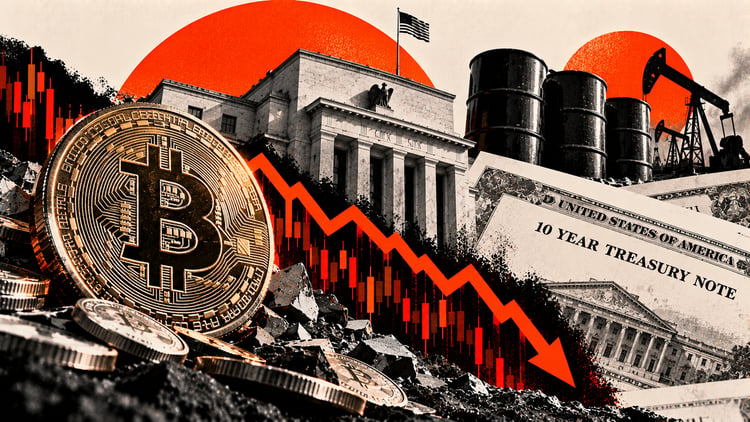
US-listed spot Bitcoin Exchange-Traded Funds (ETFs) recorded modest inflows on Monday, while Strategy (MSTR) paused its Bitcoin purchases and Strive (ASST) added 6,182 BTC last week. Meanwhile, QCP Capital highlights that upcoming hyperscaler earnings and developments in the Middle East are likely to shape the Crypto King’s next directional move.
Institutional demand shows mild bullish signs
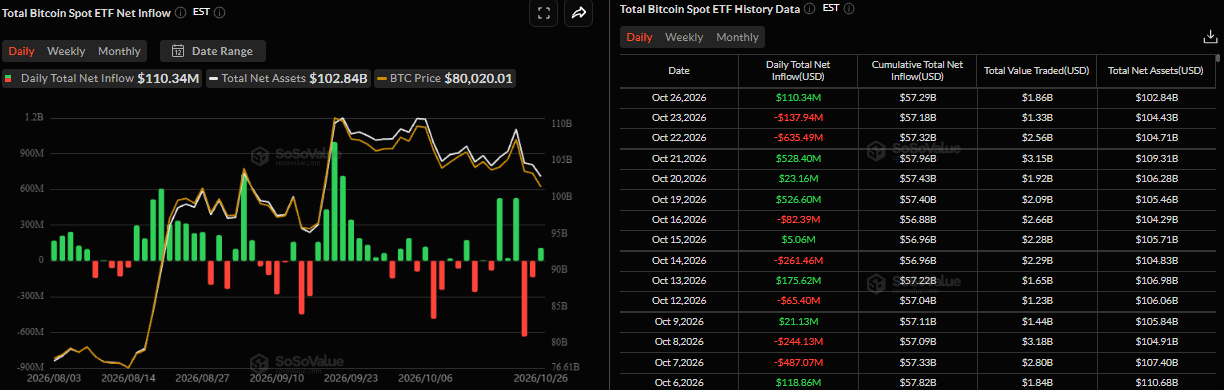
Institutional demand began the week on a modest positive note. SoSoValue data showed that spot Bitcoin ETFs recorded an inflow of $110.34 million on Monday, after a net inflow of $301.2 million last week, breaking a two-week outflow streak. However, Monday’s inflows were modest and failed to support a recovery; if this inflow trend continues and strengthens through the week, BTC could recover.
Lookonchain posted on its X account on Monday that Strategy didn’t buy any BTC last week, while Strive bought 6,182 BTC. Strategy's pause marks a shift in institutional accumulation, with the company stepping back after several weeks of buying as Strive ramps up its purchases. Strive’s continued accumulation could help cushion selling pressure and provide some support for BTC.
Traders await key catalyst
QCP Capital said in its Monday report that Bitcoin’s next directional move is likely to depend more on upcoming hyperscaler earnings and developments in the Middle East than on the outcome of the Federal Open Market Committee (FOMC) meeting scheduled for October 27–28.
Microsoft and Alphabet are due to report their Q3 earnings on Wednesday, followed by Amazon on Thursday. According to QCP Capital, results that justify continued heavy investment in Artificial Intelligence (AI) could ease concerns over hyperscaler valuations. However, disappointing results could extend the ongoing AI-driven market sell-off.
“Oil is the second driver. The US cut staff at Middle East embassies over the weekend, and US President Donald Trump said a strike on Iran could come as early as Sunday before ruling it out,” added the analyst.
QCP Capital outlined three potential scenarios for Bitcoin this week. Firstly, the base case is that the Federal Reserve (Fed) holds rates and BTC ranges between $78,000 and $86,000.
Second, the bull case is that results ease AI capex fears and Fed Chair Kevin Warsh softens the December signal, pulling yields lower. BTC would then reclaim the $80,000-$81,500 cost-basis band and push toward $86,000, then $88,000-$90,000.
Lastly, the bear case is a surprise hike or a press conference that locks in December, combined with Middle East escalation. These developments would send 10-year US Treasury yields back above 5% and take BTC through $78,000.
Bitcoin technical outlook: Weakening momentum indicators
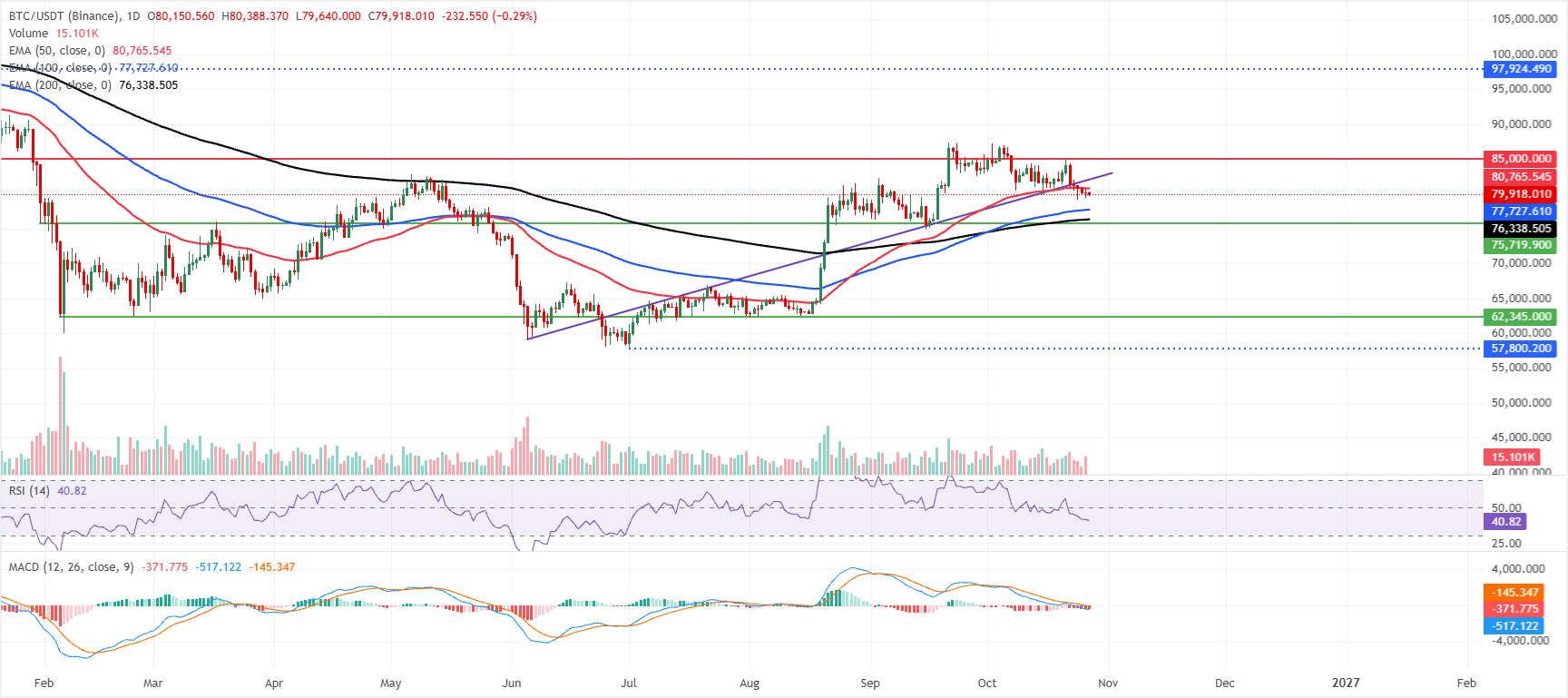
Bitcoin price trades at $79,918 on Tuesday, holding above the 100-day and 200-day Exponential Moving Averages (EMAs) at $77,727 and $76,338, which underpin a medium-term constructive tone. However, it remains capped by the 50-day EMA at $80,765, keeping the near-term bias neutral to slightly bearish while price consolidates just beneath this dynamic barrier.
Momentum indicators lean soft, with the Relative Strength Index (RSI) hovering around 41 and the Moving Average Convergence Divergence (MACD) below zero, suggesting waning bullish pressure as buyers struggle to extend the prior advance.
On the topside, immediate resistance is located at the 50-day EMA near $80,765, and a daily close above this level would open the way toward the horizontal barrier at $85,000, where previous supply is likely to re-emerge.
On the downside, initial support appears at the 100-day EMA at $77,727, followed by a deeper structural floor at the 200-day EMA around $76,338, and a break below this latter level would significantly weaken the broader trend and expose BTC to a more pronounced corrective phase.
(The technical analysis of this story was written with the help of an AI tool. Know more.)
Bitcoin, altcoins, stablecoins FAQs
Bitcoin is the largest cryptocurrency by market capitalization, a virtual currency designed to serve as money. This form of payment cannot be controlled by any one person, group, or entity, which eliminates the need for third-party participation during financial transactions.
Altcoins are any cryptocurrency apart from Bitcoin, but some also regard Ethereum as a non-altcoin because it is from these two cryptocurrencies that forking happens. If this is true, then Litecoin is the first altcoin, forked from the Bitcoin protocol and, therefore, an “improved” version of it.
Stablecoins are cryptocurrencies designed to have a stable price, with their value backed by a reserve of the asset it represents. To achieve this, the value of any one stablecoin is pegged to a commodity or financial instrument, such as the US Dollar (USD), with its supply regulated by an algorithm or demand. The main goal of stablecoins is to provide an on/off-ramp for investors willing to trade and invest in cryptocurrencies. Stablecoins also allow investors to store value since cryptocurrencies, in general, are subject to volatility.
Bitcoin dominance is the ratio of Bitcoin's market capitalization to the total market capitalization of all cryptocurrencies combined. It provides a clear picture of Bitcoin’s interest among investors. A high BTC dominance typically happens before and during a bull run, in which investors resort to investing in relatively stable and high market capitalization cryptocurrency like Bitcoin. A drop in BTC dominance usually means that investors are moving their capital and/or profits to altcoins in a quest for higher returns, which usually triggers an explosion of altcoin rallies.
Artículos destacados
1Dólar australiano: pierde impulso cerca de sus máximos recientes frente al dólar estadounidense – UOB2Precio de la plata hoy: la plata cae, según datos de FXStreet3Oro: riesgos en ambas direcciones cerca de los mínimos recientes – OCBC4Previsión del GBP/USD: cae a mínimos de una semana cerca de 1,3320, el retroceso de Fibonacci del 38,2 %, ante un dólar más firme5Previsión del índice del dólar estadounidense: se mantiene por encima de 102,00 tras superar la EMA de nueve días6Dólar neozelandés: la subida de tipos del RBNZ respalda al kiwi frente al dólar estadounidense – ING7Previsión del AUD/USD: se consolida por encima de la EMA de 20 días mientras la atención se centra en la política de la Fed8Libra esterlina: cotiza en un rango frente al dólar estadounidense a la espera del presupuesto británico - HSBC9El euro pierde terreno frente al dólar canadiense pese a la caída de los precios del petróleo

¡Comience ahora!
Regístrese y acceda a los mercados globales en menos de 3 minutos

Conéctese con nosotros









Contactos
Teléfono: +61 2 8036 8388
Fax: +61 2 8036 8388
Correo electrónico: support@tmgm.com



La información proporcionada en este sitio web es únicamente de carácter general y no constituye asesoramiento financiero personal. Antes de actuar sobre cualquier información de este sitio web, debe considerar la idoneidad de la información en relación con sus objetivos, situación financiera y necesidades. Invertir en CFD y contratos de margen de FX conlleva riesgos significativos y no es adecuado para todos los inversores. Puede perder más que su depósito inicial. Usted no posee ni tiene ningún interés en el activo subyacente. Le recomendamos que busque asesoramiento independiente y se asegure de comprender plenamente los riesgos involucrados antes de operar. Es importante que lea y considere el documento de divulgación antes de adquirir cualquier producto listado en el sitio web. La información y los anuncios ofrecidos en este sitio web no están destinados al uso por parte de ninguna persona en ningún país o jurisdicción donde dicho uso sea contrario a las leyes y regulaciones locales. Los productos y servicios ofrecidos en este sitio web no están destinados a residentes de Estados Unidos, Malasia y Tailandia.
TMGM está autorizado y regulado en varias jurisdicciones.
Trademax Australia Limited, que opera como TMGM, está regulada por la Comisión Australiana de Valores e Inversiones (ASIC), AFSL n.º 436416, y está ubicada en Level 28, One International Tower, 100 Barangaroo Avenue, 2000 Sydney, NSW Australia.
Correo electrónico: support@tmgm.com.au
Trademax Global Limited, que opera como TMGM, está autorizada y regulada por la Comisión de Servicios Financieros de Vanuatu (VFSC), número de registro 40356, y está registrada en 1276, Kumul Highway, Port Vila, Vanuatu, República de Vanuatu.
Correo electrónico: support@tmgm.com
Trademax Global Markets (SE) Limited, que opera como TMGM, está autorizada y regulada por la Autoridad de Servicios Financieros (FSA) de Seychelles, con número de licencia SD224. La empresa está registrada en Office No 13, Providence Estate ABIS Centre, Mahe, Seychelles.
Correo electrónico: support@tmgm.com
Trademax Global Markets (International) Pty Ltd, que opera como TMGM, está autorizada y regulada por la Comisión de Servicios Financieros de Mauricio (FSC) con licencia n.º GB22201012, y está registrada en 33, Edith Cavell Street C/o IQ EQ Fund Services (Mauritius) Ltd Port Louis, 11324 Mauricio.
Correo electrónico: support@tmgm.com
Copyright © TMGM. Todos los derechos reservados