
News & AnalysisCareer

A 1.1% decline leaves Silver (XAG/USD) trading near $57.40 in Wednesday’s European session. Higher oil prices have fuelled concerns over rising global inflation, putting the white metal under selling pressure.
At the time of writing, WTI Oil is trading slightly higher at around $98.25, not far from the five-week high of $101.05 reached on Tuesday.
Energy supply risks continue to mount as Iran maintains its attacks on oil tankers and threatens Saudi Arabia’s oil infrastructure. These risks are sustaining a premium in oil prices.
Growing concerns over Middle East supplies have pushed oil prices higher, according to analysts at Danske Bank, who say traders are becoming more cautious about "Red Sea shipping risks and threats to oil infrastructure in Saudi Arabia." Noting that oil prices "have gained more than 10% this month", the bank attributes the move to "intensifying hostilities involving Saudi Arabia and Iran-backed Houthi forces, as well as Russia and Ukraine's attacks on energy infrastructure raised supply risks further," which has strengthened the market’s recent upward momentum.
If inflationary pressures intensify, expectations of interest rate rises by the Federal Reserve (Fed) could strengthen further. Such a scenario would lift yields on interest-bearing assets while reducing the appeal of non-yielding assets such as Silver.
For now, however, the CME FedWatch tool indicates that the Fed is expected to leave interest rates unchanged at its policy meeting later this month.
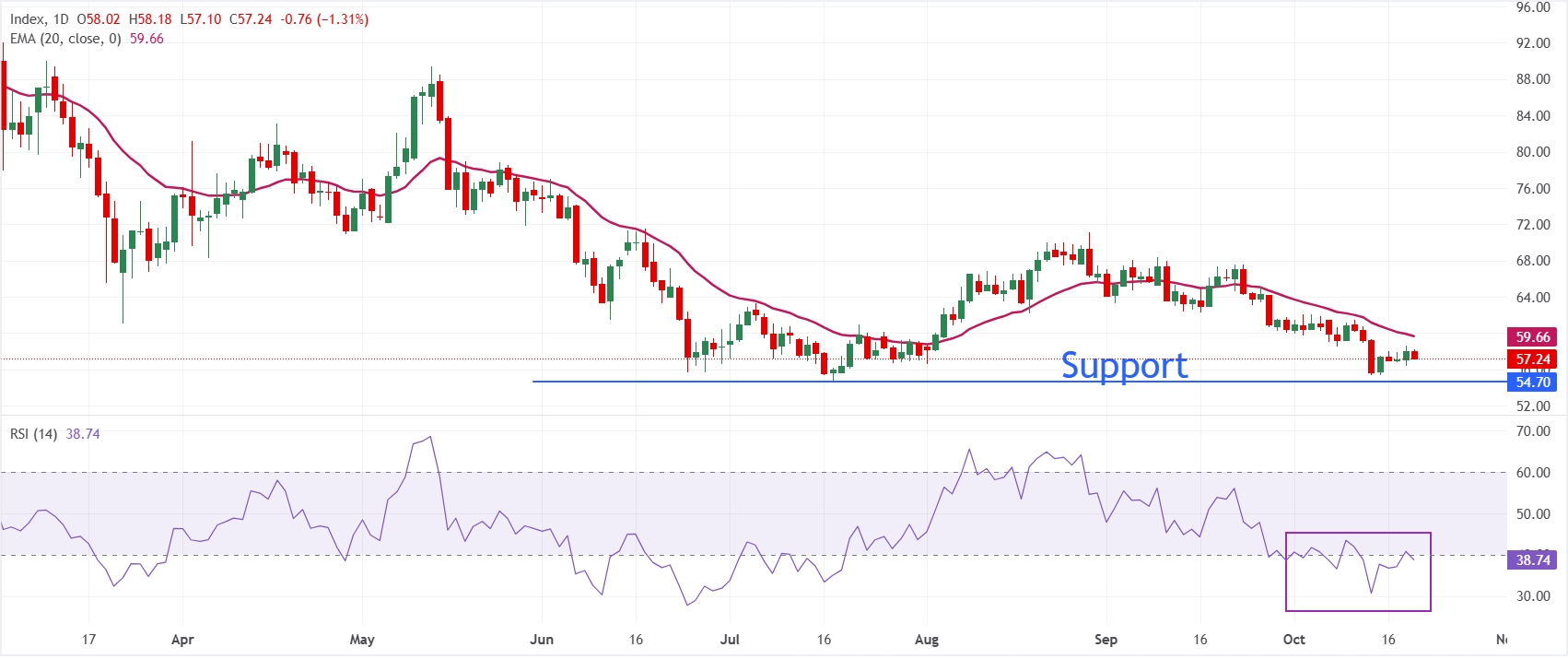
Trading at $57.25 on the daily chart, XAG/USD remains beneath the 20-day exponential moving average (EMA) of $59.66, maintaining a bearish near-term outlook. This dynamic overhead resistance continues to limit the metal’s advance, suggesting that rallies may struggle for as long as the price stays below the EMA. At 38.77, the Relative Strength Index (RSI) is still under the neutral 50 threshold, signalling persistent bearish momentum rather than an extreme oversold reading.
The 20-day EMA at $59.66 provides the first resistance on the upside. A sustained move above it would be required to alleviate immediate downward pressure. The key support on the downside is the 17 July low of $54.77.
(The technical analysis of this story was written with the help of an AI tool. Know more.)
Widely traded by investors, Silver is a precious metal with a long history as both a store of value and a means of exchange. Gold attracts greater interest, but traders may choose Silver for its intrinsic value, to diversify their portfolios or as a possible hedge when inflation is high. Exposure can be gained by purchasing physical Silver in the form of coins or bars, or through instruments such as exchange-traded funds that follow its price in international markets.
A broad range of influences can drive movements in Silver. Its safe-haven appeal can lift prices during geopolitical instability or fears of a severe recession, though the effect is generally less pronounced than for Gold. Lower interest rates tend to support Silver because it pays no yield. The US Dollar (USD) is another important influence: with Silver quoted in dollars (XAG/USD), a stronger Dollar usually restrains prices, while a weaker one is likely to lift them. Investment demand, recycling rates and mining supply also play a role, with Silver considerably more abundant than Gold.
With electrical conductivity among the highest of any metal, exceeding that of Copper and Gold, Silver has extensive industrial applications, notably in electronics and solar energy. Prices can rise when demand surges and tend to fall when it weakens. Developments in the US, Chinese and Indian economies can also trigger price fluctuations. Large industrial sectors in the US and, especially, China use Silver in a variety of processes, while Indian consumer demand for Silver jewellery is another important influence on prices.
Gold’s price movements are generally mirrored by Silver: when Gold advances, Silver usually rises too, reflecting their similar safe-haven status. Relative valuations can be assessed using the Gold/Silver ratio, which measures how many ounces of Silver equal the value of one ounce of Gold. A high reading may be interpreted by some investors as a sign that Silver is undervalued or Gold overvalued. Conversely, a low reading might indicate that Gold is undervalued compared with Silver.







Phone: +61 2 8036 8388
Fax: +61 2 8036 8388
Email: support@tmgm.com



The information provided on this website is of a general nature only and does not constitute personal financial advice. Before acting on any information on this website, you should consider the suitability of the information in relation to your objectives, financial situation and needs. Investing in CFDs and FX Margin Contracts carries significant risks and is not suitable for all investors. You may lose more than your initial deposit. You do not own, or have, any interest in the underlying asset. We recommend that you seek independent advice and ensure you fully understand the risks involved before trading. It is important that you read and consider the disclosure document before you acquire any product listed on the website. The information and advertisements offered on this website are not intended for use by any person in any country or jurisdiction where such use would be contrary to local laws and regulations. The Products and Services offered on this website are not intended for residents of the United States, Malaysia and Thailand.
TMGM is authorized and regulated in various jurisdictions.
Trademax Australia Limited, trading as TMGM, is regulated by the Australian Securities and Investments Commission (ASIC), AFSL no. 436416 and is located at Level 28, One International Tower, 100 Barangaroo Avenue, 2000 Sydney, NSW Australia.
Email: support@tmgm.com.au
Trademax Global Limited, trading as TMGM, is authorized and regulated by the Vanuatu Financial Services Commission (VFSC), registration number 40356 and registered at 1276, Kumul Highway, Port Vila, Vanuatu, Republic of Vanuatu.
Email: support@tmgm.com
Trademax Global Markets (SE) Limited, trading as TMGM, is authorized and regulated by the Financial Services Authority (FSA) of Seychelles, with license number SD224. The company is registered at Office No 13, Providence Estate ABIS Centre, Mahe, Seychelles.
Email: support@tmgm.com
Trademax Global Markets (International) Pty Ltd, trading as TMGM, is authorized and regulated by the Financial Services Commission, Mauritius (FSC) with license no. GB22201012, and registered at 33, Edith Cavell Street C/o IQ EQ Fund Services (Mauritius) Ltd Port Louis, 11324 Mauritius.
Email: support@tmgm.com
Copyright © TMGM. All rights reserved

