
News & AnalysisCareer

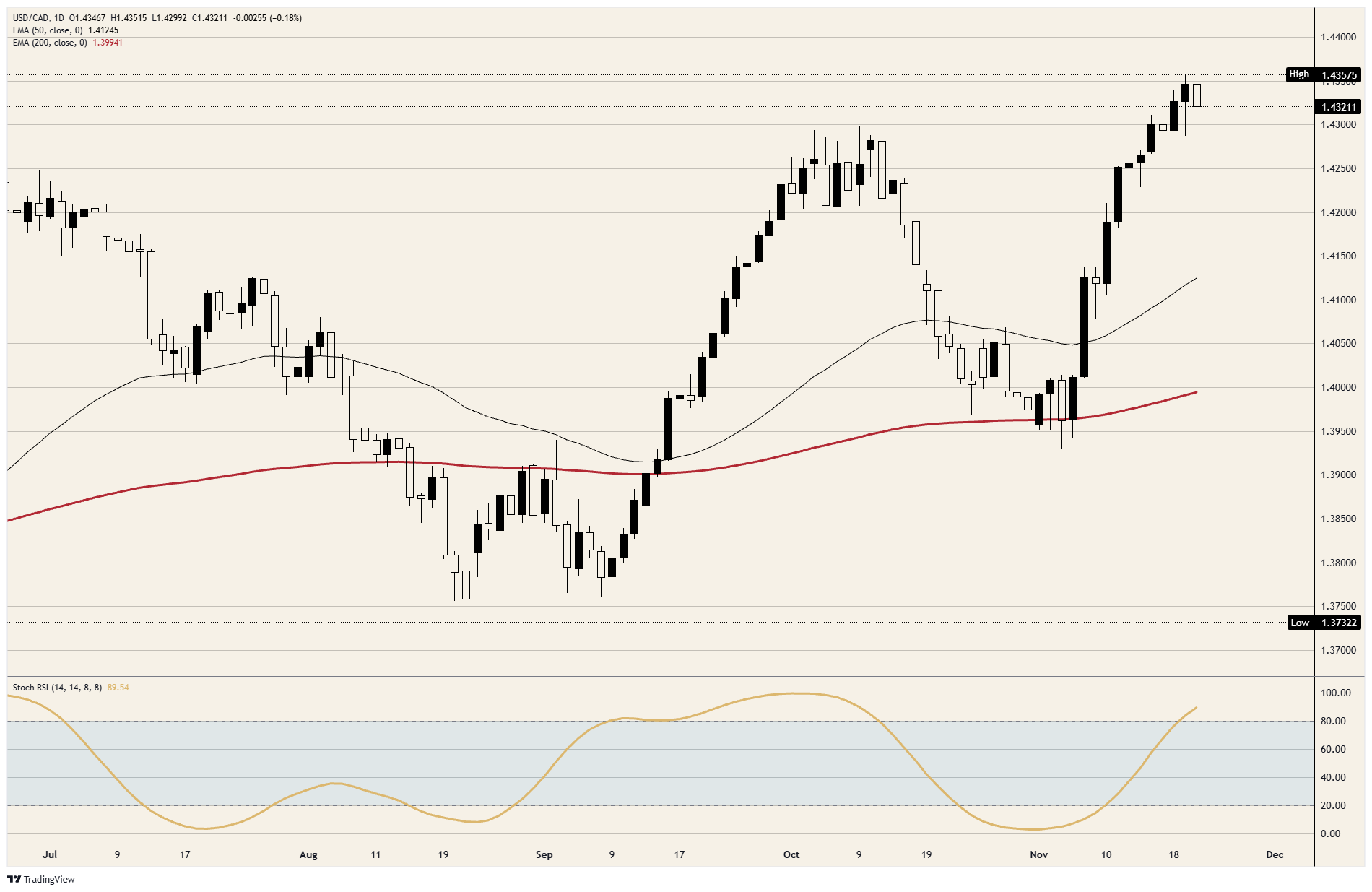
Canadian retail sales exceeded forecasts by a tenth, helping to pull USD/CAD lower on Friday alongside a weaker US Dollar. Even so, the retreat has reversed little of the advance that carried the pair to a 19-month high on Thursday after gains in seven of eight sessions. Having eased from just above 1.4350, USD/CAD remains above Thursday's low.

With the Fed's rate at 3.75%-4.00%, the Bank of Canada (BoC) raised its own to 2.50% on 28 October. Both central banks announce their next decisions on 9 December. Markets have fully priced in a quarter-point increase from the Fed, while its officials have raised the possibility of a half-point move. November has seen the spread between US and Canadian two-year yields widen by about a fifth of a point, accompanied by a rise in USD/CAD.
September's Canadian retail sales increased by 0.8%, against expectations of 0.7%, while sales excluding autos advanced 1.0%. A 6.9% rise at gasoline stations led the gains, with volumes up 0.1%. However, Statistics Canada's preliminary estimate points to a 1.5% decline in October, tempering the stronger-than-expected September figure. Crude Oil, meanwhile, is on course for a third consecutive weekly decline, removing the other incentive to buy the Loonie.
Tuesday's speech by BoC Governor Macklem is scheduled for 16:30 GMT, roughly two weeks before the central bank decides whether to deliver a second rate increase following October's move. Canada's third-quarter current account figures are then due at 13:30 GMT on Friday, 27 November.
Fed Governor Cook is due to speak on Friday at 17:15 GMT. On Wednesday, 25 November, October's core Personal Consumption Expenditures Price Index (PCE) inflation figures and the preliminary third-quarter Gross Domestic Product (GDP) reading arrive at 13:30 GMT. GDP growth is forecast at an annualised 3.4%. Both releases will inform the scale of the Fed's December rate increase, shaping the US side of the rate differential.
Friday's retreat amounts to around a seventh of the rally that began just below 1.3950 on 4 November. The session's low came just below 1.4300, the level at which the pair recorded three peaks in October. Beneath the current price, both the 50-day Exponential Moving Average (EMA), just above 1.4100, and the 200-day EMA, just below 1.4000, are moving higher. Daily momentum has entered overbought territory for the first time since early October.
The Canadian Dollar (CAD) responds chiefly to the Bank of Canada's (BoC) interest rate settings, Oil prices, economic health, inflation and the trade balance. Oil is Canada's largest export, while the trade balance measures the difference between the value of the country's exports and imports. Investor sentiment also matters: an appetite for riskier assets (risk-on) tends to support CAD, whereas a preference for safe havens marks a risk-off environment. Conditions in the US economy are another major influence on the Canadian Dollar, as the US is Canada's largest trading partner.
By setting the interest rate at which banks can lend to each other, the Bank of Canada (BoC) influences borrowing costs across the economy and, in turn, the Canadian Dollar. Its principal objective is to keep inflation at 1-3%, raising or lowering rates as required. Comparatively high interest rates generally support CAD. The BoC can also alter credit conditions through quantitative easing or tightening; easing tends to weigh on CAD, while tightening tends to strengthen it.
As petroleum is Canada's largest export, changes in Oil prices tend to affect the Canadian Dollar immediately, making Oil a major driver of its value. Rising Oil prices generally lift CAD by increasing overall demand for the currency, while falling prices have the reverse effect. More expensive Oil also makes a positive trade balance more likely, providing further support for CAD.
Inflation was traditionally regarded as harmful to a currency because it erodes the value of money. In modern times, however, looser controls on cross-border capital flows have seen the reverse hold true. When inflation rises, central banks tend to increase interest rates, drawing in more capital from international investors seeking attractive returns on their money. Those inflows raise demand for the domestic currency, which in Canada is the Canadian Dollar.
By indicating the economy's health, macroeconomic releases can move the Canadian Dollar. GDP, Manufacturing and Services PMIs, employment figures and consumer sentiment surveys are among the indicators capable of influencing CAD's direction. Economic strength supports the currency by attracting greater foreign investment and potentially prompting the Bank of Canada to raise interest rates, which strengthens it further. Weak economic figures, by contrast, are likely to weigh on CAD.







Phone: +61 2 8036 8388
Fax: +61 2 8036 8388
Email: support@tmgm.com



The information provided on this website is of a general nature only and does not constitute personal financial advice. Before acting on any information on this website, you should consider the suitability of the information in relation to your objectives, financial situation and needs. Investing in CFDs and FX Margin Contracts carries significant risks and is not suitable for all investors. You may lose more than your initial deposit. You do not own, or have, any interest in the underlying asset. We recommend that you seek independent advice and ensure you fully understand the risks involved before trading. It is important that you read and consider the disclosure document before you acquire any product listed on the website. The information and advertisements offered on this website are not intended for use by any person in any country or jurisdiction where such use would be contrary to local laws and regulations. The Products and Services offered on this website are not intended for residents of the United States, Malaysia and Thailand.
TMGM is authorized and regulated in various jurisdictions.
Trademax Australia Limited, trading as TMGM, is regulated by the Australian Securities and Investments Commission (ASIC), AFSL no. 436416 and is located at Level 28, One International Tower, 100 Barangaroo Avenue, 2000 Sydney, NSW Australia.
Email: support@tmgm.com.au
Trademax Global Limited, trading as TMGM, is authorized and regulated by the Vanuatu Financial Services Commission (VFSC), registration number 40356 and registered at 1276, Kumul Highway, Port Vila, Vanuatu, Republic of Vanuatu.
Email: support@tmgm.com
Trademax Global Markets (SE) Limited, trading as TMGM, is authorized and regulated by the Financial Services Authority (FSA) of Seychelles, with license number SD224. The company is registered at Office No 13, Providence Estate ABIS Centre, Mahe, Seychelles.
Email: support@tmgm.com
Trademax Global Markets (International) Pty Ltd, trading as TMGM, is authorized and regulated by the Financial Services Commission, Mauritius (FSC) with license no. GB22201012, and registered at 33, Edith Cavell Street C/o IQ EQ Fund Services (Mauritius) Ltd Port Louis, 11324 Mauritius.
Email: support@tmgm.com
Copyright © TMGM. All rights reserved


