
News & AnalysisCareer

Continued withdrawals from spot Bitcoin Exchange-Traded Funds (ETFs), alongside hawkish minutes from the Federal Reserve’s (Fed) latest Federal Open Market Committee (FOMC) meeting, are dampening investor sentiment and fuelling worries about tighter liquidity conditions. Against that backdrop, Bitcoin (BTC) struggles to advance around $63,500 on Thursday, having fallen towards its weekend low to trade near $62,000 on Wednesday. These pressures are constraining the recovery of the leading cryptocurrency.
Released late on Wednesday, the eagerly anticipated minutes of the Fed’s October monetary policy meeting struck a hawkish tone. Most officials favoured leaving rates unchanged in October, although their September estimates suggested that further increases were broadly acceptable. Inflation could require tighter policy, some policymakers warned, while some even contemplated a larger December increase should the data deteriorate.
Within this wider economic discussion, most participants noted the rapid expansion of AI-related debt, much of it financed through complicated and opaque structures. Some Fed officials also voiced concern that exposure to AI was becoming concentrated in a “small number” of companies.
With markets already pricing in a December rate increase, the observations were not entirely unexpected. Nevertheless, the minutes suggested a slightly steeper and more prolonged path for rates. That outlook continues to underpin the US Dollar (USD) and weigh on Bitcoin, which slipped towards the weekend low of $62,000 on Wednesday.
A further deterioration in institutional appetite for Bitcoin is contributing to selling pressure. According to SoSoValue, BTC spot ETFs registered net withdrawals of $306.42 million on Wednesday, their second consecutive day of outflows this week, after a billion-dollar withdrawal last week. Further BTC declines could follow if withdrawals persist and accelerate this week.
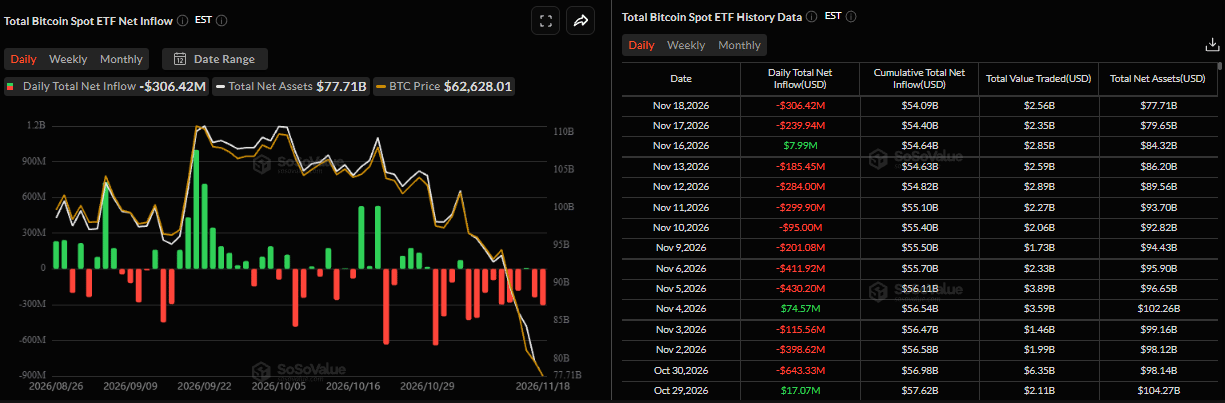
Investors who acquired Bitcoin through ETFs during the third quarter are now sitting on sizeable unrealised losses, Bitfinex told FXStreet. Using each day’s net flow as a weight for the Bitfinex daily closing price produces an average entry level of around $80,070 over that period, putting third-quarter ETF buyers around 19% below their purchase price. Across the full quarter, meanwhile, the flow-weighted average entry price is $78,300, indicating an unrealised loss of approximately 17%.
The Bitfinex analyst said: “We expect Bitcoin to remain inside the July Base, between about $60,100 and $68,600, the range implied by options for the 27 November expiry, with risks still skewed towards a retest of $62,029 and the $61,300 lower edge of the Base,” adding: “To the upside, three consecutive sessions of ETF inflows with CME OI stabilizing and STH-SOPR recovering towards 1 would indicate that institutional selling has ended and bring $69,400 and then $72,700 into view. To the downside, acceptance below $61,300 with ETF outflows above $300 million a day would point to the $57,803 cycle low,” the analyst said.
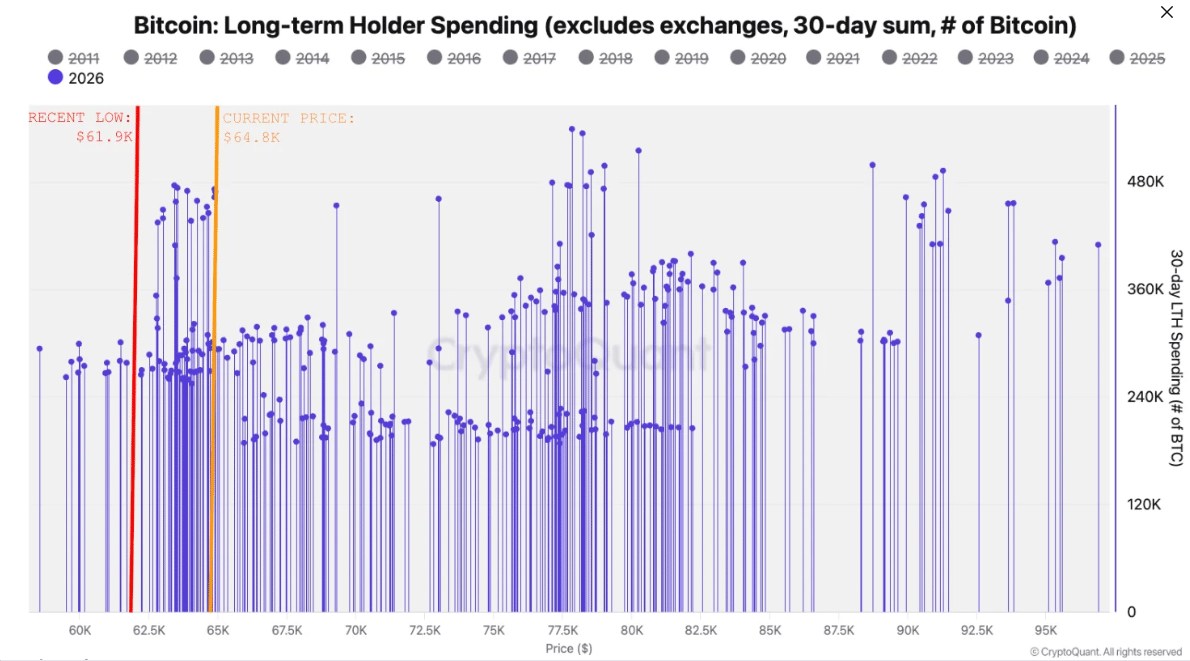
The $62,000 to $65,000 band could provide Bitcoin with support, according to CryptoQuant’s report on Tuesday, which identified a substantial concentration of long-term holder spending, or purchases by new investors, in that area.
In the chart below, the 30-day sum of spending by long-term holders, excluding exchanges, is plotted against the price at which it occurred during 2026. Daily observations form the individual points, with the greatest density between $62,000 and $65,000. Bitcoin spent much of June to mid-August trading within this band before its rally got under way.
The CryptoQuant analyst explained: “Investors tend to defend their cost basis, which is why a dense cluster of this kind may act as a price support,”
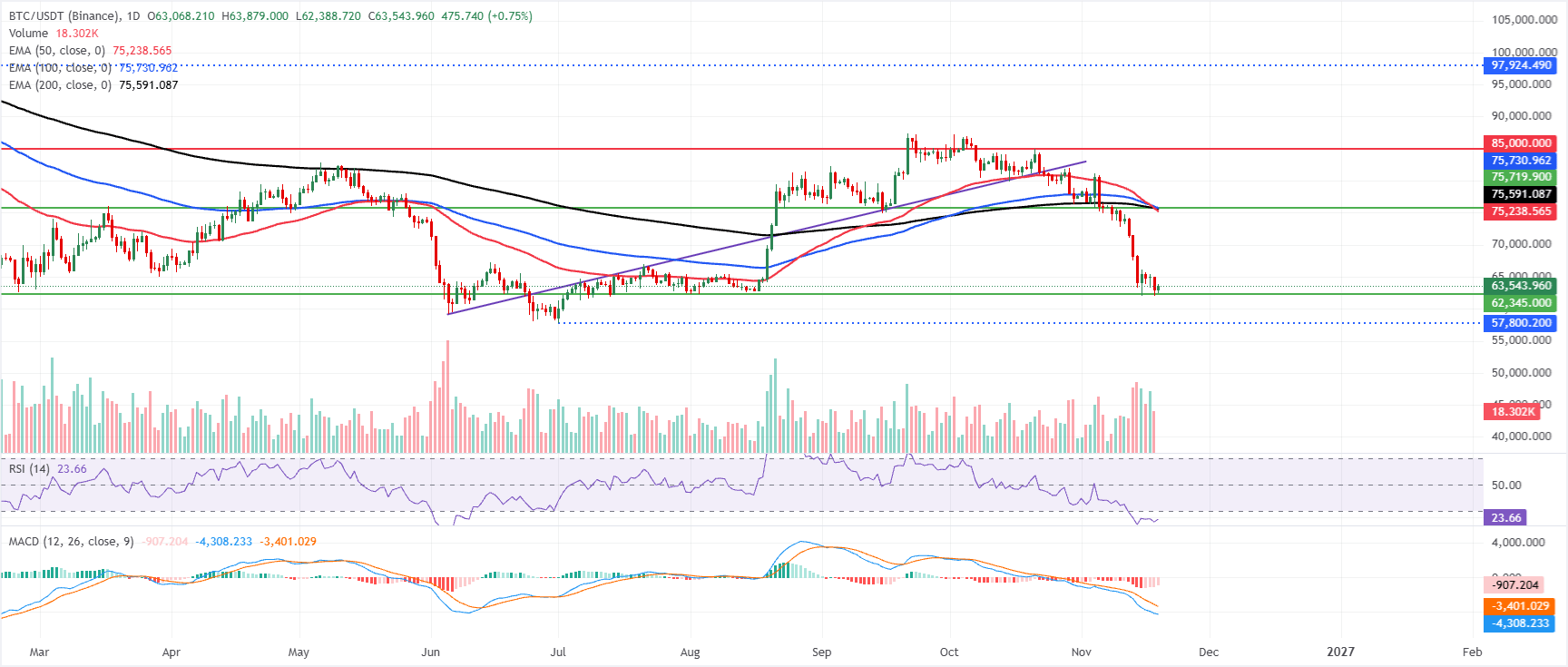
At $63,543 on Thursday, Bitcoin remains well beneath the 50-day, 100-day and 200-day Exponential Moving Averages (EMAs), grouped at roughly $75,200 to $75,700. This positioning maintains a bearish short-term bias.
Momentum indicators also point to pronounced, albeit stretched, downside pressure. The Moving Average Convergence Divergence (MACD) is firmly negative, its line beneath the signal line and both below zero, while the Relative Strength Index (RSI) sits near 24 in oversold territory.
Any recovery would first encounter the 50-day EMA at $75,238, ahead of the 200-day EMA at $75,591 and the 100-day EMA at $75,730. Together, these averages form a concentrated resistance zone above current prices. Further afield, horizontal resistance near $85,000 could attract stronger selling if a broader rebound develops.
(The technical analysis of this story was written with the help of an AI tool. Know more.)
Designed to function as money, Bitcoin is a virtual currency and the largest cryptocurrency by market capitalisation. No single individual, group or entity can control this payment method, removing the requirement for third-party involvement in financial transactions.
The term altcoin covers any cryptocurrency other than Bitcoin. Some, however, also exclude Ethereum, on the grounds that forks originate from these two cryptocurrencies. Under that interpretation, Litecoin is the first altcoin: it was forked from the Bitcoin protocol and is therefore an “improved” version of it.
A stablecoin is a cryptocurrency intended to maintain a steady price, backed by reserves of the asset it represents. Its value is tied to a commodity or financial instrument, such as the US Dollar (USD), while an algorithm or demand governs its supply. Stablecoins primarily provide a route into and out of cryptocurrencies for investors seeking to trade or invest in them. They also offer a way to store value, given the volatility generally associated with cryptocurrencies.
By comparing Bitcoin’s market capitalisation with the combined value of all cryptocurrencies, Bitcoin dominance gives a clear indication of investor interest in Bitcoin. BTC dominance is typically high ahead of and during a bull run, when investors turn to relatively stable cryptocurrencies with large market capitalisations, such as Bitcoin. When dominance falls, it generally signals that investors are reallocating capital and/or profits to altcoins in pursuit of greater returns, often setting off a surge in altcoin rallies.







Phone: +61 2 8036 8388
Fax: +61 2 8036 8388
Email: support@tmgm.com



The information provided on this website is of a general nature only and does not constitute personal financial advice. Before acting on any information on this website, you should consider the suitability of the information in relation to your objectives, financial situation and needs. Investing in CFDs and FX Margin Contracts carries significant risks and is not suitable for all investors. You may lose more than your initial deposit. You do not own, or have, any interest in the underlying asset. We recommend that you seek independent advice and ensure you fully understand the risks involved before trading. It is important that you read and consider the disclosure document before you acquire any product listed on the website. The information and advertisements offered on this website are not intended for use by any person in any country or jurisdiction where such use would be contrary to local laws and regulations. The Products and Services offered on this website are not intended for residents of the United States, Malaysia and Thailand.
TMGM is authorized and regulated in various jurisdictions.
Trademax Australia Limited, trading as TMGM, is regulated by the Australian Securities and Investments Commission (ASIC), AFSL no. 436416 and is located at Level 28, One International Tower, 100 Barangaroo Avenue, 2000 Sydney, NSW Australia.
Email: support@tmgm.com.au
Trademax Global Limited, trading as TMGM, is authorized and regulated by the Vanuatu Financial Services Commission (VFSC), registration number 40356 and registered at 1276, Kumul Highway, Port Vila, Vanuatu, Republic of Vanuatu.
Email: support@tmgm.com
Trademax Global Markets (SE) Limited, trading as TMGM, is authorized and regulated by the Financial Services Authority (FSA) of Seychelles, with license number SD224. The company is registered at Office No 13, Providence Estate ABIS Centre, Mahe, Seychelles.
Email: support@tmgm.com
Trademax Global Markets (International) Pty Ltd, trading as TMGM, is authorized and regulated by the Financial Services Commission, Mauritius (FSC) with license no. GB22201012, and registered at 33, Edith Cavell Street C/o IQ EQ Fund Services (Mauritius) Ltd Port Louis, 11324 Mauritius.
Email: support@tmgm.com
Copyright © TMGM. All rights reserved

