
News & AnalysisCareer

Near 0.6660, temporary support emerges for the Australian Dollar (AUD) against the US Dollar (USD) during early European trading on Thursday. The pair nevertheless remains 0.4% lower at around 0.6690.
October's weak employment figures triggered heavy selling of the Australian Dollar earlier in the day. Rather than holding at the expected 4.7%, the Unemployment Rate climbed to 4.9%, its highest reading since June 2021.

Against expectations of 25K additional workers, Australia's labour force contracted by 43.5K. Employers had also cut 36.4K jobs in September.
With Australia's labour market showing signs of cooling, concerns over further interest rate increases by the Reserve Bank of Australia (RBA) are expected to recede further.
Expectations of a hawkish RBA stance were already subdued: the latest monetary policy minutes revealed policymakers' considerable concern over mounting economic risks.
Following the RBA's recent increase in its policy rate to 4.85%, Commerzbank analysts say the latest minutes “underscore once again that the threshold for another rate hike is likely to be rather high,” with the rate now at “its highest level since the global financial crisis in 2008.” In their assessment, the fact that policy is “already well above the RBA’s estimate of the neutral rate of around 3-4%,” adds to the impression of policymakers' reluctance to tighten further.
As Commerzbank points out, “the three members who voted against the latest rate hike warned that the economy could already be close to a sharper downturn,” which the analysts believe “suggests that the RBA is likely to be cautious about further rate hikes for now.”
Adding to the pressure on the Australian Dollar pair is a sharp rise in the US Dollar, driven by fears that the Federal Reserve (Fed) will raise interest rates several times in the near term.
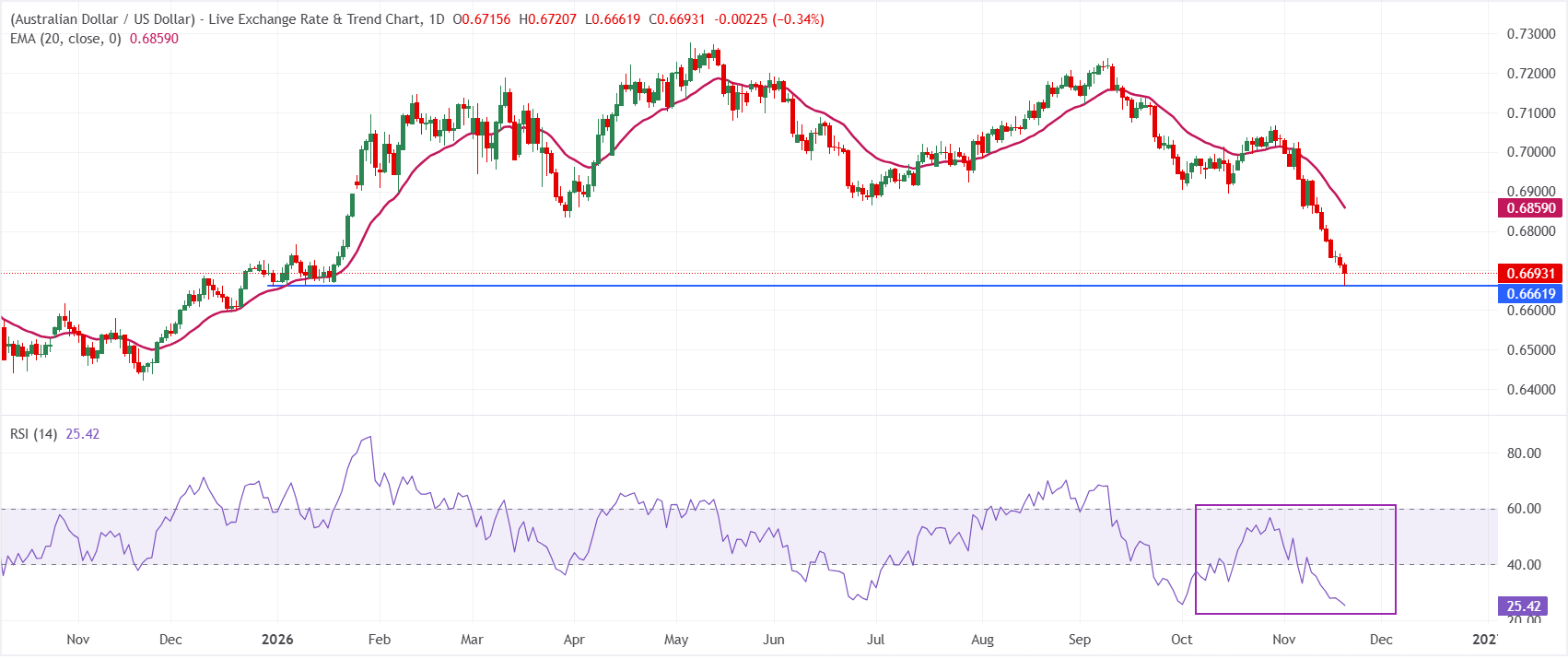
Trading at 0.6693 on the daily chart, AUD/USD continues to retreat, leaving the near-term outlook bearish. Immediate resistance sits overhead at the 20-day exponential moving average (EMA) of 0.6859, with the spot rate still firmly below this key trend indicator. At 25, the Relative Strength Index (14) signals oversold conditions. Selling remains dominant, although downward momentum could begin to fade if bears become reluctant to push the pair to fresh lows.
A daily close above initial resistance at the 20-day EMA, around 0.6860, would be required to temper the bearish outlook and create scope for a corrective recovery. Below that moving average, AUD/USD is expected to remain exposed to further losses. Traders will be monitoring the RSI for evidence that selling is either running out of steam or gathering renewed momentum.
(The technical analysis of this story was written with the help of an AI tool. Know more.)
Published by the Australian Bureau of Statistics, the Unemployment Rate expresses unemployed workers as a percentage of the total civilian labour force. A rising rate points to an absence of growth in Australia's labour market and weakness in the economy. For the Australian Dollar (AUD), a lower reading is regarded as bullish, whereas a higher reading is viewed as bearish.
Find out more.Latest release: Thu 19 Nov 2026 00:30
Publication frequency: Monthly
Actual reading: 4.9%
Consensus forecast: 4.7%
Previous reading: 4.7%
Data source: Australian Bureau of Statistics
The unemployment rate is a closely monitored measure in the Australian Bureau of Statistics’ (ABS) overview of Australian labour market trends. Published around 15 days after the end of the month, the indicator offers insight into broader economic conditions through its strong correlation with consumer spending and inflation. Although it is a lagging indicator, it influences interest rate decisions at the Reserve Bank of Australia (RBA), which in turn move the Australian dollar. A favourable reading generally supports the AUD.







Phone: +61 2 8036 8388
Fax: +61 2 8036 8388
Email: support@tmgm.com



The information provided on this website is of a general nature only and does not constitute personal financial advice. Before acting on any information on this website, you should consider the suitability of the information in relation to your objectives, financial situation and needs. Investing in CFDs and FX Margin Contracts carries significant risks and is not suitable for all investors. You may lose more than your initial deposit. You do not own, or have, any interest in the underlying asset. We recommend that you seek independent advice and ensure you fully understand the risks involved before trading. It is important that you read and consider the disclosure document before you acquire any product listed on the website. The information and advertisements offered on this website are not intended for use by any person in any country or jurisdiction where such use would be contrary to local laws and regulations. The Products and Services offered on this website are not intended for residents of the United States, Malaysia and Thailand.
TMGM is authorized and regulated in various jurisdictions.
Trademax Australia Limited, trading as TMGM, is regulated by the Australian Securities and Investments Commission (ASIC), AFSL no. 436416 and is located at Level 28, One International Tower, 100 Barangaroo Avenue, 2000 Sydney, NSW Australia.
Email: support@tmgm.com.au
Trademax Global Limited, trading as TMGM, is authorized and regulated by the Vanuatu Financial Services Commission (VFSC), registration number 40356 and registered at 1276, Kumul Highway, Port Vila, Vanuatu, Republic of Vanuatu.
Email: support@tmgm.com
Trademax Global Markets (SE) Limited, trading as TMGM, is authorized and regulated by the Financial Services Authority (FSA) of Seychelles, with license number SD224. The company is registered at Office No 13, Providence Estate ABIS Centre, Mahe, Seychelles.
Email: support@tmgm.com
Trademax Global Markets (International) Pty Ltd, trading as TMGM, is authorized and regulated by the Financial Services Commission, Mauritius (FSC) with license no. GB22201012, and registered at 33, Edith Cavell Street C/o IQ EQ Fund Services (Mauritius) Ltd Port Louis, 11324 Mauritius.
Email: support@tmgm.com
Copyright © TMGM. All rights reserved


