

Trading
Explore a wide range of markets with competitive pricing, deep liquidity, and advanced trading tools.
Learn More 
Platform
Trade seamlessly with TMGM's powerful platform, built for speed, precision, and a superior trading experience.
Learn More Trading Platform
Academy
Learn the fundamentals of trading with beginner-friendly resources, including guides, webinars, and market insights.
Learn More News & Analysis
Get real-time market updates and expert analysis to stay ahead of trading opportunities
Learn More News & Analysis
About
Learn what sets TMGM apart — our global presence, regulatory strength, and commitment to innovation in trading.
Learn More Why Choose TMGM
Sponsorship
US Dollar holds firm: why is Bessent's Fed overtightening warning having little impact?
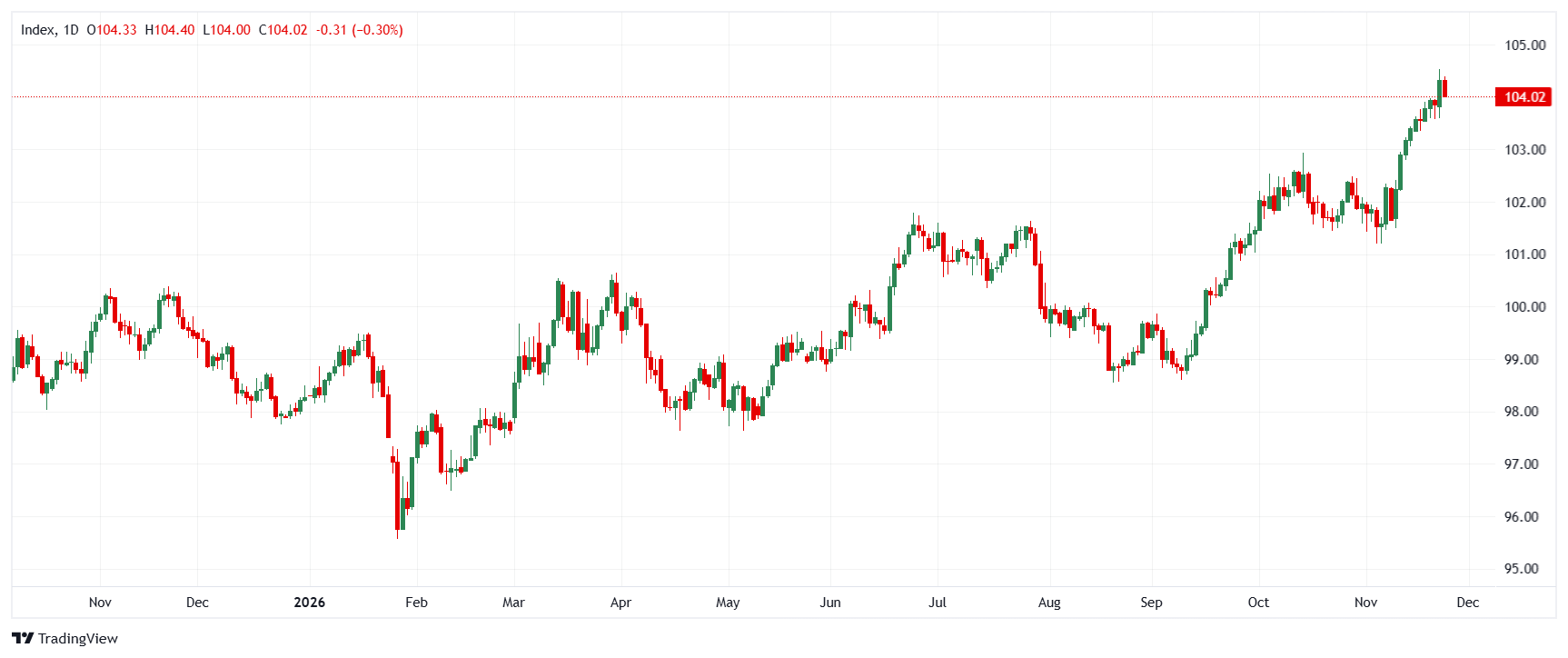
Support for the US Dollar (USD) remains firm ahead of the Thanksgiving holiday week. Recovering US equity futures and resilient domestic fundamentals are countering concerns that the Federal Reserve (Fed) could overtighten. Treasury Secretary Scott Bessent has argued against aggressive rate increases, saying lower crude oil prices and tighter financial conditions weaken the case for a 50 bps move. Nevertheless, persistent underlying inflation, AI-led capital expenditure and a stabilising labour market leave a 25 bps December Fed funds rate hike firmly on course. Strategists at TD Securities and Brown Brothers Harriman (BBH) are weighing two possibilities: sustained inflation pressures could trigger a broader tightening cycle, or a shrinking US growth lead over major peers could undermine a central source of US Dollar strength.
Four total Fed hikes and resilient growth to support US Dollar, TD Securities expects
According to strategists at TD Securities, four total Federal Reserve rate hikes should support the US Dollar. They expect strong underlying US activity, underpinned by AI investment and high-income consumers, together with inflation risks linked to the Iran conflict, to drive those increases. Their GDP growth projection eases from 2.6% in 2026 to 2.3% in 2027, with recession probability at 25%. Ahead of key Gross Domestic Product (GDP) and Personal Consumption Expenditures (PCE) inflation releases, a stabilising labour market and debate within the FOMC over forward guidance maintain pressure for tighter policy.
"GDP growth will likely moderate in 2027 to 2.3% Q4/Q4 after ending a firm 2.6% in 2026. Stable growth should result in a still-low unemployment rate of 4.2% by Q4 2027... We expect output growth to move sideways through next year, reflecting the lingering impact of the oil shock. The Iran conflict, AI build-out, and resilient economic activity present inflationary risks, which we expect will lead to four total Fed hikes... In an interview, Waller confirmed he would support a 50bp hike if it is not communicated that additional tightening in the meetings following December is likely."
25bps December hike still on course; Brown Brothers Harriman monitors US growth lead
According to Elias Haddad at Brown Brothers Harriman (BBH), the US Dollar recouped earlier losses as US equity futures rebounded. Attention now centres on the November US S&P Global Composite Purchasing Managers’ Index (PMI), forecast at 55.6 against 55.9 previously. Treasury Secretary Scott Bessent’s caution against overtightening reduces the likelihood of a 50 bps increase. However, strong growth, favourable labour conditions and persistent underlying inflation leave a 25 bps December hike on track. Haddad warns that a further reduction in the US growth lead over the Eurozone, UK and Japan would weaken a fundamental pillar of support for the Greenback.
"USD clawed back most of its early losses and US equity futures are mounting a rebound from last week’s tech selloff. The US November S&P Global PMI takes the spotlight today... The composite PMI is expected to dip to 55.6 vs. 55.9 in October. The US growth advantage has narrowed against the Eurozone, UK, and Japan but remains sizeable. A further narrowing of the gap, particularly if driven by weaker US activity, would erode a key pillar of USD strength... Bessent’s comments are unlikely to knock a 25bps December fed funds rate hike off course... Importantly, robust US growth, favorable labor market conditions and sticky underlying inflation support the Fed’s hawkish bias."
25 bps December hike remains central to US Dollar outlook
A 25 bps December hike remains firmly on track. Solid domestic momentum and the Federal Reserve’s commitment to containing persistent inflation continue to underpin the US Dollar, although policymakers differ over the pace of tightening. TD Securities points to energy shocks and AI investment as inflationary forces that could ultimately produce four total Fed hikes, alongside GDP growth of 2.6% in 2026. Brown Brothers Harriman (BBH) sees Treasury Secretary Bessent’s pushback as insufficient to derail the December increase. It also stresses that traders must monitor November PMI data, with 55.6 expected, for indications that a diminishing US growth advantage could start to weaken the Greenback’s core support.
(This article was created with the help of an Artificial Intelligence tool and reviewed by an editor. Learn more.)
POPULAR ARTICLES
1Australian Dollar consolidates following overextended slide against US Dollar – UOB2US Dollar holds firm: why is Bessent's Fed overtightening warning having little impact?3BRL falls against US Dollar amid fiscal concerns – Societe Generale4Fed interest rate hike bets slow gold’s rebound5Crypto Today: ETF redemptions persist as Bitcoin and Ethereum ease, XRP steadies6Mexican Peso to rise against US Dollar as Fed hike bets recede, Rabobank expects7South African Rand: Political risk tempers optimism – Commerzbank8Hungarian Forint Rebounds Against Euro on Support From Moody’s and MNB – Societe Generale9Silver price today: FXStreet data show a decline

Get Started!
Sign up and access the Global Markets in less than 3 minutes

Connect With Us









Contacts
Phone: +61 2 8036 8388
Fax: +61 2 8036 8388
Email: support@tmgm.com



The information provided on this website is of a general nature only and does not constitute personal financial advice. Before acting on any information on this website, you should consider the suitability of the information in relation to your objectives, financial situation and needs. Investing in CFDs and FX Margin Contracts carries significant risks and is not suitable for all investors. You may lose more than your initial deposit. You do not own, or have, any interest in the underlying asset. We recommend that you seek independent advice and ensure you fully understand the risks involved before trading. It is important that you read and consider the disclosure document before you acquire any product listed on the website. The information and advertisements offered on this website are not intended for use by any person in any country or jurisdiction where such use would be contrary to local laws and regulations. The Products and Services offered on this website are not intended for residents of the United States, Malaysia and Thailand.
TMGM is authorized and regulated in various jurisdictions.
Trademax Australia Limited, trading as TMGM, is regulated by the Australian Securities and Investments Commission (ASIC), AFSL no. 436416 and is located at Level 28, One International Tower, 100 Barangaroo Avenue, 2000 Sydney, NSW Australia.
Email: support@tmgm.com.au
Trademax Global Limited, trading as TMGM, is authorized and regulated by the Vanuatu Financial Services Commission (VFSC), registration number 40356 and registered at 1276, Kumul Highway, Port Vila, Vanuatu, Republic of Vanuatu.
Email: support@tmgm.com
Trademax Global Markets (SE) Limited, trading as TMGM, is authorized and regulated by the Financial Services Authority (FSA) of Seychelles, with license number SD224. The company is registered at Office No 13, Providence Estate ABIS Centre, Mahe, Seychelles.
Email: support@tmgm.com
Trademax Global Markets (International) Pty Ltd, trading as TMGM, is authorized and regulated by the Financial Services Commission, Mauritius (FSC) with license no. GB22201012, and registered at 33, Edith Cavell Street C/o IQ EQ Fund Services (Mauritius) Ltd Port Louis, 11324 Mauritius.
Email: support@tmgm.com
Copyright © TMGM. All rights reserved