

Trading
Explore a wide range of markets with competitive pricing, deep liquidity, and advanced trading tools.
Learn More 
Platform
Trade seamlessly with TMGM's powerful platform, built for speed, precision, and a superior trading experience.
Learn More Trading Platform
Academy
Learn the fundamentals of trading with beginner-friendly resources, including guides, webinars, and market insights.
Learn More News & Analysis
Get real-time market updates and expert analysis to stay ahead of trading opportunities
Learn More News & Analysis
About
Learn what sets TMGM apart — our global presence, regulatory strength, and commitment to innovation in trading.
Learn More Why Choose TMGM
Sponsorship
2027 Federal Reserve rate hikes expected as US core PCE inflation is set to accelerate in October
- 0.3% is the expected monthly rise in October’s core Personal Consumption Expenditures Price Index. Annual growth is forecast at 3.2%.
- 3.8% is the forecast for headline annual inflation, up from September’s 3.6%.
- Below 1.1000, EUR/USD continues to face pressure as traders price in additional Fed interest rate increases.
13:30 GMT on Wednesday is the scheduled release time for October’s Personal Consumption Expenditures (PCE) Price Index. The United States (US) Bureau of Economic Analysis (BEA) will publish the figures. As the Federal Reserve’s (Fed) preferred inflation gauge, the index attracts close market scrutiny and is central to monetary policy decisions.

No further major inflation report is due before the Fed’s monetary policy decision on 9 December. Another rate increase is widely expected, so this release could matter more for expectations of monetary tightening in early 2027.
0.3% monthly rise expected: The Fed’s key PCE inflation gauge
Excluding volatile food and energy prices, the core PCE Price Index is expected by market participants to show a 0.3% MoM increase in October, unchanged from September’s pace. The annual rate is projected to reach 3.2%, compared with 3.1% a month earlier.
For the headline PCE Price Index, forecasts point to a monthly gain of 0.3%, down from September’s 0.5%. Annual growth, however, is expected to rise from 3.6% to 3.8%. That would take inflation further above the central bank’s 2% target, despite the anticipated easing in monthly price pressures.
The argument for additional monetary tightening has already gained support from recent US data. October’s Consumer Price Index (CPI) increased 0.4% MoM against a market forecast of 0.3%. Core CPI advanced 0.3% for a third successive month. The labour market also showed resilience, with the US economy adding 165K jobs in October.
This month’s PCE report is particularly important because the main annual CPI inflation readings for October could not be published. The calculation lacked October 2025 data following last year’s US government shutdown.
At the Royal Bank of Canada (RBC), economists forecast a slightly sharper rise in annual core PCE inflation, to 3.3%. Falling producer prices in some categories, notably airfares and medical care services, should nevertheless limit the increase, the bank says. RBC also questions the capacity of US households to keep absorbing higher energy costs. Consumer spending has held up, but greater dependence on consumer credit and a low personal saving rate could pose growing problems as interest rates rise.
Following a 25 basis points (bps) rate increase in September, the Fed left its target range at 3.75%-4.00% in October. Two policymakers nevertheless favoured another increase. Published on 18 November, the Minutes of that October meeting also showed widespread backing for further monetary tightening.
The CME FedWatch Tool puts current market-implied odds of a 25 bps December rate increase at approximately 97%. The probability of a further rise in January is around 60%.
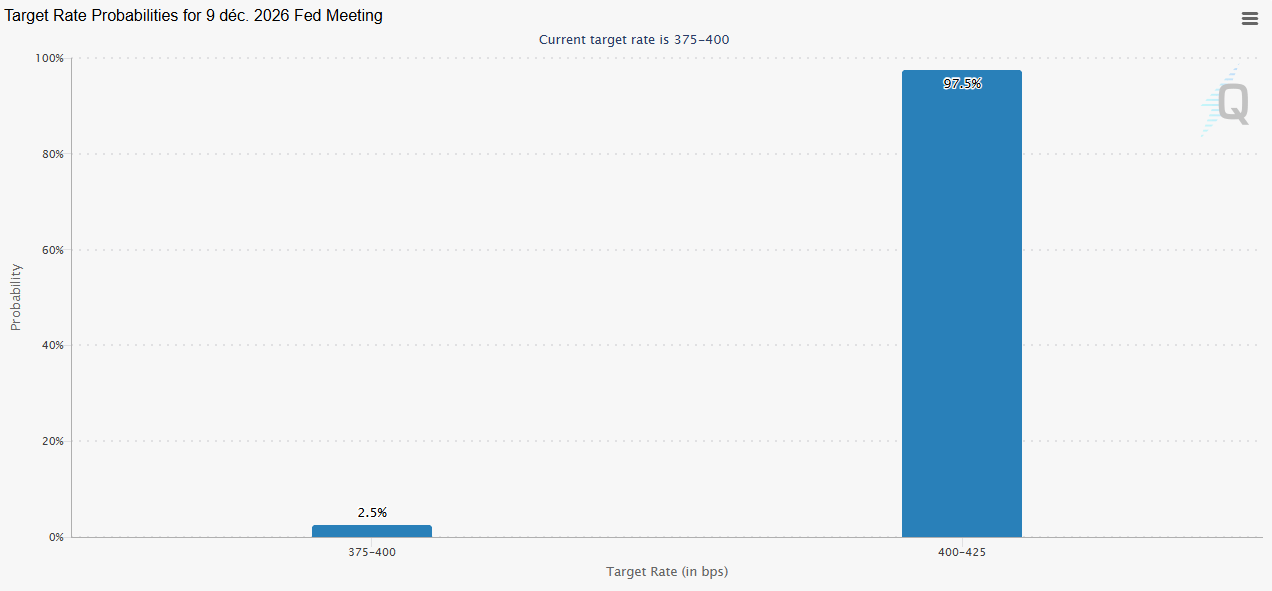
An in-line PCE result should therefore support expectations of a December rate increase, though the immediate market response could be limited. Wednesday’s figures matter chiefly for their ability to alter policy expectations beyond the Fed’s last meeting of the year.
1.1000 in focus: EUR/USD awaits Personal Consumption Expenditures Price Index
Expectations of further Fed tightening have supported the US Dollar (USD), helping drive EUR/USD beneath the psychological 1.1000 level in recent sessions. Much of that policy support now appears reflected in the currency’s price. For the US Dollar to appreciate substantially further, markets may need to reprice the Fed’s 2027 policy outlook in a more hawkish direction.
If monthly core PCE exceeds the 0.3% forecast, markets could raise their bets on a January rate increase and potentially revive expectations of a third increase in March. That would support US Treasury yields and the US Dollar while weighing on the Euro (EUR). A weaker-than-forecast result, by contrast, could lead investors to reduce their expectations for tightening after December, giving EUR/USD scope to regain ground. One softer inflation report alone, however, is unlikely to materially weaken the case for a December rate increase.
Alongside PCE, traders must weigh an updated estimate of US third-quarter Gross Domestic Product (GDP) and weekly Initial Jobless Claims, both released at the same time. Liquidity is also likely to be thinner before Thursday’s Thanksgiving holiday, potentially magnifying EUR/USD moves if the figures deliver a substantial surprise.
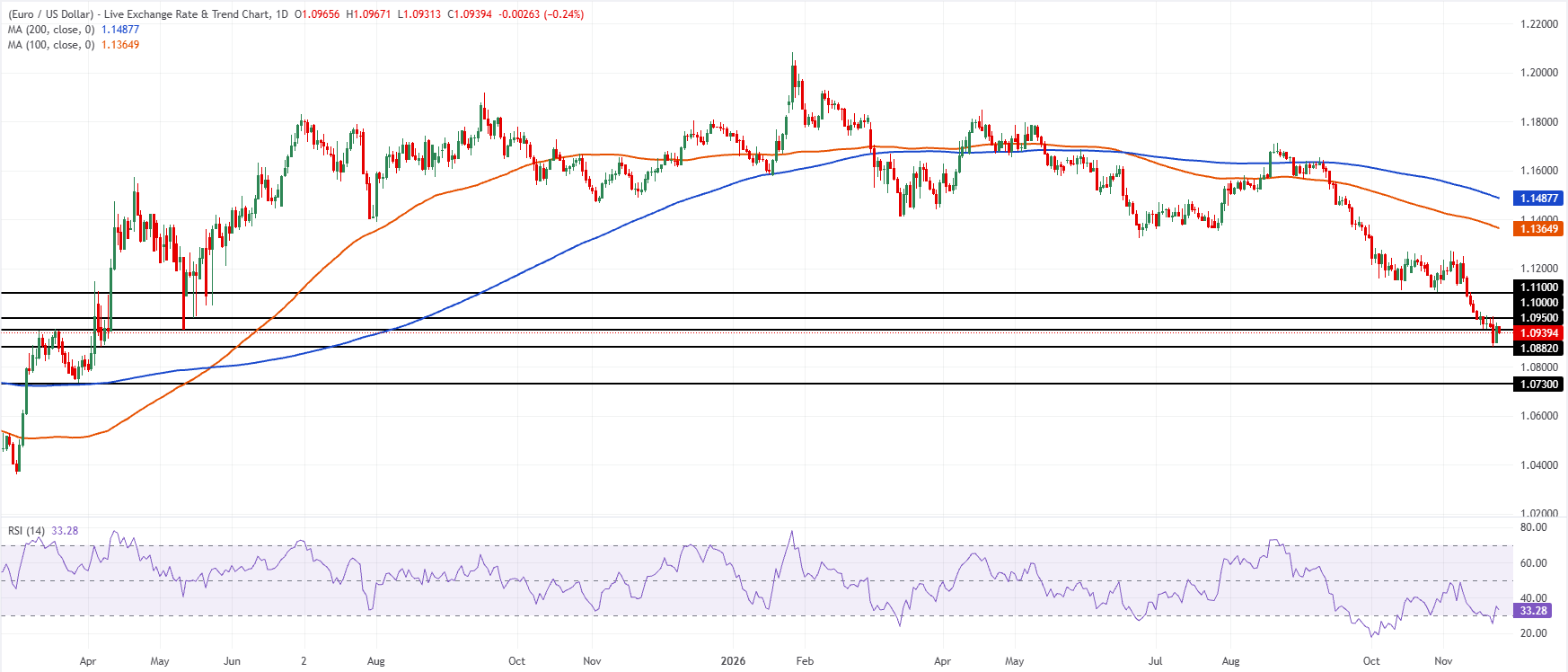
On the daily chart, the technical picture for EUR/USD remains firmly bearish. Its 100-day and 200-day Simple Moving Averages (SMAs) stand at 1.1365 and 1.1488, respectively, well above the current price and both sloping downwards. At around 33, the daily Relative Strength Index (RSI) reinforces the negative momentum, although it remains just above oversold territory.
An upside inflation surprise could send EUR/USD back towards its recent yearly low of 1.0882. Losing that support would leave room for an extended fall towards the 1.0730 area.
A downside inflation surprise could instead lift EUR/USD through near-term resistance at 1.0950, bringing the psychological 1.1000 mark into view. Holding above that level could enable a further rebound towards 1.1100, without changing the broader downtrend.
Economic Data Indicator
Personal Consumption Expenditures Price Index: Monthly Change (MoM)
Published monthly by the US Bureau of Economic Analysis, the Personal Consumption Expenditures (PCE) measures price movements in goods and services bought by consumers in the United States (US). Its MoM reading compares the reference month’s prices with those of the preceding month. Consumers may substitute one product for another when prices change, and the PCE Deflator can capture these shifts. This is why the Federal Reserve favours it as an inflation measure. A higher reading is generally positive for the US Dollar (USD), whereas a lower result is generally negative.
Continue reading.Next publication: Wed 25 Nov 2026 13:30
Release frequency: Every month
Consensus forecast: 0.3%
Previous reading: 0.5%
Data source: US Bureau of Economic Analysis
Inflation: Key Questions Answered
Around 2% is the inflation rate central banks typically target. Their mandate is to keep inflation manageable, with core inflation serving as both their target measure and the figure economists watch most closely. Inflation tracks price increases across a representative basket of goods and services. The headline rate is generally reported as a percentage change month-on-month (MoM) and year-on-year (YoY). The core measure strips out more volatile components, including food and fuel, whose prices can fluctuate with geopolitical developments and seasonal factors.
2% is the key threshold for core CPI described here. A reading above 2% usually leads to higher interest rates, while a reading below 2% generally has the opposite effect. The Consumer Price Index (CPI) tracks changes in the prices of a basket of goods and services over time, normally reported as percentage changes month-on-month (MoM) and year-on-year (YoY). Central banks target the core CPI measure because it removes volatile food and fuel components. As higher interest rates support a currency, higher inflation generally strengthens it. Falling inflation tends to have the reverse effect.
A country's currency tends to strengthen when inflation is high and weaken when inflation is low, however counter-intuitive that may appear. The link runs through interest rates: central banks normally raise rates to curb higher inflation. Those higher rates draw in more global capital from investors seeking attractive returns on their money.
Gold historically served as a store of value for investors during periods of high inflation. Investors still often buy Gold for its safe-haven qualities during extreme market turmoil, but most of the time high inflation does not provide the same support. The reason is the policy response: central banks raise interest rates to bring inflation under control. For Gold, higher rates are a headwind. They raise the opportunity cost of holding the metal rather than an interest-bearing asset or cash in a deposit account. Lower inflation, by contrast, tends to support Gold by bringing interest rates down and making the metal a more attractive investment alternative.
POPULAR ARTICLES
1CPI shock leaves RBA on hold: Australian Dollar – TD Securities2Silver price today: FXStreet data shows a decline32027 Federal Reserve rate hikes expected as US core PCE inflation is set to accelerate in October4Euro: Higher gas prices fail to prevent rebound against US Dollar – Danske Bank50.8370 rejection confirms a double top: USD/CHF price forecast6Japanese Yen: Potential gains against US Dollar amid range trading – UOB761.8% Fibo retracement at 104.65: US Dollar Index Price Forecast highlights difficulty extending rally beyond this level8Gas prices to help Norwegian Krone retain war gains – Commerzbank9Swedish Krona: Assessing PPM-flow effects and seasonality – Nordea


Get Started!
Sign up and access the Global Markets in less than 3 minutes

Connect With Us









Contacts
Phone: +61 2 8036 8388
Fax: +61 2 8036 8388
Email: support@tmgm.com



The information provided on this website is of a general nature only and does not constitute personal financial advice. Before acting on any information on this website, you should consider the suitability of the information in relation to your objectives, financial situation and needs. Investing in CFDs and FX Margin Contracts carries significant risks and is not suitable for all investors. You may lose more than your initial deposit. You do not own, or have, any interest in the underlying asset. We recommend that you seek independent advice and ensure you fully understand the risks involved before trading. It is important that you read and consider the disclosure document before you acquire any product listed on the website. The information and advertisements offered on this website are not intended for use by any person in any country or jurisdiction where such use would be contrary to local laws and regulations. The Products and Services offered on this website are not intended for residents of the United States, Malaysia and Thailand.
TMGM is authorized and regulated in various jurisdictions.
Trademax Australia Limited, trading as TMGM, is regulated by the Australian Securities and Investments Commission (ASIC), AFSL no. 436416 and is located at Level 28, One International Tower, 100 Barangaroo Avenue, 2000 Sydney, NSW Australia.
Email: support@tmgm.com.au
Trademax Global Limited, trading as TMGM, is authorized and regulated by the Vanuatu Financial Services Commission (VFSC), registration number 40356 and registered at 1276, Kumul Highway, Port Vila, Vanuatu, Republic of Vanuatu.
Email: support@tmgm.com
Trademax Global Markets (SE) Limited, trading as TMGM, is authorized and regulated by the Financial Services Authority (FSA) of Seychelles, with license number SD224. The company is registered at Office No 13, Providence Estate ABIS Centre, Mahe, Seychelles.
Email: support@tmgm.com
Trademax Global Markets (International) Pty Ltd, trading as TMGM, is authorized and regulated by the Financial Services Commission, Mauritius (FSC) with license no. GB22201012, and registered at 33, Edith Cavell Street C/o IQ EQ Fund Services (Mauritius) Ltd Port Louis, 11324 Mauritius.
Email: support@tmgm.com
Copyright © TMGM. All rights reserved