

Trading
Explore a wide range of markets with competitive pricing, deep liquidity, and advanced trading tools.
Learn More 
Platform
Trade seamlessly with TMGM's powerful platform, built for speed, precision, and a superior trading experience.
Learn More Trading Platform
Academy
Learn the fundamentals of trading with beginner-friendly resources, including guides, webinars, and market insights.
Learn More News & Analysis
Get real-time market updates and expert analysis to stay ahead of trading opportunities
Learn More News & Analysis
About
Learn what sets TMGM apart — our global presence, regulatory strength, and commitment to innovation in trading.
Learn More Why Choose TMGM
Sponsorship
Swiss Franc holds steady against US Dollar as attention turns to PCE data
- 0.8415: Swiss Franc holds broadly steady against the US Dollar.
- Three successive interest rate increases are expected from the Fed in the near term.
- Renewed gains in global AI shares have provided further support for the US Dollar.
0.8415 is the broadly unchanged level for the Swiss Franc (CHF) against the US Dollar (USD). The pair is trading around that level late in Tuesday’s Asian session, having levelled off after last week’s rally stalled near 0.8444.
Hawkish expectations for the Federal Reserve (Fed) continue to support a positive outlook for the pair. Also underpinning that outlook is the renewed global Artificial Intelligence (AI) rally, which followed Nvidia’s reinstatement of Jensen Huang as CEO.

Three consecutive Fed hikes expected as US economy withstands tighter policy
TD Securities economists see the policy backdrop moving towards renewed tightening. The bank now expects "the Fed to hike three consecutive times starting in December." Explaining their assessment, they say "inflation remains above target and is moving in the wrong direction," alongside evidence that "the labor market has stabilized, with some signs of strengthening, and activity data has been robust." Their conclusion is that "the economy can handle more restriction, and the Fed is likely to provide it," although they emphasise that "the evolution of inflation data will determine the extent and pace of hikes later in the cycle."
Wednesday’s scheduled release of the United States (US) Personal Consumption Expenditure (PCE) Price Index for October is the next focus for investors seeking fresh inflation signals.
Persistent price pressures are likely to feature in the release, according to Commerzbank, which expects “the inflation rate… expected to rise to 3.8% in October, and even without food and energy prices, the inflation rate is expected to be too high at 3.2%.”
For the Swiss Franc, attention is on November’s ZEW Expectations – Survey figures, scheduled for release in November. The sentiment reading fell sharply to -15.3 in October, compared with a positive 2.6 in September.
0.8414: USD/CHF Technical Outlook
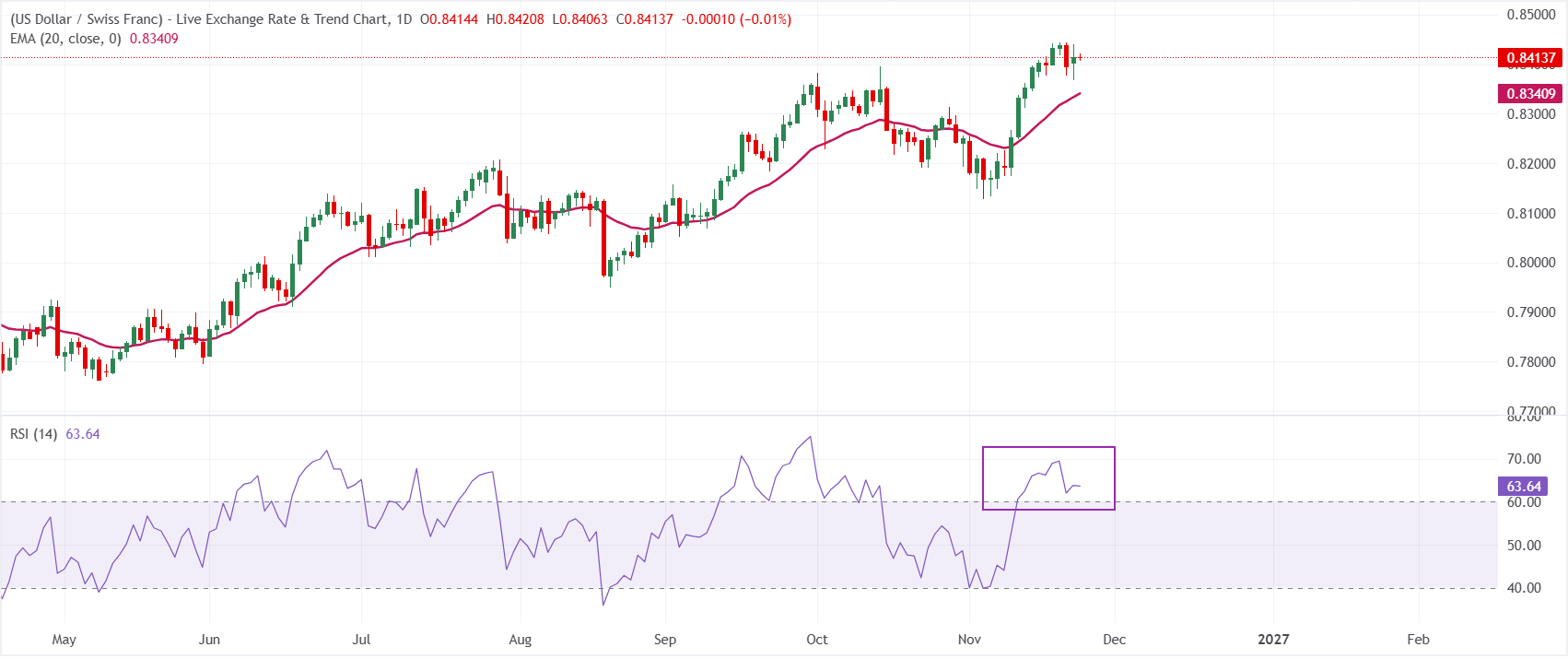
USD/CHF stands at 0.8414 on the daily chart. Trading above the 20-day exponential moving average (EMA) of 0.8341 preserves the pair’s bullish near-term bias and its recent recovery from the 0.82 area. At 63.6, the Relative Strength Index (RSI) remains positive without reaching overbought thresholds. This suggests buyers retain control, with no exhaustion signal yet.
The 0.8341 area provides immediate downside support through demand around the 20-day EMA. The latest price pivot, 0.8414, also serves as an intraday floor while the pair remains above it. Holding this support zone would keep the technical structure tilted towards further advances. Pullbacks would therefore likely be viewed as corrections rather than a change in trend.
(The technical analysis of this story was written with the help of an AI tool. Know more.)
Economic Data Indicator
Personal Consumption Expenditures - Annual Price Index (YoY)
Published monthly by the US Bureau of Economic Analysis, the Personal Consumption Expenditures (PCE) measure tracks price changes for goods and services bought by consumers in the United States (US). Its YoY reading compares the reference month’s prices with those a year earlier. Consumers may switch between goods in response to price movements, and the PCE Deflator accounts for these substitutions. For this reason, it is the Federal Reserve’s preferred inflation gauge. A high reading is generally supportive of the US Dollar (USD); a low reading is generally negative for the currency.
Learn more.Upcoming release: Wed 25 Nov 2026 13:30
Publication frequency: Every month
Market consensus: 3.8%
Previous reading: 3.6%
Data source: US Bureau of Economic Analysis
POPULAR ARTICLES
1Swiss Franc holds steady against US Dollar as attention turns to PCE data2Cardano Price Forecast: ADA hovers near lows amid persistent whale selling31.0900: EUR/USD price forecast remains bearish as pair edges above this level amid oversold conditions4US AI stock rebound leaves British Pound vulnerable against US Dollar5India Gold price today: FXStreet data show a decline in Gold prices6Pi Network Price Forecast: PI gains continue as bearish momentum weakens7XRP and XLM rebound at risk from bears: Ripple and Stellar outlook8Below 104.50: United States Dollar Index eases; renewed AI optimism bolsters Fed rate hike bets9NASDAQ recovery lifts US Dollar outlook as New Zealand Dollar trades cautiously


Get Started!
Sign up and access the Global Markets in less than 3 minutes

Connect With Us









Contacts
Phone: +61 2 8036 8388
Fax: +61 2 8036 8388
Email: support@tmgm.com



The information provided on this website is of a general nature only and does not constitute personal financial advice. Before acting on any information on this website, you should consider the suitability of the information in relation to your objectives, financial situation and needs. Investing in CFDs and FX Margin Contracts carries significant risks and is not suitable for all investors. You may lose more than your initial deposit. You do not own, or have, any interest in the underlying asset. We recommend that you seek independent advice and ensure you fully understand the risks involved before trading. It is important that you read and consider the disclosure document before you acquire any product listed on the website. The information and advertisements offered on this website are not intended for use by any person in any country or jurisdiction where such use would be contrary to local laws and regulations. The Products and Services offered on this website are not intended for residents of the United States, Malaysia and Thailand.
TMGM is authorized and regulated in various jurisdictions.
Trademax Australia Limited, trading as TMGM, is regulated by the Australian Securities and Investments Commission (ASIC), AFSL no. 436416 and is located at Level 28, One International Tower, 100 Barangaroo Avenue, 2000 Sydney, NSW Australia.
Email: support@tmgm.com.au
Trademax Global Limited, trading as TMGM, is authorized and regulated by the Vanuatu Financial Services Commission (VFSC), registration number 40356 and registered at 1276, Kumul Highway, Port Vila, Vanuatu, Republic of Vanuatu.
Email: support@tmgm.com
Trademax Global Markets (SE) Limited, trading as TMGM, is authorized and regulated by the Financial Services Authority (FSA) of Seychelles, with license number SD224. The company is registered at Office No 13, Providence Estate ABIS Centre, Mahe, Seychelles.
Email: support@tmgm.com
Trademax Global Markets (International) Pty Ltd, trading as TMGM, is authorized and regulated by the Financial Services Commission, Mauritius (FSC) with license no. GB22201012, and registered at 33, Edith Cavell Street C/o IQ EQ Fund Services (Mauritius) Ltd Port Louis, 11324 Mauritius.
Email: support@tmgm.com
Copyright © TMGM. All rights reserved