

Trading
Explore a wide range of markets with competitive pricing, deep liquidity, and advanced trading tools.
Learn More 
Platform
Trade seamlessly with TMGM's powerful platform, built for speed, precision, and a superior trading experience.
Learn More Trading Platform
Academy
Learn the fundamentals of trading with beginner-friendly resources, including guides, webinars, and market insights.
Learn More News & Analysis
Get real-time market updates and expert analysis to stay ahead of trading opportunities
Learn More News & Analysis
About
Learn what sets TMGM apart — our global presence, regulatory strength, and commitment to innovation in trading.
Learn More Why Choose TMGM
Sponsorship
Three-month low: Pound stabilises after UK retail sales exceed forecasts
- Seven declines in eight sessions precede GBP/USD's rebound from a three-month low.
- A half-point hike remains in discussion among Fed officials despite lower US inflation expectations.
- Monday brings UK and US PMIs and BoE Chief Economist Pill; US core PCE follows on Wednesday.
GBP/USD is back just above 1.3100. The pair briefly slipped below that threshold to its weakest level in more than three months. Better UK retail sales and softer US inflation expectations have offered Sterling little more than a pause in its decline. Following losses in seven of the previous eight sessions, the recovery has yet to clear the midpoint of Thursday's range.

A quarter-point Fed increase is fully priced in, which would lift its rate to 4.00%-4.25% versus the UK's 4% Bank Rate. That would come eight days before the Bank of England (BoE) meeting. However, Fed Governor Waller advocated a half-point rise on Wednesday for the December 8-9 meeting, while Chicago Fed President Goolsbee has not excluded that option. Markets assign a BoE hike a probability near 80%, compared with 90% before Wednesday's UK inflation data. Rate expectations on both sides have therefore shifted against Sterling.
October UK retail sales increased 0.7%, beating expectations for no change. According to the Office for National Statistics, purchases of tinned food and long-life milk following the government's Be Ready emergency campaign explained part of the gain. That reflects stockpiling rather than demand supporting a BoE rate increase. Meanwhile, the University of Michigan's one-year inflation expectations declined from 4.3% to 3.7%, reducing the case for a half-point Fed hike.
November PMIs and core PCE in focus
Monday's schedule starts with November UK Purchasing Managers Index (PMI) readings at 09:30 GMT, followed by BoE Chief Economist Pill at 13:00 GMT. Speaking to the Financial Times on November 14, Pill said rates would have to rise again in 2027, in addition to December. Both the data and his remarks are relevant to the December 17 decision.
Friday brings Fed Governor Cook's remarks at 17:15 GMT, before New York Fed President Williams speaks on Monday at 21:00 GMT. Due at 13:30 GMT on Wednesday, November 25, October core Personal Consumption Expenditures Price Index (PCE) inflation is forecast at 3.2% year on year, up from 3.1%. The release will inform the choice between a quarter-point and a half-point increase on December 9.
1.3300 and 1.3400 frame the moving averages
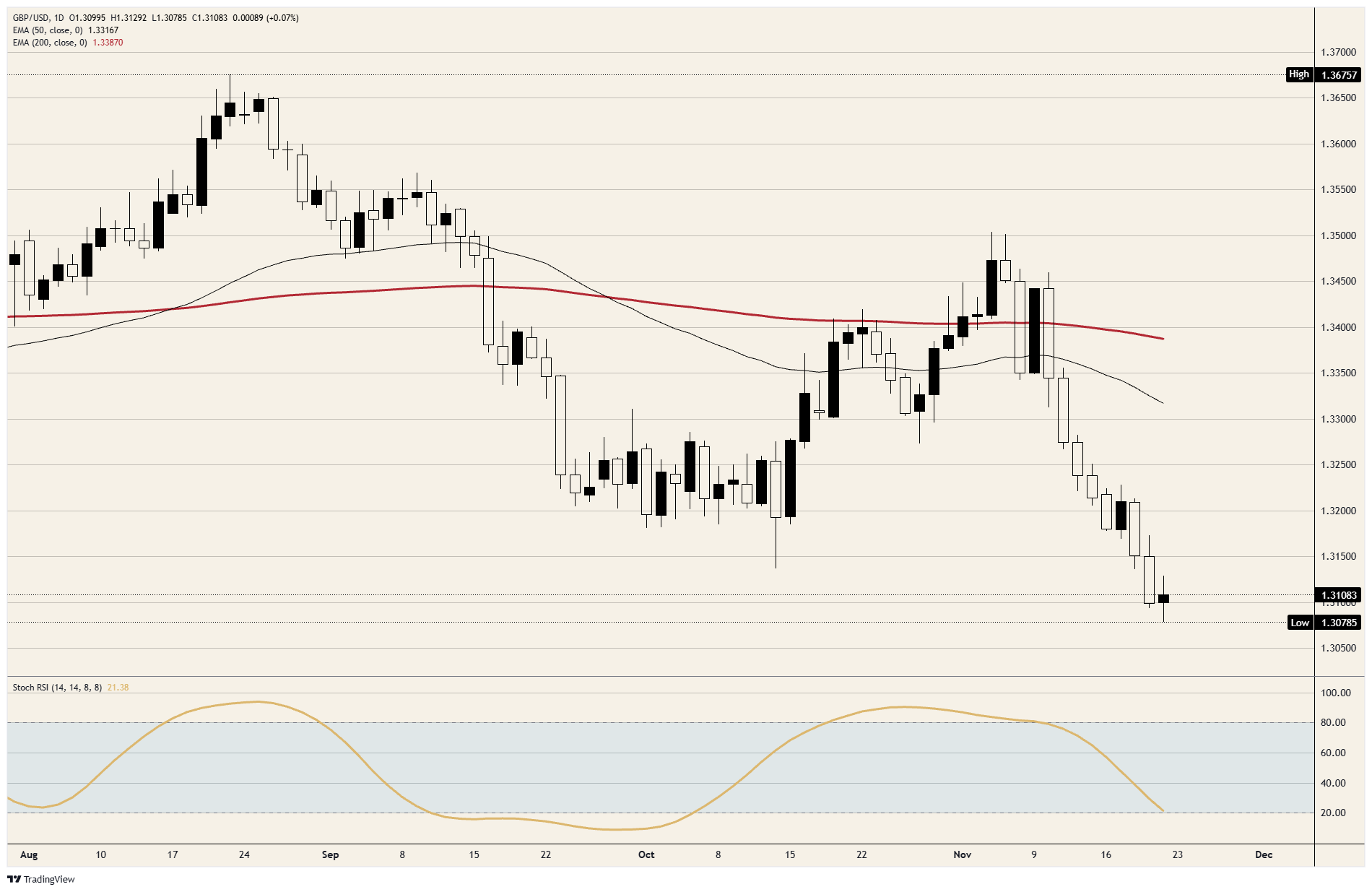
GBP/USD has surrendered its entire recovery from October's low near 1.3150 to the November 4 high near 1.3500. That advance had retraced about two-thirds of the decline from August's peak just below 1.3700. Sitting just above 1.3300, the 50-day Exponential Moving Average (EMA) remains below the 200-day EMA, which is just under 1.3400. Daily momentum is now close to oversold after reaching overbought territory at the beginning of November.
GBP/USD: daily price chart
Pound Sterling: key questions
Dating back to 886 AD, the Pound Sterling (GBP) is the world's oldest currency and serves as the United Kingdom's official currency. Figures for 2022 rank it fourth globally by foreign exchange (FX) trading activity, with 12% of all transactions and average daily turnover of $630 billion. Among its principal pairs, GBP/USD, known as ‘Cable’, represents 11% of FX trading. GBP/JPY, referred to by traders as the ‘Dragon’, accounts for 3%, while EUR/GBP contributes 2%. Responsibility for issuing Pound Sterling rests with the Bank of England (BoE).
Monetary policy set by the Bank of England is the strongest influence on Pound Sterling's value. Policy decisions depend on progress towards the BoE's main objective of “price stability”, meaning inflation holding steady at around 2%. Interest-rate adjustments are its principal means of meeting that objective. To curb excessive inflation, the BoE raises rates, increasing borrowing costs for households and businesses. GBP generally benefits because higher rates enhance the UK's appeal to international investors seeking somewhere to place their funds. By contrast, inflation that is too low signals slower economic growth. The BoE would then consider rate cuts to reduce borrowing costs, encouraging businesses to take out loans for investment in projects that generate growth.
The Pound Sterling can respond to economic releases because they indicate the economy's health. GDP, Manufacturing and Services PMIs, and employment figures can each help determine GBP's direction. Economic strength supports Sterling by drawing in overseas investment. It may also prompt the BoE to raise interest rates, directly strengthening GBP. Weak economic readings, by contrast, are likely to push the Pound Sterling lower.
The Trade Balance is another important release for Pound Sterling. Over a specified period, it compares a country's export earnings with its spending on imports. Strong overseas appetite for a country's exports creates additional demand for its currency as foreign buyers purchase those goods. A positive net Trade Balance consequently supports the currency, while a negative balance has the opposite effect.
POPULAR ARTICLES
119-month low: Canadian retail sales offer the Loonie some respite2Three-month low: Pound stabilises after UK retail sales exceed forecasts3Hong Kong: Cautious re-engagement fuelled by policy support – BNY4Third Weekly Loss Still on Track for Euro Despite Modest Gains as US Dollar Softens5Breaking: $60,000 gives way as Bitcoin selling pressure intensifies6BTC and XAU deepen losses: Bitcoin vs Gold Forecast as hawkish Fed expectations weigh7Gold: Bullish case holds despite setback – TD Securities8Q4 outlook: RBC expects modest Canadian growth despite Q3 weakness9200-week SMA in focus: Silver price forecast as XAG/USD faces persistent selling pressure

Get Started!
Sign up and access the Global Markets in less than 3 minutes

Connect With Us









Contacts
Phone: +61 2 8036 8388
Fax: +61 2 8036 8388
Email: support@tmgm.com



The information provided on this website is of a general nature only and does not constitute personal financial advice. Before acting on any information on this website, you should consider the suitability of the information in relation to your objectives, financial situation and needs. Investing in CFDs and FX Margin Contracts carries significant risks and is not suitable for all investors. You may lose more than your initial deposit. You do not own, or have, any interest in the underlying asset. We recommend that you seek independent advice and ensure you fully understand the risks involved before trading. It is important that you read and consider the disclosure document before you acquire any product listed on the website. The information and advertisements offered on this website are not intended for use by any person in any country or jurisdiction where such use would be contrary to local laws and regulations. The Products and Services offered on this website are not intended for residents of the United States, Malaysia and Thailand.
TMGM is authorized and regulated in various jurisdictions.
Trademax Australia Limited, trading as TMGM, is regulated by the Australian Securities and Investments Commission (ASIC), AFSL no. 436416 and is located at Level 28, One International Tower, 100 Barangaroo Avenue, 2000 Sydney, NSW Australia.
Email: support@tmgm.com.au
Trademax Global Limited, trading as TMGM, is authorized and regulated by the Vanuatu Financial Services Commission (VFSC), registration number 40356 and registered at 1276, Kumul Highway, Port Vila, Vanuatu, Republic of Vanuatu.
Email: support@tmgm.com
Trademax Global Markets (SE) Limited, trading as TMGM, is authorized and regulated by the Financial Services Authority (FSA) of Seychelles, with license number SD224. The company is registered at Office No 13, Providence Estate ABIS Centre, Mahe, Seychelles.
Email: support@tmgm.com
Trademax Global Markets (International) Pty Ltd, trading as TMGM, is authorized and regulated by the Financial Services Commission, Mauritius (FSC) with license no. GB22201012, and registered at 33, Edith Cavell Street C/o IQ EQ Fund Services (Mauritius) Ltd Port Louis, 11324 Mauritius.
Email: support@tmgm.com
Copyright © TMGM. All rights reserved