

Trading
Explore a wide range of markets with competitive pricing, deep liquidity, and advanced trading tools.
Learn More 
Platform
Trade seamlessly with TMGM's powerful platform, built for speed, precision, and a superior trading experience.
Learn More Trading Platform
Academy
Learn the fundamentals of trading with beginner-friendly resources, including guides, webinars, and market insights.
Learn More News & Analysis
Get real-time market updates and expert analysis to stay ahead of trading opportunities
Learn More News & Analysis
About
Learn what sets TMGM apart — our global presence, regulatory strength, and commitment to innovation in trading.
Learn More Why Choose TMGM
Sponsorship
One CPI release left for New Zealand Dollar ahead of RBNZ
- A fourth consecutive session of gains lifts NZD/USD to its strongest since 23 September.
- An RBNZ rate increase to 3.00% on 28 October carries roughly 80% odds in swaps pricing.
- Wednesday brings New Zealand's third-quarter CPI, the final release before the RBNZ decision.
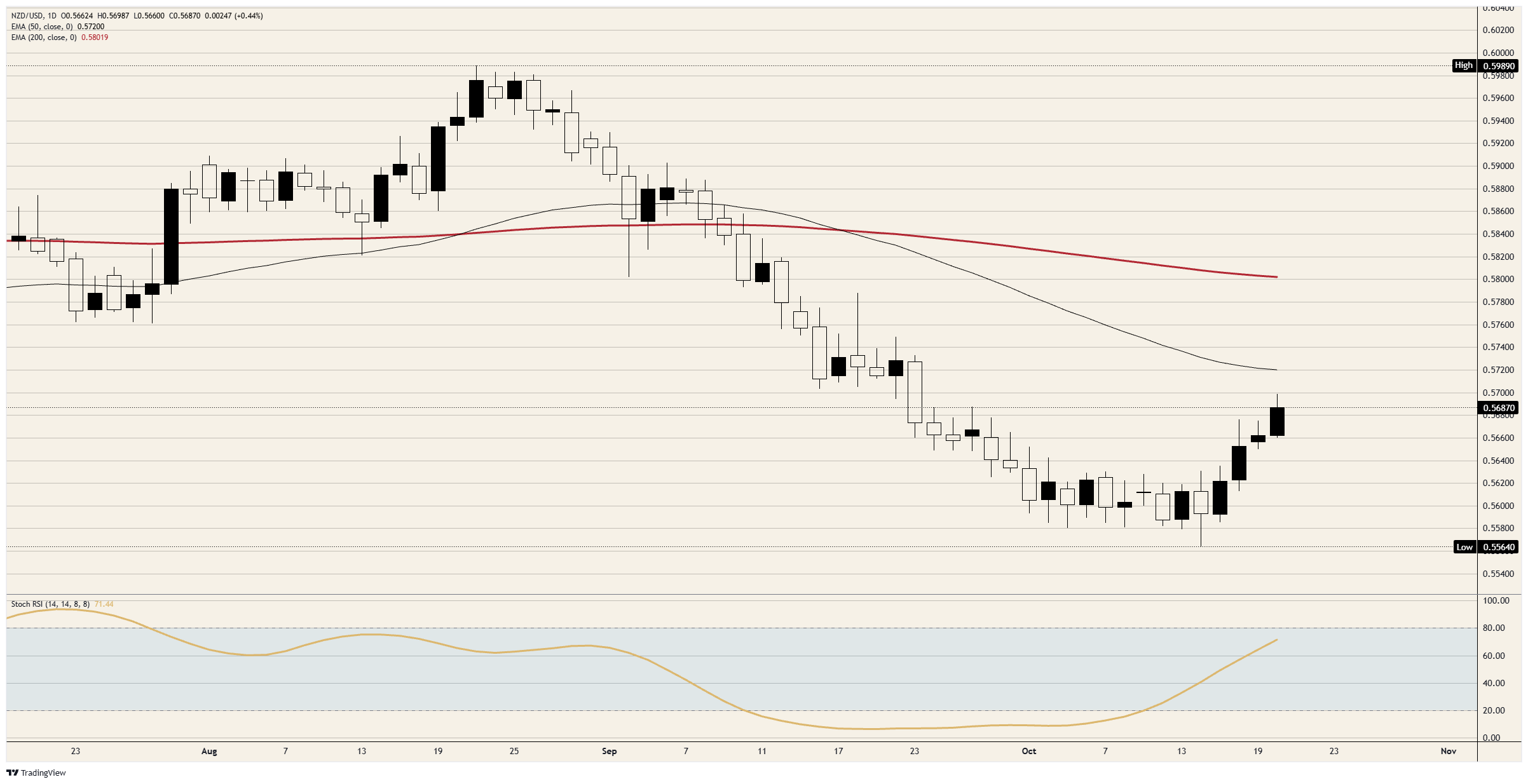
NZD/USD finished Tuesday just below 0.5700. Rising for a fourth consecutive day, the pair reached its strongest level since 23 September after advancing from slightly above 0.5650. The close was around 135 pips above the 14 October trough, its lowest point since April 2025.

An increase in the Reserve Bank of New Zealand's (RBNZ) Official Cash Rate (OCR) from 2.75% to 3.00% on 28 October has roughly an 80% probability in swaps pricing. By contrast, Fed futures assign about an 83% probability to unchanged rates on the same day. The final Consumer Price Index (CPI) release before that decision arrives on Wednesday. Its quarterly forecast of 0.8% matches the RBNZ's projection to the decimal place.
Tuesday's decline in Crude Oil lowers the foreign-currency cost of New Zealand's fuel imports. All of the country's refined fuel has been sourced overseas since its sole refinery closed in 2022. In September, the annual trade deficit expanded from $5.61 billion to NZD $6.18 billion, making cheaper fuel a reduction in the bill payable in foreign currency.
3.8% Annual CPI Forecast Leads the Calendar
Annual inflation is expected to ease from 4.1% to 3.8% in the third-quarter CPI release from Stats NZ, due at 21:45 GMT on Wednesday. That would be a tenth below the RBNZ's 3.9% projection. An outcome below the central bank's projection has implications for whether the 28 October rate increase proceeds.
A rise from 199K to 200K is forecast for US weekly jobless claims, scheduled for Thursday at 12:30 GMT. The US week then concludes with Friday's S&P Global and University of Michigan surveys at 13:45 GMT and 14:00 GMT, respectively, ahead of the Fed's own decision on 28 October.
20 Pips Separate Tuesday's High From the 50-Day EMA
Tuesday's high sits around 20 pips below the 50-day Exponential Moving Average (EMA), while the 200-day EMA stands near 0.5800. Since the 14 October low, NZD/USD has retraced almost a third of its decline from just below 0.6000 in August.
Daily Price Chart: NZD/USD
New Zealand Dollar: Key Questions
Economic conditions in New Zealand and domestic central bank policy largely determine the value of the New Zealand Dollar (NZD). Known as the Kiwi, it is a familiar currency among investors, but several more specific influences also affect its movements. China is New Zealand's largest trading partner, so developments in the Chinese economy tend to influence the Kiwi. Negative Chinese economic news is likely to signal weaker demand for New Zealand exports, weighing on its economy and, in turn, its currency. Dairy prices are another important driver because dairy is New Zealand's leading export industry. Higher prices lift export revenue, supporting both the economy and NZD.
A medium-term inflation range of 1% to 3%, centred on the 2% midpoint, is the Reserve Bank of New Zealand's (RBNZ) objective. The bank sets interest rates at a level appropriate to achieving and maintaining that goal. Excessive inflation prompts the RBNZ to raise rates to slow economic activity. Higher rates also lift bond yields, making investment in New Zealand more attractive and supporting NZD. Rate reductions, by contrast, generally weaken the currency. NZD/USD can also be strongly influenced by the interest rate differential: the gap between actual or expected New Zealand rates and those set by the US Federal Reserve.
New Zealand's macroeconomic releases provide crucial evidence of economic conditions and can affect the valuation of the New Zealand Dollar (NZD). Strong growth, low unemployment and robust confidence support the currency. Rapid economic expansion attracts overseas investment; when accompanied by elevated inflation, it may also prompt the Reserve Bank of New Zealand to raise interest rates. Weak economic figures, on the other hand, are likely to lead to NZD depreciation.
Risk-on conditions generally favour the New Zealand Dollar (NZD). When investors see limited risks across markets and feel optimistic about growth, the outlook for commodities and ‘commodity currencies’ such as the Kiwi tends to improve. During market disruption or economic uncertainty, the reverse usually applies. Investors tend to dispose of higher-risk assets in favour of more stable safe havens, leaving NZD weaker.
POPULAR ARTICLES
1Indirect US talks continue via intermediary countries, Iran’s Araghchi says2RBA's Hauser: Inflation outlook slightly above expectations, appears worse than forecast3158.00: Yen remains pinned nearby ahead of Japan’s inflation figures4$2,400: Ethereum rebounds for a sixth day despite ETF outflows5Below $4,150: Gold retreats as high oil prices bolster prospects of further Fed tightening6December, not October, seen as likely timing for BoJ rate hike – Reuters poll7One CPI release left for New Zealand Dollar ahead of RBNZ80.70 breached: Aussie Dollar hits two-week high on RBA inflation warning9ZEW Sentiment Misses Forecast, Euro Gains Remain Limited
LIVE QUOTES

Get Started!
Sign up and access the Global Markets in less than 3 minutes

Connect With Us









Contacts
Phone: +61 2 8036 8388
Fax: +61 2 8036 8388
Email: support@tmgm.com



The information provided on this website is of a general nature only and does not constitute personal financial advice. Before acting on any information on this website, you should consider the suitability of the information in relation to your objectives, financial situation and needs. Investing in CFDs and FX Margin Contracts carries significant risks and is not suitable for all investors. You may lose more than your initial deposit. You do not own, or have, any interest in the underlying asset. We recommend that you seek independent advice and ensure you fully understand the risks involved before trading. It is important that you read and consider the disclosure document before you acquire any product listed on the website. The information and advertisements offered on this website are not intended for use by any person in any country or jurisdiction where such use would be contrary to local laws and regulations. The Products and Services offered on this website are not intended for residents of the United States, Malaysia and Thailand.
TMGM is authorized and regulated in various jurisdictions.
Trademax Australia Limited, trading as TMGM, is regulated by the Australian Securities and Investments Commission (ASIC), AFSL no. 436416 and is located at Level 28, One International Tower, 100 Barangaroo Avenue, 2000 Sydney, NSW Australia.
Email: support@tmgm.com.au
Trademax Global Limited, trading as TMGM, is authorized and regulated by the Vanuatu Financial Services Commission (VFSC), registration number 40356 and registered at 1276, Kumul Highway, Port Vila, Vanuatu, Republic of Vanuatu.
Email: support@tmgm.com
Trademax Global Markets (SE) Limited, trading as TMGM, is authorized and regulated by the Financial Services Authority (FSA) of Seychelles, with license number SD224. The company is registered at Office No 13, Providence Estate ABIS Centre, Mahe, Seychelles.
Email: support@tmgm.com
Trademax Global Markets (International) Pty Ltd, trading as TMGM, is authorized and regulated by the Financial Services Commission, Mauritius (FSC) with license no. GB22201012, and registered at 33, Edith Cavell Street C/o IQ EQ Fund Services (Mauritius) Ltd Port Louis, 11324 Mauritius.
Email: support@tmgm.com
Copyright © TMGM. All rights reserved