

Trading
Explore a wide range of markets with competitive pricing, deep liquidity, and advanced trading tools.
Learn More 
Platform
Trade seamlessly with TMGM's powerful platform, built for speed, precision, and a superior trading experience.
Learn More Trading Platform
Academy
Learn the fundamentals of trading with beginner-friendly resources, including guides, webinars, and market insights.
Learn More News & Analysis
Get real-time market updates and expert analysis to stay ahead of trading opportunities
Learn More News & Analysis
About
Learn what sets TMGM apart — our global presence, regulatory strength, and commitment to innovation in trading.
Learn More Why Choose TMGM
Sponsorship
Fed interest rate hike bets slow gold’s rebound
- A hawkish Fed outlook curbs demand for Gold, leaving Monday’s recovery struggling to gain traction.
- A 20-month high gives way to a modest US Dollar pullback, cushioning Gold against further losses.
- $3,700 marks immediate resistance for XAU/USD as momentum signals stay bearish.
XAU/USD trades around $3,620 at the time of writing. Gold is slightly weaker in subdued European trading on Tuesday, having reached an intraday high of $3,678. Buyers remain cautious amid a hawkish Federal Reserve (Fed) outlook following the previous day’s recovery from a low not seen in more than a year.

A 3.1% advance on Monday followed Nvidia’s decision to reinstate Jensen Huang as CEO, which triggered a Wall Street rebound. The equity recovery relieved pressure on precious metals. Last week’s share-market sell-off had led some investors to liquidate Gold holdings to offset losses and meet margin calls.
With market sentiment finding its footing, the focus is returning to the pace of potential Fed rate increases. Traders are pricing in a succession of hikes over the coming months as officials maintain that tighter policy is necessary to reduce inflation. Gold pays no interest, making higher borrowing costs a typical headwind.
Fed’s Williams maintains hawkish stance, with rate pace tied to data
According to analysts at Danske Bank, John Williams, a permanent FOMC voter, repeated in newswire comments that “persistently high inflation continues to point the Fed towards tighter monetary policy,” while stressing that the “pace of future rate increases will depend on incoming data.” On the next policy moves, Williams said he had no “a particular timing” in mind, but did not rule out “moving at consecutive meetings if needed.” In Danske Bank’s assessment, the comments “confirm the broadly hawkish tone from Fed officials in recent weeks” and “support our call for 25bp hikes in December, January and March.”
Further Fed tightening remains a broad source of support for the US Dollar (USD). Tuesday’s modest retreat nevertheless cushions Gold’s losses. After hitting a 20-month high of 104.53 on Monday, the US Dollar Index (DXY) is trading around 104.15.
Consumer Confidence is the main release on an otherwise sparse US calendar on Tuesday. More significant tests follow on Wednesday: the October Personal Consumption Expenditures (PCE) Price Index, the Fed’s preferred inflation measure, and the second estimate of third-quarter US Gross Domestic Product (GDP).
Technical analysis: Subdued momentum leaves Gold exposed to declines
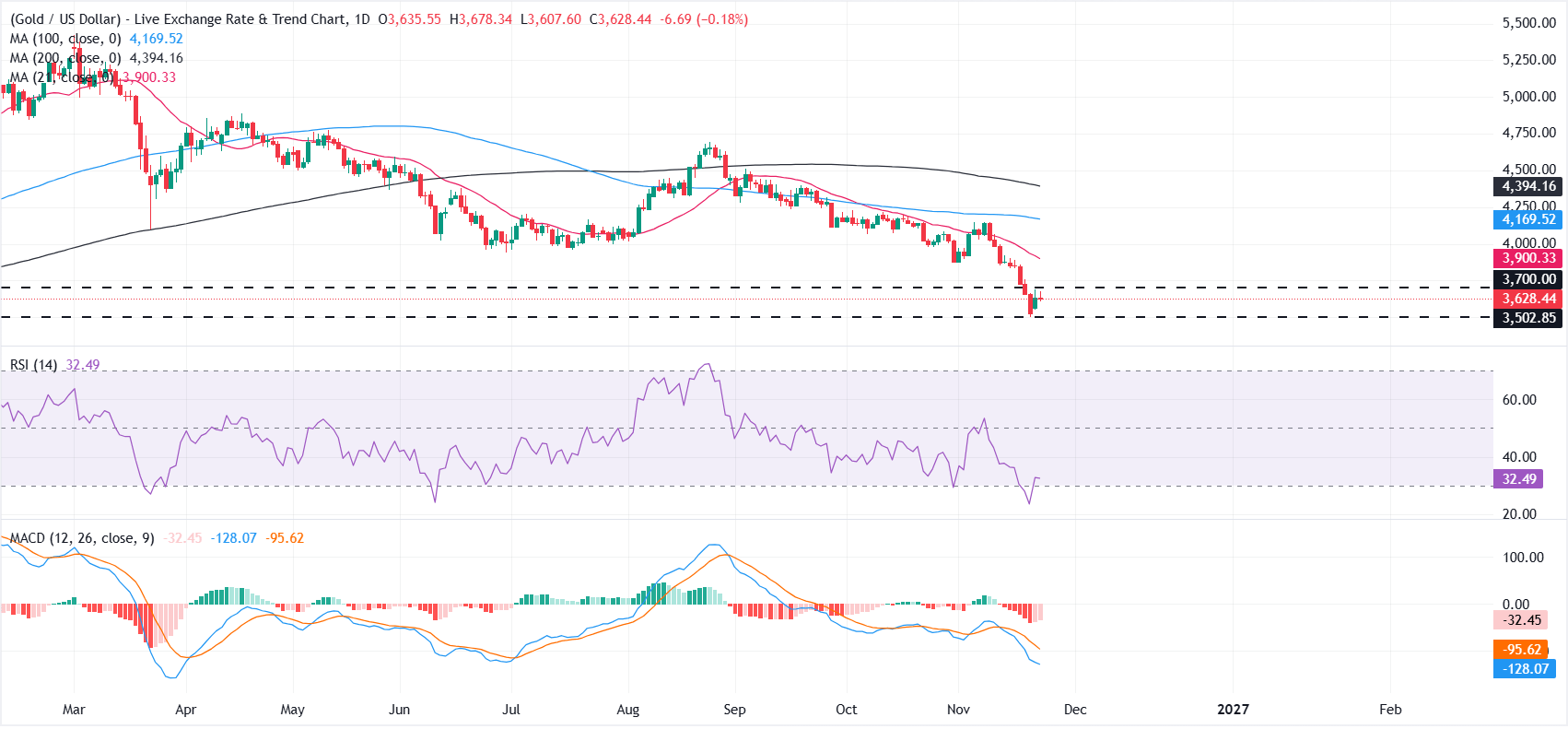
A reading of 32 leaves the daily Relative Strength Index (RSI) close to oversold territory. The Moving Average Convergence Divergence (MACD) indicator also remains deeply negative, pointing to continued downward momentum rather than a firm base. XAU/USD’s near-term bias stays bearish, with the price firmly beneath the 21-day simple moving average (SMA) and the longer-term 100-day and 200-day SMAs. This concentration of moving averages overhead indicates that rebounds remain corrective within the wider downtrend.
$3,700 is the first upside hurdle, marked by horizontal resistance. Beyond it lies the 21-day SMA at $3,900, followed by further barriers at the 100-day SMA of $4,169 and the 200-day SMA of $4,394. Friday’s $3,502 low provides the next important downside support. A sustained breach could prolong the sell-off; holding above that level could instead encourage limited short-covering towards $3,700 resistance.
(The technical analysis of this story was written with the help of an AI tool. Know more.)
Gold: Frequently asked questions
As a widely used store of value and means of exchange, Gold has held an important place throughout human history. Its modern appeal extends beyond its lustre and use in jewellery: investors broadly regard the precious metal as a safe-haven asset, or a suitable investment during periods of turbulence. Because Gold is not dependent on a particular issuer or government, it is also widely viewed as a hedge against inflation and currency depreciation.
1,136 tonnes of Gold, valued at around $70 billion, were added to central bank reserves in 2022, according to the World Gold Council. That was the largest annual purchase since records began. Central banks are Gold’s largest holders. To underpin their currencies during turbulent periods, they typically diversify reserves and purchase Gold to reinforce perceptions of economic and currency strength. Substantial Gold reserves can strengthen confidence in a country’s solvency. Emerging-economy central banks, including those in China, India and Turkey, are rapidly expanding their Gold holdings.
Both the US Dollar and US Treasuries, major reserve and safe-haven assets, have an inverse correlation with Gold. A weaker Dollar generally accompanies a rise in Gold, allowing investors and central banks to diversify their holdings during unsettled periods. The metal also tends to move inversely to risk assets: equity rallies usually weigh on Gold prices, whereas selling in riskier markets tends to benefit the precious metal.
Gold responds to a broad set of influences. Its safe-haven role means geopolitical instability or concerns about a deep recession can trigger a rapid price rise. With no yield to offer, the metal typically benefits from lower interest rates, while more expensive borrowing generally weighs on it. Most price movements nevertheless hinge on the US Dollar (USD), since Gold is quoted in dollars (XAU/USD). Dollar strength tends to restrain Gold prices; a softer Dollar is more likely to lift them.
POPULAR ARTICLES
1BRL: Fiscal fears drive weakness against US Dollar – Societe Generale2Fed interest rate hike bets slow gold’s rebound3Crypto Today: ETF redemptions persist as Bitcoin and Ethereum ease, XRP steadies4Mexican Peso to rise against US Dollar as Fed hike bets recede, Rabobank expects5South African Rand: Political risk tempers optimism – Commerzbank6Hungarian Forint Rebounds Against Euro on Support From Moody’s and MNB – Societe Generale7Silver price today: FXStreet data show a decline8Japanese Yen: Upside risk against US Dollar amid range-bound trading – UOB9Nine-year ICO ban: South Korea proposes repeal and mandatory bank-led Won stablecoins


Get Started!
Sign up and access the Global Markets in less than 3 minutes

Connect With Us









Contacts
Phone: +61 2 8036 8388
Fax: +61 2 8036 8388
Email: support@tmgm.com



The information provided on this website is of a general nature only and does not constitute personal financial advice. Before acting on any information on this website, you should consider the suitability of the information in relation to your objectives, financial situation and needs. Investing in CFDs and FX Margin Contracts carries significant risks and is not suitable for all investors. You may lose more than your initial deposit. You do not own, or have, any interest in the underlying asset. We recommend that you seek independent advice and ensure you fully understand the risks involved before trading. It is important that you read and consider the disclosure document before you acquire any product listed on the website. The information and advertisements offered on this website are not intended for use by any person in any country or jurisdiction where such use would be contrary to local laws and regulations. The Products and Services offered on this website are not intended for residents of the United States, Malaysia and Thailand.
TMGM is authorized and regulated in various jurisdictions.
Trademax Australia Limited, trading as TMGM, is regulated by the Australian Securities and Investments Commission (ASIC), AFSL no. 436416 and is located at Level 28, One International Tower, 100 Barangaroo Avenue, 2000 Sydney, NSW Australia.
Email: support@tmgm.com.au
Trademax Global Limited, trading as TMGM, is authorized and regulated by the Vanuatu Financial Services Commission (VFSC), registration number 40356 and registered at 1276, Kumul Highway, Port Vila, Vanuatu, Republic of Vanuatu.
Email: support@tmgm.com
Trademax Global Markets (SE) Limited, trading as TMGM, is authorized and regulated by the Financial Services Authority (FSA) of Seychelles, with license number SD224. The company is registered at Office No 13, Providence Estate ABIS Centre, Mahe, Seychelles.
Email: support@tmgm.com
Trademax Global Markets (International) Pty Ltd, trading as TMGM, is authorized and regulated by the Financial Services Commission, Mauritius (FSC) with license no. GB22201012, and registered at 33, Edith Cavell Street C/o IQ EQ Fund Services (Mauritius) Ltd Port Louis, 11324 Mauritius.
Email: support@tmgm.com
Copyright © TMGM. All rights reserved