

Trading
Explore a wide range of markets with competitive pricing, deep liquidity, and advanced trading tools.
Learn More 
Platform
Trade seamlessly with TMGM's powerful platform, built for speed, precision, and a superior trading experience.
Learn More Trading Platform
Academy
Learn the fundamentals of trading with beginner-friendly resources, including guides, webinars, and market insights.
Learn More News & Analysis
Get real-time market updates and expert analysis to stay ahead of trading opportunities
Learn More News & Analysis
About
Learn what sets TMGM apart — our global presence, regulatory strength, and commitment to innovation in trading.
Learn More Why Choose TMGM
Sponsorship
Near yearly low: Euro looks vulnerable as Fed-ECB policy takes centre stage
- 1.1113 marks the Euro’s yearly low against the US Dollar. The currency remains vulnerable near that level ahead of the Fed’s policy decision.
- French fiscal concerns and climbing oil prices maintain downward pressure on the Euro.
- Interest rates are expected to remain unchanged at both the Fed and the ECB.
1.1113 is the Euro’s (EUR) yearly low against the US Dollar (USD). The pair trades near that level in Wednesday’s European session, weighed down by mounting unease in French bond markets and higher oil prices.

2022 confidence lows and wider French spreads weigh on Euro
Domestic political tensions are becoming more apparent in French markets, according to Scotiabank strategists, who note that “French bonds … underperforming, nudging the spread over 10Y bunds back up to 161bps.” Highlighting the sharp deterioration in sentiment, they add that “French Consumer Confidence plunged to 80 in October, equaling the low seen in 2022, reflecting recent pollical tensions and social unrest.”
Fears of further risks to energy supplies have meanwhile driven oil prices higher at a faster pace, following a drone attack by Iran-backed Houthis on Saudi Arabia’s largest oil facility.
A military spokesperson for the Iran-aligned Houthis said on Tuesday that the group had struck Saudi Arabia’s largest oil refinery with a missile. The claimed attack marked an escalation in strikes against the world’s second-largest crude producer. Reuters reports that Saudi authorities did not immediately confirm the strike on the facility, which has a capacity of 550,000 barrels per day.
Thursday’s European Central Bank monetary policy announcement and Friday’s preliminary German Harmonized Index of Consumer Prices (HICP) figures for October will be key upcoming catalysts for the Euro. Expectations point to the ECB leaving interest rates unchanged.
For the US Dollar, attention is on the Federal Reserve’s (Fed) monetary policy announcement, due at 18:00 GMT.
December and March hikes: Danske Bank’s Fed outlook
With the US policy announcement approaching, Danske Bank analysts say “the main event of the week is this evening's FOMC rate decision and the following press conference,” adding that they “expect the Fed to keep policy rates unchanged, in line with consensus, while markets price in a 10% probability of a hike.”
Explaining its forecast for dissent, the bank says “most central FOMC members have signalled that they can wait until December before hiking again, although a few see more urgency,” leading its analysts to “expect 2-3 dissenting votes in favour of a hike.”
Danske Bank maintains that it “still see[s] a need for further tightening”, while noting that “all eyes are on Fed, which are expected to leave rates unchanged.” The bank continues to forecast “two more hikes, in December and March.” Its base case is for Chair Powell “to reiterate his firm commitment to bringing inflation back to target”.
1.1126: EUR/USD Technical Outlook
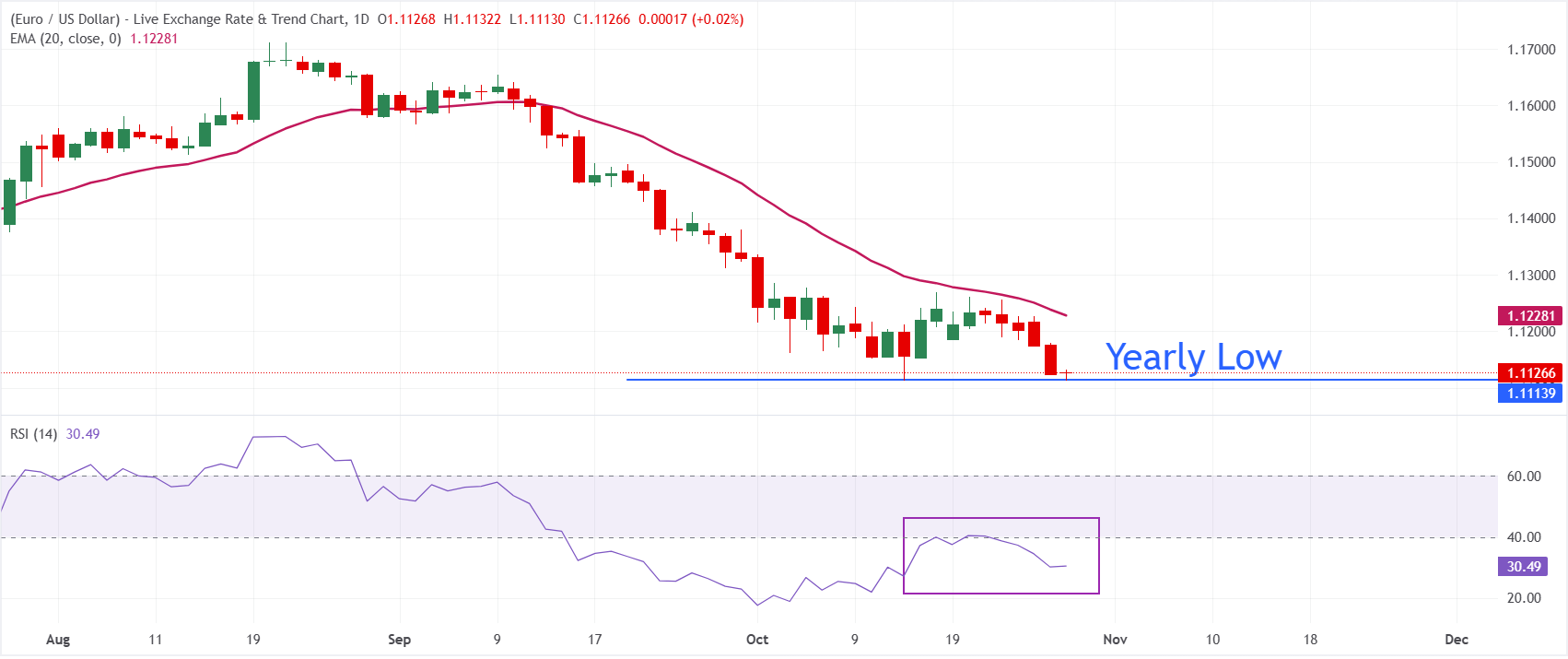
At 1.1126 on the daily chart, EUR/USD retains a bearish bias below its 20-day exponential moving average (EMA) of 1.1228. This dynamic resistance continues to cap the pair. A Relative Strength Index (RSI) reading near 30 also suggests that downward momentum remains dominant. Approaching oversold conditions may temper near-term selling, rather than signal a reversal of the trend.
The 20-day EMA near 1.1228 provides the first resistance on the upside. A daily close above it would be required to reduce the prevailing bearish pressure and indicate a more lasting corrective rebound. Before that level is recovered, any rallies are likely to be treated as corrections within the wider downtrend. With no nearby structural support on the chart, renewed selling momentum would leave the pair exposed to fresh lows.
(The technical analysis of this story was written with the help of an AI tool. Know more.)
Economic Data Event
Fed Policy Rate Decision
Eight scheduled meetings each year give the Federal Reserve (Fed) the opportunity to review monetary policy and decide on interest rates. Its dual mandate is to maintain full employment and keep inflation at 2%. To pursue these goals, it primarily sets the rates at which it lends to banks and at which banks lend to one another. A rate increase generally supports the US Dollar (USD) by drawing in more foreign capital. A reduction generally weakens the USD, as capital moves to countries offering better returns. When rates remain unchanged, the focus shifts to the Federal Open Market Committee (FOMC) statement: a hawkish tone points to expectations of higher interest rates ahead, while a dovish tone points to expectations of lower rates.
Learn more.Upcoming release: Wed 28 Oct 2026 18:00
Release frequency: Irregular intervals
Market consensus: 4%
Previous reading: 4%
Data source: Federal Reserve
POPULAR ARTICLES
1Iran: Our policy remains unchanged, with no flexibility on the nuclear issue2Bitcoin, Ethereum, XRP rebound ahead of Fed decision: Crypto today3Czech Koruna: Political tensions drive up risk premium – Commerzbank4Pi Network Price Forecast: PI Stalls Amid Core Team Investment Fund Expansion to Axis Robotics5New Zealand Dollar faces growing downside risks against US Dollar – Societe Generale6Euro: Key Support Against US Dollar at Risk as Lending Slows - ING7Below 1.3300: British Pound pares losses as UK budget takes centre stage82.50%: BoC expected to lift interest rates9Silver price today: FXStreet data shows a decline

Get Started!
Sign up and access the Global Markets in less than 3 minutes

Connect With Us









Contacts
Phone: +61 2 8036 8388
Fax: +61 2 8036 8388
Email: support@tmgm.com



The information provided on this website is of a general nature only and does not constitute personal financial advice. Before acting on any information on this website, you should consider the suitability of the information in relation to your objectives, financial situation and needs. Investing in CFDs and FX Margin Contracts carries significant risks and is not suitable for all investors. You may lose more than your initial deposit. You do not own, or have, any interest in the underlying asset. We recommend that you seek independent advice and ensure you fully understand the risks involved before trading. It is important that you read and consider the disclosure document before you acquire any product listed on the website. The information and advertisements offered on this website are not intended for use by any person in any country or jurisdiction where such use would be contrary to local laws and regulations. The Products and Services offered on this website are not intended for residents of the United States, Malaysia and Thailand.
TMGM is authorized and regulated in various jurisdictions.
Trademax Australia Limited, trading as TMGM, is regulated by the Australian Securities and Investments Commission (ASIC), AFSL no. 436416 and is located at Level 28, One International Tower, 100 Barangaroo Avenue, 2000 Sydney, NSW Australia.
Email: support@tmgm.com.au
Trademax Global Limited, trading as TMGM, is authorized and regulated by the Vanuatu Financial Services Commission (VFSC), registration number 40356 and registered at 1276, Kumul Highway, Port Vila, Vanuatu, Republic of Vanuatu.
Email: support@tmgm.com
Trademax Global Markets (SE) Limited, trading as TMGM, is authorized and regulated by the Financial Services Authority (FSA) of Seychelles, with license number SD224. The company is registered at Office No 13, Providence Estate ABIS Centre, Mahe, Seychelles.
Email: support@tmgm.com
Trademax Global Markets (International) Pty Ltd, trading as TMGM, is authorized and regulated by the Financial Services Commission, Mauritius (FSC) with license no. GB22201012, and registered at 33, Edith Cavell Street C/o IQ EQ Fund Services (Mauritius) Ltd Port Louis, 11324 Mauritius.
Email: support@tmgm.com
Copyright © TMGM. All rights reserved