

Trading
Explore a wide range of markets with competitive pricing, deep liquidity, and advanced trading tools.
Learn More 
Platform
Trade seamlessly with TMGM's powerful platform, built for speed, precision, and a superior trading experience.
Learn More Trading Platform
Academy
Learn the fundamentals of trading with beginner-friendly resources, including guides, webinars, and market insights.
Learn More News & Analysis
Get real-time market updates and expert analysis to stay ahead of trading opportunities
Learn More News & Analysis
About
Learn what sets TMGM apart — our global presence, regulatory strength, and commitment to innovation in trading.
Learn More Why Choose TMGM
Sponsorship
Bitcoin, Ethereum, XRP rebound ahead of Fed decision: Crypto today
- Bitcoin trades above $81,000. Its recovery gathers pace as markets await the Fed’s next interest rate decision.
- Strengthening momentum indicators support Ethereum’s second consecutive daily advance.
- With the MACD approaching a buy signal, XRP bulls seek to reassert control of the trend.
Bitcoin (BTC) is back above $81,000 on Wednesday. The renewed advance is improving cryptocurrency market sentiment ahead of the Federal Reserve’s (Fed) forthcoming interest rate decision.
Following Bitcoin’s lead, Ethereum (ETH) is approaching $2,400 as bulls appear to add exposure. Improving momentum indicators are also supporting Ripple (XRP), which is moving higher above $1.33.

Fed rate decision approaches as crypto gains
Against a backdrop of heightened inflation concerns and high oil and energy prices linked to persistent Middle East geopolitical tensions, the Federal Open Market Committee (FOMC) is due to announce its interest rate decision later on Wednesday.
CME’s FedWatch Tool puts the probability of unchanged rates at 91%, in line with broad expectations. Traders will instead scrutinise Fed Chair Kevin Warsh's post-meeting press conference for indications of the policy outlook.
With inflation still above the 2% long-term target, persistent price pressures remain a key challenge for the Fed. Warsh has repeatedly stressed the regulator’s commitment to lowering inflation, although the US economy continues to show resilience.
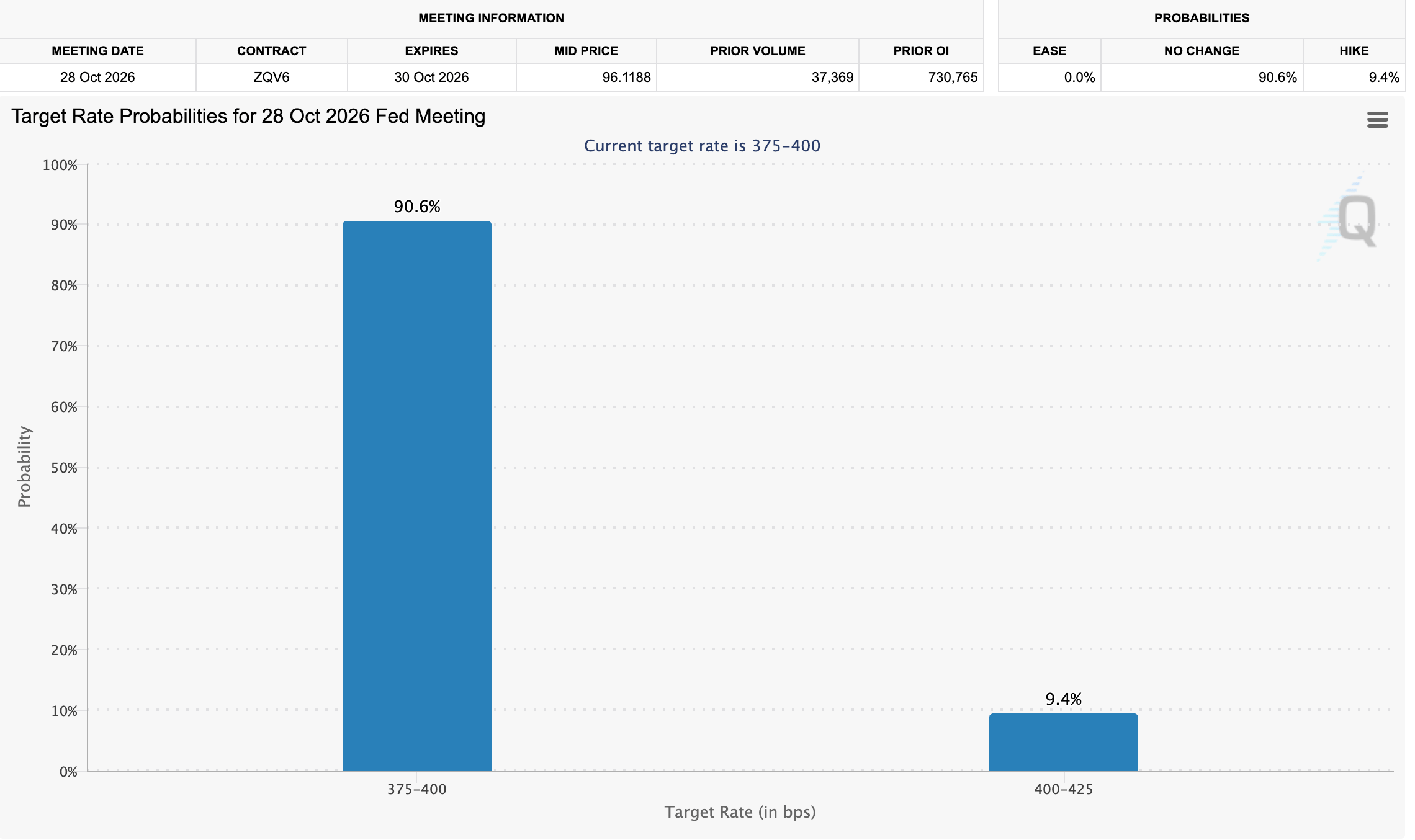
In emailed commentary, Ian Weisberger, Co-founder and CEO of CoinRoutes, said: “This is a nervy week for crypto. In the space of three days, traders face a Fed rate decision, results from the biggest tech companies in the world, and around $12 billion worth of bitcoin bets expiring on Friday,” adding, “Then the US midterms land next Tuesday.”
$81,494: Bitcoin tests recovery traction
At $81,494, Bitcoin is consolidating within the upper half of its recent Bollinger Bands range, leaving the short-term outlook broadly neutral. Underlying support comes from the 50-day Exponential Moving Average (EMA) at $80,831, which remains below the price. However, Bitcoin has yet to clear the Bollinger middle band at $81,941, indicating that upward momentum remains tentative.
Neither momentum gauge points to dominant buying pressure: the Relative Strength Index (RSI) is near neutral at 48, while the Moving Average Convergence Divergence (MACD) remains below zero.
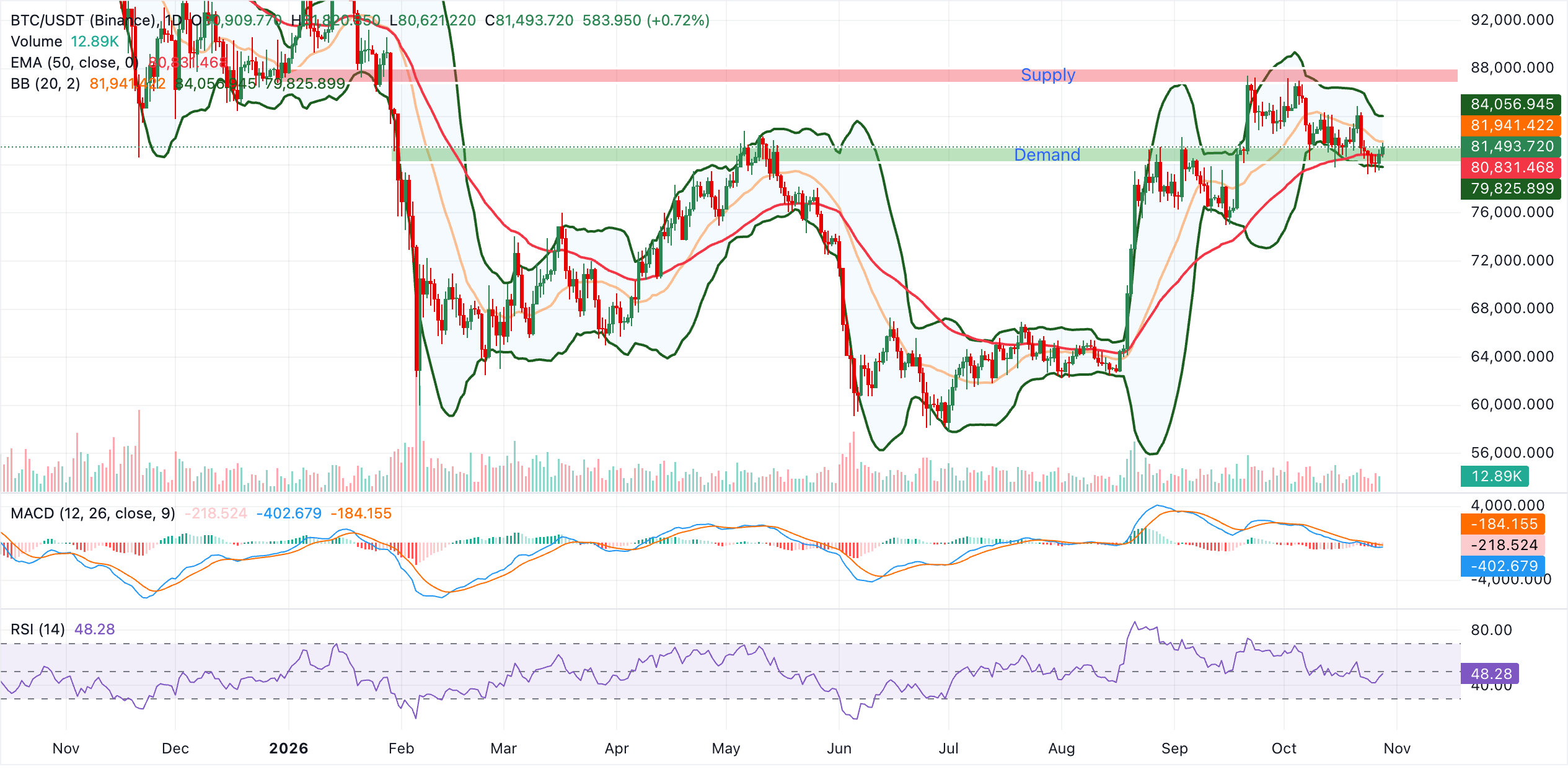
A sustained move through initial resistance at the Bollinger middle band around $81,941 would bring the upper band near $84,056 into focus as the next obstacle. Immediate downside support sits at the 50-day EMA around $80,831. Should the consolidation break lower, a deeper retreat would put the lower Bollinger band near $79,826 in play, where buyers would be expected to respond more decisively.
$2,374: Ethereum bulls regain ground
A second consecutive daily gain has brought Ethereum to $2,374, though the outlook remains cautiously bearish. Spot prices are still beneath both the Bollinger middle band around $2,421 and the 50-day EMA near $2,452.
Sellers have not secured full control despite the weaker broader structure. The pair remains just above rising trendline support near $2,369 and above the lower Bollinger Band at approximately $2,305.
Bullish conviction remains limited, as reflected in an RSI near 41. The MACD is still negative, but its shrinking downside readings indicate that bearish momentum is beginning to fade rather than strengthen.
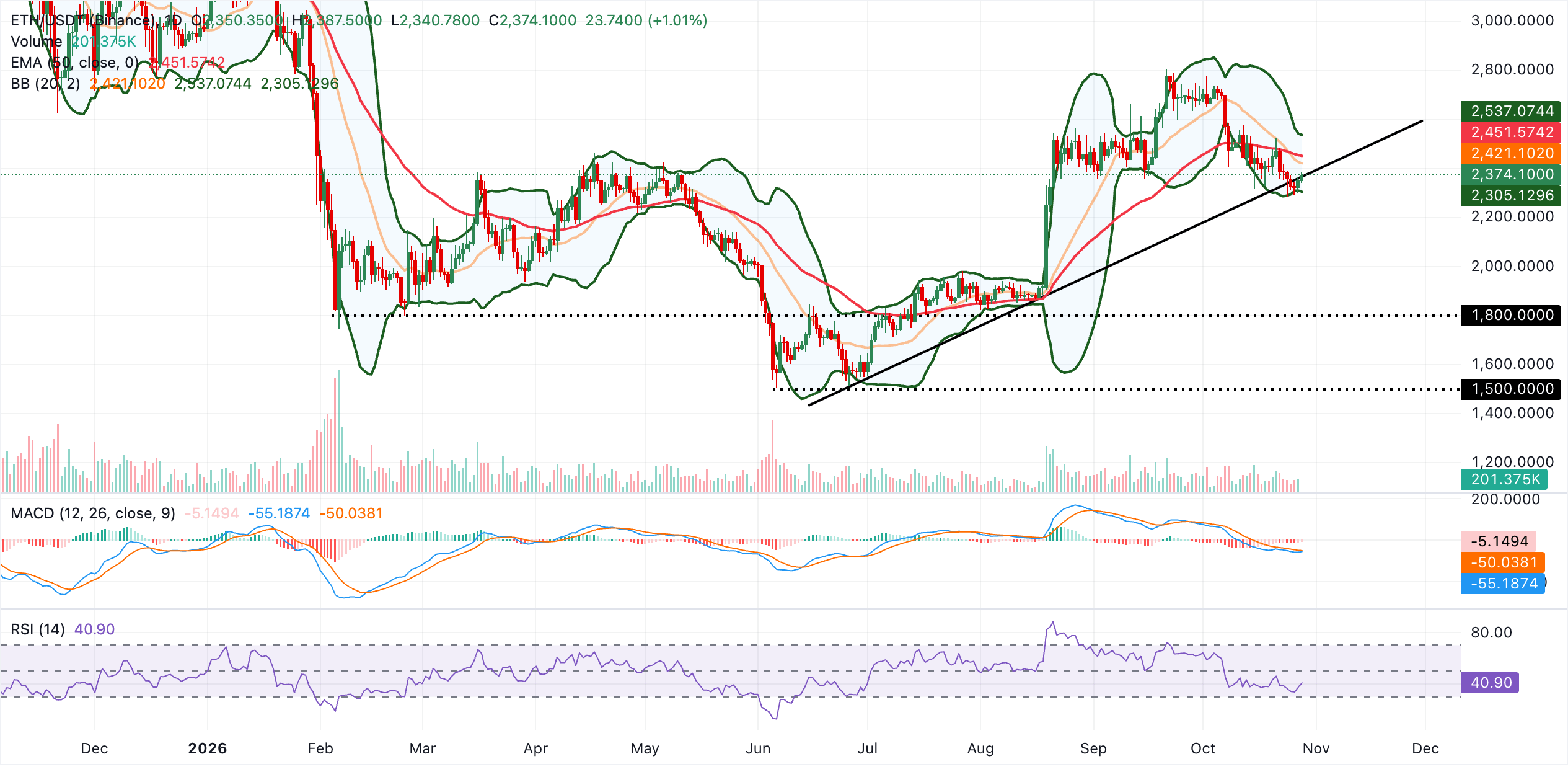
To clear the first resistance hurdle, Ethereum needs a sustained break above the Bollinger Band middle line around $2,421. That would open a route towards the 50-day EMA near $2,452, followed by the more demanding upper Bollinger Band barrier around $2,537, where advances could falter. On a retreat, the reclaimed trendline area near $2,369 offers immediate support, followed by the lower Bollinger Band around $2,305. A daily close below the latter would likely leave ETH vulnerable to a deeper correction.
$1.33: XRP bulls protect crucial support
Trading above $1.33, XRP is seeing bulls strengthen their position in an effort to reclaim control of the trend. Near-term upside nevertheless remains constrained. The price is just below the 20-day Bollinger middle band around $1.33 and beneath the 50-day EMA near $1.36. Despite a slightly positive MACD reading, that positioning leaves the broader outlook mildly bearish.
An RSI around 46 points to a lack of directional momentum, favouring consolidation over a forceful breakout. Meanwhile, the established descending resistance trendline, projected from above $1.70, still governs the medium-term structure.
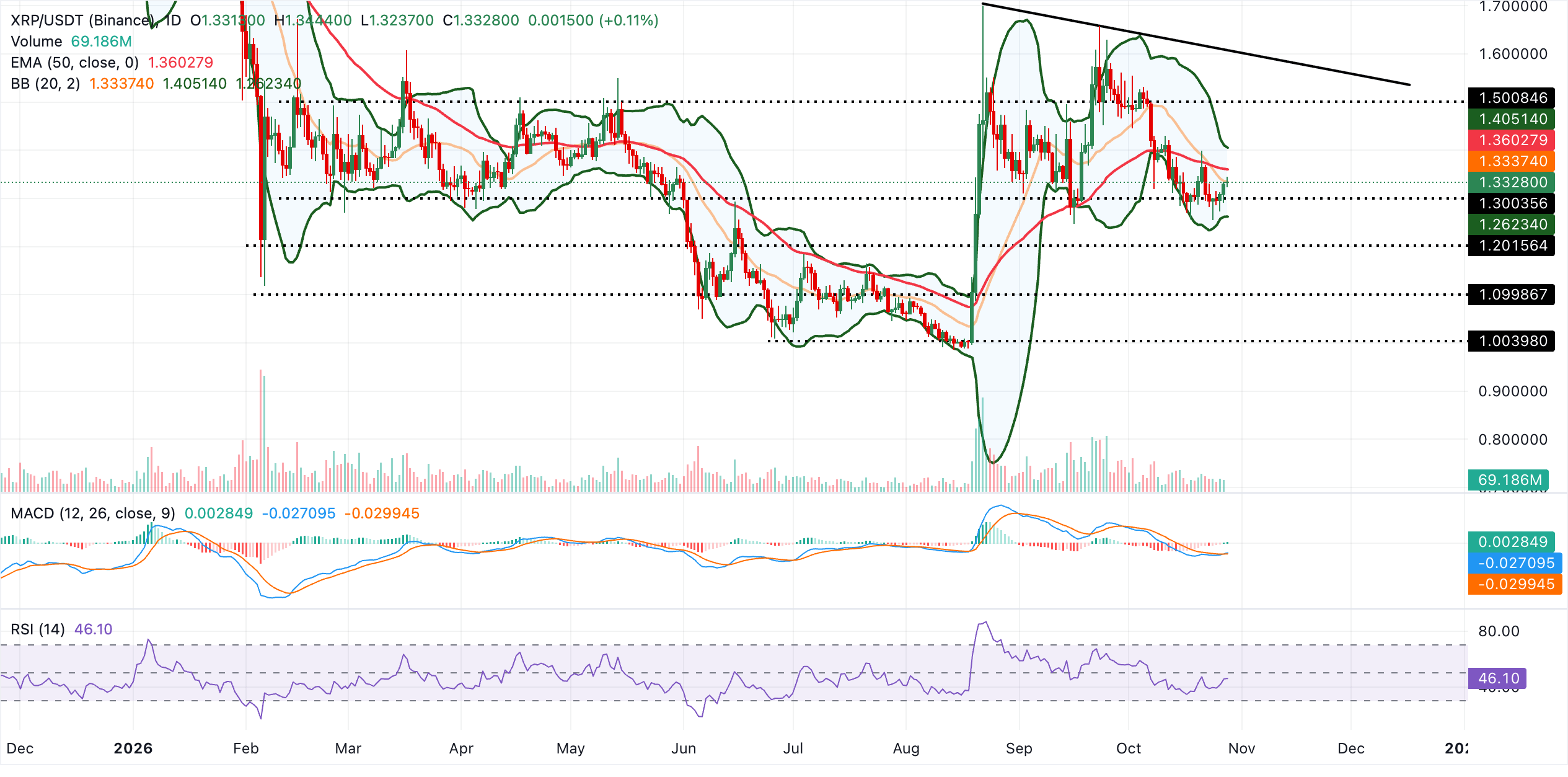
A daily close above the first resistance level, the Bollinger middle band at $1.33, would put the 50-day EMA near $1.36 in view. The upper Bollinger band around $1.41 would then become the next upside objective. The lower Bollinger band near $1.26 provides the first significant technical support. Losing that level would likely revive selling pressure and open the way for a deeper retracement within the prevailing downtrend channel defined by the falling resistance line.
(The technical analysis of this story was written with the help of an AI tool. Know more.)
Bitcoin, altcoins and stablecoins: key questions
Designed to function as money, Bitcoin is a virtual currency and the largest cryptocurrency by market capitalisation. No single person, group or entity can control this payment method, removing the need for third parties to participate in financial transactions.
The term altcoin covers cryptocurrencies other than Bitcoin. Some also exclude Ethereum, however, on the grounds that forks originate from these two cryptocurrencies. Under that interpretation, Litecoin would be the first altcoin: it was forked from the Bitcoin protocol and is therefore an “improved” version of it.
Backed by reserves of the assets they represent, stablecoins are cryptocurrencies built to maintain a stable price. Each stablecoin is pegged to a commodity or financial instrument, such as the US Dollar (USD), while an algorithm or demand regulates its supply. Their primary purpose is to offer investors a route into and out of cryptocurrency trading and investment. They also provide a way to store value, given the volatility generally associated with cryptocurrencies.
Comparing Bitcoin's market capitalisation with the combined market capitalisation of all cryptocurrencies produces the Bitcoin dominance ratio. This offers a clear indication of investor interest in Bitcoin. Before and during a bull run, BTC dominance is typically high as investors favour relatively stable, large-market-cap cryptocurrencies such as Bitcoin. Conversely, falling BTC dominance usually signals that investors are shifting capital and/or profits into altcoins to pursue higher returns, often setting off a surge in altcoin rallies.
POPULAR ARTICLES
1Canadian Dollar: Upside limited against US Dollar ahead of BoC decision - MUFG2$81,000 reclaimed: Bitcoin Price Forecast as BTC traders await Fed policy decision and Big Tech earnings3British Pound weakens as UK budget announcement nears4$4,070 area: Gold price forecast as XAU/USD rebound stalls below former support5Iran: Our policy remains unchanged, with no flexibility on the nuclear issue6Bitcoin, Ethereum, XRP rebound ahead of Fed decision: Crypto today7Czech Koruna: Political tensions drive up risk premium – Commerzbank8Pi Network Price Forecast: PI Stalls Amid Core Team Investment Fund Expansion to Axis Robotics9New Zealand Dollar faces growing downside risks against US Dollar – Societe Generale
LIVE QUOTES


ALL ABOUT TECHNICAL
What Is the Dark Cloud Cover Pattern and How Do You Trade It?
What Is the Piercing Line Candlestick Pattern and How Do You Trade It?
What Are Tweezer Top and Bottom Candlestick Patterns?
Inside Bar Candlestick Pattern: What It Is, How to Identify It, and How to Trade It
Hanging Man Candlestick Pattern: How to Identify and Trade It
How to Draw Fibonacci Retracement: Mastering the Golden Ratio in Trading
What is the Relative Strength Index (RSI)
What is Scalping in Trading & How Does It Work
Get Started!
Sign up and access the Global Markets in less than 3 minutes

Connect With Us









Contacts
Phone: +61 2 8036 8388
Fax: +61 2 8036 8388
Email: support@tmgm.com



The information provided on this website is of a general nature only and does not constitute personal financial advice. Before acting on any information on this website, you should consider the suitability of the information in relation to your objectives, financial situation and needs. Investing in CFDs and FX Margin Contracts carries significant risks and is not suitable for all investors. You may lose more than your initial deposit. You do not own, or have, any interest in the underlying asset. We recommend that you seek independent advice and ensure you fully understand the risks involved before trading. It is important that you read and consider the disclosure document before you acquire any product listed on the website. The information and advertisements offered on this website are not intended for use by any person in any country or jurisdiction where such use would be contrary to local laws and regulations. The Products and Services offered on this website are not intended for residents of the United States, Malaysia and Thailand.
TMGM is authorized and regulated in various jurisdictions.
Trademax Australia Limited, trading as TMGM, is regulated by the Australian Securities and Investments Commission (ASIC), AFSL no. 436416 and is located at Level 28, One International Tower, 100 Barangaroo Avenue, 2000 Sydney, NSW Australia.
Email: support@tmgm.com.au
Trademax Global Limited, trading as TMGM, is authorized and regulated by the Vanuatu Financial Services Commission (VFSC), registration number 40356 and registered at 1276, Kumul Highway, Port Vila, Vanuatu, Republic of Vanuatu.
Email: support@tmgm.com
Trademax Global Markets (SE) Limited, trading as TMGM, is authorized and regulated by the Financial Services Authority (FSA) of Seychelles, with license number SD224. The company is registered at Office No 13, Providence Estate ABIS Centre, Mahe, Seychelles.
Email: support@tmgm.com
Trademax Global Markets (International) Pty Ltd, trading as TMGM, is authorized and regulated by the Financial Services Commission, Mauritius (FSC) with license no. GB22201012, and registered at 33, Edith Cavell Street C/o IQ EQ Fund Services (Mauritius) Ltd Port Louis, 11324 Mauritius.
Email: support@tmgm.com
Copyright © TMGM. All rights reserved