

Trading
Explore a wide range of markets with competitive pricing, deep liquidity, and advanced trading tools.
Learn More 
Platform
Trade seamlessly with TMGM's powerful platform, built for speed, precision, and a superior trading experience.
Learn More Trading Platform
Academy
Learn the fundamentals of trading with beginner-friendly resources, including guides, webinars, and market insights.
Learn More News & Analysis
Get real-time market updates and expert analysis to stay ahead of trading opportunities
Learn More News & Analysis
About
Learn what sets TMGM apart — our global presence, regulatory strength, and commitment to innovation in trading.
Learn More Why Choose TMGM
Sponsorship
2.50%: BoC expected to lift interest rates
- 2.50% is the interest rate expected from the Bank of Canada on Wednesday, following an anticipated increase of 25 basis points.
- A steep September decline in Canadian employment has made the case for monetary tightening more difficult.
- For indications of additional rate rises, investors will closely assess the central bank's guidance.
2.50% is the benchmark rate expected from the Bank of Canada (BoC) on Wednesday. The anticipated increase of 25 basis points reflects persistent inflation concerns, which are pressing policymakers towards tighter monetary policy even as evidence of economic weakness grows.

A rate rise would be the central bank's first since July 2023. In a Reuters poll, 19 of 34 economists expect an increase. The outcome is still uncertain, however, with recent data underscoring the difficulties confronting Canada's economy.
Higher energy prices were the main driver as Canada's Consumer Price Index (CPI) increased 3.1% YoY in September, up from 3% in August. Measures of underlying inflation softened, by contrast, indicating that wider price pressures remain relatively contained. Prolonged Oil price increases could eventually feed through to other goods and services, BoC Governor Tiff Macklem has warned.
September also brought a sharp deterioration in Canada's labour market. Against forecasts for a 7K gain, employment fell by 68.3K jobs, extending August's loss of 41.7K jobs. A rise in the Unemployment Rate from 6.4% to 6.5% added to concerns over softer domestic demand.
Economists remain split over these contrasting signals. A quarter-point increase is expected by BBH and Scotiabank, whereas TD Securities sees the BoC waiting until December. Pointing to muted underlying inflation and economic weakness, Standard Chartered also favours leaving rates on hold.
To judge whether further tightening or a more cautious stance lies ahead, investors will look beyond Wednesday's rate decision. The focus will be on the BoC's revised economic projections and Governor Macklem's remarks.
BoC policy decision: release timing and potential USD/CAD impact
Wednesday's policy announcement is due at 13:45 GMT, when the BoC will also publish its updated Monetary Policy Report. Further detail on the policy outlook will come from Governor Tiff Macklem's press conference at 14:30 GMT.
Hawkish guidance alongside a 25-basis-point increase could lift the Canadian Dollar (CAD), putting downward pressure on USD/CAD. By contrast, USD/CAD could rise and the Canadian Dollar weaken if rates remain unchanged or cautious guidance emphasises labour market weakness.
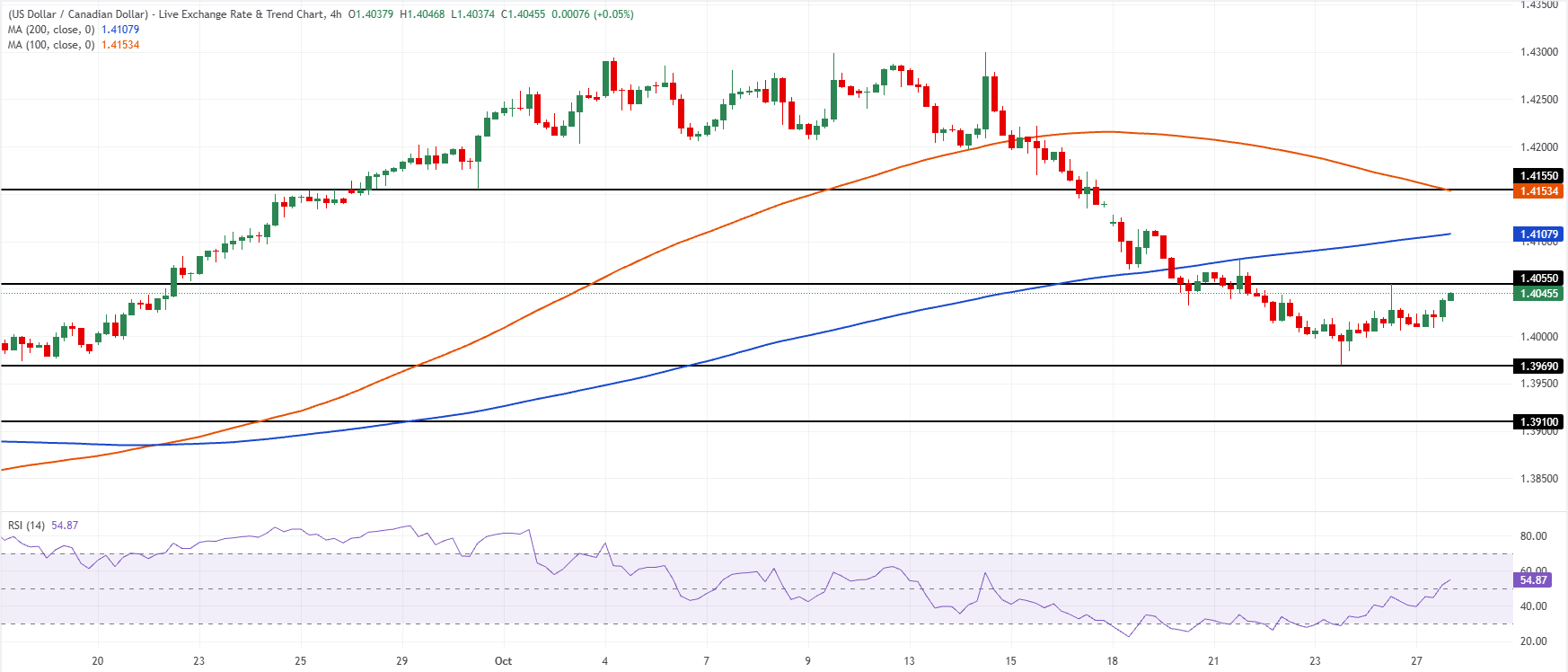
On the four-hour chart, the horizontal barrier at 1.4055 continues to cap USD/CAD's near-term performance, with the pair trading just below it. Price also remains beneath the 200-period simple moving average (SMA) at 1.4108 and the 100-period SMA at 1.4153. At 54.9, the Relative Strength Index (14) has moved back into mildly positive territory, pointing to improving momentum. Those overhead averages nevertheless continue to constrain price action and limit further upside for now.
The first upside hurdle is 1.4055, followed by the 200-period SMA at 1.4108. Further up, the 100-period SMA at 1.4153 combines with the nearby horizontal level of 1.4155 to create a wider supply zone. Immediate downside support stands at 1.3969, ahead of a lower floor at 1.3910. A break beneath 1.3910 would likely leave the pair vulnerable to additional short-term bearish pressure.
(The technical analysis of this story was written with the help of an AI tool. Know more.)
Economic Data
Interest Rate Decision: BoC
At the close of each of its eight scheduled meetings per year, the Bank of Canada (BoC) announces its interest rate decision. An assessment that inflation will exceed the target is hawkish and prompts the BoC to raise rates to bring inflation down. Higher rates draw greater foreign capital inflows, making this bullish for CAD. Conversely, an expectation that inflation will fall below target is dovish and leads the BoC to cut rates. The aim is to stimulate Canada's economy and bring inflation back up. As lower rates discourage foreign capital inflows, this is bearish for CAD.
Continue reading.Next announcement: Wed 28 Oct 2026 13:45
Release schedule: Non-regular
Consensus forecast: 2.5%
Prior reading: 2.25%
Data source: Bank of Canada
Bank of Canada: Key Questions
1-3% is the inflation range the Bank of Canada (BoC) seeks to maintain. Price stability is its primary mandate. Based in Ottawa, the BoC sets Canada’s interest rates and directs monetary policy through eight scheduled meetings each year, supplemented by emergency meetings as needed. Raising or lowering interest rates is its principal means of maintaining price stability. Relatively high rates generally support a stronger Canadian Dollar (CAD), while lower rates tend to have the opposite effect. Its other policy tools include quantitative easing and quantitative tightening.
Reserved for extreme circumstances, Quantitative Easing (QE) is a policy tool under which the Bank of Canada prints Canadian Dollars to purchase assets from financial institutions, typically government or corporate bonds. This generally weakens the CAD. The BoC turns to QE as a last resort when interest rate cuts alone are unlikely to deliver price stability. During the Great Financial Crisis of 2009-11, the Bank of Canada deployed this measure after banks’ loss of confidence in one another’s ability to repay debts caused credit to freeze.
As the reverse of QE, quantitative tightening (QT) follows once an economic recovery is under way and inflation begins to climb. Under QE, the Bank of Canada supplies liquidity to financial institutions by purchasing their government and corporate bonds. Under QT, however, the BoC halts further asset purchases and no longer reinvests the principal from its existing bonds as they mature. The policy generally supports the Canadian Dollar and is considered bullish for the currency.
POPULAR ARTICLES
1$81,000 reclaimed: Bitcoin Price Forecast as BTC traders await Fed policy decision and Big Tech earnings2British Pound weakens as UK budget announcement nears3$4,070 area: Gold price forecast as XAU/USD rebound stalls below former support4Iran: Our policy remains unchanged, with no flexibility on the nuclear issue5Bitcoin, Ethereum, XRP rebound ahead of Fed decision: Crypto today6Czech Koruna: Political tensions drive up risk premium – Commerzbank7Pi Network Price Forecast: PI Stalls Amid Core Team Investment Fund Expansion to Axis Robotics8New Zealand Dollar faces growing downside risks against US Dollar – Societe Generale9Euro: Key Support Against US Dollar at Risk as Lending Slows - ING
LIVE QUOTES


Get Started!
Sign up and access the Global Markets in less than 3 minutes

Connect With Us









Contacts
Phone: +61 2 8036 8388
Fax: +61 2 8036 8388
Email: support@tmgm.com



The information provided on this website is of a general nature only and does not constitute personal financial advice. Before acting on any information on this website, you should consider the suitability of the information in relation to your objectives, financial situation and needs. Investing in CFDs and FX Margin Contracts carries significant risks and is not suitable for all investors. You may lose more than your initial deposit. You do not own, or have, any interest in the underlying asset. We recommend that you seek independent advice and ensure you fully understand the risks involved before trading. It is important that you read and consider the disclosure document before you acquire any product listed on the website. The information and advertisements offered on this website are not intended for use by any person in any country or jurisdiction where such use would be contrary to local laws and regulations. The Products and Services offered on this website are not intended for residents of the United States, Malaysia and Thailand.
TMGM is authorized and regulated in various jurisdictions.
Trademax Australia Limited, trading as TMGM, is regulated by the Australian Securities and Investments Commission (ASIC), AFSL no. 436416 and is located at Level 28, One International Tower, 100 Barangaroo Avenue, 2000 Sydney, NSW Australia.
Email: support@tmgm.com.au
Trademax Global Limited, trading as TMGM, is authorized and regulated by the Vanuatu Financial Services Commission (VFSC), registration number 40356 and registered at 1276, Kumul Highway, Port Vila, Vanuatu, Republic of Vanuatu.
Email: support@tmgm.com
Trademax Global Markets (SE) Limited, trading as TMGM, is authorized and regulated by the Financial Services Authority (FSA) of Seychelles, with license number SD224. The company is registered at Office No 13, Providence Estate ABIS Centre, Mahe, Seychelles.
Email: support@tmgm.com
Trademax Global Markets (International) Pty Ltd, trading as TMGM, is authorized and regulated by the Financial Services Commission, Mauritius (FSC) with license no. GB22201012, and registered at 33, Edith Cavell Street C/o IQ EQ Fund Services (Mauritius) Ltd Port Louis, 11324 Mauritius.
Email: support@tmgm.com
Copyright © TMGM. All rights reserved