

Trading
Explore a wide range of markets with competitive pricing, deep liquidity, and advanced trading tools.
Learn More 
Platform
Trade seamlessly with TMGM's powerful platform, built for speed, precision, and a superior trading experience.
Learn More Trading Platform
Academy
Learn the fundamentals of trading with beginner-friendly resources, including guides, webinars, and market insights.
Learn More News & Analysis
Get real-time market updates and expert analysis to stay ahead of trading opportunities
Learn More News & Analysis
About
Learn what sets TMGM apart — our global presence, regulatory strength, and commitment to innovation in trading.
Learn More Why Choose TMGM
Sponsorship
$81,000 reclaimed: Bitcoin Price Forecast as BTC traders await Fed policy decision and Big Tech earnings
- $81,000 is back in reach as Bitcoin retakes the level on Wednesday. The recovery continues ahead of the Fed’s policy announcement and forthcoming Big Tech results.
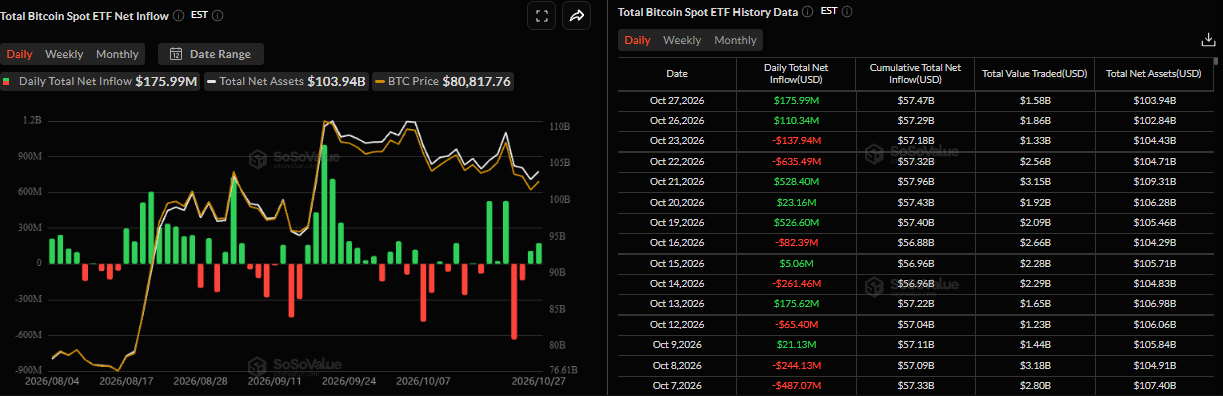
- $175.99 million flowed into spot Bitcoin ETFs on Tuesday, extending inflows to a second consecutive day.
- Weak participation and inactive investors are central concerns in a K33 Research report, which warns that a sharp increase in volatility is imminent.
$81,000 was reclaimed by Bitcoin (BTC) on Wednesday. The recovery extended as investors awaited the Federal Reserve (Fed) monetary policy announcement and forthcoming Big Tech results. A second consecutive day of inflows into spot Bitcoin Exchange Traded Funds (ETFs) this week pointed to mildly bullish institutional demand.

Separately, subdued participation and investor inactivity feature prominently among the concerns in a K33 Research report. It cautions that the Crypto King could be nearing a period of greater volatility.
$175.99 million in ETF inflows signals cautious optimism before Fed decision
Tuesday’s spot Bitcoin ETF inflows reached $175.99 million, compared with $110.34 million on Monday, according to SoSoValue. The figures point to modest institutional buying and a cautiously bullish stance towards Bitcoin. Inflows nevertheless remain below last week’s levels, indicating caution before the US Federal Reserve’s (Fed) interest rate announcement later on Wednesday.
An unchanged benchmark rate within the current 3.75% to 4.00% target range is the broad expectation for Wednesday’s Fed decision. The CME FedWatch tool puts the market-implied probability of no change at the October meeting at 90.6%, with an 84.4% probability of a December rate increase. For guidance on the central bank’s economic assessment and policy path, traders will scrutinise Fed Chair Kevin Warsh’s press conference remarks.
BTC could face pressure if hawkish comments weaken risk appetite. A more dovish message, by contrast, could underpin its continuing recovery.
Middle East tensions are another source of caution for BTC traders. According to the Wall Street Journal, the US has advised several Gulf Arab countries to prepare for a “short, intense military campaign” following the US midterm elections.
Crude oil has drawn support from these developments. West Texas Intermediate (WTI) gained more than 1% on the day to roughly $101 per barrel. Costlier oil could intensify inflation concerns, weaken appetite for risk and limit BTC’s upside.
Q3 Big Tech results draw market focus
Wednesday brings Q3 earnings from Microsoft and Alphabet, with Amazon scheduled to follow on Thursday. These major technology companies’ reports are also drawing investors’ attention.
Concerns about hyperscaler valuations could ease if the results validate sustained heavy spending on Artificial Intelligence (AI), helping risk appetite. Weak results, however, could intensify the AI-driven sell-off already under way and pressure risk-sensitive assets, including Bitcoin.
1.3% OI volatility signals unusually quiet conditions
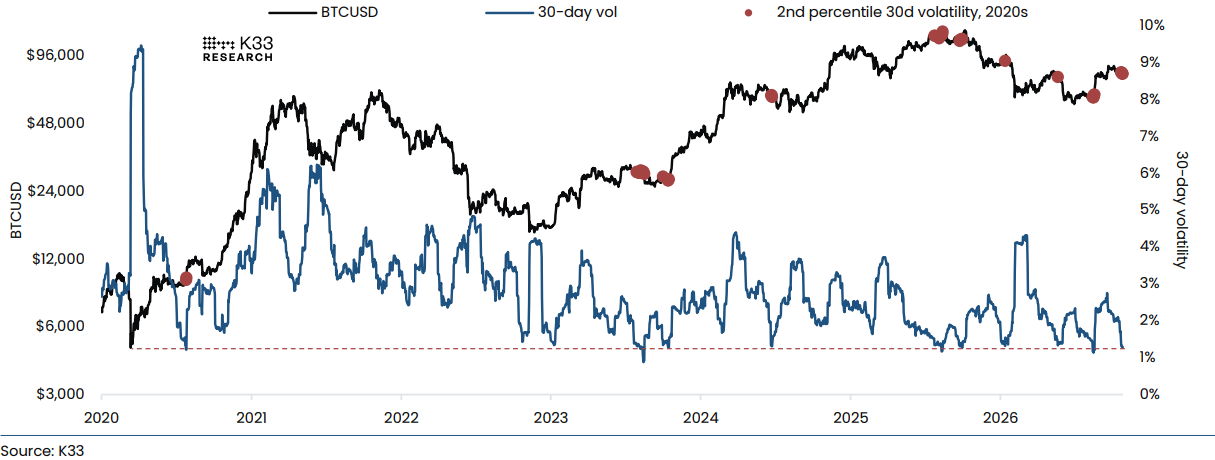
Tuesday’s K33 Research report flagged investor inactivity and weak market participation as major concerns for BTC prices. Against that backdrop, it warned that volatility could soon expand.
At 1.3%, the 30-day volatility of perpetual Open Interest (OI) marks the 26th lowest reading since June 2021. Meanwhile, 30-day price volatility sits in this decade’s 2nd percentile. Traders remain on the sidelines, and trading volumes have fallen to lows not reached between March 2024 and June 2026.
The analyst added: “Calm like this lets leverage build gradually until a price move forces positions to close and pushes prices further. Regimes this quiet rarely last for long, so a volatility expansion looks likely soon. This also fits well with the frantic pace of the upcoming event calendar, setting the stage for prices to once again start swinging,”
$81,113: Bitcoin technical outlook stays mildly bullish
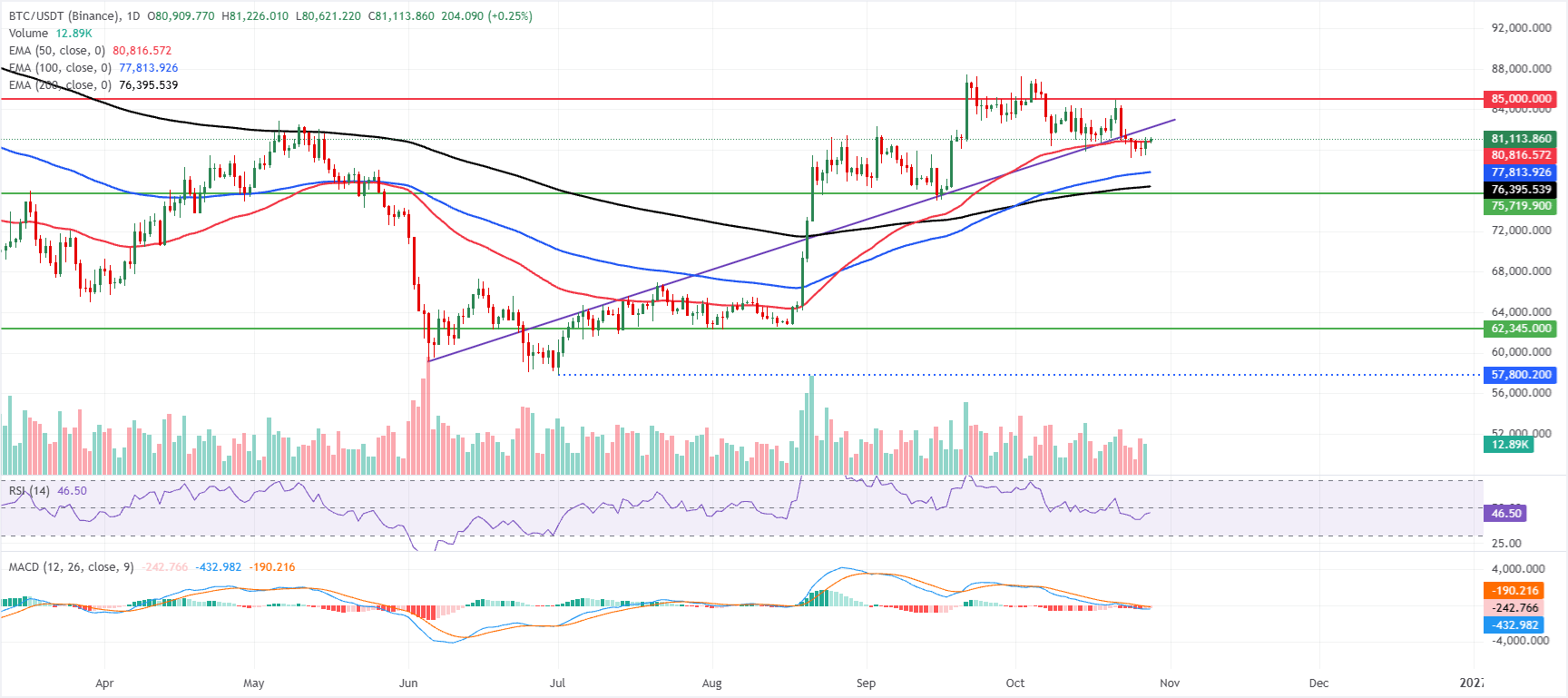
$81,113 is Bitcoin’s trading price on Wednesday. Consolidation above a closely grouped set of Exponential Moving Averages (EMAs) keeps the bias constructive and bullish. Below the spot price are the 50-day EMA at $80,816, the 100-day EMA at $77,813 and the 200-day EMA at $76,395. Their position suggests that support for the broader uptrend persists despite the recent retreat.
Momentum remains restrained. The Relative Strength Index (RSI) is near 46, while Moving Average Convergence Divergence (MACD) remains negative. Together, these indicators currently suggest consolidation rather than a fresh, forceful advance.
Horizontal resistance around $85,000 is the first significant upside obstacle. Supply at this level previously halted gains, making it the key barrier buyers must overcome to regain upward momentum.
Initial buying interest is expected near the 50-day EMA at $80,816. Further support lies at the 100-day EMA at $77,813, followed by the 200-day EMA around $76,395. A daily close beneath this EMA zone would substantially weaken the existing bullish structure and leave scope for a deeper correction.
(The technical analysis of this story was written with the help of an AI tool. Know more.)
FAQs on Bitcoin, altcoins and stablecoins
By market capitalisation, Bitcoin ranks as the largest cryptocurrency. It is a virtual currency created to function as money. No single person, group or entity can control this payment method, removing the need for third parties in financial transactions.
The term altcoin covers cryptocurrencies other than Bitcoin. Some also exclude Ethereum, however, because these two cryptocurrencies are the starting points for forks. Under that interpretation, Litecoin is the first altcoin: it was forked from the Bitcoin protocol and is therefore an “improved” version of it.
A stablecoin is a cryptocurrency intended to maintain a stable price, backed by reserves of the asset it represents. Its value is pegged to a commodity or financial instrument, such as the US Dollar (USD), while an algorithm or demand regulates its supply. Stablecoins primarily give investors a route into and out of cryptocurrency trading and investment. They can also serve as a store of value, as cryptocurrencies are generally exposed to price volatility.
The ratio of Bitcoin’s market capitalisation to the combined market capitalisation of all cryptocurrencies is known as Bitcoin dominance. It offers a clear indication of investor interest in Bitcoin. BTC dominance is typically high before and during bull runs, when investors favour relatively stable cryptocurrencies with large market capitalisations, such as Bitcoin. Falling BTC dominance generally signals that investors are shifting capital and/or profits into altcoins to seek higher returns. That shift usually sparks a surge in altcoin rallies.
POPULAR ARTICLES
1Australian Dollar: Persistent inflation may prompt another RBA rate hike - Standard Chartered2Ripple and Robinhood broaden partnership scope as XRP rebound stalls3US Dollar: Support underpinned by hawkish risks – OCBC4UK Budget in focus as Euro recovers against British Pound51.6% Kiwi slump as RBNZ unexpectedly holds rates: Why December hike bets may fail to offer relief6Canadian Dollar: Support expected from BoC tightening and forecasts – BBH7India M3 Money Supply came in at 16%, above expectations (0%) in October 128British Pound: ABN AMRO sees higher BoE rates ahead and a neutral budget90.5564 in Focus: NZD/USD Bears Target 18-Month Low
LIVE QUOTES

Get Started!
Sign up and access the Global Markets in less than 3 minutes

Connect With Us









Contacts
Phone: +61 2 8036 8388
Fax: +61 2 8036 8388
Email: support@tmgm.com



The information provided on this website is of a general nature only and does not constitute personal financial advice. Before acting on any information on this website, you should consider the suitability of the information in relation to your objectives, financial situation and needs. Investing in CFDs and FX Margin Contracts carries significant risks and is not suitable for all investors. You may lose more than your initial deposit. You do not own, or have, any interest in the underlying asset. We recommend that you seek independent advice and ensure you fully understand the risks involved before trading. It is important that you read and consider the disclosure document before you acquire any product listed on the website. The information and advertisements offered on this website are not intended for use by any person in any country or jurisdiction where such use would be contrary to local laws and regulations. The Products and Services offered on this website are not intended for residents of the United States, Malaysia and Thailand.
TMGM is authorized and regulated in various jurisdictions.
Trademax Australia Limited, trading as TMGM, is regulated by the Australian Securities and Investments Commission (ASIC), AFSL no. 436416 and is located at Level 28, One International Tower, 100 Barangaroo Avenue, 2000 Sydney, NSW Australia.
Email: support@tmgm.com.au
Trademax Global Limited, trading as TMGM, is authorized and regulated by the Vanuatu Financial Services Commission (VFSC), registration number 40356 and registered at 1276, Kumul Highway, Port Vila, Vanuatu, Republic of Vanuatu.
Email: support@tmgm.com
Trademax Global Markets (SE) Limited, trading as TMGM, is authorized and regulated by the Financial Services Authority (FSA) of Seychelles, with license number SD224. The company is registered at Office No 13, Providence Estate ABIS Centre, Mahe, Seychelles.
Email: support@tmgm.com
Trademax Global Markets (International) Pty Ltd, trading as TMGM, is authorized and regulated by the Financial Services Commission, Mauritius (FSC) with license no. GB22201012, and registered at 33, Edith Cavell Street C/o IQ EQ Fund Services (Mauritius) Ltd Port Louis, 11324 Mauritius.
Email: support@tmgm.com
Copyright © TMGM. All rights reserved