

Trading
Explore a wide range of markets with competitive pricing, deep liquidity, and advanced trading tools.
Learn More 
Platform
Trade seamlessly with TMGM's powerful platform, built for speed, precision, and a superior trading experience.
Learn More Trading Platform
Academy
Learn the fundamentals of trading with beginner-friendly resources, including guides, webinars, and market insights.
Learn More News & Analysis
Get real-time market updates and expert analysis to stay ahead of trading opportunities
Learn More News & Analysis
About
Learn what sets TMGM apart — our global presence, regulatory strength, and commitment to innovation in trading.
Learn More Why Choose TMGM
Sponsorship
October ADP Employment Report: job growth expected to slow
- 69K net new jobs are forecast for October in the US ADP Employment Change report.
- Only a substantial downside surprise in October’s ADP figures is likely to undermine confidence in robust US economic momentum.
- With the midterm election outcome dominating attention before Friday’s NFP report, the US Dollar is likely to see only a limited impact.
69K new private-sector jobs are expected in October. That would mark a moderate slowdown from September’s 90K, according to market consensus for the ADP Employment Change report. The Automatic Data Processing (ADP) Research Institute will publish the October figures on Wednesday.

Financial markets scrutinise ADP figures for clues ahead of the key Nonfarm Payrolls (NFP) report, usually published a couple of days later by the US Bureau of Labor Statistics (BLS). This Wednesday, attention will also turn to the US ISM Services Purchasing Managers Index (PMI). Above all, markets will be weighing the implications of the Democrats’ victory in the US midterm elections.
69K Jobs Expected: ADP Growth to Ease as Labour Market Holds Firm
A run of robust US economic releases has strengthened investor confidence in the outlook ahead of October’s ADP employment figures. Last week’s preliminary Gross Domestic Product (GDP) data put third-quarter annualised growth at 3.4%, led by consumer spending, investment and government expenditure.
Monday’s US ISM Manufacturing PMI added to that picture. Factory activity accelerated more than expected, signalling a strong start to the fourth quarter.
Together, these releases reinforce the US economic exceptionalism narrative. Combined with strong inflation pressures, they create ideal conditions for further monetary tightening by the Federal Reserve (Fed). Futures markets assign a 75% probability to another quarter-point rate increase in December, according to the CME FedWatch tool. That prospect is helping the US Dollar Index (DXY) hold relatively steady near its year-to-date highs.
A substantial setback in October’s ADP figures would therefore be needed to cause a major disruption. The September Nonfarm Payrolls report recorded an employment gain of 29K, after 133K jobs were added in August. This points to a stabilising labour market, with no clear evidence of deterioration so far.
Nevertheless, the decisive Democratic victory in the US midterm elections could keep the Greenback under pressure on Wednesday. ING Analyst Francesco Pesole offers this assessment: “a Democratic sweep (...) could be seen as slightly negative for the US Dollar from a few angles, from higher risk of government shutdown and gridlock on debt ceiling negotiations to potential damage to already shaky AI-related sentiment.”
13:15 GMT ADP Release: Limited US Dollar Impact Expected
At 13:15 GMT on Wednesday, the US ADP Employment Change report is forecast to record 69K new private-sector jobs for October. Markets remain focused on the midterm election outcome ahead of Friday’s crucial NFP release. As the ADP result is unlikely to shift expectations for a December Fed rate increase, its effect on the US Dollar (USD) is also likely to be limited.
The US ISM Services PMI follows a few hours later on Wednesday. Forecasts point to a modest October slowdown, but readings are still expected to indicate expansion and solid business activity in the sector. Here too, only a markedly disappointing result would be likely to shake market confidence in US economic strength.
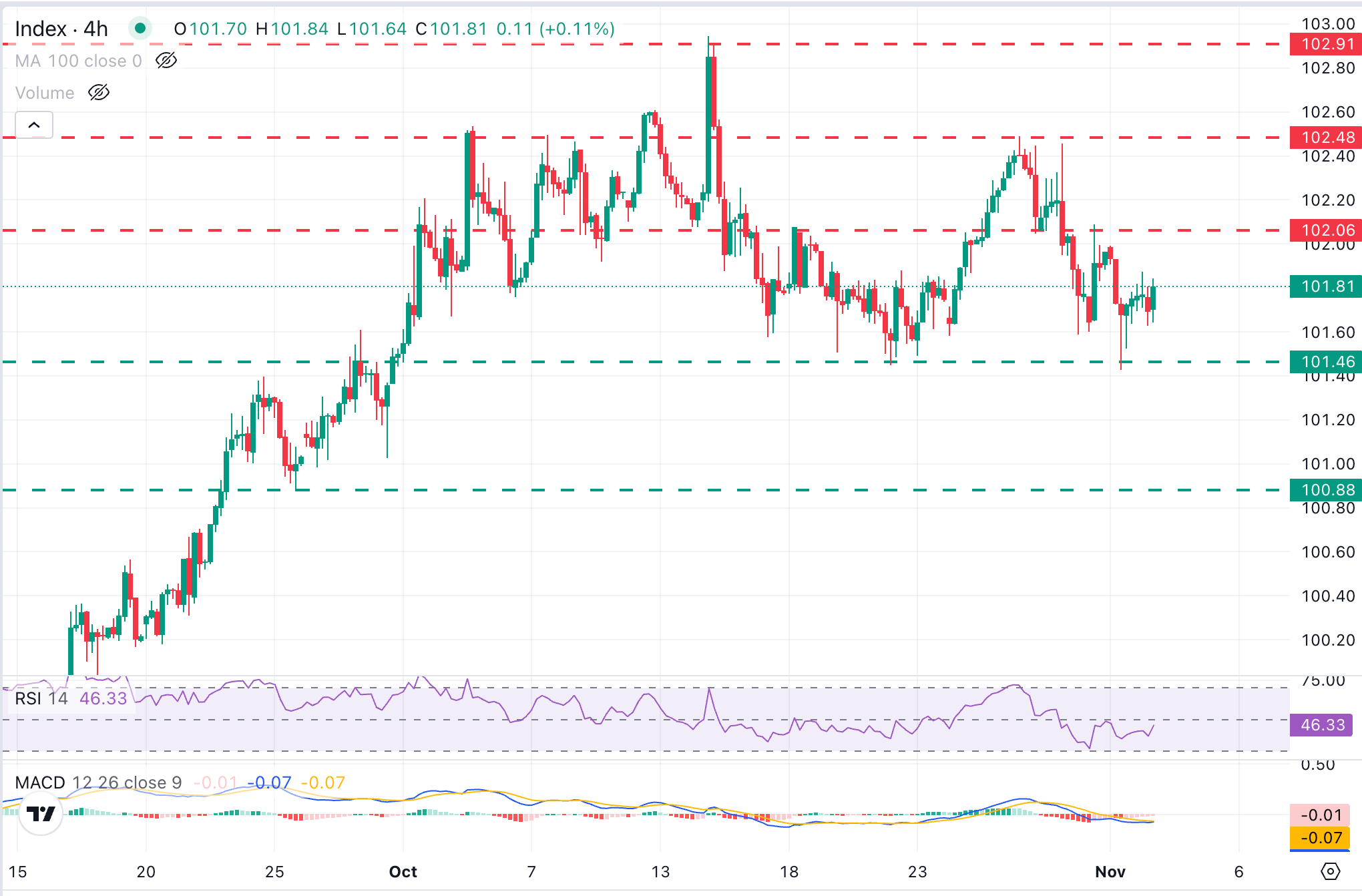
Technically, the US Dollar Index (DXY) is trading near the bottom of the range established since early October. Its 4-hour chart points to a neutral-to-bearish short-term bias. With the Relative Strength Index (14) below the mid-50 area, directional conviction appears weak. The Moving Average Convergence Divergence (MACD) histogram also remains below zero. Taken together, these signals suggest modest selling pressure rather than a decisive downtrend.
A break below support around 101.50, the lows of 22 October and 2 November, would be needed to confirm a trend change, according to FXStreet FX analyst Guillermo Alcalá. That would open the way towards the late-September lows between 101.00 and 100.90.
For resistance, Alcalá highlights the 30 October high just above 102.00, followed by the 28 and 29 October highs around 102.50. Beyond those levels sits the 18-month peak of 102.95 reached in mid-October.
Employment: Key Questions
As a measure of economic health, labour market conditions play a central role in currency valuation. When employment is high, or unemployment low, consumer spending and economic growth benefit, supporting the domestic currency. A particularly tight labour market, where too few workers are available to fill vacancies, can also influence inflation and monetary policy: strong demand for labour against limited supply pushes wages higher.
Policymakers closely monitor how quickly wages rise. Strong pay growth gives households more money to spend, typically pushing up consumer goods prices. Unlike volatile inflation drivers such as energy prices, wage increases are unlikely to be reversed. Pay growth is therefore regarded as an important source of underlying, persistent inflation. This is why central banks worldwide scrutinise wage data when setting monetary policy.
A central bank’s objectives determine how much weight it gives labour market conditions. For some, employment is an explicit part of their mandate alongside inflation control. The US Federal Reserve (Fed), for instance, has a dual mandate to promote maximum employment and stable prices. By contrast, the European Central Bank’s (ECB) sole mandate is to keep inflation in check. Whatever their mandate, policymakers regard labour market conditions as important because they indicate economic health and are directly linked to inflation.
Economic Data Indicator
ADP Employment Change: Private-Sector Jobs
Published by Automatic Data Processing Inc., the largest US payroll processor, ADP Employment Change tracks changes in the number of people employed in the US private sector. An increase generally supports consumer spending and stimulates economic growth. Markets therefore traditionally view a high reading as positive for the US Dollar (USD), and a low reading as negative.
Find out more.Next publication: Wed 4 November 2026 13:15
Release schedule: Every month
Consensus forecast: 69K
Prior reading: 90K
Data provider: ADP Research Institute
The Bureau of Labor Statistics usually releases Nonfarm Payrolls two days after the ADP report. Given the correlation between the two series, traders often regard employment data from ADP, America’s largest payroll provider, as an early indicator of that release. The series track each other closely overall, although individual months can show substantial differences. FX traders also monitor ADP for the same reason they follow NFP: sustained, robust employment growth adds to inflationary pressures, increasing the likelihood of a Fed interest rate rise. A reading above consensus generally supports the USD.
POPULAR ARTICLES
1Euro extends gains nearing four-week highs amid hot Eurozone Inflation figures2Pi Network Price Forecast: Record lows in sight for PI as bullish breakout hopes recede34% YoY rise in Eurozone flash HICP in October matches expectations4Swedish Krona: SEK draws support from Riksbank hikes – Societe Generale5$52.00 Reached: Silver Price Forecast as Lower Yields and Weak US Dollar Lift XAG/USD6Swiss Franc: Hawkish SNB risk underpins franc – ING7Silver price today: FXStreet data shows silver moving higher8October ADP Employment Report: job growth expected to slow9US midterm elections: Bitcoin price forecast signals potential volatility shock for BTC

Get Started!
Sign up and access the Global Markets in less than 3 minutes

Connect With Us









Contacts
Phone: +61 2 8036 8388
Fax: +61 2 8036 8388
Email: support@tmgm.com



The information provided on this website is of a general nature only and does not constitute personal financial advice. Before acting on any information on this website, you should consider the suitability of the information in relation to your objectives, financial situation and needs. Investing in CFDs and FX Margin Contracts carries significant risks and is not suitable for all investors. You may lose more than your initial deposit. You do not own, or have, any interest in the underlying asset. We recommend that you seek independent advice and ensure you fully understand the risks involved before trading. It is important that you read and consider the disclosure document before you acquire any product listed on the website. The information and advertisements offered on this website are not intended for use by any person in any country or jurisdiction where such use would be contrary to local laws and regulations. The Products and Services offered on this website are not intended for residents of the United States, Malaysia and Thailand.
TMGM is authorized and regulated in various jurisdictions.
Trademax Australia Limited, trading as TMGM, is regulated by the Australian Securities and Investments Commission (ASIC), AFSL no. 436416 and is located at Level 28, One International Tower, 100 Barangaroo Avenue, 2000 Sydney, NSW Australia.
Email: support@tmgm.com.au
Trademax Global Limited, trading as TMGM, is authorized and regulated by the Vanuatu Financial Services Commission (VFSC), registration number 40356 and registered at 1276, Kumul Highway, Port Vila, Vanuatu, Republic of Vanuatu.
Email: support@tmgm.com
Trademax Global Markets (SE) Limited, trading as TMGM, is authorized and regulated by the Financial Services Authority (FSA) of Seychelles, with license number SD224. The company is registered at Office No 13, Providence Estate ABIS Centre, Mahe, Seychelles.
Email: support@tmgm.com
Trademax Global Markets (International) Pty Ltd, trading as TMGM, is authorized and regulated by the Financial Services Commission, Mauritius (FSC) with license no. GB22201012, and registered at 33, Edith Cavell Street C/o IQ EQ Fund Services (Mauritius) Ltd Port Louis, 11324 Mauritius.
Email: support@tmgm.com
Copyright © TMGM. All rights reserved