

التداول
اكتشف مجموعة متنوعة من الأسواق العالمية مع تسعير تنافسي، سيولة عالية، وأدوات تداول متقدمة تدعم قراراتك الاستثمارية.
اكتشف المزيد 
منصات التداول
تداول بسلاسة مع منصة TMGM القوية، المصممة للسرعة والدقة وتجربة تداول فائقة.
اكتشف المزيد منصات التداول
الأكاديمية
تعلّم أساسيات التداول من خلال محتوى تعليمي مُبسط ومصمم للمبتدئين، يشمل أدلة تعليمية،ندوات مباشرة عبر الإنترنت، وتحليلات لأهم تحركات السوق.
اكتشف المزيد أكاديمية TMGM
الأخبار والتحليلات
تابع أحدث تطورات الأسواق لحظة بلحظة، مع تحليلات احترافية تساعدك على اتخاذ قرارات مدروسة والاستفادة من فرص التداول.
اكتشف المزيد الأخبار والتحليلات
معلومات عنا
تعرّف على ما يميز TMGM، من حضور عالمي قوي وإشراف تنظيمي موثوق، إلى التزامنا المستمر بالابتكار وتطوير بيئة تداول متقدمة.
اكتشف المزيد لماذا TMGM؟
Bitcoin Price Forecast: BTC resumes downtrend as Nvidia-driven squeeze fades, ETF outflows persist
- Bitcoin trades below $61,000 on Tuesday, remaining under pressure and at risk of retesting its yearly low of $55,130.
- Monday’s rally following news involving Nvidia and Jensen Huang proved short-lived, suggesting a positioning squeeze rather than a confirmed market bottom.
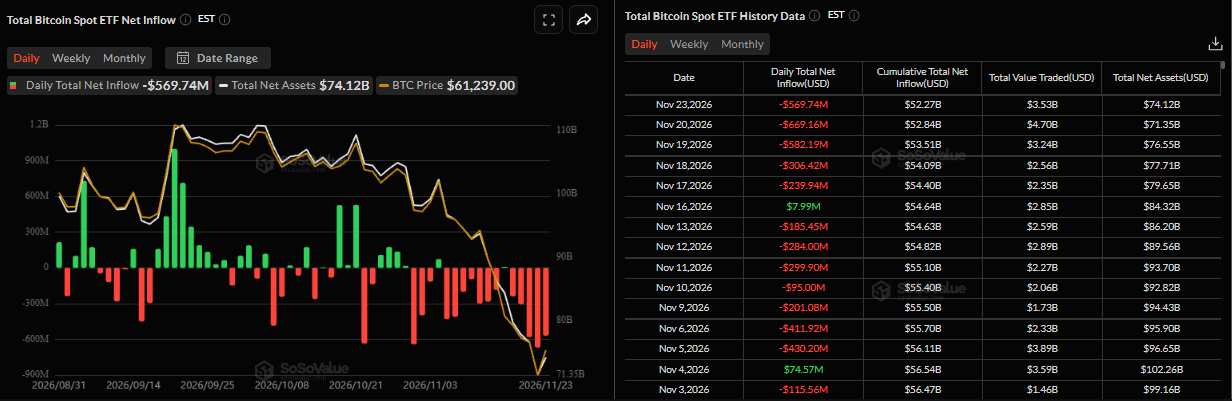
- US-listed BTC spot ETFs recorded an outflow of $569.74 million on Monday, after the third consecutive week of billion-dollar withdrawals.
Bitcoin (BTC) remains under pressure, trading below $61,000 at the time of writing on Tuesday after Monday’s brief recovery quickly lost momentum. The rebound, supported by Nvidia-related optimism and a wave of short liquidations, failed to signal a sustained shift in market sentiment. Meanwhile, persistent institutional selling, with Bitcoin spot Exchange Traded Funds (ETFs) recording $569.74 million in outflows on Monday, keeps the Crypto King vulnerable to another test of its yearly low at $55,130.

Bitcoin rally fades as Nvidia-driven optimism fails to sustain gains
Bitcoin price remains in a broader downtrend. News that Nvidia’s board had unanimously reinstated Jensen Huang as CEO, effective immediately, provided a temporary boost to the Crypto King, sending BTC to an intraday high of $64,603 on Monday. However, the rally quickly lost momentum, and Bitcoin closed the day at $61,270.
Bitcoin’s brief recovery appears to have been driven partly by a wave of short liquidations rather than sustained buying demand. The Coinglass liquidation chart below shows two major spikes in short liquidations, wiping out over $165 million in leveraged BTC short positions. Traders betting on BTC’s decline were forced to close their positions, suggesting that the move was a positioning squeeze rather than evidence of a confirmed market bottom.
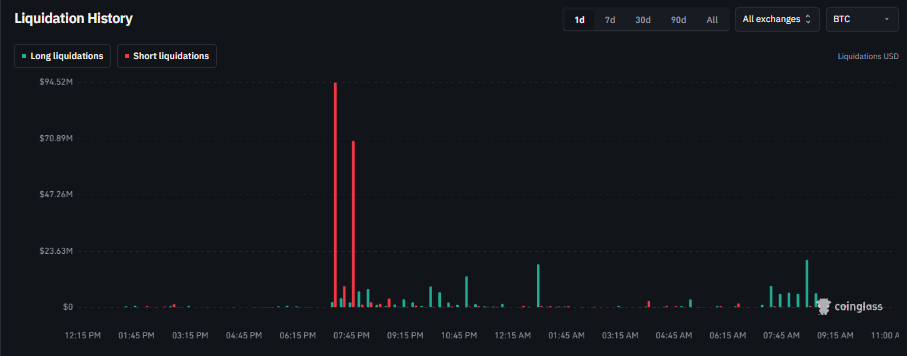
Jordan Schlosser, CTO and Co-founder at IPX Exchange, told FXStreet that the move looks like a positioning squeeze rather than a fundamental reset. He pointed to a sharp rebound in chip stocks following their worst weekly performance since 2001. Nvidia has gained more than 30%, the semiconductor ETF is on track for its best day since April 2025, and the 3x leveraged chip fund has climbed around 40%, suggesting bearish bets are being unwound. However, with the S&P 500 still in correction territory, Schlosser said he would want to see chip stocks hold their gains through the week before calling a market bottom.
Institutional selling continues
Institutional demand for Bitcoin began the week on a negative note. SoSoValue data shows BTC spot ETFs recorded net outflows of $569.74 million on Monday, after $1.07 billion in outflows the previous week, the highest weekly outflows since the end of June. Moreover, last week’s outflow marked the third consecutive week of billion-dollar withdrawals, indicating weakening investor demand. If this outflow trend continues and intensifies this week, it could put additional pressure on BTC, pushing it toward yearly lows.
Bitcoin technical outlook: Heading toward the $55,000 mark
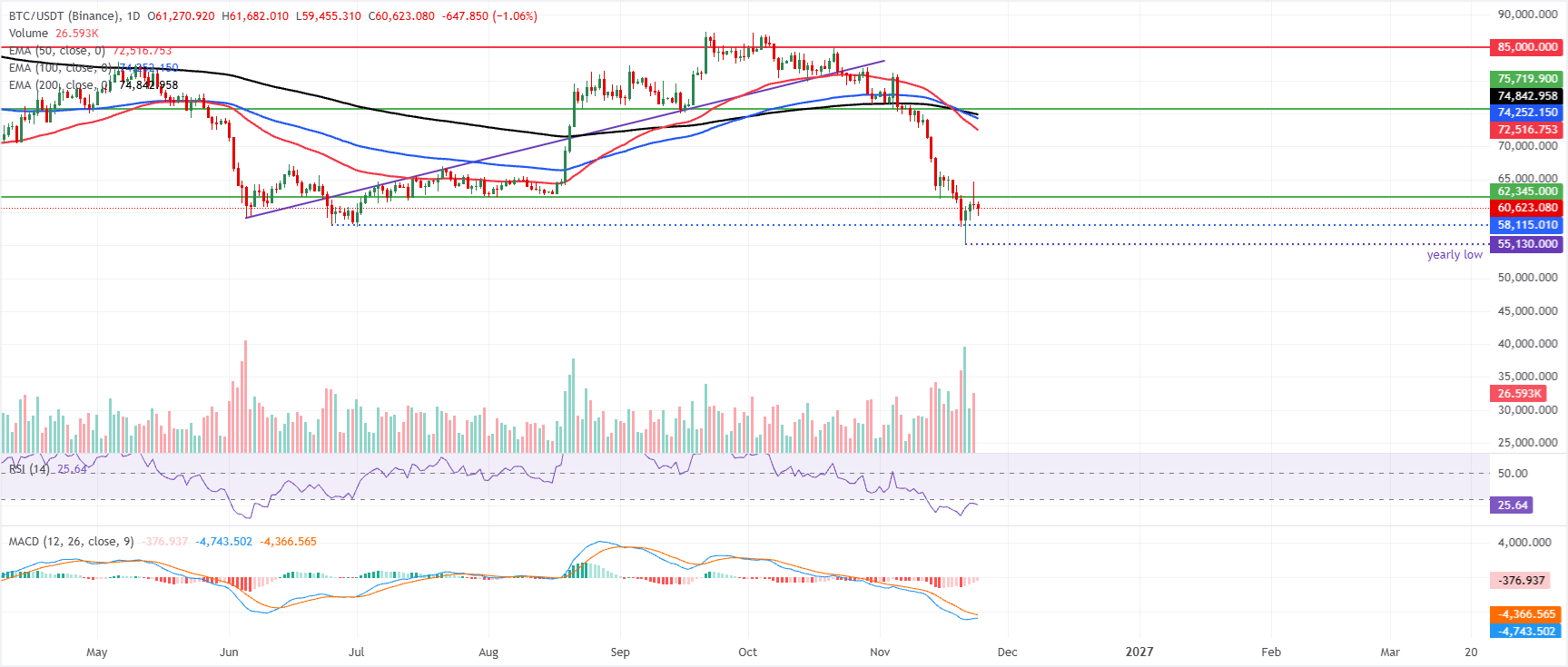
Bitcoin price trades at $60,623 at the time of writing on Tuesday, heading toward the yearly low of $55,130. BTC maintains a clear bearish bias as it holds well below the 50-day, 100-day, and 200-day Exponential Moving Averages (EMAs), clustered between roughly $72,500 and $74,800 and acting as a dense overhead cap.
Momentum remains weak, with the Relative Strength Index (RSI) stuck in oversold territory near 25 on the daily chart. At the same time, the Moving Average Convergence Divergence (MACD) histogram stays negative, hinting only at a modest improvement in selling pressure.
On the topside, initial resistance sits at the 50-day EMA around $72,516, followed by the 100-day EMA near $74,252 and the 200-day EMA near $74,842, while a more distant horizontal barrier sits at $85,000.
On the downside, the oversold RSI near 25 and the slightly recovering MACD line support a short-term stabilization phase. Still, the broader structure suggests any bounce would likely struggle to sustain above the EMA cluster unless buyers regain control decisively.
(The technical analysis of this story was written with the help of an AI tool. Know more.)
Bitcoin, altcoins, stablecoins FAQs
Bitcoin is the largest cryptocurrency by market capitalization, a virtual currency designed to serve as money. This form of payment cannot be controlled by any one person, group, or entity, which eliminates the need for third-party participation during financial transactions.
Altcoins are any cryptocurrency apart from Bitcoin, but some also regard Ethereum as a non-altcoin because it is from these two cryptocurrencies that forking happens. If this is true, then Litecoin is the first altcoin, forked from the Bitcoin protocol and, therefore, an “improved” version of it.
Stablecoins are cryptocurrencies designed to have a stable price, with their value backed by a reserve of the asset it represents. To achieve this, the value of any one stablecoin is pegged to a commodity or financial instrument, such as the US Dollar (USD), with its supply regulated by an algorithm or demand. The main goal of stablecoins is to provide an on/off-ramp for investors willing to trade and invest in cryptocurrencies. Stablecoins also allow investors to store value since cryptocurrencies, in general, are subject to volatility.
Bitcoin dominance is the ratio of Bitcoin's market capitalization to the total market capitalization of all cryptocurrencies combined. It provides a clear picture of Bitcoin’s interest among investors. A high BTC dominance typically happens before and during a bull run, in which investors resort to investing in relatively stable and high market capitalization cryptocurrency like Bitcoin. A drop in BTC dominance usually means that investors are moving their capital and/or profits to altcoins in a quest for higher returns, which usually triggers an explosion of altcoin rallies.
المقالات الشائعة
1سوق الفوركس اليوم: موجة صعود للأسهم العالمية بقيادة أسهم التكنولوجيا، والدولار الأمريكي يستقر عند أعلى مستوياته في 20 شهرًا2اليورو يقبع عند أدنى مستوياته في 19 شهرًا وسط تجدد التوقعات برفع الاحتياطي الفيدرالي أسعار الفائدة بوتيرة حادة3160.40: مستوى يتعين على USD/JPY اختراقه لبدء موجة صعود جديدة4توقعات أسعار الفضة: XAG/USD يتحول إلى الهبوط مع انتعاش قوي لأسهم الذكاء الاصطناعي العالمية5الأسهم: انتعاش أسهم التكنولوجيا يوسّع فجوات الأداء بين القطاعات - بنك دانسكي6توقعات أسعار أبرز العملات الرقمية البديلة: ريبل وكاردانو وسولانا تبدد مكاسب موجة الارتياح التي حفّزتها Nvidia7الدولار الأسترالي يعزز مكاسبه فوق 0.6600 مع تحسن شهية المخاطرة، والمتداولون يترقبون بيانات مؤشر أسعار نفقات الاستهلاك الشخصي الأمريكي8الروبية الهندية: بنك الاحتياطي الهندي يرفع الفائدة لدعم مكاسبها أمام الدولار الأمريكي - كومرتس بنك9اليورو: استمرار الضعف مع مخاطر التشبع البيعي أمام الدولار الأمريكي – UOB


ابدأ الآن!
سجّل وابدأ التداول في الأسواق العالمية خلال أقل من 3 دقائق

تواصل معنا









جهات الاتصال
الهاتف +61 2 8036 8388
الفاكس +61 2 8036 8388
البريد الإلكتروني support@tmgm.com
الموقع الإلكتروني https://www.tmgmsea.com



المعلومات المقدمة على هذا الموقع الإلكتروني ذات طبيعة عامة فقط ولا تشكل نصيحة مالية شخصية. قبل اتخاذ أي إجراء بناءً على أي معلومات واردة في هذا الموقع الإلكتروني، ينبغي عليك النظر في مدى ملاءمة هذه المعلومات لأهدافك ووضعك المالي واحتياجاتك. ينطوي الاستثمار في عقود الفروقات وعقود الهامش على الفوركس على مخاطر كبيرة، وهو غير مناسب لجميع المستثمرين. قد تخسر أكثر من إيداعك الأولي. أنت لا تملك الأصل الأساسي، ولا لديك أي مصلحة فيه. نوصي بأن تطلب مشورة مستقلة وأن تتأكد من أنك تفهم تمامًا المخاطر التي تنطوي عليها قبل التداول. من المهم أن تقرأ وثيقة الإفصاح وتدرسها قبل الحصول على أي منتج مدرج على الموقع الإلكتروني. إن المعلومات والإعلانات المعروضة على هذا الموقع الإلكتروني غير مخصصة للاستخدام من قبل أي شخص في أي بلد أو ولاية قضائية يكون فيها هذا الاستخدام مخالفًا للقوانين واللوائح المحلية. المنتجات والخدمات المعروضة على هذا الموقع الإلكتروني غير مخصصة للمقيمين في الولايات المتحدة وماليزيا وتايلاند.
TMGM مرخصة ومنظمة في ولايات قضائية مختلفة.
شركة Trademax Australia Limited، التي تتداول باسم TMGM، منظمة من قبل لجنة الأوراق المالية والاستثمارات الأسترالية (ASIC)، رقم AFSL 436416 وتقع في المستوى 28، برج دولي واحد، 100 شارع بارانجارو، 2000 سيدني، نيو ساوث ويلز أستراليا.
البريد الإلكتروني: support@tmgm.com.au
شركة Trademax Global Limited، التي تتداول باسم TMGM، مرخصة ومنظمة من قبل لجنة الخدمات المالية في فانواتو (VFSC)، رقم التسجيل 40356 ومسجلة في 1276، طريق كومول السريع، بورت فيلا، فانواتو، جمهورية فانواتو.
البريد الإلكتروني: support@tmgm.com
شركة Trademax Global Markets (SE) Limited، المعروفة باسم TMGM، مرخصة ومنظمة من قبل هيئة الخدمات المالية (FSA) في سيشيل، برقم الترخيص SD224. الشركة مسجلة في المكتب رقم 13، مركز ABIS العقاري، ماهي، سيشيل.
البريد الإلكتروني: support@tmgm.com
شركة Trademax Global Markets (International) Pty Ltd، التي تتداول باسم TMGM، مرخصة ومنظمة من قبل لجنة الخدمات المالية، موريشيوس (FSC) برقم الترخيص GB22201012، ومسجلة في 33، شارع إديث كافيل c/o IQ EQ Fund Services (Mauritius) Ltd بورت لويس، 11324 موريشيوس.
البريد الإلكتروني: support@tmgm.com
حقوق الطبع والنشر © TMGM. جميع الحقوق محفوظة